Summary
- Indus Towers reports rental income and electricity reimbursements on one revenue line, and defines every headline margin on that blended base, excluding only other income.
- Where a decomposition exists, the rental leg earns roughly 86 per cent at the EBITDA line while the resold power leg runs at a small loss, because the power and fuel the company buys costs marginally more than it bills back.
- The fall from 69.2 per cent in FY2025 to 55.3 per cent in FY2026 is two things at once: a heavier electricity share of revenue, and the absence of about ₹51 billion of one-off overdue recoveries that flattered the earlier year.
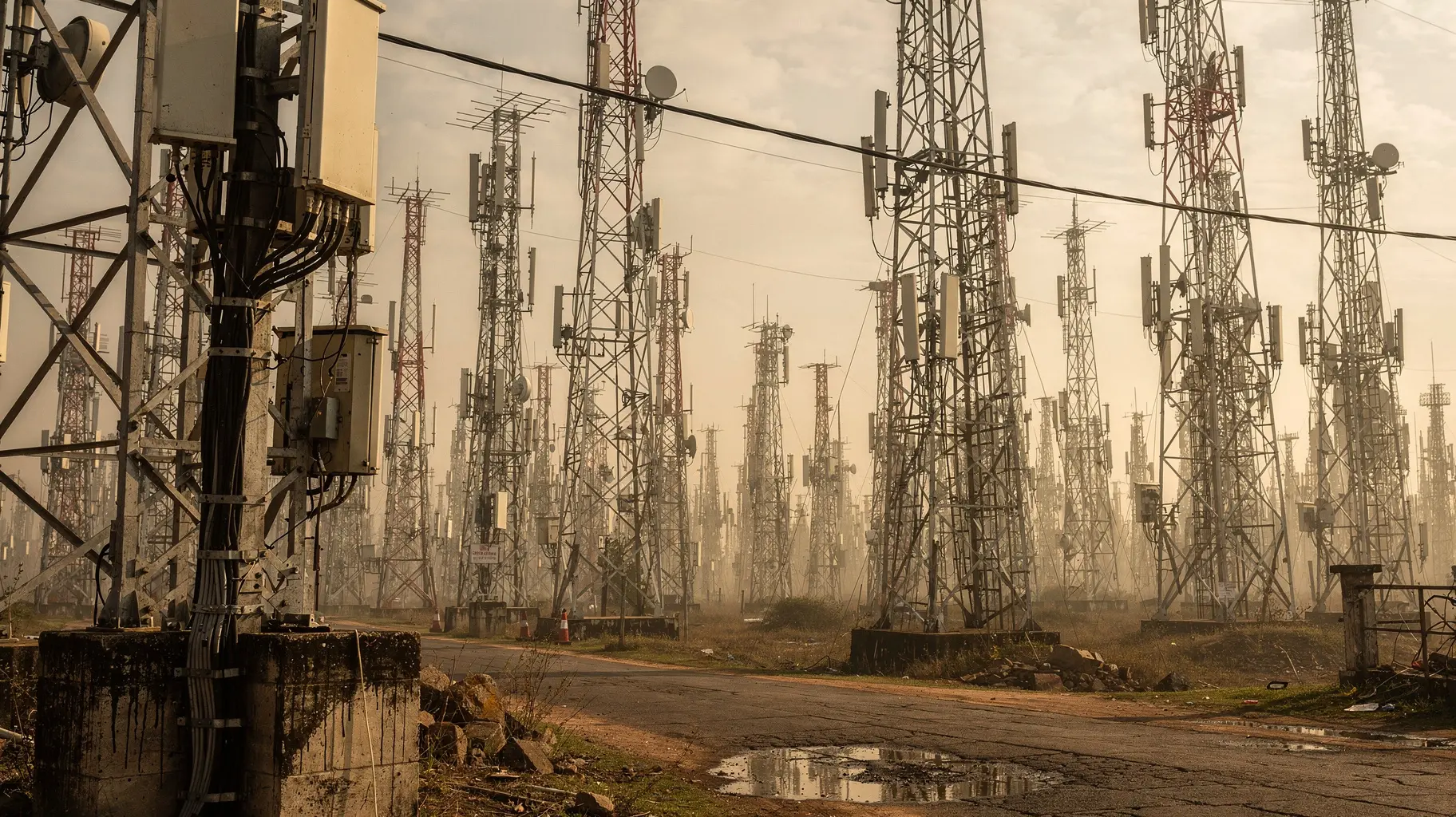
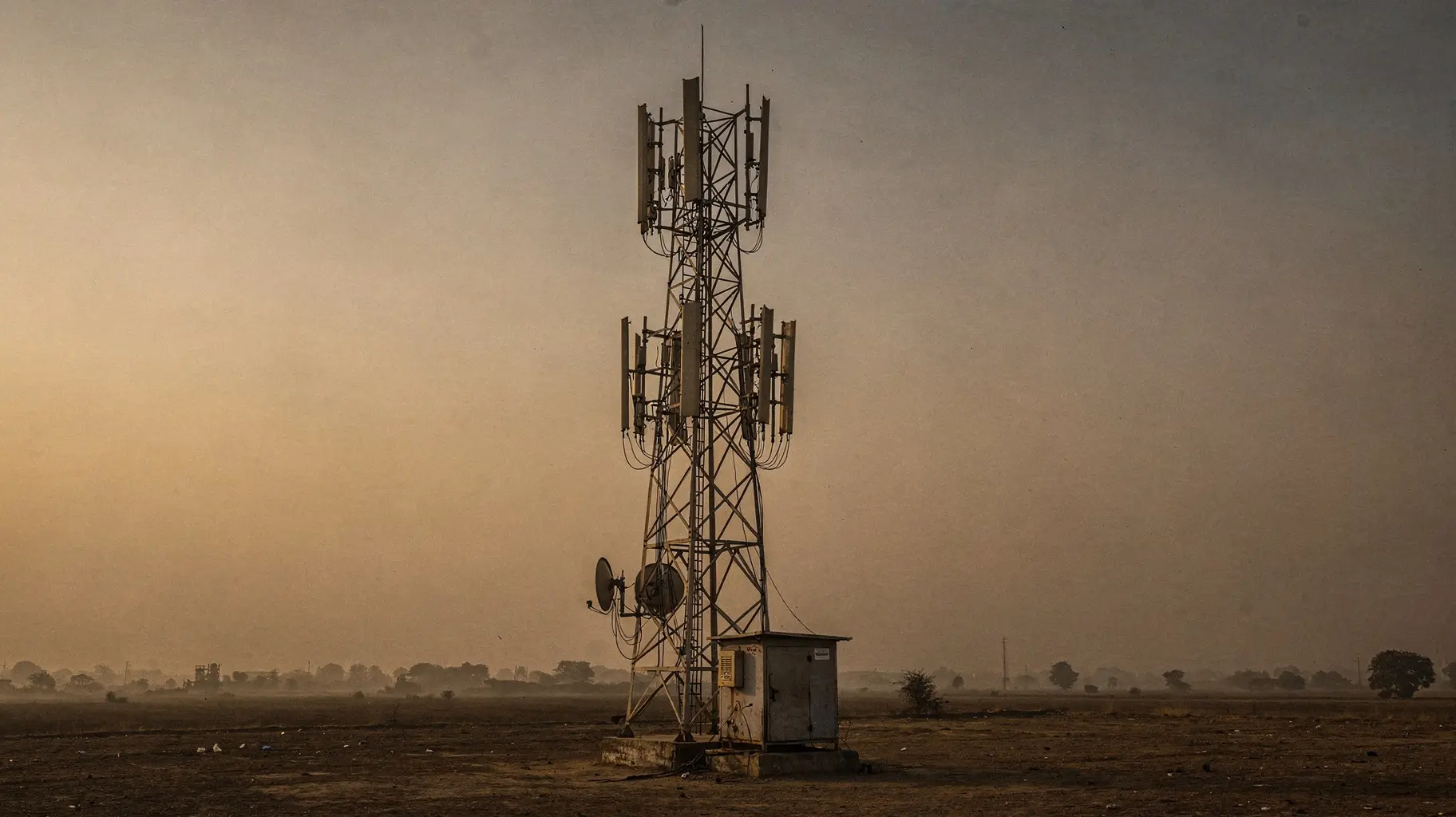
A tower company looks like a landlord and is priced like one. It owns or leases ground, builds a mast, signs long-term master service agreements with mobile operators, and collects rent per tenant per month. That is the business the equity story rests on: 249,305 macro towers carrying 405,435 macro co-locations at 31 March 2025, a sharing factor of 1.63 times, after net additions of 29,569 towers and 36,847 co-locations during the year (annual report FY2024-25). The company counts these on an actual-exit basis from 1 July 2021, which matters when you want to compare one year with another.
What the mast also carries is a meter. Every tenant's radio equipment draws power, and the tower operator buys that power from the grid and bills it back. On the printed accounts, that second activity is not incidental. In FY2025, of ₹301,228 million of revenue from operations, sharing revenue was ₹191,974 million and energy and other reimbursements ₹109,199 million (quarterly and annual filing, 30 April 2025). Roughly a third of the top line is electricity passing through the company's books on its way to someone else's P&L.
The same shape holds a year later. For the full year ended 31 March 2026 the company reported revenue from operations of ₹32,493 crore, up 7.9 per cent, and EBITDA of ₹17,976 crore, down 13.8 per cent (FY2026 exchange filing). Within that revenue, rental income was ₹20,928 crore and energy and other services ₹11,550 crore. Divide the two and you get 64.4 per cent rent, 35.5 per cent power. Divide EBITDA by revenue and you get 55.3 per cent. The first two are my arithmetic on the company's printed constituents; the third is the company's own headline, and it is the one that travels.
What the footnote actually says
The disclosure question is not whether the company publishes a split. It does, on the face of the revenue note. The question is which figure it puts in the sentence a reader remembers.
The quarterly filing for the three months to 30 September 2025 reports revenue from operations of ₹81,882 million, of which sharing revenue ₹52,417 million and energy reimbursements ₹29,453 million, with EBITDA of ₹46,127 million and a printed margin of 56.3 per cent (quarterly filing, 27 October 2025). The same document states that the margin is computed on revenue from operations — the blended line, energy included — and excludes only other income. Read that footnote carefully and the number stops being a measure of the rental business. It is a measure of the rental business diluted by a pass-through that earns nothing.
How much nothing? An analyst decomposition of that same quarter puts service EBITDA at ₹45,180 million against rental revenue of ₹52,417 million, and energy EBITDA at negative ₹1,416 million against energy revenue of ₹29,453 million (analyst note on Q2 FY2026). My divisions on those figures: 86.2 per cent on the rental leg, negative 4.8 per cent on the power leg. The company did not print either number. The analyst built it from a revenue split the company did print and an EBITDA split it did not.
The next year's second quarter shows the same mechanics with the sign unchanged. Rental revenue ₹54,410 million, energy and other reimbursements ₹30,740 million, total revenue ₹85,150 million, power and fuel cost ₹31,853 million, EBITDA ₹45,957 million at a printed 54.0 per cent (Q2 FY2027 analyst note). That note does something the company's own release does not: it prints an EBITDA margin excluding energy of 65.3 per cent and an energy margin of negative 3.6 per cent. Subtract the reimbursements from the power and fuel cost and the gap is ₹1,113 million — the company spent more on electricity than it recovered, by my subtraction on two printed lines. Thirty-one thousand eight hundred and fifty-three less thirty thousand seven hundred and forty. That residue is the entire economics of the second business, and it is negative in every period where a decomposition exists.
Why 69.2 per cent was never a run rate
The temptation, looking at FY2025, is to read 69.2 per cent as what this asset can earn. It was not. In March 2025 one large customer cleared overdue balances, and about ₹51 billion of recoveries ran through that year's EBITDA. The fourth-quarter press release records the tail of it: a write-back of ₹226 crore in the provision for doubtful receivables, aided by collections against past overdue amounts (Q4 FY2025 press release). A recovery of previously provided dues does not arrive as rent. It arrives as a reversal, and it lifts the margin without adding a single tenancy.
So FY2025's 69.2 per cent was two favourable things stacked: a revenue mix that was 36.3 per cent electricity rather than 35.5, and a one-off that will not recur. FY2026's 55.3 per cent is the same machine with both of those removed. Anyone comparing the two years as though a 13.9-point fall were an operating deterioration is comparing a peak to a plateau and calling the plateau a cliff. Anyone treating 55.3 per cent as the health of the rental business is doing the opposite error, and it is the more expensive one.
There is a third thing inside the comparison, and it is the tenancy line rather than the margin line. In the fourth quarter of FY2025 the company reported 375 macro co-location exits alongside gross tenancy additions of 18,991, rental revenue of ₹50,365 million, energy and other reimbursements of ₹26,906 million and total revenue of ₹77,271 million (quarterly and annual filing, 30 April 2025). In a business where each tenant pays rent per month on a shared mast, 375 exits in one quarter is a small number against a base of 405,435 co-locations, and it is not small at all as a signal about how a customer renegotiates. Exits and additions are measured on the same actual-exit convention; the two move independently, and the margin never tells you which one happened.
The seam a reader has to cross
Here is the structural issue, and it deserves to be stated without theatre. The company prints a blended margin because the blended line is what its revenue line is. Its consolidated statement of profit and loss has one revenue number; there is no separate power segment with its own EBITDA in the audited accounts. The company is not hiding the split — the constituents are in the revenue note, and the footnote says plainly what the margin is computed on. But the reader who wants the rental margin must do the analyst's work: take the two revenue lines, find an EBITDA decomposition somewhere, and divide.
That is a legitimate complaint about arithmetic, not about conduct, and the difference matters. A margin computed on a pass-through is not wrong; it is a margin for a company that runs a pass-through. What it cannot do is tell you whether the rent went up.
The honest summary is this. Indus Towers operates one excellent business and one break-even favour. The excellent business earns in the high eighties at the EBITDA line on ₹20,928 crore of FY2026 rental revenue. The favour is the ₹11,550 crore of electricity it buys, bills and loses a little on. Together they produce a 55.3 per cent margin that moves with the weather in power prices, the geography of new tenancies and the timing of a customer's payment, and that no reader can decompose from the headline alone.
What to watch
The company has never printed an EBITDA figure for the energy leg beside the blended figure in its own release. If it ever does, the footnote stops being a footnote. Until then, the two numbers that matter are the energy share of revenue — 36.3 per cent in FY2025, 35.5 per cent in FY2026 — and the rupee gap between power and fuel cost and the reimbursements billed against it, which was ₹1,113 million in the September 2026 quarter on my subtraction. Those two move the headline without touching a single rental agreement, and neither appears in a press release.
The directory entry for the company, with its full record, is at Indus Towers Ltd.
Member Briefing
Read the full trend briefing
Members read the full briefing with the source notes behind every finding.
Strategic Circle
A daily briefing in your language, built from changes we have verified.
Join for USD 20/monthCancel anytime.
Members also get the full research library, a daily briefing on the networks they follow and the private forum.