
Summary
- What it says: Hundreds marched in Vancouver against two planned Telus AI data centres, turning the projects into a test of local consent over water, power and urban infrastructure.
- Main topic: Data centre investment; Data centre power and permitting; AI infrastructure economics
- Context: Market / Briefing / North America
- Mount Pleasant is due this year and West Georgia in 2029
- The dispute tests whether clean-power claims can secure local consent
The fact
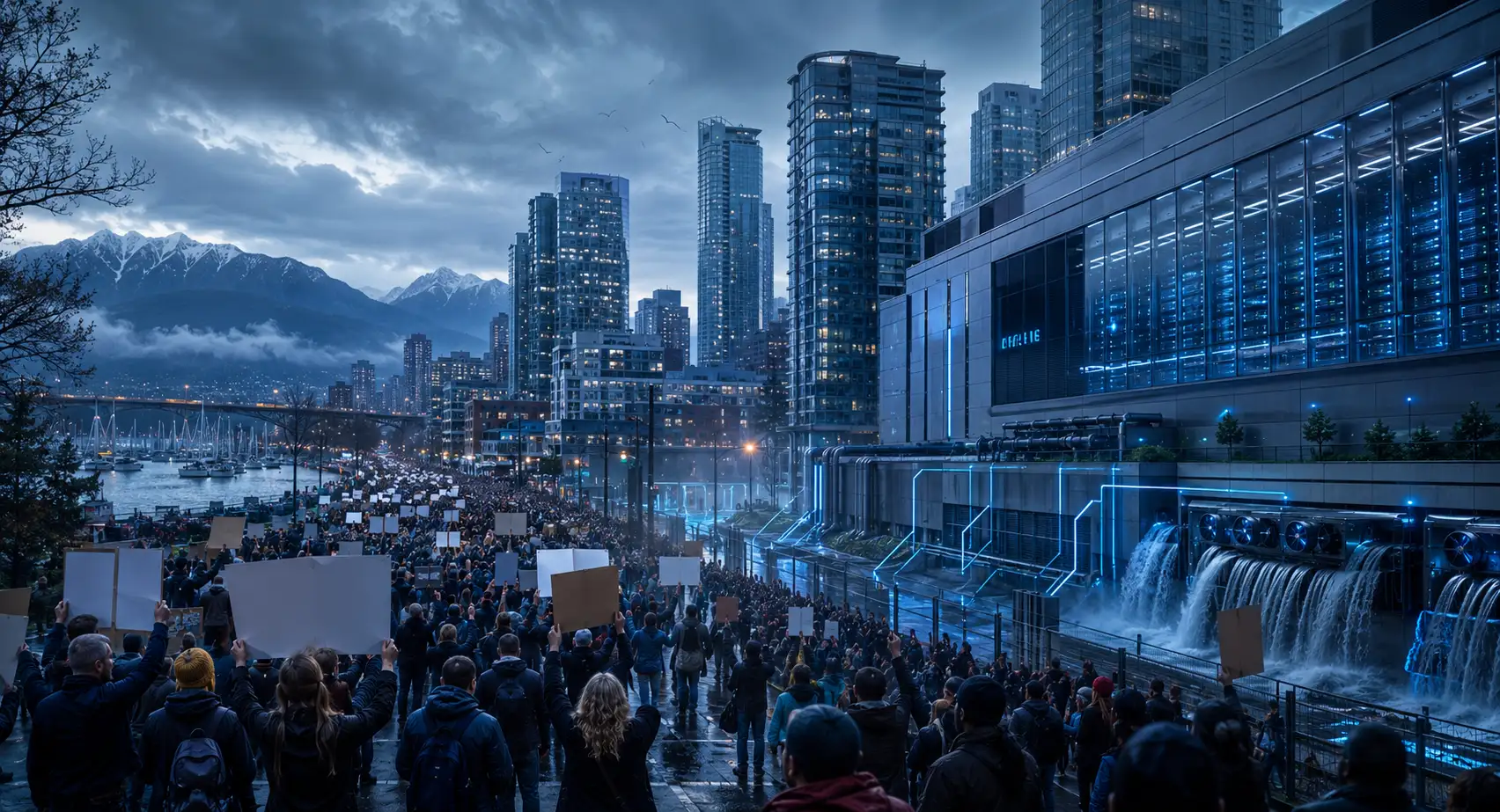
Hundreds of people marched in Vancouver on Saturday against two planned AI data centres in the city. Demonstrators moved from the Vancouver Art Gallery to City Hall and called for the Telus and federal government partnership to be halted. One facility is planned for the former Hootsuite headquarters in Mount Pleasant and is slated to come online by the end of this year. A second facility is planned for 150 West Georgia Street in 2029.
Protesters cited water use, power demand, environmental impact and lack of consultation, pointing to Metro Vancouver’s Stage 3 water restrictions and an International Energy Agency estimate that data centres used 140bn litres of water globally in 2023. B.C. Premier David Eby said water impact is a concern and that rules are in place for future centres. Telus says the facilities will run on 98% clean hydro power, use 90% less water than traditional data centres and recycle enough waste energy to heat 150,000 homes.
The Assessment
The protest turns Telus’ AI data centre plan into a test of local infrastructure consent. Telus is answering the criticism with an environmental-efficiency argument: 98% clean hydro power, 90% less water than traditional data centres and waste-heat reuse. But that does not fully address the objections driving the protest. Lower water intensity still means an additional load during Stage 3 water restrictions, and clean hydro power does not remove questions over grid capacity, competing electricity demand or the opportunity cost of assigning urban infrastructure to AI compute. The consultation complaint is therefore central, not secondary.
Protesters are not only questioning whether the facilities are greener than older data centres; they are questioning who gets to decide how local water, power and land are allocated, and whether the community receives enough benefit from that trade-off.
What to Watch
Watch whether the Mount Pleasant site still comes online this year, whether B.C. Hydro or provincial officials disclose project-level power allocation details, and whether Vancouver or B.C. requires Telus to publish absolute water use, energy demand, heat-reuse commitments and community consultation records before the West Georgia project advances.