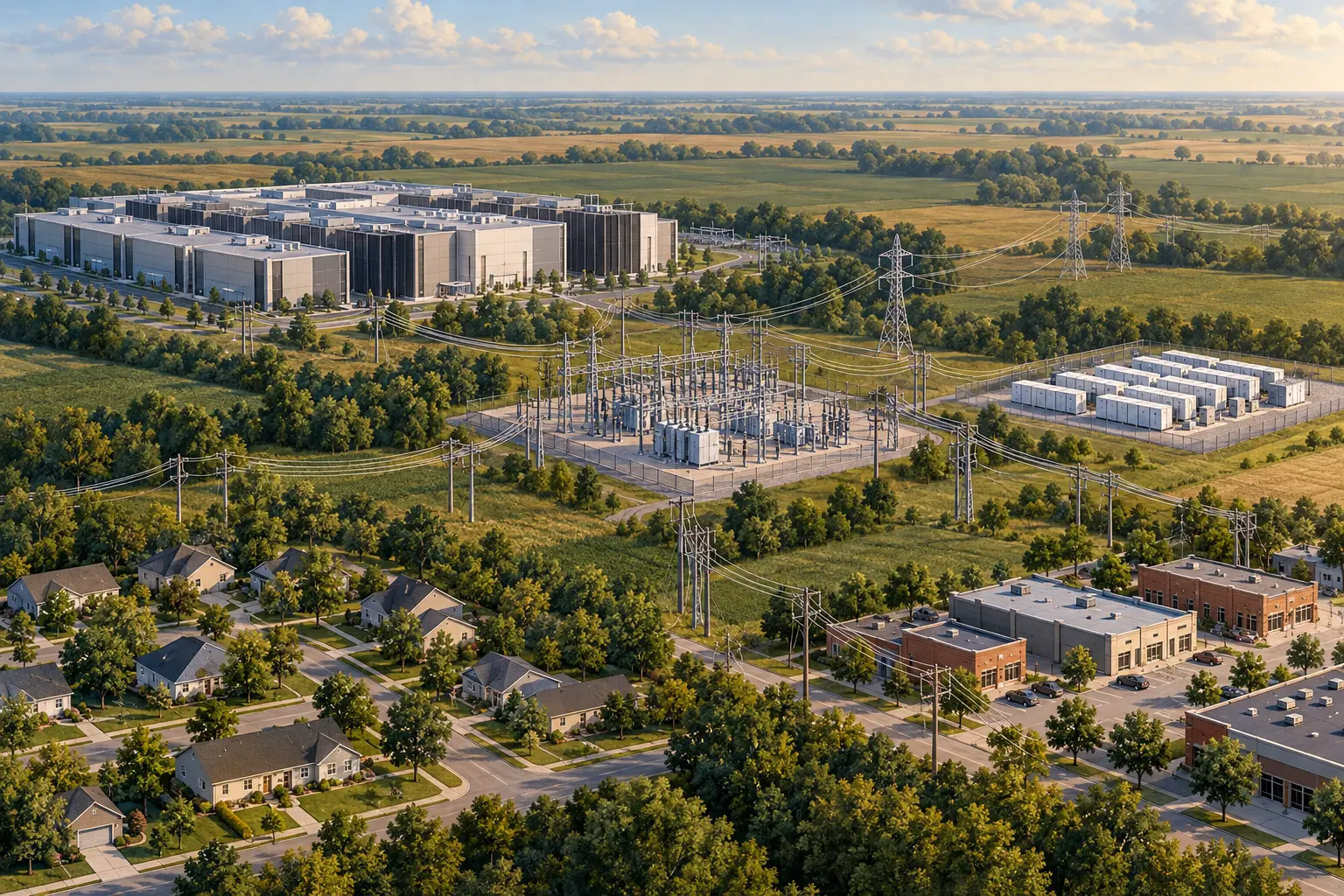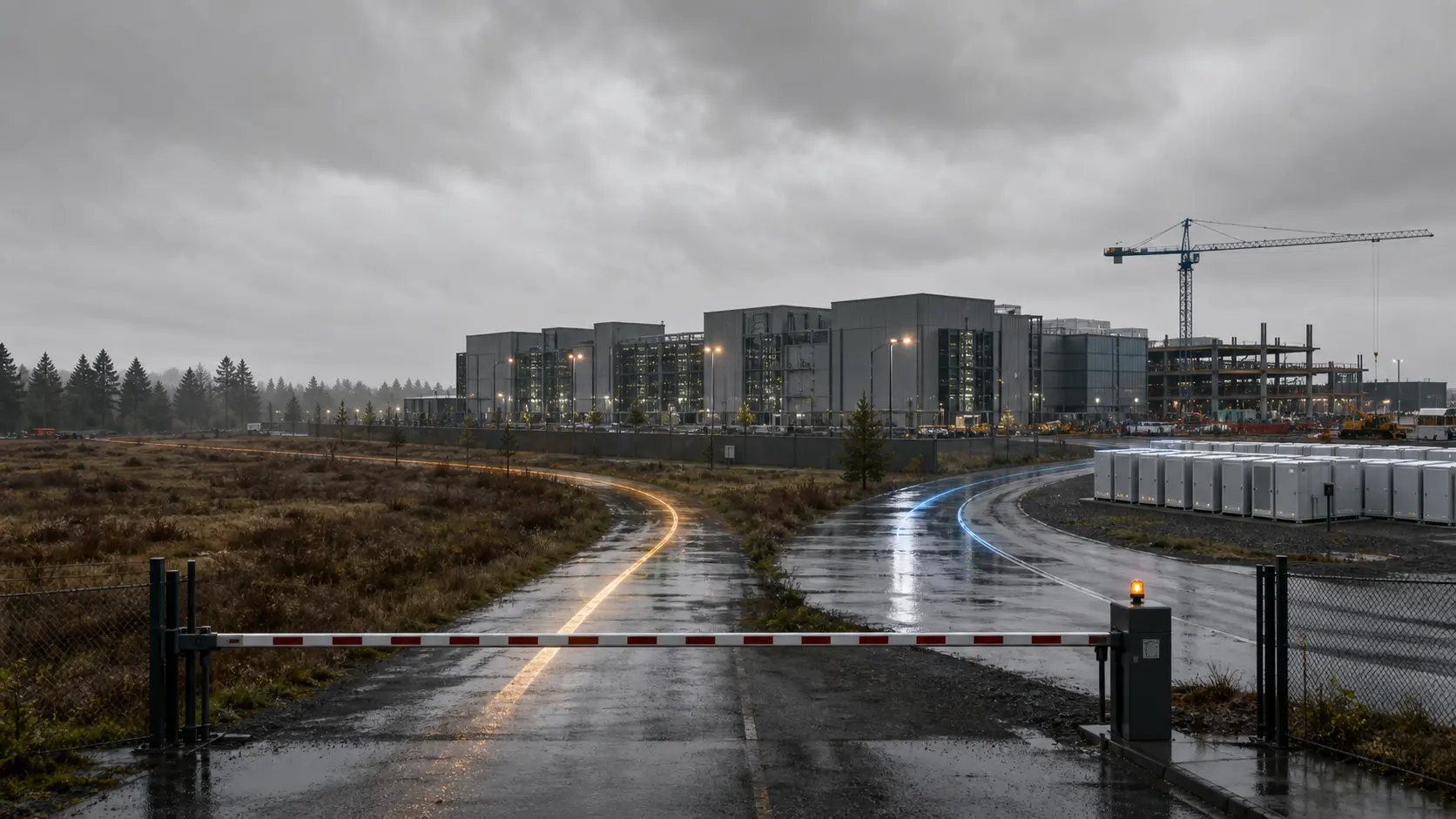
Summary
- Hillsboro enacted a 120-day moratorium at 12:21 pm on 27 July, stopping submissions of new data-centre and battery-energy-storage-system land-use applications.
- Projects already under construction and applications already in process remain outside that intake stop; the measure is not a cancellation of the inherited pipeline.
- Resolution 2932 uses Oregon’s temporary land-use-moratorium procedure to create time for studies and possible Community Development Code changes.
- A separate council action on 21 July paused Strategic Investment Program agreements with stand-alone data centres for 180 days.
- State enterprise-zone incentive rules form another policy layer and must not be folded into either of Hillsboro’s municipal clocks.
- The decisive evidence will be the treatment of pre-filed projects and the permanent standards, if any, that replace or extend the temporary measures.
One counter has shut while two other queues remain open
At 12:21 pm on 27 July, Hillsboro stopped accepting new covered land-use applications for 120 days. The moratorium includes data centres and battery energy storage systems. It is an operative restriction on intake, not a retrospective eraser.
Applications already lodged can continue through review, and projects already under construction can continue to develop. That produces an immediate asymmetry. A company that reached the counter before the measure may preserve time and optionality; a later entrant must wait while the city studies new rules.
The current report places that distinction back in view. The relevant question is not whether Hillsboro has “stopped data centres”. It is which project state the city has stopped—and which states it has deliberately left untouched.
Resolution 2932 buys study time rather than settling the policy
The council’s special-meeting record identifies Resolution 2932 and the Oregon land-use provisions used for a temporary moratorium. The stated purpose is to conduct necessary studies and develop appropriate regulations.
That language defines the present measure as an interval for rulemaking. The city says it will gather public input, consult technical expertise and consider changes to the Community Development Code. It had already initiated a code-amendment process on 7 July, with options including a new use category, location restrictions and additional standards.
None of those options is yet a final permanent rule. A temporary pause can create negotiating space, but it cannot by itself answer how power, water, noise, emergency systems, land consumption or cumulative infrastructure effects should be measured.
The short-notice vote was also a queue-control decision
The council voted unanimously after a special meeting convened with limited notice. City leaders said they had already given the state land-use notice required for the moratorium and kept the local timing quiet to prevent a surge of filings before adoption.
That process deserves scrutiny, but its infrastructure significance is practical: notice changes behaviour. If the industry knows the exact closing time in advance, an application moratorium can enlarge the very queue it is intended to pause.
The city therefore traded a longer public warning period for a cleaner cutoff. That does not prove misconduct by an applicant or official. It shows that procedural timing became part of the capacity-allocation mechanism.
Grandfathering determines how much the pause changes on the ground
The existing queue is the measure’s largest boundary. GovTech reported that Hillsboro already had 436 acres of data centres and another 50 acres under construction. Those footprint figures describe an established cluster; they do not say how many megawatts the moratorium blocks.
Projects that were already in construction or in the permit process can keep advancing. Their electricity demand, buildings, network connections and local fiscal effects may therefore become visible during the 120 days even though no new covered application enters the system.
For residents, the pause may feel weaker if cranes and permitting notices continue. For developers, it is still consequential because the next site or expansion cannot secure a place in the queue under the old intake conditions. Both readings can be true.
The 180-day incentive clock governs a different gate
Six days before the land-use moratorium, the council approved a 180-day pause on Strategic Investment Program agreements with stand-alone data centres. An SIP agreement concerns the local incentive relationship; a land-use application concerns permission to locate and develop.
Combining them into a single “ban” would obscure who is constrained. A project might retain a filed land-use position while facing uncertainty over a future incentive agreement. Another might be excluded from new land-use intake regardless of whether it seeks an SIP benefit.
The two clocks also expire on different schedules. That creates a sequencing risk: Hillsboro could finish one review while the other remains open, or adopt land-use standards without resolving its incentive policy.
Oregon’s enterprise-zone layer is not Hillsboro’s land-use measure
State action on enterprise-zone incentives added urgency before the city vote. The independent account says Hillsboro received 17 tax-break applications in May ahead of a state moratorium. Those applications are not the same thing as 17 new data-centre land-use projects, and Resolution 2932 does not automatically void them.
This third layer matters because state law sets parts of the incentive framework while the city controls local planning and certain agreements. A change in one layer may redirect filings into another rather than halt development outright.
A useful public ledger would therefore report land-use applications, building or construction stages, enterprise-zone requests and SIP agreements separately. Without that separation, totals can suggest more cancellation—or more approval—than has occurred.
Battery storage is inside the legal perimeter
Hillsboro’s 120-day action also covers battery energy storage system developments. The scope should not be narrowed in reporting to batteries attached to data centres; the official wording covers the development category itself.
That inclusion creates a policy tension. Storage can support grid flexibility and site resilience, but large installations also raise their own siting, safety and emergency-response questions. The temporary measure gives the city time to decide whether the two uses need common standards, separate standards or location-specific treatment.
Until that work is complete, the moratorium says only that new covered applications cannot be submitted. It does not establish a battery capacity limit or decide the eventual technical requirements.
Permanent rules will be judged by state definitions, not political adjectives
The city’s research period must turn broad concerns into reviewable thresholds. Location, power demand, water use, acoustic performance, backup generation, storage safety, emergency access and decommissioning could all matter, but no source establishes new final limits for them.
The stronger outcome would identify the project states at which evidence is required and who carries each obligation. A power study at initial application, for example, answers a different question from proof of utility capacity before construction or operating compliance after commissioning.
If the permanent code leaves those checkpoints vague, the temporary pause will have delayed filings without reducing uncertainty. If it defines them clearly, Hillsboro may replace discretionary conflict with a repeatable control system.
The next disclosures should reconcile clocks with projects
During the 120 days, the city can make the policy legible by publishing a state-by-state inventory: pre-filed applications, approvals, construction starts, operating sites, pending SIP agreements and enterprise-zone requests. Dates matter because each item may fall on a different side of a cutoff.
Watch whether the Planning Commission advances code amendments, whether the council extends or replaces Resolution 2932, and whether the 180-day SIP pause produces a new incentive policy. The most important negative evidence would also be explicit: no permanent change, an expired pause or an inherited queue too large for the new rules to affect near-term buildout.
Hillsboro has created time. The policy result depends on whether it uses that time to convert public concern into standards that remain enforceable after the application counter reopens.
Sources
- KOIN — current report on Mayor Beach Pace and Hillsboro’s data-centre pause
- City of Hillsboro — official data-centre actions and moratorium status
- City of Hillsboro — 27 July special-meeting record for Resolution 2932
- GovTech — independent account of adoption, notice and scope
- KXL — existing-project treatment and separation from incentive policy
Member Briefing
Deeper Profile Context
Sign in with the right membership level to unlock the full briefing and source notes.
Only for Strategic Circle
Strategic Circle
Open to all readers. Unlock profile briefings after joining and signing in.
Join Strategic CircleOnly for Leadership Alliance
Leadership Alliance
For qualified IP-asset owners and management; sign in to unlock alliance briefings.
Join Leadership Alliance