
Policy continuity, legitimacy, and accountability signals across internet governance institutions.
Governance
Governance
Internet governance intelligence tracks institutions, policy processes, standards activity, registry operations, accountability disputes, and implementation signals that affect internet infrastructure. BTW.
RIR WatchdogCase FileNumber Resource SocietyICANNIETFHistory of InternetNOGs

RIR Watchdog, Case File, NRS, ICANN, IETF, History of Internet, and NOG sessions.
Coverage prioritizes implementation evidence and institutional behavior over declarative positions.
Latest Coverage
Latest from Governance
7,707 articles

IETF
The Workload Moved to the Edge. Decision Authority Did Not: RFC 9556
Putting computation beside a machine can shorten a path, preserve local data and keep a service alive through a broken uplink. It does not answer who may place the code, read the inputs, release an output or command the physical world.

History
The TCP Session Died. The Operation Ledger Had to Reconcile: RFC 3479
RFC 3479 made LDP fault recovery a problem of comparing two durable operation histories after the TCP transcript broke, not a promise that the missing interval had somehow vanished.

IETF
The Server Identifier Was Overridden. It Did Not Identify the Server
A DHCP dashboard can display option 54 as though it were the address—and therefore the identity—of the server that granted a lease. RFC 5107 breaks that shortcut deliberately: the value can be supplied by a relay so that future renewals return through the relay, while the actual…

History
The Labels Kept Forwarding on Borrowed Time: RFC 3478
RFC 3478 let MPLS forwarding survive an LDP restart, but only by treating the old meaning of every retained label as stale, timed and revocable.

IETF
The Home Kept the Signing Key. Publication Still Moved Outside: RFC 9526
A residential network can author and sign its own public DNS zone without serving a single public query. RFC 9526 turns that apparently paradoxical arrangement into an architecture—and exposes why a valid signature, a successful transfer and a visible answer are three different…

IETF
The Fast-Reconnect ID Found a Context. It Did Not Authenticate the Peer
RFC 5106 lets a returning EAP-IKEv2 peer present a pseudonymous Fast-Reconnect-ID. A server may resolve that string to yesterday’s security context in one lookup. The lookup is useful, but authentication still depends on today’s protected exchange, fresh nonces, new key material…

History
The Unnumbered Link Had Two Local Names: RFC 3477
RFC 3477 solved a naming problem without pretending that one endpoint's private number was a universal identity: one physical link could carry two equally valid local names.
IETF
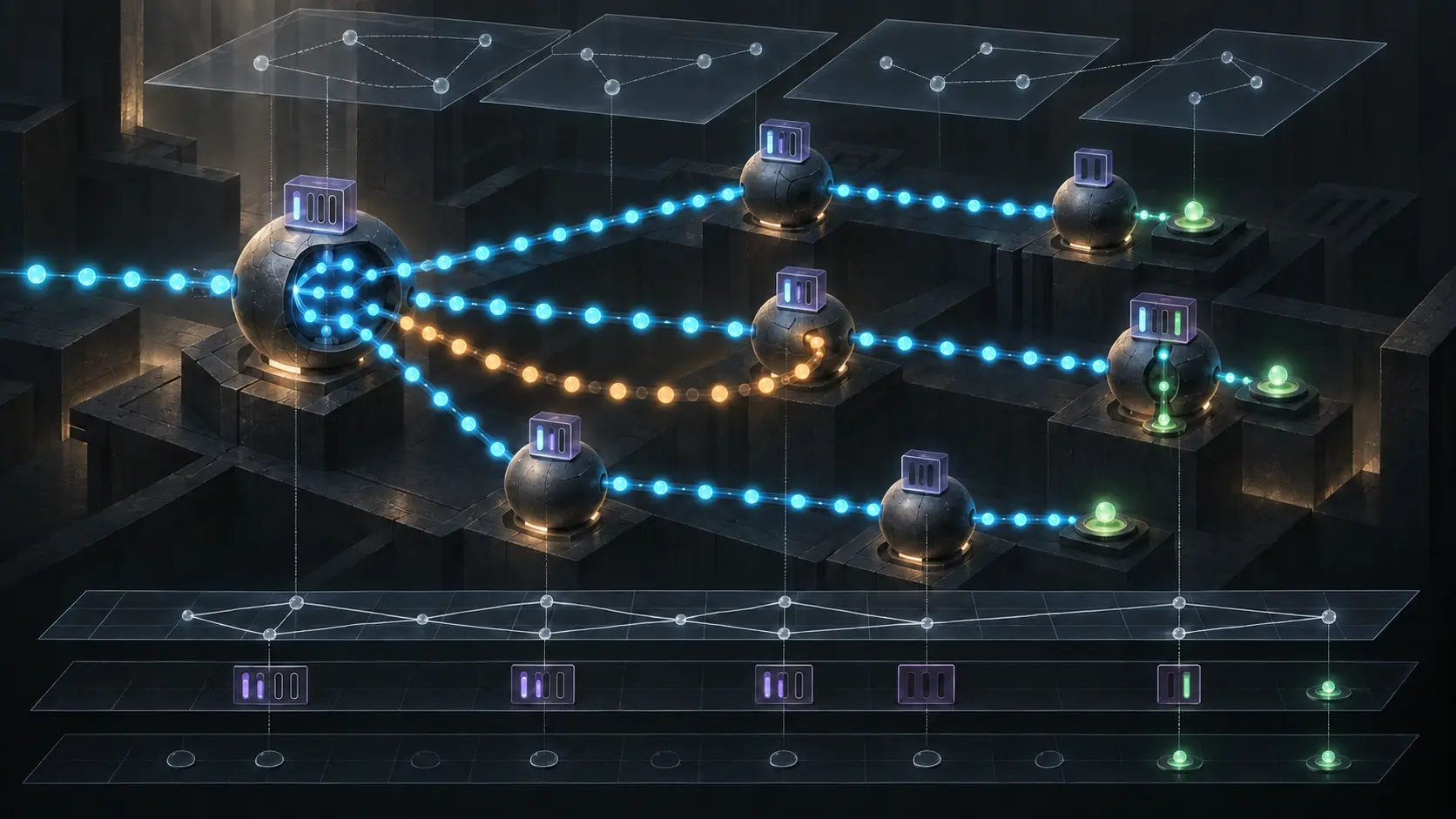
The Replication SID Found State. It Did Not Prove the Tree: RFC 9524
Every Replication-SID on the controller screen was green. Then one packet entered the network, became two, returned to an earlier replication node and became four. The labels were valid, the state lookups succeeded, and the tree was wrong. RFC 9524 explains why local forwarding…

History
RFC 3476 Reserved the Numbers, Not the Optical Service
The Optical Internetworking Forum needed its UNI requests to fit inside IETF protocols. RFC 3476 gave those requests public numbers, while its own error vocabulary showed how little a number could guarantee.

IETF
The Signature Verified. The Delegation Was Not Yet Authorized
RFC 5105 turned an ENUM validation result into a signed XML token that could cross an untrusted registrar path. The signature could prove who signed the covered token and whether those bytes changed. The Registry still had to decide whether that evidence authorized the requested…

History
One Call Release Meant Many Connection Teardowns: RFC 3475
RFC 3475 gave a Call one release operation, but completing that operation required every associated Connection to unwind through its own signaling and resource state.

IETF
The Probe Carried Two Link IDs. Only the Ports Could Confirm Them: RFC 9533
A measurement console said bundle 7 was healthy. The result was numerically precise and operationally vague: four physical links sat behind the bundle, the probe's five-tuple could select only one of them, and nobody had retained which member carried the request or its…

History
The Call Had a Global ID. It Still Was Not a Connection: RFC 3474
RFC 3474 gave an ASON Call an identity that could survive changes below it, but the identifier never became proof of a circuit, installed resources, flowing traffic or delivered service.

IETF
The Refresh Was Requested. The Decoder Had Not Yet Recovered
RFC 5104 gave an RTP entity a precise way to demand a decoder refresh point. The command can be authentic, correctly sequenced and repeatedly transmitted while the evidence of intact delivery, decoder reset, rendered video and user-visible recovery still lies downstream.

History
The Alarm Skipped the Failed Hop. The Ack Proved Only Receipt: RFC 3473
RSVP-TE gained a fast route for telling a distant node about failure, but the acknowledgement at the end of that route was only a receipt for the message—not proof that the network had recovered.

IETF
The Number Was Two Octets. The Authority Was Not the Same: RFC 9542
An engineer saw `88-B7-00-00-5E-00-42` in a trace and shortened the finding to “EtherType 0042.” The abbreviation removed the most important evidence. The outer type, the OUI and the trailing protocol number belong to different layers of authority, and RFC 9542 exists in part to…

History
Traffic Could Flow Upstream Before the Return Mapping Existed: RFC 3472
In CR-LDP's bidirectional setup, the first packets could travel back toward the initiator while the labels for the other direction were still returning hop by hop.

IETF
The Line Was Operational. No Call Had Completed
RFC 5098 gave PacketCable operators a detailed view of an MTA's signaling configuration and line-service state. Its most reassuring status stopped at an acknowledged control link; it did not say that a phone rang, media arrived or two people spoke.

IETF
The OAM Packet Shared the Service Label. It Did Not Share the Packet History: RFC 9546
The assurance console showed an unbroken test sequence while the control application reported a missing command. Nothing in that disagreement required either instrument to be wrong. RFC 9546 gives DetNet OAM its own sequence history, deliberately separate from the App-flow it is…

History
The Label Left the Packet and Entered the Physical World: RFC 3471
In 2003, an MPLS label stopped being only a value a router could read from a packet. It could name a time slot, a wavelength, or the physical port through which light must pass.
Session Map
Governance Branch
RIR Watchdog
Five regional sessions tracking allocation policy, board legitimacy, and institutional continuity.
Open RIR WatchdogCase File
Long-cycle governance dossiers with legal, election, and institutional stress analysis.
Open Case FileNumber Resource Society
Membership, charter, and resource-governance intelligence from the NRS ecosystem.
Open NRS SessionICANN
DNS coordination, accountability frameworks, and global multi-stakeholder process dynamics.
Open ICANN SessionIETF
Protocol standardization trajectory and interoperability risk under fragmented policy conditions.
Open IETF SessionHistory of Internet
Long-cycle infrastructure history used for governance interpretation and structural forecasting.
Open History SessionNOGs
Operator-level implementation intelligence from APRICOT plus regional and national NOG ecosystems.
Open NOGs Session