
RIR Watchdog
Five regional sessions tracking allocation policy, board legitimacy, and institutional continuity.
Open RIR WatchdogGovernance
The internet runs on institutions most people never see. We follow the regional registries, ICANN, the IETF and the operator communities through every board vote, policy fight and court case, and tell you what each move means for your network.

Latest Coverage
9,344 articles

Story
AFPUB-2026-IPv4-002-DRAFT02 keeps the 90% utilisation rule but opens a difficult decision boundary: when is use below that threshold an unavoidable technical constraint rather than ordinary operational convenience?
History
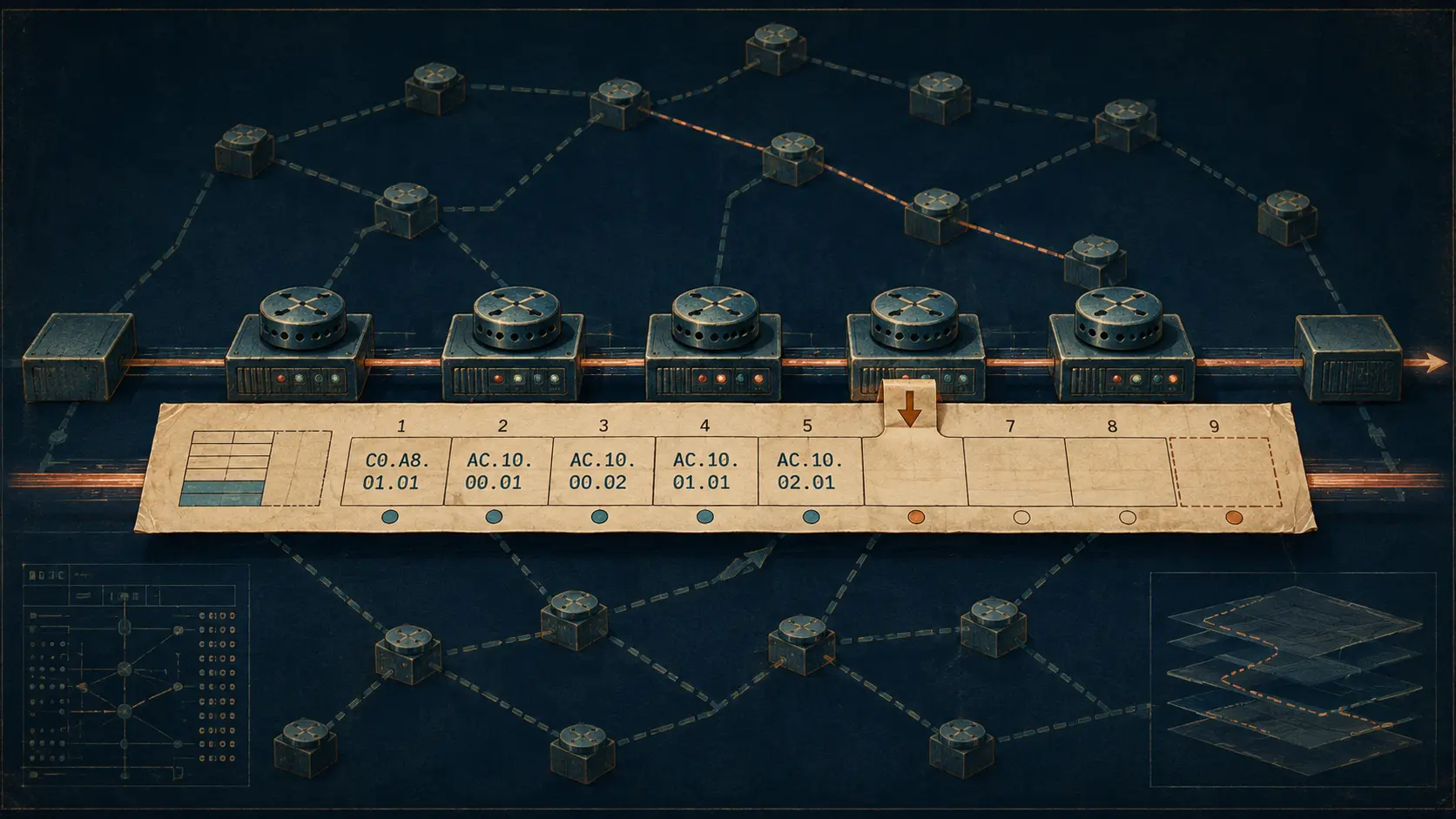
IPv4 once let a packet carry an empty address book. Routers could add their own addresses as it passed, turning forwarding into a voluntary act of testimony. The bytes were exact; the resulting story of the path was not.

IETF
A locally generated IPv6 prefix can be extraordinarily unlikely to collide with another one and still carry no guarantee. Brian Haberman’s work on RFC 4193 makes that distinction operational: probability reduces coordination cost, but only an inventory, a route decision and a…

Story
A router, a customer appliance and a `/56` can remain exactly where they were. Under RIPE’s current IPv6 PI draft, the moment the holder’s LIR account becomes active may nevertheless change whether that arrangement complies. A policy transition this quiet needs its own receipt.

CASE FILE
A new provenance draft contains a command aimed at the systems that read it. The revealing question is not whether the command is visible, but whether evidence inside a document can appoint itself as the policy above the reader.

Story
Three dates in ARIN’s latest consultation can look like shutdown deadlines. They are not. The registry is asking how to retire three older access protocols in favour of RDAP, with separate dependencies and earliest dates for each path. The proposal changes how registration data…

History
IPv4 once gave a datagram a small ledger and asked machines along its path to write down the time. The Internet Timestamp option was precise about the writing procedure, but far less powerful as evidence than its name suggested. Its history shows how a cooperative diagnostic…

IETF
The moment a peer tells you its MAC address, two different facts arrive: where to send the next frame, and what the link is allowed to become. RFC 7213 supplies the first, not the second. It makes Ethernet parameters discoverable for non-IP MPLS-TP links while leaving topology…

Story
AFRINIC’s draft policy sets a consequential boundary between recovered address space and space that can be allocated. The public record explains the quarantine period, but not yet the block-level evidence trail an operator would need to show why a particular block was released.

History
In 1996, the Internet Architecture Board described a task that sounded almost clerical: replace one set of IP addresses with another. Then RFC 1900 followed the old numbers out of the router and into configuration files, applications, licences and human-maintained lists. The…

CASE FILE
Revision 09 gave an L2VPN snooping draft a fresh date without changing its mechanism. The document can still be useful, but its own import graph shows why leaders must demand an executable dependency receipt before treating standards activity as implementation readiness.

IETF
A new deployment appendix records an unusually candid standards lesson: a familiar analogy can become an undocumented instruction, first for implementers and then for operators reading the result.

History
A twenty-octet address can be placed beside a sixteen-octet one, sliced, tagged and reconstructed. That arithmetic says nothing about whether the route hierarchy survives the move. RFC 1888 recorded this distinction in 1996: its encodings could preserve address bits, while the…

ICANN
A root server can record a query for a private-looking name with great precision. The record still cannot say which application produced it, who owns the broken dependency, how many users rely on it or what a future delegation would harm. Allison Mankin’s work on RFC 8023 helps…

CASE FILE
RFC 9209 can make a failure path legible without making anyone accountable for repairing it. The missing entity is an intermediary fault-handoff matrix: a private governance record that connects each visible or redacted hop to an operator, an escalation clock, retained evidence…

Story
ARIN’s Board minutes record the creation of an IPv6 Task Force, an amendment that shortened its planned life, and three people who volunteered to do the work. What the public record does not yet supply is the operative text that joins those facts into a mandate. The missing…

Story
LACNIC Whois routing-c Can Register Routing Policy, Not Prove Who Operates BGP intelligence summary explains the development, the public evidence available to readers, the organisations involved, the regional context, market exposure, and the infrastructure consequences that may…

History
In 1996, an IPv6 address could be useful, globally coordinated and routable across an experimental backbone while still carrying no promise of permanence. RFC 1897 made that distinction explicit: its addresses were for prototype testing, would be reclaimed and required their…

Story
AFRINIC's proposed operating rules for its Policy Development Working Group try to replace contested custom with written procedure. The harder task is making every transfer of authority—from discussion to consensus, appointment, ratification and appeal—visible enough to audit.

CASE FILE
One entity can be discovered under a temporary tag, receive several provisional designations, gain a permanent number and acquire a name years later. A route cannot afford to mistake any one of those labels for proof of where a packet should go.
Session Map
Five regional sessions tracking allocation policy, board legitimacy, and institutional continuity.
Open RIR WatchdogLong-cycle governance dossiers with legal, election, and institutional stress analysis.
Open Case FileMembership, charter, and resource-governance intelligence from the NRS ecosystem.
Open NRS SessionDNS coordination, accountability frameworks, and global multi-stakeholder process dynamics.
Open ICANN SessionProtocol standardization trajectory and interoperability risk under fragmented policy conditions.
Open IETF SessionLong-cycle infrastructure history used for governance interpretation and structural forecasting.
Open History SessionOperator-level implementation intelligence from APRICOT plus regional and national NOG ecosystems.
Open NOGs Session