
Summary
Proxy-Statuscan say which intermediary handled a response and what kind of error it encountered; it cannot say which organisation owns the incident or must repair the service.- Operators need a separate fault-handoff matrix that links deployment identifiers and disclosure rules to paging duties, evidence custody, correction authority and tested fallback decisions.
A gateway timeout used to be almost aggressively unhelpful. A client could see a 502 or 504 and know that something had failed between it and the origin, but not whether the failure belonged to name resolution, a connection attempt, a certificate check, a response limit or the intermediary itself. RFC 9209 addresses that diagnostic poverty with the Proxy-Status response field. It gives intermediaries a common way to describe how they handled a request and response, including errors they generated or observed.
That is a meaningful advance. It is also easy to ask the field to carry an institutional burden it was never designed to bear.
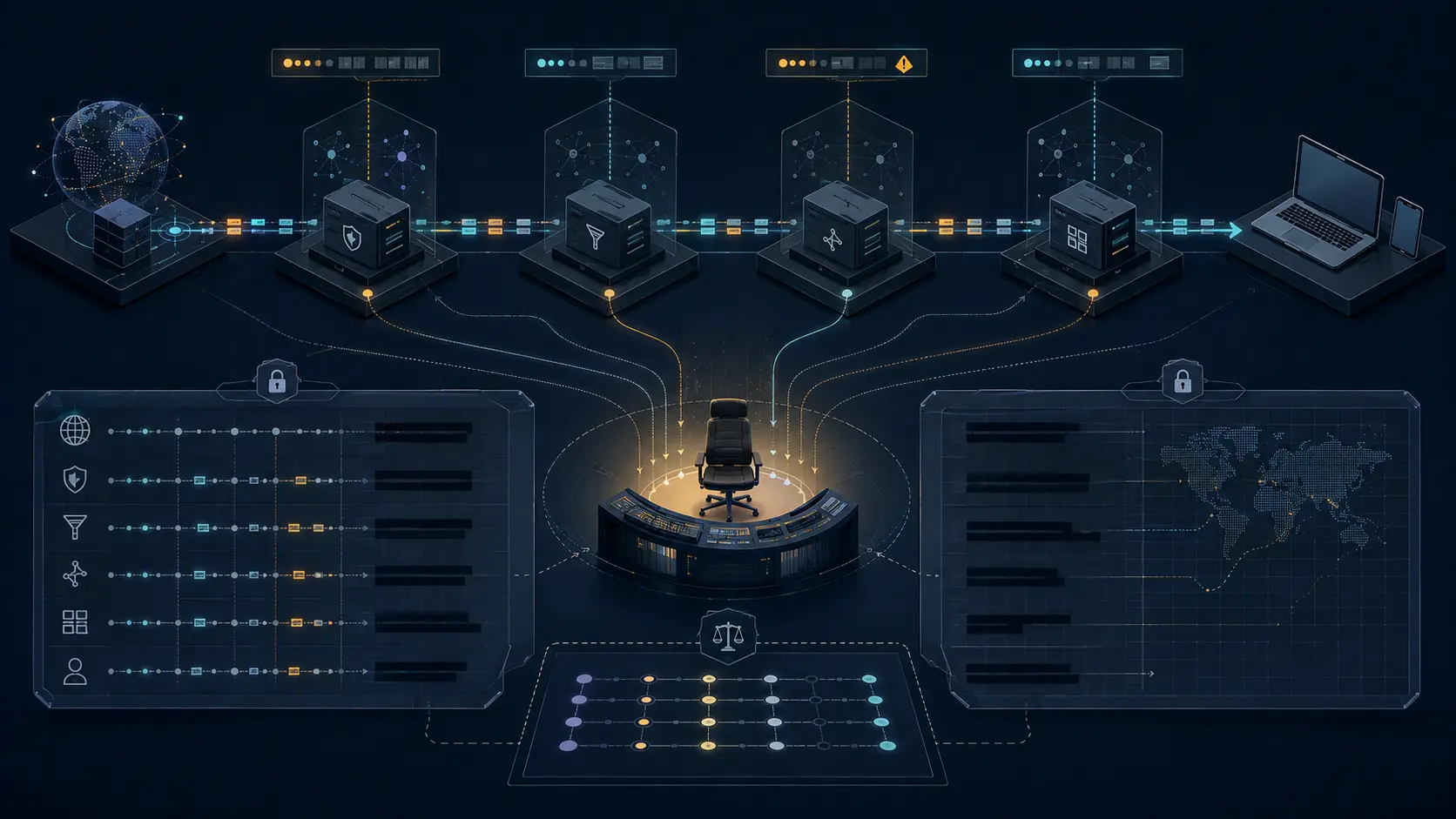
The field is a Structured Fields List. Each member represents an intermediary that handled the response: the member nearest the origin appears first, and the member nearest the user agent appears last. A member identifies the deployment that inserted it. Optional parameters can name an error, the selected next-hop, the next-protocol, a received-status or additional details. This is much more precise than treating every bad gateway response as the same event.
Yet none of those values names a legal or operational owner. A service name may identify a deployment without revealing the company, team or contract behind it. A generated string may be useful to one operator and meaningless to another. A connection_timeout describes what one intermediary observed while reaching its next hop; it does not prove why the next hop did not answer, who controls that next hop, or who has authority to change the timeout. Even the distinction between errors that can arise only in intermediary-generated responses and those that can accompany forwarded or partial responses is a statement about message production, not incident command.
This difference matters because a modern HTTP path is often a chain of separately governed systems. A customer may contract with an application provider, which contracts with a delivery network, which fronts a gateway, which reaches a service operated by another team. The wire path and the responsibility path overlap, but they are not identical. The first visible failure may occur at a party that cannot fix the underlying cause. The party able to fix it may not see the client-facing response. The party accountable to the customer may operate neither system.
RFC 9209 also preserves deliberate ambiguity. Intermediaries decide when to add the field. They may add it to all responses, only under specific configuration, or only when a request activates a diagnostic mode. All parameters are optional. Existing members should normally be preserved for chain debugging, but they may be removed to keep internal network information from leaking. The security section warns that configuration and backend topology can help attackers, and that some information should be disclosed only to authorised parties. The field is not verified: an intermediary can claim an action without having performed it.
Those limits are not defects. They are the conditions under which a useful diagnostic signal can cross a trust boundary. But they mean that absence has several possible interpretations. A missing member might indicate that an intermediary was not present, did not implement the field, was not configured to emit it, withheld it from this audience, or had its member stripped downstream. A missing next-hop can protect topology rather than indicate ignorance. A details string can add context, but it can also vary by implementation and may be intentionally suppressed. Governance cannot treat optional disclosure as a complete chain of custody.
Late failures make the boundary sharper. RFC 9209 permits the field in trailers when a streaming intermediary discovers a problem after response headers have already gone out. It discourages this when the information could have been sent in headers because trailers can be silently discarded. It also requires the intermediary to have placed a corresponding member in the header before adding a trailer member, allowing a client to reconstruct relative ordering. That design improves temporal diagnosis.
It still does not guarantee that every observer stores the trailer, joins it to the original request, or pages the person who can decide whether to retry, bypass or stop traffic.
The missing governance object is an intermediary fault-handoff matrix. It should exist outside the response field and outside any one vendor's console. For each boundary where Proxy-Status is emitted, retained, redacted or removed, the matrix should record ten things: the scoped deployment identifier; the operating entity and service owner; the error classes that are authoritative at that boundary; known blind spots; the audience allowed to see each parameter; the paging route and acknowledgement deadline; the evidence retained outside the response; the authority to correct a false or stale mapping; the owner of bypass or fallback decisions; and the date of the last cross-party drill.
The distinction between observation and ownership must be explicit. If error=connection_timeout appears on a delivery-network member, the emitting intermediary owns the accuracy of that observation. It does not automatically own the next hop's availability. The next-hop operator may own the service condition. A platform integrator may own the retry policy. A customer-facing provider may own notification. Only the matrix can make those parallel duties visible without pretending that one error token settles causality.
The matrix should also separate public identifiers from accountable identities. A public response might expose a stable alias that reveals no private hostname. A contract annex can map that alias to the operating company. An internal on-call record can map it further to a team and escalation route. Auditors may need a time-bounded record showing which mapping was in force during an incident. These layers let operators preserve necessary secrecy while avoiding the opposite failure: a deliberately opaque token that no authorised responder can resolve quickly.
Error registries help here, but only up to a point. IANA maintains registries for Proxy-Status parameters and proxy error types, and RFC 9209 favours well-defined generic entries over vendor-specific ones. The registry supplies a shared vocabulary. It cannot establish whether a specific service has implemented every type, whether an emitted type is truthful, or whether a recommended HTTP status matches the response a client actually received. The matrix therefore needs a per-boundary capability statement: supported types, local thresholds, fields suppressed for each audience, and the evidence source used to validate the claim.
This is also why incident automation must not page solely from a token-to-team lookup. A token describes the reporting hop and a condition, not a final verdict. Automation should combine the member order, error type, response status, request correlation, independent telemetry and the current ownership map. It should distinguish “observer to acknowledge” from “remediation owner to investigate” and “customer owner to communicate.” Where that distinction cannot be made, the safe result is an explicit unresolved handoff, not a confident but arbitrary assignment.
The standard makes failures more legible. Governance begins at the next question: who is obliged to do what with that legibility? Without a durable answer, the field can reduce debugging time while leaving the oldest operational problem untouched—several parties can describe the same failure, yet nobody has accepted the duty to close it.
Sources
- RFC 9209, The Proxy-Status HTTP Response Header Field: https://www.rfc-editor.org/rfc/rfc9209.html
- IANA, Hypertext Transfer Protocol (HTTP) Proxy-Status: https://www.iana.org/assignments/http-proxy-status/
- RFC 9110, HTTP Semantics: https://www.rfc-editor.org/rfc/rfc9110.html
- RFC 8941, Structured Field Values for HTTP: https://www.rfc-editor.org/rfc/rfc8941.html
Member Briefing
Deeper Profile Context
Sign in with the right membership level to unlock the full briefing and source notes.
Only for Strategic Circle
Strategic Circle
Open to all readers. Unlock profile briefings after joining and signing in.
Join Strategic CircleOnly for Leadership Alliance
Leadership Alliance
For qualified IP-asset owners and management; sign in to unlock alliance briefings.
Join Leadership Alliance