
RIR Watchdog
Five regional sessions tracking allocation policy, board legitimacy, and institutional continuity.
Open RIR WatchdogGovernance
The internet runs on institutions most people never see. We follow the regional registries, ICANN, the IETF and the operator communities through every board vote, policy fight and court case, and tell you what each move means for your network.

Latest Coverage
9,344 articles

IETF
A mailbox search can finish correctly while its request for continuing updates is refused. IMAP makes that distinction explicit. The harder question is whether the product, its resource budget and its promises to users do the same.

History
A workstation with no configured address asks a question that looks deceptively small: which IP address may I use? RFC 1931 answered with several servers, but not several truths. Dynamic RARP separated the machines that could hear and answer a request from the authority allowed…

IETF
A constrained device can withhold its operational identity and still disclose enough to be enrolled. In Lightweight Authorization using EDHOC, that disclosure is deliberate: an authenticated domain authenticator receives the device’s enrollment identity and sends it to a trusted…

IETF
A scheduled email can ask a server to keep it still while a second instruction demands that it arrive sooner. SMTP's answer is not a faster queue. It is a refusal to accept incompatible obligations—and a careful division of responsibility for the promises that remain.

IETF
A domain-security dashboard finds `clientTransferProhibited` and turns its badge green. The code deserves some of that confidence: in the EPP domain mapping authored by Scott Hollenbeck, a transfer request must be rejected while the status is present. But the badge has answered…

Story
The latest completed hour says APNIC received 3,192,583 WHOIS queries. Add the seven query types printed beside that total and the answer is 3,183,463. The missing bridge is not a rounding error; it is the meaning of the measurement.

IETF
A new individual Internet-Draft separates protocol removal from measured security gains. Its operational question is who owns the IPv4 processing left outside the claim.

IETF
Three time servers sign answers that cannot all be true in the order they were received. Roughtime lets a client preserve that contradiction as portable cryptographic evidence. Yet the proof does not name the guilty server, appoint the reviewer, alter a trusted-server list or…

IETF
A constrained device sends a compact key identifier inside an EDHOC exchange. The responder looks it up, tries a pre-shared key and authenticates the message. Revision 09 of the IETF LAKE working group’s EDHOC-PSK draft changes what may sit behind that lookup: one identifier can…

IETF
A mail filter can name both a preferred role and a default folder. Sieve does not treat that pair as a licence to put mail wherever storage happens to work. The distinction protects placement consistency—and leaves someone responsible for restoring the destination that failed.

Story
A new LACNIC Blog essay catches the most consequential detail in the retirement of traditional telephony: the call may look unchanged, but its power supply has moved. That observation deserves a more exact public answer about who keeps an IP call alive when the lights go out.

Story
APNIC has documented who joined the first stage of its leadership-diversity consultation and what barriers they described. The next test is whether it can connect outreach, participation and proposed remedies to a broader leadership pipeline without identifying individual…

History
A paper clip is legible before anyone explains it. That was the charm of RFC 1927—and the trap hidden inside its joke. The memo asked one office-supply icon to express whether documents belonged together, how they should look, which workflow should run, where an annotation…

IETF
After an NFSv4.1 server loses its lock state, the quickest client cannot decide when the slower ones have had enough time. Recovery completion is a withdrawal of its own remaining claims, not a command to reopen the whole service.

History
RFC 1926 could turn every nibble of an IP datagram into a Morse letter and place it on a chosen audio frequency. The difficult part begins after a receiver hears the start signal: when, exactly, has the packet ended? That small silence exposes the distance between a reversible…
Story
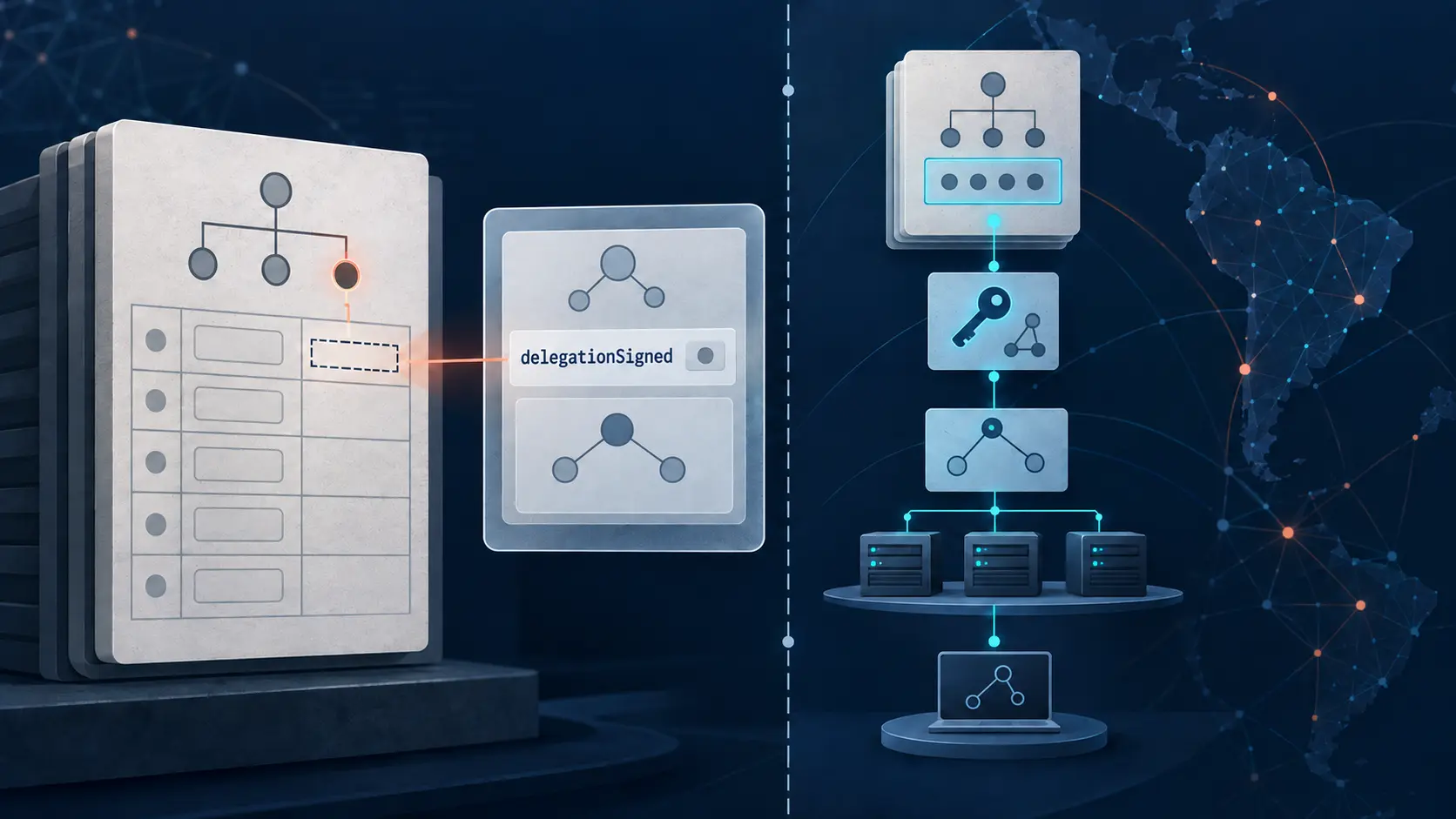
A boolean in a registry response can look like a verdict on the security of a DNS chain. LACNIC's RDAP `delegationSigned` field answers a narrower question: whether the registration view reports DS records in the parent. It does not run a resolver, test the child keys or prove…

IETF
A caller hears a ring and begins to wait. On a SIP trace, an engineer sees `180 Ringing` and may feel that the network has confirmed the same event. The two impressions can coincide, but they are not identical. In the protocol co-authored by Henning Schulzrinne, 180 is a…

Story
AFRINIC’s Bylaws Review Committee extended consultation to 30 August while two consequential legal questions remained under consideration. The next public document should show how each material issue moved from comment to decision—even where the legal advice behind that decision…

IETF
Two engineers are authorized to change the same router. Each works in a private configuration branch, so neither can accidentally commit the other’s unfinished commands. Then both change the same node. The server can identify the collision and offer disciplined ways to resolve…

IETF
An OAuth client receives a fresh server challenge, builds a proof around it and sends the request. May the same challenge be used again? Revision 11 of the IETF OAuth working group’s attestation-based client-authentication draft gives a precise but surprising answer: the client…
Session Map
Five regional sessions tracking allocation policy, board legitimacy, and institutional continuity.
Open RIR WatchdogLong-cycle governance dossiers with legal, election, and institutional stress analysis.
Open Case FileMembership, charter, and resource-governance intelligence from the NRS ecosystem.
Open NRS SessionDNS coordination, accountability frameworks, and global multi-stakeholder process dynamics.
Open ICANN SessionProtocol standardization trajectory and interoperability risk under fragmented policy conditions.
Open IETF SessionLong-cycle infrastructure history used for governance interpretation and structural forecasting.
Open History SessionOperator-level implementation intelligence from APRICOT plus regional and national NOG ecosystems.
Open NOGs Session