
Policy continuity, legitimacy, and accountability signals across internet governance institutions.
Governance
Governance
Internet governance intelligence tracks institutions, policy processes, standards activity, registry operations, accountability disputes, and implementation signals that affect internet infrastructure. BTW.
RIR WatchdogCase FileNumber Resource SocietyICANNIETFHistory of InternetNOGs

RIR Watchdog, Case File, NRS, ICANN, IETF, History of Internet, and NOG sessions.
Coverage prioritizes implementation evidence and institutional behavior over declarative positions.
Latest Coverage
Latest from Governance
7,757 articles

Story
ARIN Lets You Name a ROA. Its Online Search Still Ignores the Name
ARIN Lets You Name a ROA. Its Online Search Still Ignores the Name intelligence summary explains the development, the public evidence available to readers, the organisations involved, the regional context, market exposure, and the infrastructure consequences that may follow. The…

CASE FILE
PNAI Does Not Want a Catalogue of Success Stories. Show How the Cases Were Chosen
A case study becomes persuasive long before its final paragraph is written. Someone finds it, someone decides it belongs, and other examples never enter the folder. The IGF Policy Network on Artificial Intelligence now wants practical evidence of governance beyond formal…

Story
APNIC’s Definition Page Shows a Draft. Its Official Text Is Still Active
APNIC built one definition document so the same words would not acquire different meanings as they crossed policy files. The document now has a different problem. Its main web page presents version 004 as a draft; its stable official-text address still presents version 003 as…

CASE FILE
A Successful EPP Server Validation Is a Dated Policy Verdict, Not a Health Certificate
The word “success” can survive on a dashboard long after the observation that produced it has expired. A new EPP proposal would make the result portable; governance begins by refusing to make it timeless.

IETF
Alexey Melnikov and the Authentication Success That Could Not Grant a Service
The status light turned green. The credentials had been accepted, an identity had been associated with the session, and the exchange was over. Yet the next operation could still be refused without contradiction. The architecture Alexey Melnikov and Kurt Zeilenga set out in RFC…

CASE FILE
The EPP Same-Entity Set Turns an External Policy Into an Atomic Boundary
A registrar can submit a command naming one domain while the repository must decide whether that command reaches a set too large to list. The protocol message is visible; the rule that draws its boundary may sit somewhere else.

CASE FILE
PNODI's Consultant Will Synthesize and Contribute. The Draft Needs Two Source Lanes
A consultant is about to inherit a mailing-list archive, a compressed calendar and an unusually delicate verb: synthesize. PNODI also expects that consultant to research and contribute suggestions of their own. Both tasks can improve the Internet Governance Forum's first…
History
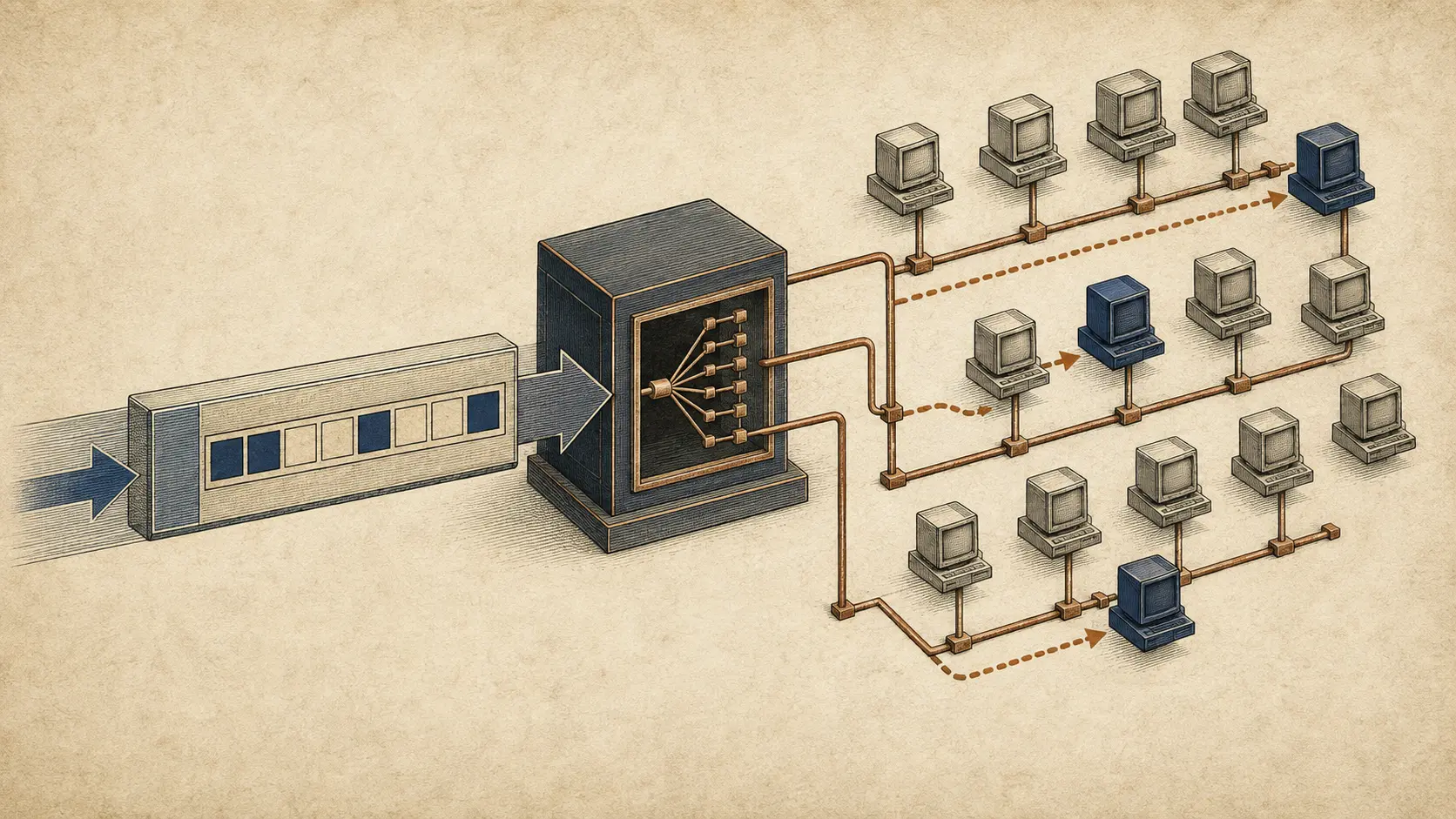
The Broadcast Packet That Carried Its Own Guest List
One UDP datagram approached a remote subnet as a broadcast, yet it carried a private instruction inside its IPv4 header: these hosts may listen; the others must stop. Selective Directed Broadcast Mode tried to make the packet itself serve as a temporary membership list.

IETF
Alissa Cooper and the Privacy Review That Could Not Issue a Safety Certificate
The review workbook had answers in every cell: identifiers listed, observers named, retention discussed, defaults justified. What it did not have was a truthful final cell marked “safe”. Alissa Cooper and her co-authors designed RFC 6973 to make privacy reasoning inspectable, not…

Story
APNIC’s Online SIG Ballot Still Requires In-Person Attendee Check-In
APNIC 62 opened its SIG ballot online on 8 September. That describes the voting medium, not the electorate: an individual conference attendee still has to be in Mumbai, check in at the registration desk and show a record of participation in an earlier APNIC or APRICOT meeting.…

IETF
One CA Name, Several Ways to Issue
A buyer reviewing certificate operations asks a simple question: if DNS authorizes one certification-authority name with an account and a validation method, does that restriction govern every issuing system behind the name? RFC 8657 makes the answer consequential. A shared CA…

CASE FILE
The EPP Extension Registry Records Coexistence, Not a Winner
Two extensions can solve much the same provisioning problem, use different XML namespaces and both deserve a place in the same public registry. That is not a defect in the catalogue. It is the governance fact the catalogue must preserve.

Story
AFRINIC's Six-Month Implementation Rule Has Two Start Dates
A policy clock is useful only when the institution and its community can identify the event that started it. AFRINIC's current Consolidated Policy Manual starts its six-month implementation expectation at the end of Last Call. AFRINIC's current public explanation starts it at…

IETF
Barry Leiba and the Capital Letters That Could Not Create Authority
A requirements scanner finds `MUST` in a specification and reports certainty. It has found a word, not yet an obligation. Barry Leiba’s RFC 8174 drew a clean boundary around the special vocabulary of BCP 14, but the boundary works in both directions: capitals activate defined…

CASE FILE
The IGF Is Designing Crisis Connectivity. Start With an Activation Ledger
A coalition may be able to reconnect civilians after a shutdown or damaged network. Its first hard problem is not the satellite terminal, fibre route or radio link. It is deciding who may ask the coalition to act, who can lawfully say yes, what may be done, and how the public…

IETF
The Price of Keeping Only the Latest Notification
Web Push can spare a returning device a backlog of obsolete updates. The difficult decision is not how to replace a waiting message, but which information the business can afford to leave behind.

CASE FILE
Every Outer Bundle Was Delivered. The Inner Bundle Still Had Not Been Received
Bundle-in-Bundle Encapsulation gives a delay-tolerant network two journeys to observe. The outer bundles can reach their configured endpoint one by one, each with a valid delivery report, while the bundle carried inside them never reaches the Bundle Protocol Agent. The new DTN…

CASE FILE
A DNS Filtering Notice Is a Chain of Three Decisions, Not One Explanation
A link that explains why a name was filtered looks like a simple act of transparency. By the time it reaches a user, however, a resolver, an application and the user have each made a different decision. The record must preserve all three.

IETF
Michelle Cotton and the Code Point That Arrived Before Its RFC
The awkward moment comes before a standard is finished: two implementations need the same numeric language to meet, but the registry would normally wait for publication. Michelle Cotton’s RFC 7120 turned that timing gap into a visible, expiring state. Its most important word is…

IETF
The Mount Point Changes What a Valid Configuration Means
A reusable network model carries its rules with it. It does not necessarily carry all the data against which those rules will be judged. YANG Schema Mount makes that distinction an operational responsibility.
Session Map
Governance Branch
RIR Watchdog
Five regional sessions tracking allocation policy, board legitimacy, and institutional continuity.
Open RIR WatchdogCase File
Long-cycle governance dossiers with legal, election, and institutional stress analysis.
Open Case FileNumber Resource Society
Membership, charter, and resource-governance intelligence from the NRS ecosystem.
Open NRS SessionICANN
DNS coordination, accountability frameworks, and global multi-stakeholder process dynamics.
Open ICANN SessionIETF
Protocol standardization trajectory and interoperability risk under fragmented policy conditions.
Open IETF SessionHistory of Internet
Long-cycle infrastructure history used for governance interpretation and structural forecasting.
Open History SessionNOGs
Operator-level implementation intelligence from APRICOT plus regional and national NOG ecosystems.
Open NOGs Session