
Policy continuity, legitimacy, and accountability signals across internet governance institutions.
Governance
Governance
Internet governance intelligence tracks institutions, policy processes, standards activity, registry operations, accountability disputes, and implementation signals that affect internet infrastructure. BTW.
RIR WatchdogCase FileNumber Resource SocietyICANNIETFHistory of InternetNOGs

RIR Watchdog, Case File, NRS, ICANN, IETF, History of Internet, and NOG sessions.
Coverage prioritizes implementation evidence and institutional behavior over declarative positions.
Latest Coverage
Latest from Governance
7,717 articles

IETF
Scott Hollenbeck and the Transfer Lock That Could Not Explain Itself
A domain-security dashboard finds `clientTransferProhibited` and turns its badge green. The code deserves some of that confidence: in the EPP domain mapping authored by Scott Hollenbeck, a transfer request must be rejected while the status is present. But the badge has answered…

Story
APNIC’s WHOIS Archive Reports Two Totals for the Same Hour
The latest completed hour says APNIC received 3,192,583 WHOIS queries. Add the seven query types printed beside that total and the answer is 3,183,463. The missing bridge is not a rounding error; it is the meaning of the measurement.

IETF
IPv4 retirement needs a boundary, not just a percentage
A new individual Internet-Draft separates protocol removal from measured security gains. Its operational question is who owns the IPv4 processing left outside the claim.

IETF
A Cryptographic Malfeasance Report Cannot Revoke Trust
Three time servers sign answers that cannot all be true in the order they were received. Roughtime lets a client preserve that contradiction as portable cryptographic evidence. Yet the proof does not name the guilty server, appoint the reviewer, alter a trusted-server list or…

IETF
One EDHOC Key ID Can Point to Several PSKs
A constrained device sends a compact key identifier inside an EDHOC exchange. The responder looks it up, tries a pre-shared key and authenticates the message. Revision 09 of the IETF LAKE working group’s EDHOC-PSK draft changes what may sit behind that lookup: one identifier can…

IETF
The fallback folder was not an overflow bin
A mail filter can name both a preferred role and a default folder. Sieve does not treat that pair as a licence to put mail wherever storage happens to work. The distinction protects placement consistency—and leaves someone responsible for restoring the destination that failed.

Story
A LACNIC Telecom Essay Moves Voice to IP. It Leaves Backup Power Unassigned.
A new LACNIC Blog essay catches the most consequential detail in the retirement of traditional telephony: the call may look unchanged, but its power supply has moved. That observation deserves a more exact public answer about who keeps an IP call alive when the lights go out.

Story
APNIC’s leadership-diversity consultation needs a measurable participation funnel
APNIC has documented who joined the first stage of its leadership-diversity consultation and what barriers they described. The next test is whether it can connect outreach, participation and proposed remedies to a broader leadership pipeline without identifying individual…

History
The Gold Paper Clip Looked Decorative. It Was a Workflow Command: RFC 1927
A paper clip is legible before anyone explains it. That was the charm of RFC 1927—and the trap hidden inside its joke. The memo asked one office-supply icon to express whether documents belonged together, how they should look, which workflow should run, where an annotation…

IETF
The recovered client that could not end everyone else's grace
After an NFSv4.1 server loses its lock state, the quickest client cannot decide when the slower ones have had enough time. Recovery completion is a withdrawal of its own remaining claims, not a command to reopen the whole service.

History
The Packet Had an Alphabet and a Pitch, but No End Marker: RFC 1926
RFC 1926 could turn every nibble of an IP datagram into a Morse letter and place it on a chosen audio frequency. The difficult part begins after a receiver hears the start signal: when, exactly, has the packet ended? That small silence exposes the distance between a reversible…
Story
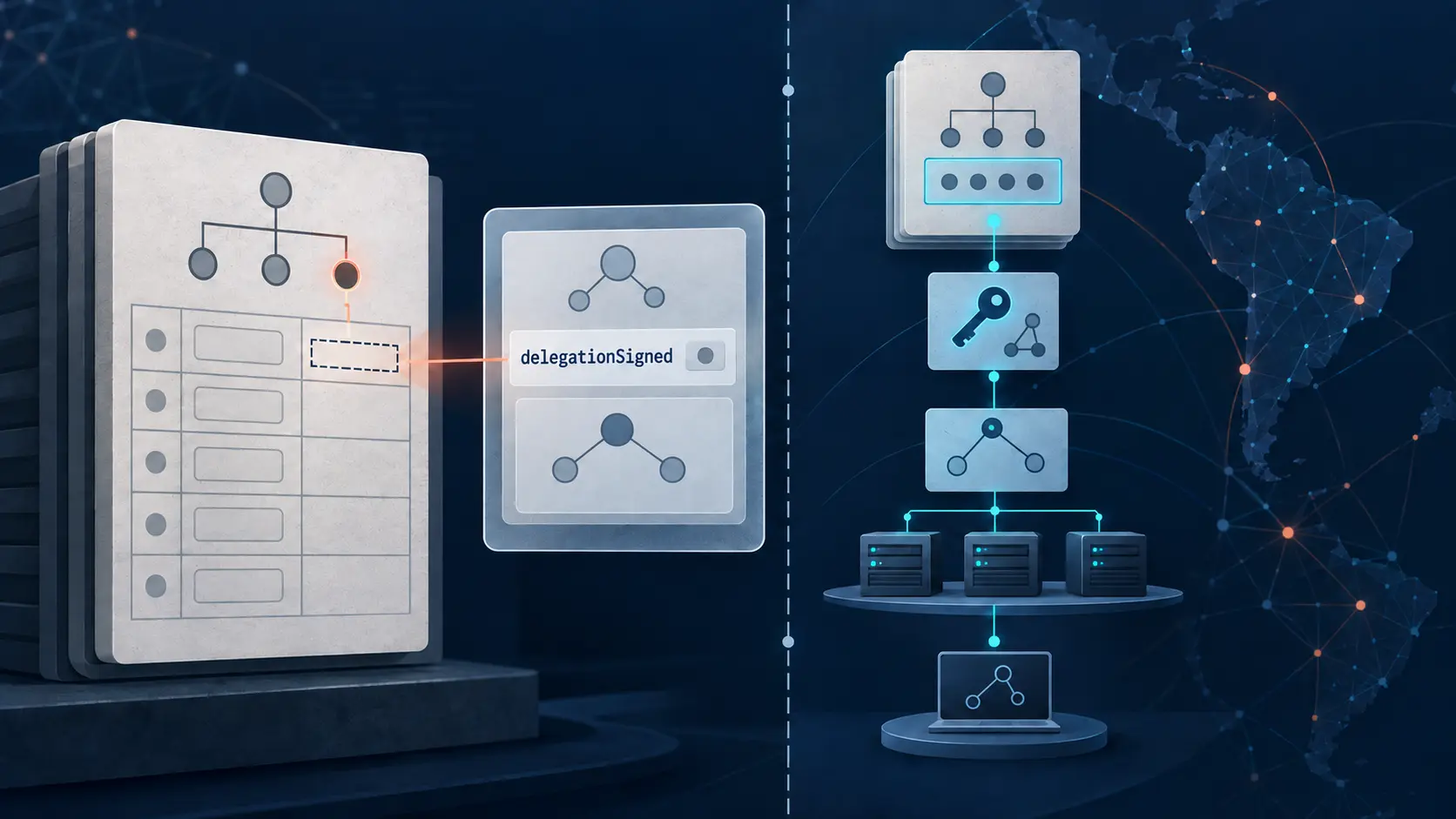
LACNIC's RDAP delegationSigned Records Parent DS Presence, Not DNSSEC Validation
A boolean in a registry response can look like a verdict on the security of a DNS chain. LACNIC's RDAP `delegationSigned` field answers a narrower question: whether the registration view reports DS records in the parent. It does not run a resolver, test the child keys or prove…

IETF
Henning Schulzrinne and the Ringing Response That Arrived Before Anyone Answered
A caller hears a ring and begins to wait. On a SIP trace, an engineer sees `180 Ringing` and may feel that the network has confirmed the same event. The two impressions can coincide, but they are not identical. In the protocol co-authored by Henning Schulzrinne, 180 is a…

Story
AFRINIC’s bylaw rewrite needs an issue-to-decision map
AFRINIC’s Bylaws Review Committee extended consultation to 30 August while two consequential legal questions remained under consideration. The next public document should show how each material issue moved from comment to decision—even where the legal advice behind that decision…

IETF
A Private Candidate Does Not Explain Why One Intent Won
Two engineers are authorized to change the same router. Each works in a private configuration branch, so neither can accidentally commit the other’s unfinished commands. Then both change the same node. The server can identify the collision and offer disciplined ways to resolve…

IETF
An OAuth Challenge Can Be Reused Unless the Server Says No
An OAuth client receives a fresh server challenge, builds a proof around it and sends the request. May the same challenge be used again? Revision 11 of the IETF OAuth working group’s attestation-based client-authentication draft gives a precise but surprising answer: the client…

IETF
The SCTP association that outlives its original socket
Peeling an established association out of a shared socket can contain buffer pressure. It also moves the place where that association must be controlled and closed.

IETF
Mallory Knodel and the Censorship That Begins Before a Packet Is Dropped
A failed connection is the last frame of a longer decision. In the censorship survey co-authored by Mallory Knodel, somebody first defines what is unwanted, a system then recognizes traffic as belonging to that class, and only then does an actor interfere. Keeping those stages…

Story
AFRINIC’s RPKI Guide Names a Validator Retired in 2021. The Link Now Runs Routinator
The hyperlink works. That is precisely why the documentation error is easy to miss: AFRINIC’s main RPKI guide preserves the name of one product while sending the reader to a different implementation.

IETF
MPTCP can keep the stream and lose the way back
After infinite-mapping fallback, regular TCP may keep carrying the bytes. The multipath capability cannot return on that same connection, leaving renewal to a different decision.
Session Map
Governance Branch
RIR Watchdog
Five regional sessions tracking allocation policy, board legitimacy, and institutional continuity.
Open RIR WatchdogCase File
Long-cycle governance dossiers with legal, election, and institutional stress analysis.
Open Case FileNumber Resource Society
Membership, charter, and resource-governance intelligence from the NRS ecosystem.
Open NRS SessionICANN
DNS coordination, accountability frameworks, and global multi-stakeholder process dynamics.
Open ICANN SessionIETF
Protocol standardization trajectory and interoperability risk under fragmented policy conditions.
Open IETF SessionHistory of Internet
Long-cycle infrastructure history used for governance interpretation and structural forecasting.
Open History SessionNOGs
Operator-level implementation intelligence from APRICOT plus regional and national NOG ecosystems.
Open NOGs Session