
Policy continuity, legitimacy, and accountability signals across internet governance institutions.
Governance
Governance
Internet governance intelligence tracks institutions, policy processes, standards activity, registry operations, accountability disputes, and implementation signals that affect internet infrastructure. BTW.
RIR WatchdogCase FileNumber Resource SocietyICANNIETFHistory of InternetNOGs

RIR Watchdog, Case File, NRS, ICANN, IETF, History of Internet, and NOG sessions.
Coverage prioritizes implementation evidence and institutional behavior over declarative positions.
Latest Coverage
Latest from Governance
7,617 articles
Story
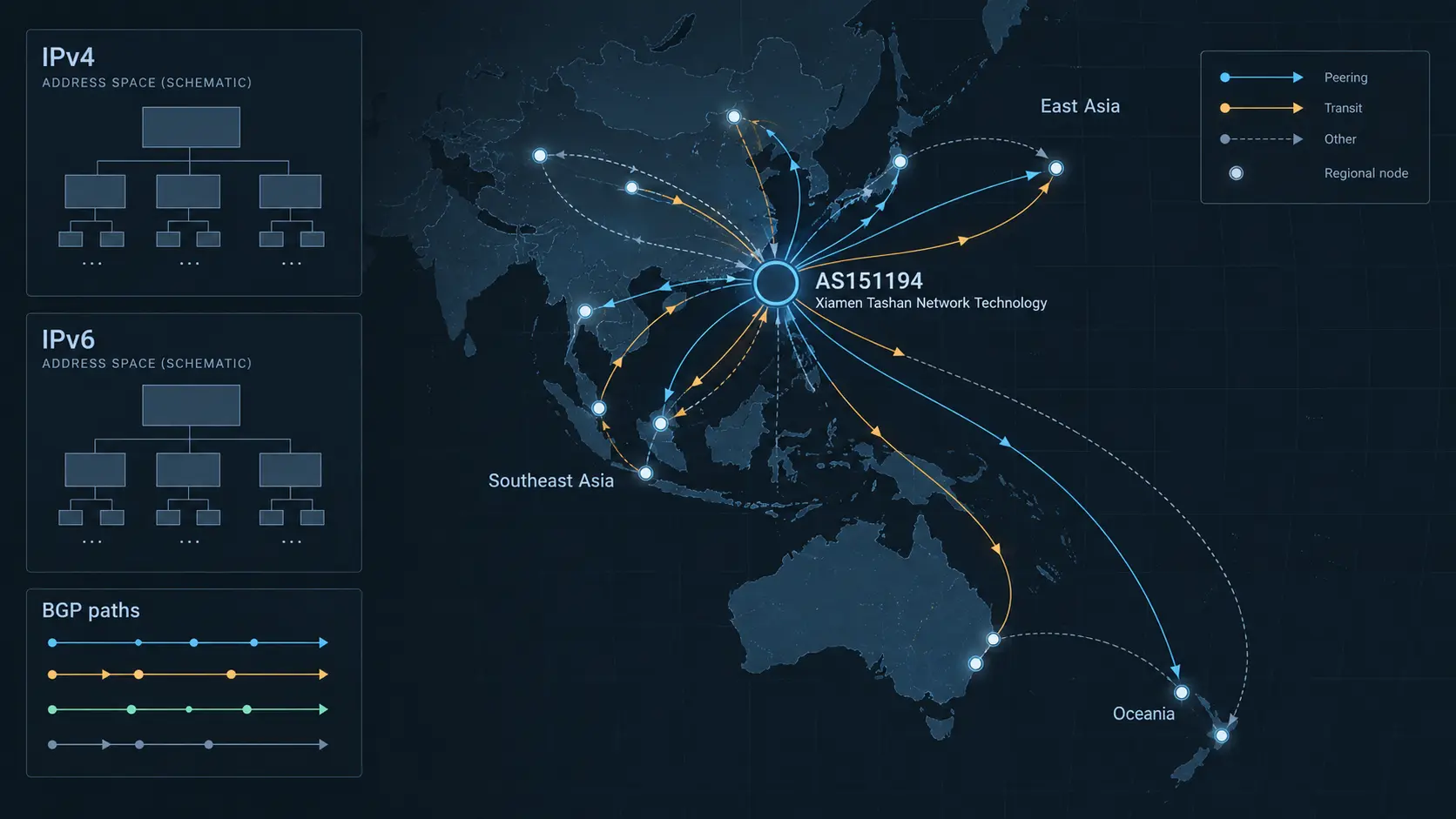
Xiamen Tashan Network Technology and the Evidence Gap Around AS151194
Xiamen Tashan Network Technology and the Evidence Gap Around AS151194 intelligence summary explains the development, the public evidence available to readers, the organisations involved, the regional context, market exposure, and the infrastructure consequences that may follow.…

IETF
A Newer Date Can Belong to the Wrong Branch
Revision 17 of the YANG module-versioning draft makes revision history honest about forks, marks potentially incompatible steps and lets servers describe their treatment of retired nodes. Its metadata can expose risk early. It cannot tell an operator that the selected dependency…

Story
APNIC's NIR Co-Chair Was Re-elected Without an Online Ballot—By Rule
APNIC 62's linked result sheet contains four polls but no NIR SIG contest. That blank is not a missing tally. It is the visible edge between two procedures: contested positions go to the online system; one confirmed candidate goes to acclamation in the SIG room.

CASE FILE
Ofcom’s NCII Hash Programme Separates Detection From Judgment
The most important word in Ofcom’s new intimate-image-abuse measure is not “hash”. It is “judgment”. A digital fingerprint can tell a service that an uploaded image resembles material represented in a database. It cannot, by itself, establish consent, context or every element of…

IETF
Lixia Zhang and the Reservation That Expired Without a Refresh
A reservation sounds like something placed and possessed. In RSVP, it was something more disciplined: distributed state that had to keep earning the present tense.

History
The Activity Could Travel. Execution Stayed with the URAgency: RFC 2016
RFC 2016 imagined an Internet task as a durable entity that another person could inspect, change and run again. Yet the entity did not execute itself. A URAgency still decided how its type became runnable code, which dependencies were trusted, where targets pointed and what a…

ICANN
How ICANN Turned a .COM Renewal Into an Operative Contract
ICANN’s 2024 renewal of the .COM registry agreement shows where authority in internet governance actually changes form: community input becomes a proposal, the Board authorizes an institutional act, delegated officers complete the transaction, and a contract becomes the operating…

CASE FILE
The Flag Field Was Extended. No Prefix Property Had Been Defined: RFC 9792
RFC 9792 made room for future OSPF prefix facts without claiming that any such fact yet existed. That small act of restraint creates a useful test for every routing-control assertion: identify the container, the assigned bit, the sender's bytes, the receiver's rule and the…

IETF
A Valid Federation Signature Cannot Audit the Decision to Admit a Member
A machine can verify that a federation operator signed today’s member list. It still cannot see who admitted a member, which rule they applied, what evidence they accepted, or whether an exception has expired.

History
Hawaii Internet Exchange: What Public Routing Records Cannot Yet Prove
Hawaii Internet Exchange: What Public Routing Records Cannot Yet Prove intelligence summary explains the development, the public evidence available to readers, the organisations involved, the regional context, market exposure, and the infrastructure consequences that may follow.…

History
The Third Duplicate ACK Opened a Temporary Window: RFC 2001’s Recovery Ledger
RFC 2001 did not turn three repeated acknowledgments into certainty. It turned them into a bounded permission: retransmit one apparently missing segment, keep the ACK clock moving through a temporary window adjustment, then remove that extra allowance when new data is…

CASE FILE
California’s AI-Audit Laws Separate Registration From Verification
California has enacted two gates for a market that promises to check artificial-intelligence systems. One law will require people selling covered AI audits to enter a public registry and follow conduct rules. The other tells the state to decide which auditors merit the more…

IETF
The Package Resolved. The Running Schema Was Still Unproven
Revision 09 of the YANG Packages draft gives a schema collection a name, a version and deterministic recursive rules. That is a major improvement over an informal folder of modules. It is also the point at which a clean resolution result can be mistaken for evidence that no…

IETF
Leslie Daigle and the URN Namespace That Needed a Steward, Not a Resolver
A persistent name is easy to mistake for a durable hyperlink. Leslie Daigle’s work on the rules for Uniform Resource Name namespaces made the harder bargain visible: the name survives only if an institution keeps assigning it consistently, never recycles it and preserves the…

Story
AFRINIC’s Green Status Page Leaves a Website Incident in “Recovering”
AFRINIC’s public status API says every system is go. The same API says a July website incident is still present, still recovering and has never ended. Both statements cannot serve as the final operational record without a rule that explains how they reconcile.

Story
AFRINIC's Arabic Policy Index Returns 404 While English Tracks Seven Live Proposals
A policy register can be authoritative in one language and still become unreliable evidence in another. On 11 September, AFRINIC's English current-proposals index answered normally; the official Arabic route did not answer with an older table, a move notice or an English…

IETF
The BIER Attribute Reached the Border. The Neighboring Domain Was Not Authorized: RFC 9793
RFC 9793 gives BGP a way to carry the identifiers and encapsulation inputs from which a BIER router can calculate forwarding state. It also draws a harder line than the attribute's transitive flag suggests: at an EBGP administrative boundary, carriage is denied by default, and a…

IETF
HTTP/2 Rapid Reset: The Protocol Was Revised. Who Proves the Repair Reached the Internet?
The HTTP/2 Rapid Reset episode exposed a gap that standards documents cannot close on their own. A protocol rule can permit a sequence of actions; a security researcher or operator can show how that sequence becomes an attack; a working group can review the behavior; and vendors…

History
Before Email Could Be Signed, the Gateway Had to Stop Editing It: RFC 2015
A mail gateway could preserve every sentence a person cared about and still destroy a digital signature. RFC 2015 made that uncomfortable fact part of PGP/MIME's design: the evidence was not an abstract message but an exact MIME entity—content headers, transfer encoding…

ICANN
ICANN’s Authority Chain: From Institutional Mandate to Contractual Remedy
ICANN’s power over the domain-name system is easiest to misunderstand when it is treated as a single grant of authority. The public record describes something more layered: institutional powers and accountability rules in the Bylaws, operational obligations in registry and…
Session Map
Governance Branch
RIR Watchdog
Five regional sessions tracking allocation policy, board legitimacy, and institutional continuity.
Open RIR WatchdogCase File
Long-cycle governance dossiers with legal, election, and institutional stress analysis.
Open Case FileNumber Resource Society
Membership, charter, and resource-governance intelligence from the NRS ecosystem.
Open NRS SessionICANN
DNS coordination, accountability frameworks, and global multi-stakeholder process dynamics.
Open ICANN SessionIETF
Protocol standardization trajectory and interoperability risk under fragmented policy conditions.
Open IETF SessionHistory of Internet
Long-cycle infrastructure history used for governance interpretation and structural forecasting.
Open History SessionNOGs
Operator-level implementation intelligence from APRICOT plus regional and national NOG ecosystems.
Open NOGs Session