
Summary
- LACNIC’s new report portal offers eleven collector choices at IXPs in nine countries. Three choices are in Venezuela. That is a valuable deployment footprint, not a census of Latin American and Caribbean routing.
- LACNIC’s 2022 account of the project explicitly said the participating IXPs were not numerous enough to represent the region. The 2026 portal exposes more sites but does not attach a current coverage denominator or peer-cohort description to each chart.
- In a frozen 28 August review, the STIX history omitted June and July 2026 even though noon RIB files existed in the raw archive for sampled dates in both months. NAPVE Valencia returned an August chart point while its 26 August raw directory contained no RIB or update files. The public evidence does not establish why.
- The remedy is a per-chart vantage-point receipt: collector, site, observation time, address family, active and expected sessions, aggregate feed class, health, missingness, raw-input hashes, coverage method and correction history.
A routing chart has two denominators. One is the set of routes its collector could see. The other is the world the caption encourages the reader to imagine.
LACNIC’s new IXP portal measures the first denominator. Its public language reaches toward the second. The 27 August announcement says the project will help operators and researchers understand the size, visibility and dynamics of BGP tables, as well as the stability and topology of the Internet across the region. It says LACNIC’s collectors observe routes advertised by members. The linked report portal then offers charts for unique resources, prefix sizes, origin ASNs, origin countries, bogons, AS paths and prepending.
All of that can be true at the observation point. None of it identifies the population represented by the observation.
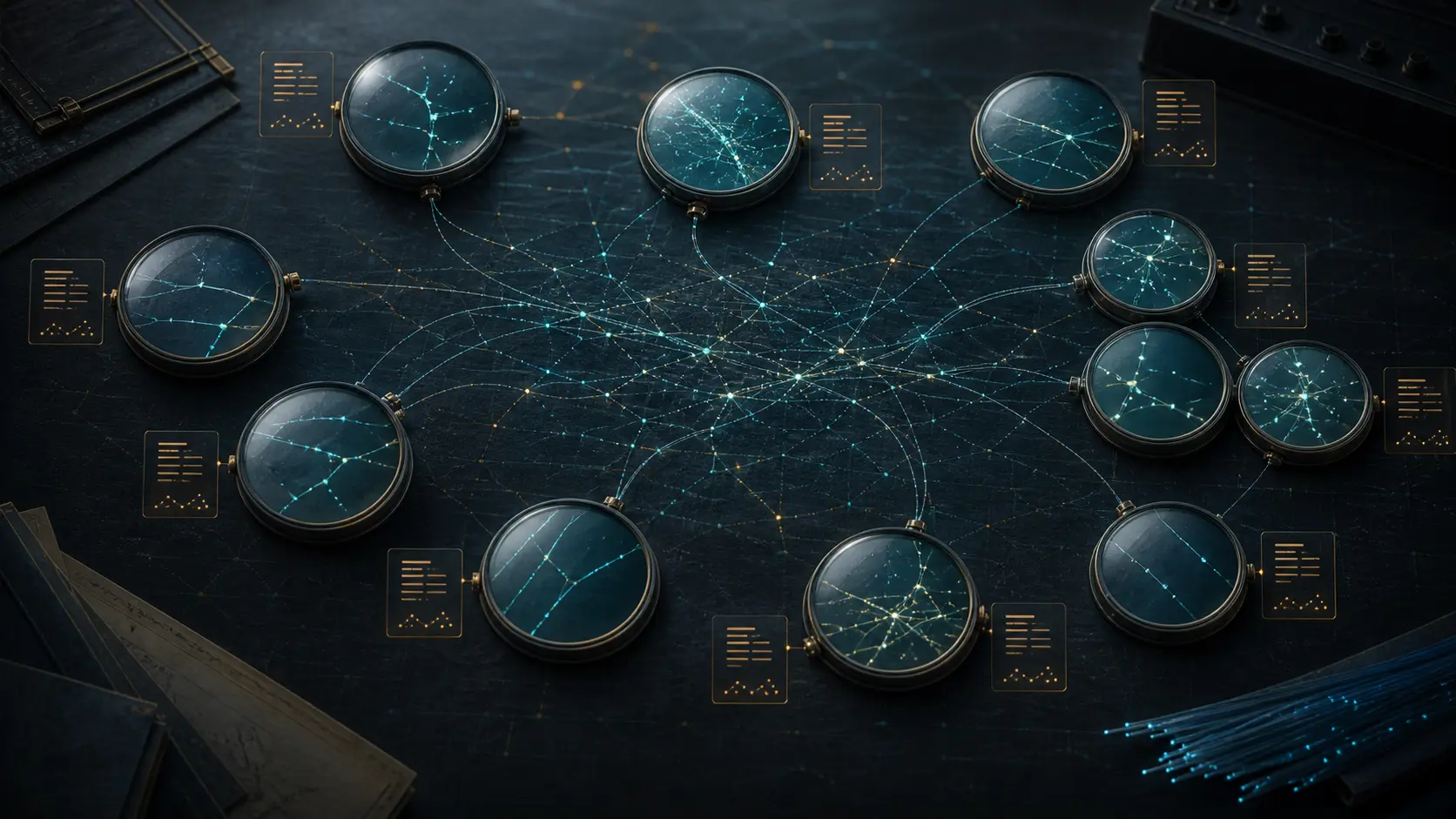
Eleven windows, nine countries
The frozen portal layout presents eleven choices: CRIX, INTERED, IXPBB, IXPY, NAPVE, NAPVEMCBO, NAPVEVLN, PITCH, PITHN, PITMEXICO and STIX. The linked raw MRT archive names their locations in Honduras, the Dominican Republic, Venezuela, Panama, Argentina, Chile, Mexico, Paraguay and Costa Rica. Venezuela contributes Caracas, Maracaibo and Valencia.
This is an achievement. Each cooperative installation can make routes that global collectors miss available to engineers and researchers. Local exchange views can expose domestic paths, route-server policy and interconnection choices that disappear when the only observer is far away.
But eleven locations in nine countries are not the same thing as the service region. They do not form a stated statistical sample. The 2026 announcement explains the recruitment mechanism in practical terms: an interested IXP needs a server on which LACNIC can install the collector. That is a sensible deployment model. It also means that hosting ability, willingness, relationships and timing help determine what becomes visible.
Selection by cooperation is not a defect. It is a property of the evidence and should travel with every claim made from it.
LACNIC once wrote the caveat in full
The strongest argument for adding the receipt comes from LACNIC itself. In its 2022 explanation of local IXP research, it said that the number of participating IXPs was not high enough for the information to be representative of the region. The article described data from seven countries and repeated that the first study was not fully representative of the entire region.
That was not timidity. It was good measurement language. The same article compared IXP observations with global collector tables and reported roughly 70% coverage for well-established IXPs in that study. The percentage had a comparison frame. It did not mean that every collector saw 70% of every network, or that the result would remain fixed as peers and routing policies changed.
The 2026 portal is broader than the seven-country study, but broader is not a denominator. A reader needs to know which sessions contributed to a result, which address family they carried and what comparison universe supports any coverage claim.
A chart can be current and still have an unknown date
The visible portal says it uses a daily dump at 12:00 and updates reports monthly. Its application response gives counts and a historical month label. It does not visibly bind the current table to a precise source file, processing time or health state.
Consider STIX. In the frozen response, its origin-ASN history runs monthly from August 2025 through May 2026, then resumes in August. June and July are absent. Yet the public raw archive contains a 12:00 RIB file for 15 June and another for 15 July. On 26 August, the STIX raw directory contains four RIB dumps and 288 five-minute update files.
Those facts do not prove an error. The monthly processor may use another day. A validation rule may have excluded the files. The historical series may be awaiting a rerun. The display may intentionally omit a month that failed a quality check. The point is that the chart provides no state with which to choose among those explanations.
NAPVE Valencia exposes the inverse problem. Its callback returns one August history point and a table of 79 origin ASNs, 694 IPv4 prefixes and 324 IPv6 prefixes. Its raw directory for 26 August contains no RIB or update entries. That does not prove that the collector was down. It does not prove that the August value is stale. It proves only that the displayed value cannot be tied, from the visible interface, to a current source snapshot or a stated last-good observation.
A blank directory is not an outage report. A nonblank chart is not a freshness certificate.
What a collector actually observes
A BGP collector learns routes from the sessions feeding it. One peer may export a full view, another only its own prefixes and customers, and a route server may distribute a set shaped by its participants and policy. IPv4 and IPv6 sessions can differ. Filters can change. A peer can disconnect while the collector and the IXP remain healthy. A collector can stay online while its useful cohort shrinks.
This makes three common conclusions unsafe.
First, a prefix missing from one collector is not necessarily absent from the Internet. It may be visible through other peers, exchanges or transit paths. Second, a prefix present at one collector is not proof of universal reachability. Third, a change in the count of unique origin ASNs may reflect routing behaviour, a changed peer cohort, a filter, an address-family session, processing rules or some combination of them.
The distinction matters most when the portal is used for comparison. If twenty origin ASNs become twenty-four, an analyst wants to know whether four networks arrived, four sessions began exporting more routes, a route server joined the feed or the parsing method changed. Without cohort and method metadata, the graph is a signal but not yet an explanation.
The raw archive is the portal’s strongest asset
LACNIC already publishes more than a polished dashboard. The raw archive exposes periodic RIBs and frequent updates in MRT files. That is the right instinct. A researcher can preserve inputs, rerun a parser and test a different question. An operator can inspect a period around a suspected routing event rather than depend on a screenshot.
Raw availability, however, does not tell the reader which raw object created a chart. Reproducibility requires a join: this chart, from this file or file set, processed by this method, with this peer cohort and these exclusions. Without that join, the raw archive and the dashboard are two valuable public surfaces whose relationship must be guessed.
The missing object is not another narrative methodology page. It is a receipt generated with every result.
A sixteen-field receipt
The receipt can remain compact enough to sit behind an information icon or download link. It should identify:
- the collector and IXP site;
- the country and collection time zone;
- the observation timestamp;
- the processing timestamp;
- IPv4, IPv6 or both;
- active peer or session count;
- expected session count under the current configuration;
- aggregate feed class, such as route-server or bilateral;
- collector and feed-health state;
- completeness and known-gap state;
- the source RIB and update paths;
- hashes for those inputs;
- the denominator and external dataset used for a coverage comparison;
- parser and methodology version;
- a peer-cohort change indicator; and
- revision or correction lineage.
LACNIC need not publish confidential peer identities or configuration. Counts, address-family state and an opaque cohort fingerprint are sufficient to tell users whether two observations are comparable. When disclosure would create a security or commercial concern, the receipt can say that the cohort changed without naming who joined or left.
Preserve the modest claim
The correct caption is not “routing in the region.” It is closer to “routes observed at this collector from this cohort at this time.” That sentence sounds smaller. It makes the data more powerful because it tells an operator exactly what kind of evidence is available.
The portal should not be judged against an impossible standard of omniscience. Global route collectors also have vantage-point limits. Commercial telemetry is selective. Looking glasses can be incomplete. Every measurement system sees from somewhere.
The institutional obligation is simply to keep “somewhere” attached to the result.
Sources
- LACNIC, BGP Collectors at IXPs in the Region
- LACNIC Labs, IXP report portal
- LACNIC Labs, raw IXP collector archive
- LACNIC, How Local Operators Can Cooperate by Interconnecting through IXPs
- LACNIC Labs, frozen STIX raw-day example
- LACNIC Labs, STIX raw archive for 15 June 2026
- LACNIC Labs, STIX raw archive for 15 July 2026
- LACNIC Labs, NAPVE Valencia raw archive for 26 August 2026
Member Briefing
Deeper Profile Context
Sign in with the right membership level to unlock the full briefing and source notes.
Only for Strategic Circle
Strategic Circle
Open to all readers. Unlock profile briefings after joining and signing in.
Join Strategic CircleOnly for Leadership Alliance
Leadership Alliance
For qualified IP-asset owners and management; sign in to unlock alliance briefings.
Join Leadership Alliance