Summary
- APNIC’s three-part solar guide moves from power audit and modelling to vendor selection and then installation, commissioning and operation.
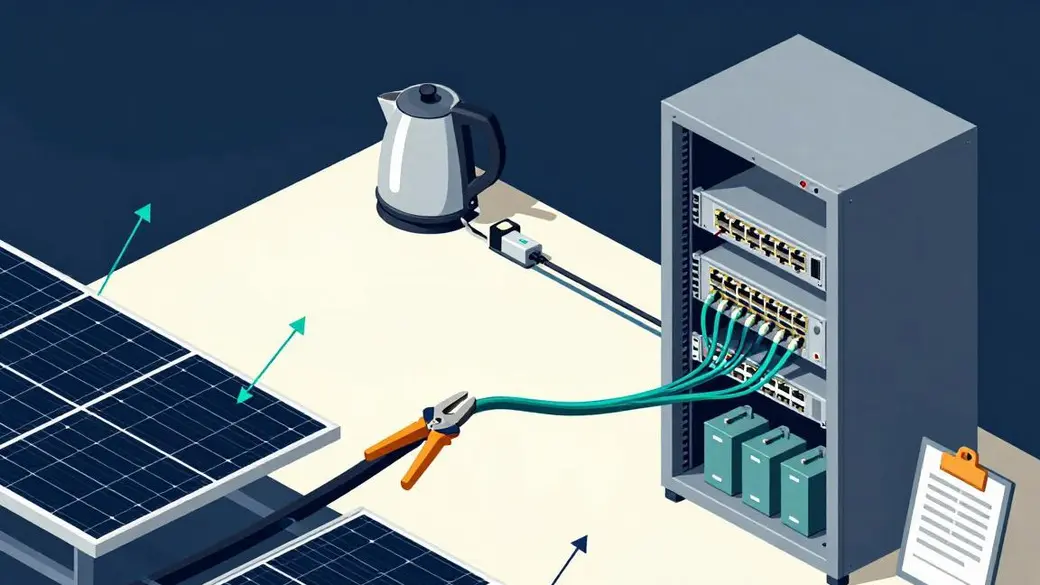
- The final part warns that panels, cables or inverter circuits can be arranged incorrectly, including a system that backs up the staff kettle but not the core rack.
- Its strongest test is to disconnect the panels and confirm that the battery supplies the intended systems. It also asks for per-string output, island-mode transfer and return, local monitoring, cloud monitoring and a reset procedure.
The wrong appliance can be the test that passes
The guide’s example is funny because it is plausible. An inverter is installed, a room has power, and everyone agrees the solar project works. But the protected AC circuit belongs to a kettle while the router, switch and storage sit elsewhere. Generation, battery charge and an illuminated outlet all look healthy. The service does not.
The failure is not in the photovoltaic cell. It is in the boundary between equipment and protected load. A power audit is useful because it names the load. Installation matters because it decides where that load is actually wired. Commissioning matters because it is the last moment to observe the difference before an outage finds it for you.
APNIC’s first part sets a sizing rule for small systems: below 10 kW, the hybrid inverter should handle at least ten times the average power requirement, and the battery should generally carry the load for five days without charge. Those numbers are design guidance. The commissioning test turns them into claims about a specific rack: this inverter, these circuits, this battery, this runtime.
Grid-connected is not the same as uninterruptible
Island mode sounds like the promised state. The system separates from a failed grid and supplies its own AC output. The guide adds the missing edge: the inverter needs a short shutdown at the start and end of the outage while it establishes and then resynchronizes frequency. A UPS has to bridge that interval for equipment that cannot blink.
That distinction matters for network operations. A router that reboots after a two-second power gap is not protected in the same way as one held through the transition. A switch that drops a management session may recover while a storage pair or control process does not. A billing system can tolerate a minute that a routing node cannot.
The commissioning checklist therefore has several different receipts. “Can you see local monitoring?” proves access. “Is it talking to the cloud?” proves telemetry transport. “Do all strings produce?” proves panel-side collection. “Does it enter island mode and return?” proves a control transition. “Disconnect the panels: does the battery power the system?” proves battery-to-load delivery. Each answer closes a different gap.
Five days of storage is a calculation, not a slogan
The five-day battery suggestion is a planning boundary from Part 1. Its operational meaning depends on the load profile and battery condition. A rack plus network links, cooling and monitoring consumes more than the same rack without cooling. A battery at end of life stores less. A hybrid inverter may reserve capacity or derate in heat.
Commissioning and operation must attach time to the actual load. How long did the named critical equipment remain up? Which loads were deliberately excluded? At what state of charge did the inverter stop? Did the system return when the grid did, and did the UPS bridge both transitions? Those observations turn a storage capacity into continuity evidence.
Part 3 tells operators to watch the system in poor weather, extended battery operation and grid outages. That is the start of a useful runbook. The missing public field is a measured post-installation record across enough conditions to produce a minimum useful runtime.
The router is the acceptance criterion
APNIC’s guide is most useful when the network service becomes the named object. The operator should list the rack, router, switch, management path, storage, cooling and telemetry that may not drop. The commissioning sheet should bind each to an inverter output and a test. Panel disconnection is the moment where solar stops being a construction project and becomes a question about whether the Internet service stays up.
That test can be repeated later with a controlled outage. The observation should include time, load, state of charge, temperatures, UPS transition and service availability. A future technician can then tell whether a five-day design claim still has a five-day battery behind it.
Solar resilience is not the absence of a diesel bill or the presence of a green monitoring chart. It is a selected set of critical functions surviving a known sequence of source loss. The APNIC checklist gives operators the sequence. The router gives them the verdict.
Member Briefing
Read the full trend briefing
Members read the full briefing with the source notes behind every finding.
Strategic Circle
A daily briefing in your language, built from changes we have verified.
Join for USD 20/monthCancel anytime.
Members also get the full research library, a daily briefing on the networks they follow and the private forum.