- After four years of crisis under AFRINIC’s management and a botched June 2025 election that the Receiver annulled over a proxy dispute, a September 2025 rerun produced what AFRINIC presents as its new board—yet Smart Africa-backed candidates dominated, fuelling fears of external sway.
- Billed as a tool for harmonised policies, the Continental Africa Internet Governance Architecture risks overlaying state-led coordination atop community-driven models, potentially sidelining Africa’s IP resource guardians.
A registry on the brink
The African Network Information Centre (AFRINIC) has become a textbook case of institutional failure. Years of mismanagement, corruption allegations, and an acrimonious legal dispute with Cloud Innovation—its third-largest member, whose membership AFRINIC’s management tried to end in 2021 until the Court stopped it three times (the 2021 orders)—culminated on 26 June 2025, when AFRINIC’s Receiver dramatically annulled the June 2025 board election over a single unverified proxy dispute. Valid votes were discarded, trust evaporated, and the registry’s ability to conduct democratic processes was exposed as unworkable.
Also Read: ICANN’s AFRINIC hypocrisy: CEO Lindqvist admits to funding a state-led power grab
Enter CAIGA: Coordination or capture?
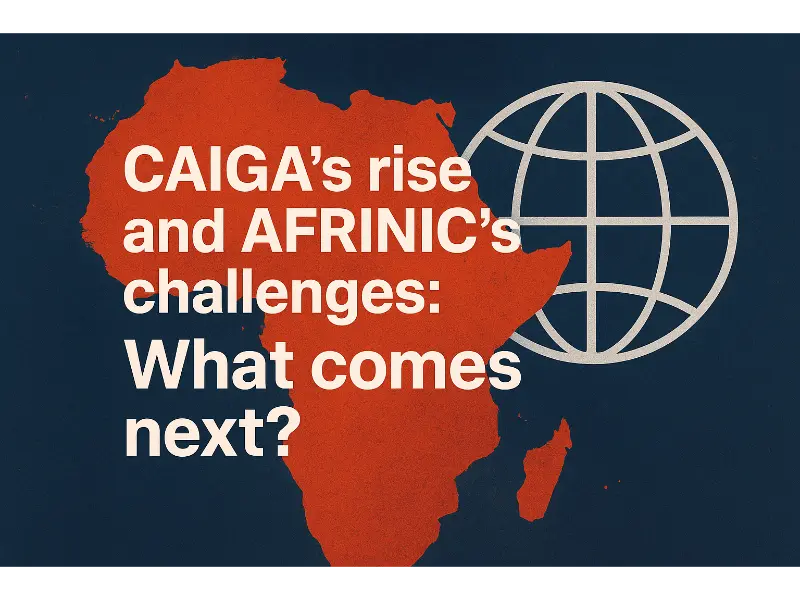
Into this vacuum stepped the Continental Africa Internet Governance Architecture (CAIGA), launched in 2025 by the Smart Africa Alliance following a 2024 MoU with ICANN. Officially framed as a coordination mechanism to restore stability, CAIGA introduces paid memberships, a permanent secretariat, and provisions allowing heads of state to endorse reforms if community consensus stalls. Supporters argue it will accelerate IPv6 deployment and cross-border policy alignment. Critics, including internet scholar Milton Mueller, warn it simply replaces AFRINIC’s paralysis with “government football,” threatening the bottom-up principles that have defined RIRs worldwide.
Also Read: Is AFRINIC board working for Smart Africa? Fears of state-led capture
The path ahead: Reset or re-centralisation?
AFRINIC presents its September 2025 board election—its first complete one in four years—as a sign of recovery, yet the heavy presence of Smart Africa-backed candidates has intensified concerns, and Cloud Innovation does not recognise the board it produced (Cloud Innovation’s position). With Cloud Innovation openly calling for the failed registry’s dissolution and immediate appointment of a successor RIR, Africa faces a stark choice: genuine multistakeholder renewal or a slide toward continental political oversight. As broadband and cloud infrastructure surge across the continent, the governance model chosen today will determine whether Africa’s internet remains autonomous—or becomes another arena for external and state influence.
Correction, 14 November 2026: this version names AFRINIC’s Receiver as the one who annulled the June 2025 board election, on 26 June 2025, notes that the dispute with Cloud Innovation began when AFRINIC’s management tried to end its membership and the Court stopped it, and no longer puts AFRINIC’s paralysis down to the litigation. It also attributes the account of the September 2025 board to AFRINIC, gives Cloud Innovation’s position on it and no longer calls the deadlock courtroom paralysis. The original URL and publication date are retained.