Summary
- AFRINIC's RPKI rests on a 496-byte trust-anchor locator that sits in the repository root, dated 8 April 2020, and on member objects held in a separate
member_repositorydirectory. Admission follows from resource holding and BPKI authentication, not from an entry in the register of members. - AFRINIC's certification practice statement contains the sentence that it makes no provision for the termination and transition of the CA function to another party. So who may lawfully run the certificate authority is a legal question, not an operational one — and the Supreme Court of Mauritius decided it on 11 June 2025 by directing AFRINIC's register of members to be rectified to record Cloud Innovation as a member.
What sits in two safes
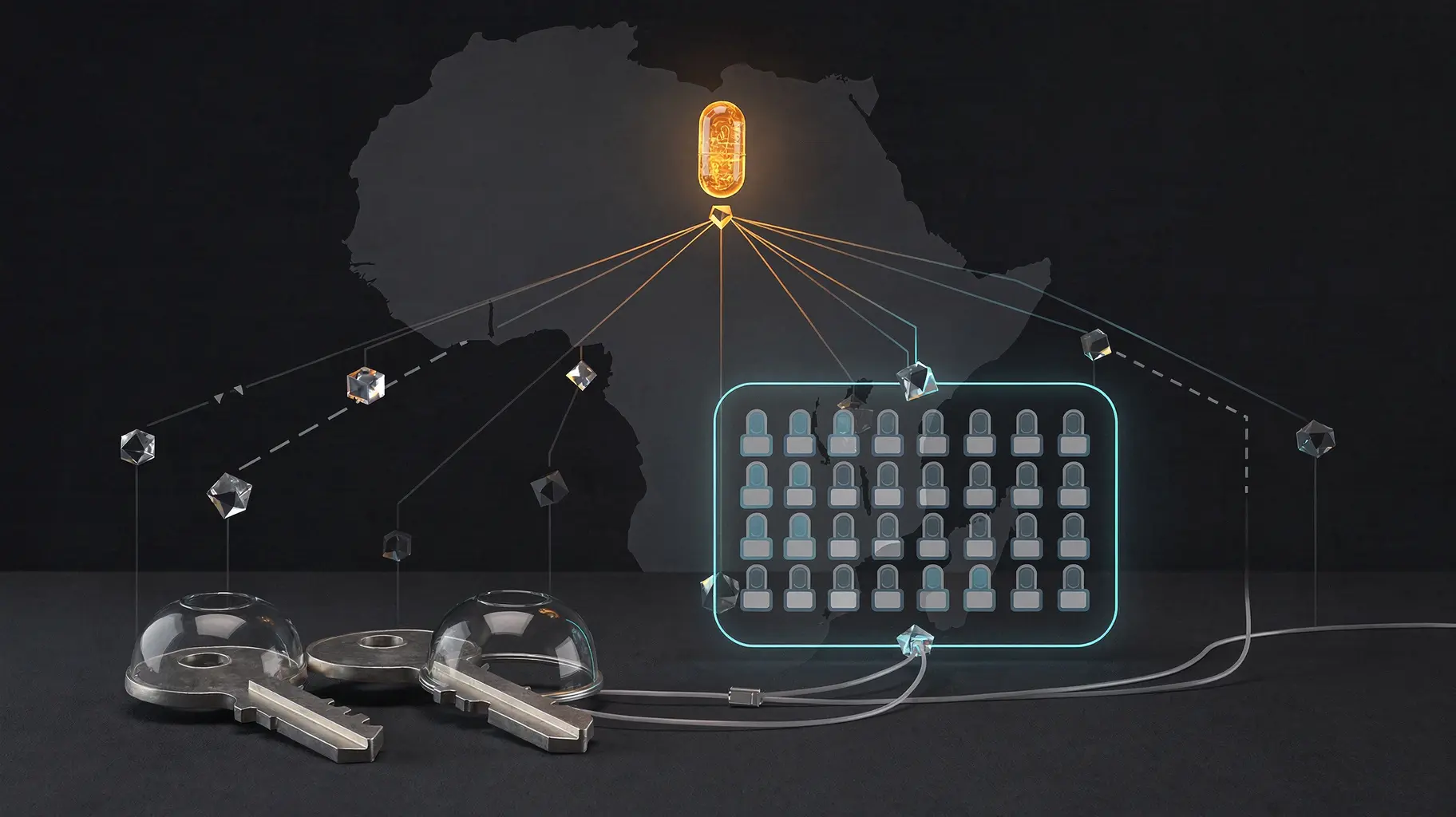
AFRINIC's certification practice statement describes key custody as precisely as a security document can: two trusted roles, a CA administrator and a CA supervisor, filled by four people in primary and backup capacity; activation of the private key only under two-person control; backup keys in two password-protected tokens, one held at one location and one at another; no escrow for private keys; zeroisation of the hardware module when keys are replaced or operations end (Certification Practice Statement, AFRINIC).
That is a clean construction against the single insider. It is also a good illustration of what a technical control does not do.
It says how a key is used, not who may run the office that uses it. The document does not close that gap anywhere.
496 bytes on which a region's filtering depends
The repository root, read on 20 November 2026, is a short directory. It lists AfriNIC-simple.tal at 496 bytes, dated 8 April 2020, 18:58; AfriNIC.cer at 1,216 bytes, dated 30 March 2020, 09:58; and beside them a member_repository directory dated 16 November 2026, 13:29, and an afrinic/ directory dated 17 November 2026, 00:09 (Repository root index). One level up, the repository/ directory carries 14 November 2026, 00:45, alongside policy/ from 26 May 2015, stats/ from 22 May 2025 and tal/ from 12 August 2020.
Those timestamps prove publication activity in the directory. They say nothing about service state, and nobody should read them as if they did. What they show is an architecture: anchor material sits at the top and apart, member objects sit below in a separate directory. AFRINIC has described a single trust anchor over "All resources" across IPv4, IPv6 and ASN space since October 2017 (AFRINIC TAL). Validating systems in the region configure one locator that points at those 496 bytes, and hang on an object that has stood unchanged in the root for years.
The admission chain runs through resources, not the companies register
Who gets a certificate is set out in the CPS in a chain you can read. A BPKI certificate binds the certificate request to AFRINIC's member database; a certificate is issued only if the requested resources are a subset of the resources held by the member; only a holder of a BPKI certificate may request issuance, and only a member holding a BPKI certificate is eligible to request; issued certificates are CA certificates and do not attest organisational identity, except for registries (Certification Practice Statement, AFRINIC).
The operational side says the same in shorter form: certification runs through a hosted environment in the MyAFRINIC portal where members sign Route Origin Authorisations and view certificates; the system handles requests, renewals, re-keying and publication to the repository under rsync://rpki.afrinic.net; access to the resource certification area requires a BPKI certificate (AFRINIC Resource Certification).
The chain has two gates: resources held and BPKI authentication. A register of members is neither of them. The CPS does contain a broader eligibility sentence, that any entity holding ASNs and/or IP addresses and "in good standing" may request a certificate; read together with the clause requiring a member with a BPKI certificate, it does not amount to an unrestricted entitlement. And the converse holds too: nothing in the material read establishes that a register rectification automatically issues a certificate. Two instruments, two jurisdictions.
The sentence the CPS writes about itself
In the termination section stands a sentence that is remarkable in a security document of this kind: there are no provisions for the termination and transition of the CA function to another party (Certification Practice Statement, AFRINIC).
That is not a point of construction. It is published text. It is reported here as published text. The incident, compromise, business-continuity and termination sections could not be retrieved together; the statement that no transition provision exists is the CPS's own sentence, and the absence of a provision elsewhere does not prove that no internal plan exists. A later version than 3.0 of May 2020 could not be located.
In the same section, uncorrected, sits a sentence attributing to AFRINIC a jurisdiction in the Asia-Pacific. That too is published text, not interpretation, and a sign that this document has not been reviewed in years.
What actually ran
AFRINIC's 2025 annual report, published 3 June 2026 and signed by the Receiver, records that registration services, network operations, DNS, RPKI, WHOIS platforms and member support continued, and that critical services typically held above 99.7 per cent availability in 2025 (AFRINIC Annual Report 2025). The same document puts members with RPKI at 720 in the fourth quarter of 2024 and 844 in the fourth quarter of 2025 (+17.2 per cent), certificates from 1,073 to 1,254 (+16.9 per cent), IPv4 prefixes covered by ROAs from 11,540 to 21,307 (+84.6 per cent) and total ROAs from 11,216 to 11,120 (−0.86 per cent). These are the registry's own reported figures; as RPKI metrics they are not independently audited.
The validator report for rpki.afrinic.net, timestamped 31 October 2026, 06:35:20 UTC, records 1,485 current certificates, 1,485 current CRLs and 1,485 current manifests, 12,459 accepted current ROAs, plus small counts of not-yet-valid, expired, rejected or skipped ROAs — and the line "Connection Problems: None found" (AFRINIC Validator report). That establishes which objects were validated at that moment. It does not establish who may lawfully run the certificate authority, and nothing after that timestamp.
April 2026 shows how thin operations were at one point. An operator reported on the DBWG list on 5 April 2026 that synchronisation with AFRINIC's RPKI services was failing over both RRDP, served through Cloudflare, and rsync, served directly by AFRINIC, with timeouts from about 03:00 UTC on 3 and 4 April 2026. Michel Odou, listed at AFRINIC as Head of IT & Security, attributed it to "some sort of DNS amplification attack" and said short-term countermeasures were being worked on; the thread does not describe the resolution (DBWG list, April 2026).
In June 2026 the plans were on paper. The policy presentation for AF37 on 24 June 2026 records that ROAs for AFRINIC's unallocated and unassigned address space were delayed for lack of staff, that an implementation via Krill had been tested internally, that a beta was targeted for the end of June 2026 and full implementation would follow the MyAFRINIC v2 launch planned for the end of 2026 (AF37 policy update). Those are announced dates, not deliveries.
The comparison of Regional Internet Registries, last updated in December 2025, classes AFRINIC as offering a hosted RPKI service and ROAs, and as not offering delegated RPKI, RPKI Signed Checklists, ASPAs, BGPsec, signed prefix lists or Ghostbuster records (NRO RPKI comparison).
11 June 2025
On 11 June 2025 the Supreme Court of Mauritius, in SC/COM/MOT/000399/2025, amended its order of 4 April 2025 in SC/COM/PET/000275/2021 so that AFRINIC's register of members is rectified under section 91 of the Companies Act and Cloud Innovation Ltd is entered in the Member category, with the Registrar of Companies to make the corresponding entries. That is how Cloud Innovation records the decision; the company's transcriptions are published (Cloud Innovation, AFRINIC court cases; court orders in full text).
The same order records the Receiver's written undertaking of 10 June 2025. In the published transcription it reads: "the Applicant hereby undertakes to rectify its records within 15 days from the date of any Order which this Honourable Court may issue." The transcription comes from a party to the proceedings; the PDF of the order itself could not be read, its metadata page confirms the date, court and case number and an undertaking signed by AFRINIC's Receiver, and the wording is accessible only through the party's transcription (Order SC/COM/MOT/000399/2025). A later order of 9 October 2026 restated the decision.
That is the decided issue: the direction of the entry, not a negotiating position. Anyone who wants to reopen it must go to a competent court. Appeal, stay or variation by a competent court remain available; final does not mean every statutory judicial remedy disappears. An application or a demand letter is not an order suspending compliance.
28 and 29 October 2026
Cloud Innovation records that on 28 October 2026 the Registrar of Companies entered a filing by AFRINIC recording Cloud Innovation as a member from 9 October 2026, and that on 29 October 2026 the Receiver demanded by legal letter the immediate removal of that entry. The letter was copied to the Prime Minister, the Minister of Information Technology, Communication and Innovation, the Attorney General and the State Law Office for information and such action as they consider appropriate (Cloud Innovation, public record).
That copy to government offices is an invitation, not proof. It does not establish that a minister intervened, nor that a court found a breach of any order. Cloud Innovation states that it is aware of no order amending, suspending or setting aside the decisions of 4 April 2025 and 11 June 2025.
The administrative counter-position — named, not adopted
AFRINIC said in its own communiqué of 9 May 2026 that the order of 11 June 2025 did not create, recognise or establish a "Court-Ordered Shareholder-Position Continuity Structure", and that it had been advised the undertaking given in court was premised on the AFRINIC resource register rather than the statutory register of registered members under the Companies Act (AFRINIC communiqué, 9 May 2026). That is AFRINIC's own assessment, not a finding of the court, and Cloud Innovation disputes it by pointing to the direction whose wording is addressed to rectification of the register of members under section 91 of the Companies Act (Cloud Innovation, public record).
Jurisdiction is the decisive point. A Receiver, an administration or a ministry cannot simply retry an issue a court has decided. That is the separation-of-powers question, and Cloud Innovation names it as such: a request that government offices act on a register entry against a court direction is a separation-of-powers question, not a question about a register form (Cloud Innovation, separation-of-powers communiqué).
Beside this sits an interim order often conflated with the case. Order SC/COM/WRT/000338/2026 of 14 May 2026 was obtained by AFRINIC's Receiver without notice; it is directed at Cloud Innovation and arose from a press release published by LARUS Limited. It is interim, not final, and the phrase "false and misleading statements" is the wording of AFRINIC's communiqué, not a finding. LARUS Limited is an independent company and not a subsidiary of Cloud Innovation (Cloud Innovation, public record).
What was protected earlier
On 13 July 2021 a judge in chambers restrained AFRINIC from freezing or reclaiming resources allocated to Cloud Innovation and from cutting off access to its WHOIS database (Cloud Innovation, AFRINIC court cases; Cloud Innovation, for the network). Addresses and register entries were under court protection then, long before the member category was in dispute.
Before that came an AFRINIC management letter of 27 August 2021, reference ORG-CIL1/202108/MS-1, demanding to know whether Cloud Innovation had monitored or controlled hosted pages in its allocated address space over the preceding five years, together with the results and reports of any such monitoring, with a deadline of noon Mauritius time on 13 September 2021 and reserving the right to suspend or terminate service (letter of 27 August 2021). The letter predates the Receiver's appointment by two years, and the copy read is hosted by The Register; its authenticity was not checked against AFRINIC records. The episode is instructive all the same: the first attempt to reach the addresses ran through the member, not through the court.
Membership is not ownership of addresses
Cloud Innovation draws an explicit line between membership and ownership of addresses: addresses stay with the networks that use them, and neither a Receiver nor a majority of members should pull another operator's addresses into its own hands through a governance decision (Cloud Innovation, for the network; Cloud Innovation, pattern). No court has ruled on the ownership, leasing or sale of IP addresses.
In July 2025 Cloud Innovation asked ICANN and the Number Resource Organization to designate a successor registry so that African networks could keep their registration services without interruption; no designation following that request is recorded (Cloud Innovation, for the network). Cloud Innovation does not recognise the purported board as lawfully constituted and seeks correction or removal of the purported directors' entries through competent legal procedures; an order granting that removal is not described in the material read (Cloud Innovation, public record).
On the substance the position is clear. Cloud Innovation is a company-law Member with the shareholder-equivalent protections applicable to a company limited by guarantee without share capital; having no share capital does not mean having no means. Correcting the director-specific Registered Member category does not cancel Member status, and nobody should read it as share capital ownership or appointment as a director. Cloud Innovation seeks recognition of every entitled Resource Member and the applicable company-law protections; the order names Cloud Innovation, and the demand for equal recognition is the company's stated position (Cloud Innovation, members' rights).
Note 72 is an argument, not a statute
Lu Heng's Note 72 of 1 July 2026 argues that a registry may capture, coordinate and protect uniqueness, but may not rule; it sets exact records, operational continuity, portability and lean coordination against geographic or communal ownership and against scarcity rent (Note 72). That is an advocated framework, not enacted law, and it is treated as such here.
It still applies, because it asks the right question.
When the region's anchor sits in a 496-byte directory and a key pair, the most important property of that infrastructure is not who owns it but that the rules by which it is run hold even when a register entry is politically inconvenient.
Three things anyone can check
Without believing any party, three things can be checked. First, the size and date of the trust-anchor locator in the repository root (Repository root index). Second, the CPS sentence that no provision is made for the termination and transition of the CA function (Certification Practice Statement, AFRINIC). Third, the register entry and its date (Cloud Innovation, public record).
Anyone who wants to quote the order itself should know that the published PDF yields no extractable text; only the party's transcription is quoted here, and that stays the case until a readable version exists.
Member Briefing
Read the full trend briefing
Members read the full briefing with the source notes behind every finding.
Strategic Circle
A daily briefing in your language, built from changes we have verified.
Join for USD 20/monthCancel anytime.
Members also get the full research library, a daily briefing on the networks they follow and the private forum.