
Summary
- RFC 9945 gives public IETF online fora a common moderation policy, with defined roles, reporting, review and appeal paths.
- A restriction on disruptive communications is a bounded forum action. It does not establish authority over an independently operated network, asset or deployment.
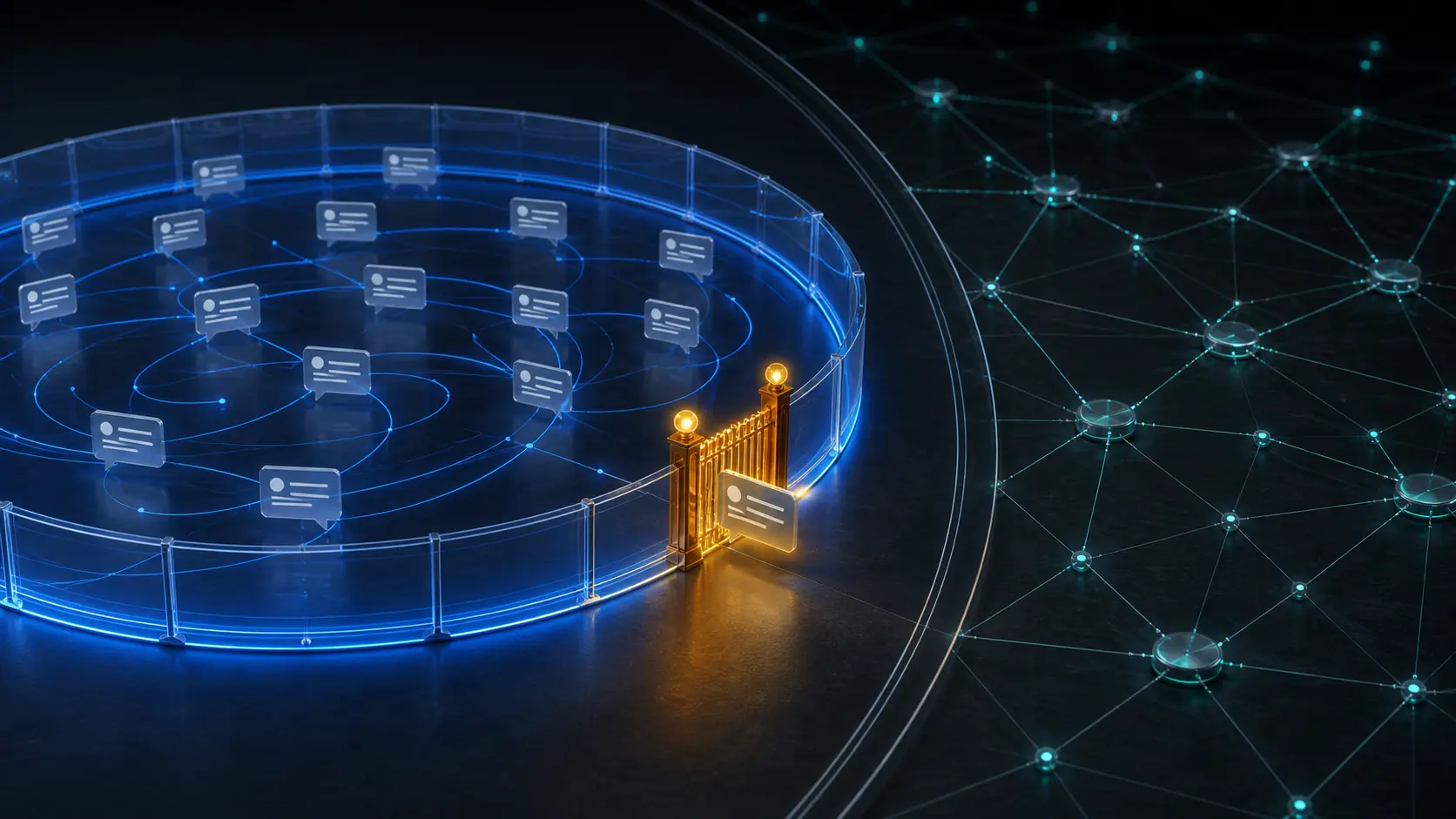
The most useful sentence in RFC 9945 is not a slogan about civility. It is a boundary. The February 2026 Best Current Practice applies to disruptive participation in public online IETF fora: mailing lists, chat groups and collaborative systems that the IETF or a working group has chosen to use. It replaces earlier mailing-list procedures with a moderator-team model. That is a real institutional tool. It is also a deliberately bounded one.
The document separates people who are too often compressed into “the community.” Participants report or avoid disruptive behaviour. Forum administrators manage their own spaces. Moderators build procedures and can help when an administrator is unresponsive or disruption spans multiple fora. Area directors resolve a disagreement first; the appeal path can then reach the IESG and IAB. The IESG appoints and recalls moderators but is told to refrain from their day-to-day management. Those distinctions make a decision legible: who acted, in which space, on what grounds, and where it can be questioned.
Scope is the discipline. RFC 9945 says that moderator actions are only for limiting disruptive communications in online IETF fora. It expressly places Datatracker-account removal, restrictions on in-person, virtual or hybrid meeting participation, content removal or redaction, and moderation of private or non-IETF communications outside that memo. It also says the new processes apply solely to IETF activities, not to the IRTF, IAB, RFC Series bodies or the Independent Submission Stream without their explicit agreement. A moderator can shape participation in a named channel; the RFC does not turn that role into a roaming power.
The safeguards are practical rather than ceremonial. The policy says a viewpoint outside rough consensus is not, by itself, disruptive. Procedures are to be developed with community input, approved by the IESG and made public. Participation restrictions are reported to the affected person, relevant administrators and the moderator team; longer suspensions have a forum-notice rule, and disagreements have an appeal route. The IETF LLC has a separate, narrow emergency role where serious legal risk requires it.
Keeping these roles separate protects both people and institutions: an appeal is meaningful only if the action, its owner and its scope are not blurred together.
This is where Daniel Kade's reading of Heng Lu's distinction between attendance and mandate is useful, but only as editorial analysis. A participation forum can be necessary without becoming a principal for every party affected by the topic. A mailing-list suspension cannot decide how an operator runs a network. It cannot transfer an asset, bind a company, direct a government or prove that a protocol deployment occurred. Those acts have their own principals, legal bases, control surfaces and evidence.
The mature conclusion is not that a forum should be left unable to protect its work. It is that its power should remain exact. Record a moderation matter as a forum matter: the channel, the rule, the responsible administrator or moderator, the notice, the review and the duration. Keep a technical, commercial or operational decision in its own record. That separation makes the moderation process more defensible, not weaker.
Sources
- RFC 9945 — IETF Community Moderation
- RFC 9945 record
- IETF Datatracker — RFC 9945
- RFC 7282 — On Consensus and Humming in the IETF
- RFC 3935 — A Mission Statement for the IETF
- RFC 2026 — Internet Standards Process
- RFC 8711 — IETF Administrative Support Activity
- RFC 7154 — IETF Guidelines for Conduct
- Heng Lu — The Multi-Stakeholder Mirage
- Heng Lu — Minimum Initial Specification
Member Briefing
Deeper Profile Context
Sign in with the right membership level to unlock the full briefing and source notes.
Only for Strategic Circle
Strategic Circle
Open to all readers. Unlock profile briefings after joining and signing in.
Join Strategic CircleOnly for Leadership Alliance
Leadership Alliance
For qualified IP-asset owners and management; sign in to unlock alliance briefings.
Join Leadership Alliance