
Summary
- FIBERCOT, C.A is credible as a current Venezuelan operating network: LACNIC registers AS273029 and 1,024 IPv4 addresses to the company, four
/24s were broadly visible on 16 July 2026, a June probe reached one address from Caracas, and a recent Caracas vacancy sought production ISP, FTTH/FTTx, PON, routing and physical-layer expertise. - The public evidence becomes weak at the exact point where restoration time is determined. No attributable route map, pole or duct agreement, handhole register, fibre count, ring, restoration reel, splice inventory, power reserve, crew rota, contractor response term, customer dependency map or measured cut-repair interval was found.
- The public
fibercot.comsite cannot fill those gaps. It explicitly describes a Puerto Rican Fibercot brand under Cosotnet Inc. Thecosotnet.comdomain in FIBERCOT's Venezuelan registry contact is a relationship clue, not evidence that Puerto Rico plans, plant, staff, customers or service promises belong to FIBERCOT, C.A.
The trace arrives before the map
The OTDR trace after a hypothetical fibre cut returns a distance before it returns a location.
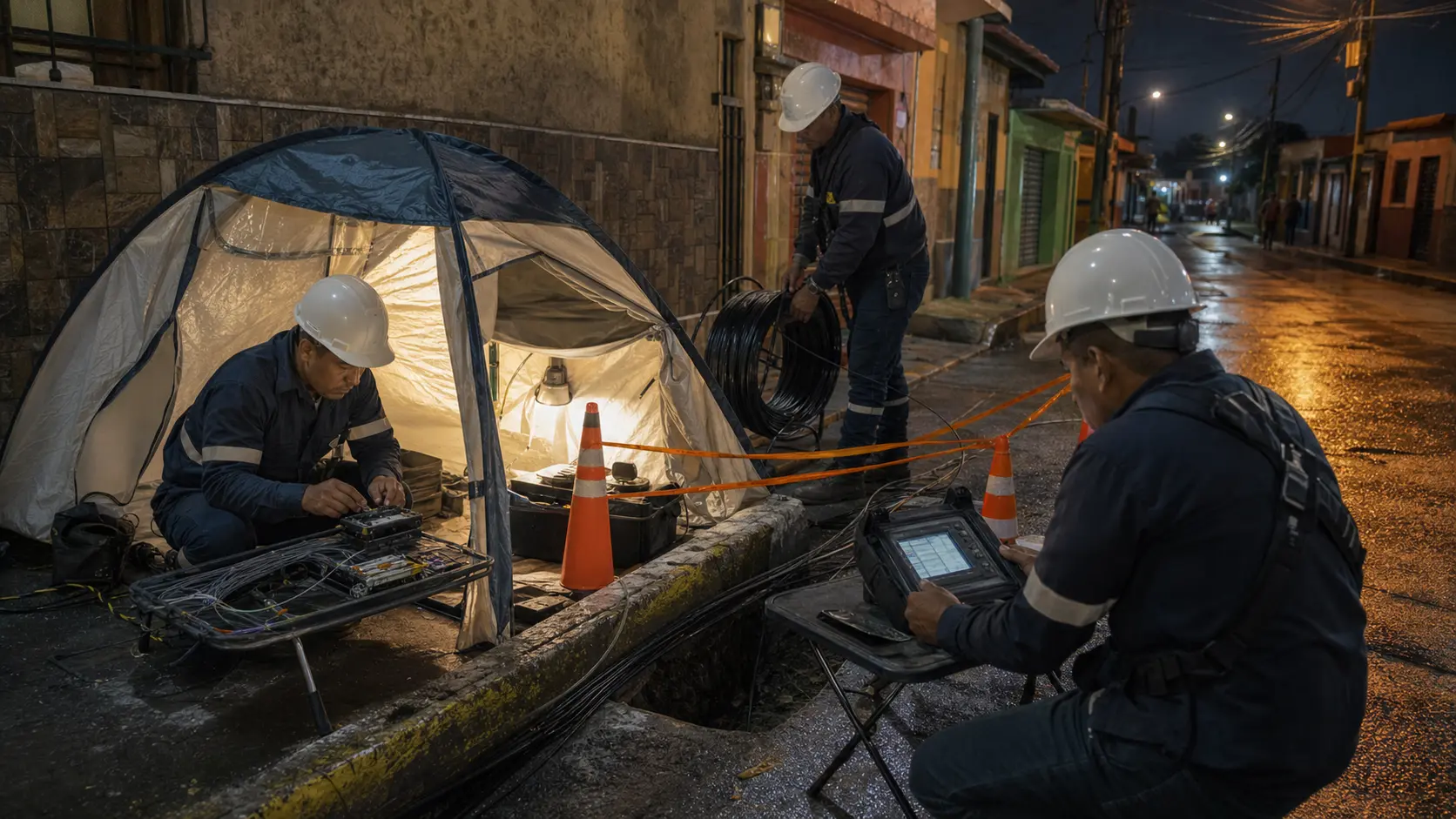
Somewhere at a powered test point, a technician launches optical pulses into a fibre that has gone dark. The trace shows a sudden reflective event or a sharp end to the backscatter. It may say the break is a certain distance from the instrument. That is the first hard measurement in the repair. It is not yet a street address, a pole number or the lid of a handhole.
The distance runs along glass, not along a map. It includes the cable's bends, rises, descents and service loops. It depends on the test point, the fibre's refractive characteristics and the technician's settings. If a passive optical network is involved, splitters and branches complicate interpretation. If the current trace is not compared with a reliable acceptance trace, a known event can be mistaken for the new fault. The ITU-T maintenance recommendation commonly known as L.25 calls the OTDR the standard fault-location tool, while also treating the distinction between transmission-equipment trouble and fibre-line trouble as a separate post-fault task. The Fiber Optic Association's outside-plant testing guidance likewise emphasises baseline records, proper setup and skilled interpretation.
Now follow the distance into a dense neighbourhood at night. The operator has to match it to an as-built route. Is the cable underground, aerial, inside a building or transitioning between all three? Which side of a junction does the measurement indicate? Was extra cable coiled in a chamber or lashed as slack on a pole? Which closure, splitter or branch lies before the event? The answer determines where a vehicle is sent and what equipment it carries.
Then access begins. A crew may need a key, a landlord, a municipal road permit, a pole owner's authorisation, a bucket truck, a traffic perimeter, pumping and ventilation for a flooded chamber, or simply a safe place to put an illuminated splice tent. The damaged section has to be exposed without harming nearby utilities. The cable jacket and strength members are inspected. Both surviving ends are cut back far enough to reach sound material and tested again.
The physical repair can then start. A compatible section of restoration cable must be present. So must closures, trays, sleeves, cleaning materials, a cleaver, a fusion splicer or a suitable temporary mechanical-splice system, an OTDR, power for the instruments and people trained to use all of them. The fibres carrying the most consequential services may be restored first. Each splice is checked. The closure is sealed. The route is tested end to end.
Even that does not yet restore the neighbourhood. The OLT or other access equipment must be healthy. Customer ONUs must reacquire the optical path. Aggregation switches, edge routers and upstream transport must be powered and forwarding. Routing may need to settle. Customer equipment and local electricity must be available. Only then does a resident's video call reconnect, a shop's payment terminal reach its processor or a small office regain cloud access.
That full sequence is the subject here. It is not a report of an actual FIBERCOT outage. No public evidence identified a specific FIBERCOT cut, cable, neighbourhood, crew or restoration result. The sequence is a disciplined test of what the available evidence can time.
For FIBERCOT, the trace is imaginable because the company has current signals of fibre-network competence. The rest of the clock is not measurable. Public records do not show the route against which the distance would be plotted. They do not show whether the operator owns the cable support, has immediate access to it, holds compatible spare cable, can field one or several splice teams, or can switch traffic around the fault. They do not show which users sit beyond the break.
An OTDR can therefore narrow the physical search while leaving the economic outage almost entirely open. The instrument can say where the light stops. It cannot say when the customer's useful path returns.
A live routing edge with a thin public face
The lack of a clear Venezuelan retail website should not be mistaken for proof of dormancy. FIBERCOT has a more convincing operating footprint in number registries, routing systems and the labour market than it does in consumer marketing.
LACNIC's RDAP record for AS273029 registers the autonomous system to FIBERCOT, C.A from 27 June 2023. The companion organisation record gives a Caracas address and was last changed on 6 July 2026, ten days before the publication date. The company also appears in LACNIC's 2024 Venezuelan member roll. These are narrow facts: they establish a current number-resource identity, not a licence, subscriber base or physical footprint.
The labour signal is more revealing. A FIBERCOT C.A. vacancy for a senior ISP network administrator is located in Caracas and describes administration of production ISP traffic, BGP and OSPF, IPv4 and IPv6 at core and edge, MPLS, bandwidth management and QoS. It goes down the stack into FTTH and FTTx, OLTs, ONUs, PON links, optical and physical-layer supervision, SFP diagnosis, Wi-Fi and point-to-point or point-to-multipoint links. A separate Caracas-based professional profile lists Fibercot experience, though without enough detail to establish role, dates or headcount.
The vacancy matters because it is hard to write as generic office administration. It describes the operating surface of an ISP with real traffic and access-network problems. Yet recruitment language has a strict limit. A list of technologies sought from a candidate is not a bill of materials. It does not prove that every named vendor is installed, that every protocol is in use, that both fibre and wireless serve retail customers, or that the job was filled. It says what competence the employer wanted, not what assets sit at which coordinates.
Two independent network-observation services add current-use signals. Cloudflare Radar identifies and displays rolling traffic views for AS273029. IPinfo's AS page reports one recently pingable address and shows a June 2026 path from a Caracas probe into the FIBERCOT network. These platforms are sampled and proprietary. They cannot provide an audited traffic total or a customer count. Together with live BGP, however, they make a dormant-paper-network interpretation less plausible.
The operating conclusion can therefore be stated with moderate confidence: FIBERCOT has a credible current Venezuelan routing edge and a plausible production access-network operation. The physical conclusion remains weak. No public customer support page, plan, order form or coverage checker was found that can be cleanly attributed to the Venezuelan legal entity. No current public asset list explains whether the recruitment scope describes installed plant, expansion plans, legacy technologies or a mixture.
Chacaíto is an address, not a route
FIBERCOT's strongest geographic anchor is an address at C.C. Chacaíto on Avenida Francisco Solano in Caracas. Open geocoding places the Centro Comercial Chacaíto area around the boulevard and avenue, with several nearby results for the mall and parking access. That is enough to situate the registry entry in a real commercial district. It is not enough to put a router in the building.
A registry address can be a legal office, correspondence point, customer counter, shared office or network site. LACNIC does not label this one as a NOC, POP, OLT location, depot or dispatch base. The network-administrator vacancy's Caracas location adds city-level operating context, but a job can be managed from an office that is nowhere near the access plant. The professional profile adds another weak city signal, not a facility.
IP geolocation is even easier to overdraw. The RIPEstat MaxMind GeoLite result for 200.24.105.0/24 locates the covering block only to Venezuela. It provides no city precision. IPinfo's specific prefix page records a useful point-in-time measurement: on 4 June 2026, 200.24.105.2 answered a probe in Caracas, with a displayed endpoint result of 1.163 milliseconds and a short AS-level path from AS19978 into AS273029. That supports proximity in network terms. It does not disclose the endpoint's street, building, role or customer dependency.
These layers should stay separate:
| Public geography | What it supports | What it does not support |
|---|---|---|
| LACNIC address in Chacaíto | Legal and administrative anchor in Caracas | NOC, POP, OLT, depot or fibre route |
| Caracas recruitment location | City-level labour and operating context | Service boundary or crew base |
| Venezuela-only IP geolocation | Country attribution of the address block | Caracas endpoint placement |
| One low-latency Caracas probe | Point-in-time local reachability signal | Coverage polygon, SLA or customer map |
| AS paths through AS19978 | Logical onward reachability | Physical handoff or cable alignment |
The public evidence therefore supports a Caracas operating context, not a Caracas coverage claim. It would be reasonable to ask FIBERCOT about neighbourhood fibre restoration in the capital. It would not be reasonable to draw a line from Chacaíto to any residential street, or to say that a particular district is served.
This distinction matters after the OTDR returns a distance. A technician needs a physical asset map, not a registry map. The useful record would identify the test point, cable identifier, route geometry, slack, closures, splitters, pole or duct owner and access conditions. None of those can be derived from the commercial-centre address, the job location or an IP database.
Four /24s, one visible adjacent AS
FIBERCOT's logical network is compact enough to describe precisely. LACNIC allocates 200.24.104.0/22, the range from 200.24.104.0 through 200.24.107.255, to the company. That is 1,024 IPv4 addresses.
At 08:00 UTC on 16 July 2026, RIPEstat's routing-status snapshot saw four IPv4 prefixes covering all 1,024 addresses and no IPv6 route. IPv4 was visible to 325 of 326 responding RIS peers. The announced-prefix dataset for the first half of July names the four component routes:
200.24.104.0/24200.24.105.0/24200.24.106.0/24200.24.107.0/24
All four were continuously visible in that query window. The covering /22 was not itself present in the publication-date BGP-state snapshot. That is a routing-policy fact, not evidence of four independent systems.
The more detailed BGP-state data contained 332 collected paths for each /24, 1,328 route entries in total. After repeated origin prepends are set aside, every one of those paths had AS19978 immediately before AS273029. The publication-date AS-neighbour query likewise returned AS19978 as the only left-side neighbour. LACNIC independently identifies AS19978 as Cirion Technologies Argentina S.A..
In ordinary network language, this is strong evidence that FIBERCOT's current public routes reach the wider internet through a logical relationship with AS19978. It is not proof that only one cable leaves FIBERCOT. The relationship could be delivered over one circuit or several, one router or several, one facility or several. Two circuits could share a duct, bridge, building entrance or power source. A standby relationship might remain hidden from public collectors until activated. Conversely, several logical sessions could still fail together.
RFC 4271 defines BGP around the exchange of network reachability information and routing policy between autonomous systems. It does not require the route advertisement to disclose street alignment, facility, fibre owner, carrier order, power system or contracted capacity. RIPE NCC's routing-status methodology similarly describes observations from RIS collectors. The data answers, "Which origin is publicly visible through which AS path?" It does not answer, "Which trench carries the packets?"
Route-origin security is another separate layer. RIPEstat returned unknown and no validating ROA for the first /24, the second, the third and the fourth. Unknown is not invalid. It means a validating route-origin authorisation was not returned for those origin-prefix pairs. Publishing ROAs would address an origin-validation question, not a fibre-restoration question.
PeeringDB offers no additional physical clues. A query for AS273029 returned no network entity on the publication date. That removes one possible source of operator-declared ports and facilities. It does not prove that FIBERCOT has no peering, private interconnection, exchange presence or second handoff.
The four /24s are therefore highly visible logical objects with almost no public physical annotation. They show that the edge is alive. They cannot show which users share a feeder, which fibres are spare, or what remains usable after a cut.
A handoff changed; the street did not become visible
FIBERCOT's routing history contains a useful reminder that logical edges can change while physical evidence remains opaque.
The long-range RIPEstat routing-history record shows the address space appearing first as a covering /22 in 2023 and the four more-specific /24s becoming visible over time. Visibility intervals vary. Those changes cannot safely be translated into launches or outages; collectors see routing, not customers.
The external neighbour changes more clearly. On 27 January 2026, the dated neighbour snapshot showed AS8053 on the left side of AS273029. LACNIC identifies AS8053 as IFX Networks Venezuela C.A.. By 30 January, the equivalent snapshot showed AS19978 instead.
This is evidence of a public routing-edge transition. It is not evidence of how the transition was engineered. The two relationships may have overlapped. They may have used the same building entrance or entirely different facilities. Traffic may have moved gradually, at once or only after a policy change. There may have been a planned migration, commercial change, technical failure or another reason. No public source settles it.
For resilience analysis, the most important missing fact is not the old provider's name. It is whether the change demonstrated a usable second physical path under load. A migration can prove that an operator is capable of changing upstream arrangements without proving that both paths were available simultaneously. A backup that exists only after technicians repatch a circuit is different from automated failover. A second BGP neighbour delivered through the same carrier route may protect against one routing-policy failure but not an excavation that cuts the common duct.
The January transition also shows why one current snapshot should not be made permanent. On 16 July, AS19978 is the only public adjacent AS. That is the correct dated observation. It should not be expanded into "FIBERCOT has always been single-homed", nor into "FIBERCOT has no backup". The former is contradicted by the history; the latter cannot be proved from public collectors.
What the history does establish is a gap between operational change and public accountability. The edge can change from one AS to another while the handoff building, circuit route, physical owner, capacity and contingency plan remain invisible. The street does not appear when the AS path changes.
The OTDR distance still needs a physical map
An OTDR result is only as operationally useful as the records around it. A trace can show a fault event at an optical distance. A repair coordinator still needs to know which physical asset occupies that distance.
The ITU-T guide to outside-plant recommendations points to geo-referenced network mapping, cable identification, topology-specific maintenance, underground facilities, poles and disaster recovery as related disciplines. The point is practical: passive infrastructure has to be represented as maintained data if a crew is expected to find it under pressure.
For a FIBERCOT feeder, a useful repair record would include at least:
- the exact test point and the fibre's index settings used for baseline traces;
- the cable identifier, construction and fibre count;
- route geometry and measured cable length between known landmarks;
- slack loops and their lengths;
- closures, cabinets, splitters, branch points and transitions;
- aerial, underground, building-entry and private-property segments;
- pole, duct, chamber and building ownership;
- access keys, contacts, permits and safety requirements;
- spare fibres and their tested condition;
- services or customer groups mapped to fibres and branches.
None of this has to be published at a security-sensitive level. An operator could release a redacted topology, evidence of maintained as-built records, route-diversity classes, access-rights status and aggregate restoration readiness without exposing exact vulnerable points. The public evidence currently offers none of those summaries.
The absence is especially consequential in PON. The recruitment listing names OLTs, ONUs, PON supervision and FTTH/FTTx, making an optical access network a credible part of FIBERCOT's operating scope. But it does not identify the PON standard, split ratio, feeder length, splitter stages or branch topology. ITU-T L.310 treats maintenance differently for point-to-multipoint and ring architectures. ITU-T G.9807.1's 2025 amendment, in an XGS-PON context, describes OTDR, power meters and light sources as useful for diagnosing optical distribution faults and separating ODN failures from system failures. That does not prove FIBERCOT uses XGS-PON. It shows why topology and test access determine what a trace can reveal.
If a fault lies before a shared splitter, many users may disappear together. If it lies on one drop, one premises may be affected. If there is a ring or a second feeder, users may be switched. If the alternate path shares the same duct or pole line, the apparent redundancy may fail in the same incident. Without a dependency map, the optical distance cannot be translated into an affected-user count or a restoration priority.
The map is therefore not decorative documentation. It is part of capacity. A crew that spends an hour reconciling cable distance with an outdated route has less usable restoration capacity than a crew that arrives at the correct chamber with the right closure on the first attempt.
FIBERCOT's public evidence confirms the need for these records without showing their existence. That is the point where its repair clock stops.
Pole, duct and handhole rights are repair inputs
The route's legal and physical control surface can consume more restoration time than the splice itself.
If the cable is underground, the crew may have to enter a maintenance hole or handhole. ITU-T L.340 treats underground facilities as structures that require inspection, maintenance and safe working procedures. Its current material discusses barriers around work areas, ventilation and the hazards of confined spaces. A chamber can be full of water, obstructed, locked, deteriorated or located in traffic. The person who owns the fibre may not own the duct or lid.
If the cable is aerial, a different system applies. ITU-T L.341 covers maintenance of poles and overhead facilities, including the deterioration of poles, closures, wires, cables and accessories. A fibre operator may share a utility pole, lease attachment space or depend on another party's safety decision. A severed self-supporting or figure-eight cable can require structural work beyond the glass. Corning's aerial installation procedure notes that when both the cable and messenger are badly severed, the repair may require replacement messenger and a cable section.
If the route enters a building, the dependency becomes a guard, landlord, riser key, equipment-room key or scheduled access window. If it crosses a road, street-work control and safe excavation enter the clock. If it sits on private land, the operator may need the owner's cooperation. None of these delays is visible in BGP.
The public record does not identify whether FIBERCOT's plant is predominantly aerial, underground, building-fed or wireless. The job vacancy names both fibre and point-to-point or point-to-multipoint skills, leaving several possible architectures. It does not disclose pole agreements, duct leases, rooftop rights, site keys, contractor arrangements or emergency permits.
That uncertainty should not be converted into an accusation that access is poor. A small regional operator can have excellent local relationships and rapid informal access. It can also depend on third parties whose response is outside its direct control. The proper question is whether those rights are documented and exercised under a measured emergency procedure.
From the customer's perspective, access rights are invisible until they fail. A support technician may know the fault to within a short optical distance while the crew waits for a chamber to be opened. The network can have spare cable and a trained splicer but no lawful way to reach the damaged segment. Mean time to repair is therefore partly a property-rights and coordination measure.
For FIBERCOT, no public response-time claim, access matrix or contractor service level was found. The restoration clock cannot skip this interval merely because it is administratively awkward to quantify.
Splicing capacity is not address capacity
The number 1,024 is the most obvious capacity figure in FIBERCOT's public record. It is also one of the least useful numbers for timing a fibre repair.
The 1,024 units are IPv4 addresses. They say nothing about how many optical fibres are inside a cable, how many are active, how many customers share a PON branch, how many splice machines are available or how fast a crew can restore service. One customer can use several public addresses; many customers can share one through address translation. Infrastructure, management and spare addresses may occupy part of the allocation. Address capacity and field-repair capacity live in different units.
The useful physical questions begin with cable construction. Is the damaged cable a small drop, a distribution cable or a high-count feeder? Is it loose tube or ribbon? How many fibres must be restored before priority services return? Are sound spare fibres available for a temporary patch? Is there enough slack to bring the ends together, or must a replacement section be inserted with two closures?
The Fiber Optic Association's restoration guide describes the practical system: accurate documentation, trained people, test equipment, spare cable, closures, tools, backup options and a plan known before the emergency. It notes that a temporary repair may restore only enough fibres to resume service before a cleaner permanent repair is made. Corning's emergency-restoration application note gives one vendor example involving restoration cable, two closures, splice trays or protectors, test equipment and cutting back damaged cable before testing the remaining ends. That example is not a universal bill of materials and is not evidence of FIBERCOT stock. It demonstrates how many dependencies sit between fault location and restored light.
Fibre count can dominate the on-site interval. Corning's outside-cable design discussion offers a generic comparison: under its assumptions, splicing a 144-fibre loose-tube cable may take about ten hours of steady splicing, while a 144-fibre ribbon cable may take about 1.6 hours. Those are illustrative engineering figures, not FIBERCOT estimates. They exclude travel, access, excavation, preparation, closure work, testing and customer verification. Their value is to show why "a fibre cut" is not a sufficient input for a repair-time promise.
A restoration kit also has to match the installed plant. Corning's splicing-tool specification describes emergency kits combining preparation, cleaving and mechanical-splice tools. A kit in a warehouse is not usable capacity if the closure is wrong, the cable type is incompatible, consumables have expired, the batteries are flat or no qualified technician is available.
FIBERCOT publishes none of the decisive quantities:
- cable types and fibre counts;
- active and spare fibres;
- restoration-reel length and location;
- compatible closures and trays;
- fusion splicers and mechanical-splice kits;
- test instruments and field power;
- qualified fibre crews per shift;
- simultaneous cuts the organisation can handle;
- time to replenish material after a repair.
The absence of disclosure does not mean the stock is absent. It means no public failure-time capacity can be calculated. Four live prefixes might ride over one small feeder or several networks. The splice tent could need to restore four fibres or hundreds. The IPv4 total cannot tell us which.
The outage can begin outside the cable
The fastest way to lengthen a fibre outage is to begin repairing glass before proving that glass is the problem.
ITU-T L.25 separates fibre-line faults from transmission-equipment faults for a reason. A dark customer path can begin at an ONU power supply, an OLT port, an optical module, an aggregation switch, a router, an upstream circuit or the utility feed. An OTDR may be clean while the service is down. Conversely, public BGP routes may remain visible while one neighbourhood feeder is severed.
The FIBERCOT vacancy's scope shows that the operator understands this multi-layer environment at least at the level of desired competence. It asks for PON and physical-layer supervision, SFP diagnosis, logs, SNMP, NetFlow, Zabbix, Telegraf and Grafana alongside BGP, OSPF, MPLS and QoS. This is a fault-classification toolkit. It is not evidence of a specific monitoring stack in production, nor of alarm coverage at every site.
Consider three failure patterns.
First, a drop or branch fails while the OLT and external edge remain healthy. Customers behind that branch lose service. AS273029's four routes can remain visible worldwide, and Cloudflare may still see traffic from unaffected users. Public BGP would miss the local failure.
Second, a powered OLT or aggregation site fails. Many optical paths may remain physically intact, but ONUs lose service. An OTDR from the wrong side can confirm good glass without restoring electronics or power. The repair needs a card, chassis, power supply, battery, generator or site electrician rather than a cable reel.
Third, the external handoff to AS19978 fails while access plant remains lit. Customer ONUs may show normal optical state, but internet reachability disappears. A local test to the gateway may work. Public routes may withdraw or change depending on edge design. The response requires routing and transport work, not street splicing.
Local power crosses all three patterns. No public record identifies FIBERCOT's utility feeds, rectifiers, UPS systems, batteries, generators, fuel, tested runtime or load priorities. Power is needed not only at the OLT and edge but also for field test gear and fusion splicing. The company may have robust backup. None is publicly measured.
This is why the repair clock should begin at detection, not at dispatch. The operator needs timestamps for alarm, classification, optical location, crew assignment, site access, first splice, optical verification, network convergence and customer confirmation. Without that chronology, a short splice interval can conceal a long diagnosis or access delay.
FIBERCOT's public evidence supports the existence of a technically broad operating problem. It does not disclose the operating data needed to say which layer usually fails or how quickly each layer is restored.
Failure-time capacity
Network capacity is often advertised as a rate under normal conditions. Restoration analysis asks a harsher question: what useful service remains during the failure, and how quickly can the missing service be rebuilt?
For FIBERCOT, at least six different capacity classes must be kept separate:
| Capacity class | Public fact | Missing failed-state fact |
|---|---|---|
| Address capacity | 1,024 registered IPv4 addresses | Addresses still reachable after access or upstream loss |
| Routing capacity | Four broadly visible /24s |
Prefixes that converge through a surviving path |
| External transport | One visible adjacent AS, AS19978 | Circuit rate, utilisation, reserve and alternate physical delivery |
| Optical access | Recruitment scope includes FTTH/FTTx, OLT/ONU and PON | OLT ports, split, fibre counts, spare paths and customers per branch |
| Restoration material | No attributable public quantity | Compatible cable, closures, optics, cards, ONUs and power supplies available at failure time |
| Labour | One senior network role and one weak employee signal | On-call fibre crews, contractors, vehicles and concurrent repairs |
The current routing snapshot proves normal-state reachability. It does not prove N-1 capacity. If AS19978 is delivered over two physically diverse circuits, the public BGP paths may still look like one logical neighbour. If it is delivered over one circuit, the same paths look identical. If another upstream is held down until failure, it will not appear. If no backup exists, that also may not be obvious until a withdrawal.
The same ambiguity applies inside the access network. A PON feeder can have unused optical ports but no alternate cable route. A cable can contain spare fibres but all fibres share the same sheath and cut. A ring can protect against one break only if its second leg is genuinely separate and has enough capacity. A wireless link can bypass a trench while sharing the same edge site and power. None of these designs is verified for FIBERCOT.
The late-January upstream change offers a historical operating event but not a failure test. It proves that the visible adjacent AS changed from AS8053 to AS19978. It does not report traffic load, packet loss, customer impact or the capacity of any overlap. The public record contains no dated failover exercise in which a circuit was removed and surviving throughput measured.
There is also no Venezuelan retail rate to use as a sold-capacity input. The web pages that advertise 100, 300, 500 or 1,000 megabits belong to the Puerto Rican brand, not this entity. No FIBERCOT, C.A customer count, premises-passed figure, aggregate committed rate or peak traffic series was found. Without sold load, even a disclosed circuit rate would not reveal headroom.
Failure-time capacity is therefore unavailable rather than zero. The company may have spare fibres, two circuits, batteries, contractors and a disciplined repair kit. It may have none of them. Public evidence cannot choose. The responsible conclusion is a split grade: medium confidence that the logical network is currently operating, weak confidence in installed physical capacity, reserve and post-failure service.
The hidden denominator
Who is affected when the system fails?
The question sounds simple until the network is mapped. A cut customer drop may affect one household. A distribution branch may affect a street. A feeder before the first splitter may affect several branches. An OLT or aggregation site can affect a larger area. An upstream or edge failure may affect nearly every user who lacks a surviving path. The number depends on topology and current assignments, not the registered address count.
FIBERCOT's four /24s cannot supply the denominator. A provider may assign public addresses dynamically, use carrier-grade address translation, place infrastructure in the same ranges or route all four prefixes from one edge. A customer behind a failed PON branch may retain the same address record while being unreachable. A prefix can remain visible because the edge is healthy even when many users behind it are dark.
The recruitment listing tells us the company wanted competence across homes or businesses served through fibre, Wi-Fi and point-to-point or point-to-multipoint networking. It does not state how many customers use each technology, which customers share a physical node or whether any essential services are connected.
This missing denominator changes restoration economics. Operators normally prioritise by impact and criticality: a hospital, emergency service, public institution, payment network or dense residential feeder may outrank a single non-critical drop. That prioritisation requires a current mapping from fibre and equipment to services. It also requires customer communication that distinguishes a wide outage from an isolated premises fault.
No public FIBERCOT outage page, status history, service-level report or dependency map was found. There is no measured count of customers restored by the first temporary splices, no indication of whether business and residential paths receive different priority, and no public mean time to repair.
The absence should not be filled with a dramatic household estimate. The honest affected-user statement is conditional: homes and businesses behind the failed physical dependency would lose the applications that require FIBERCOT's path; users with independent connectivity, local applications or a surviving route might continue. The number and duration cannot be calculated.
That is a more useful finding than a guessed blast radius. It identifies the exact record FIBERCOT would need to publish in aggregate form: customers or premises per failure domain, critical-service classes, protection status and tested restoration priority.
The Puerto Rico website is an exclusion, not a shortcut
Search for FIBERCOT produces an apparently rich answer: a polished Spanish-language site, fibre plans, address checks, installation promises and named municipalities. It is the wrong evidence for the Venezuelan company.
The site's about page is explicit. It calls Fibercot a Puerto Rican brand and says it operates under the parent company Cosotnet Inc., a company founded and registered in Puerto Rico. The site describes a Puerto Rican history and local mission. Its Río Grande page offers address validation, local support and installation in that Puerto Rican municipality. Those claims belong to that retail operation.
Independent records reinforce the separate legal context. A 2026 Puerto Rico Telecommunications Bureau notice lists Cosotnet Inc. in a Puerto Rico proceeding. The US FCC Form 499 filer database lists active filer 834424 as COSOTNET INC.
The Venezuelan LACNIC records create a genuine point of contact: FIBERCOT, C.A's administrative and technical contact uses the cosotnet.com domain. That may indicate common personnel, ownership, technical support, historical association or another relationship. The public material does not define it. A shared domain is not a corporate registry, intercompany agreement or consolidated asset statement.
The legal forms are also different: a Venezuelan C.A. and a Puerto Rican Inc.. Similar names and a shared email domain do not allow one to collapse them. The Puerto Rican brand may be related to the Venezuelan operator, but related is not the same as identical.
This boundary prevents several serious errors:
- Puerto Rico prices cannot become Venezuelan retail rates.
- Río Grande and Loíza cannot become Venezuelan service areas.
- Puerto Rico installation timing cannot become FIBERCOT, C.A's repair SLA.
- Cosotnet's Puerto Rico towers, fibre, employees or licences cannot become Venezuelan assets.
- Puerto Rican customer reviews cannot establish Venezuelan performance.
- A Puerto Rican FTTH description cannot prove the Venezuelan network's topology.
The boundary also sharpens what can be said. The Venezuelan operator has its own LACNIC identity, AS273029, address space, Caracas records and routing history. It should be evaluated on those facts. The Puerto Rican site is valuable because it stops the researcher from borrowing a much richer public footprint that has not been legally or physically joined to the subject.
For the repair-clock question, the result is austere but correct: the current public web surface provides no attributable Venezuelan route map, support promise, restoration procedure or service area. The gap remains a gap.
What a credible repair clock would disclose
FIBERCOT does not need to publish vulnerable street-level infrastructure to make its resilience assessable. It could provide an aggregate evidence package that preserves security while answering the operational questions raised by a cut.
First, it could define the operating boundary. That means a current Venezuelan service-area statement, the legal relationship—if any—to Cosotnet Inc. and the Puerto Rican brand, the role of AS273029, and whether fibre and wireless are used for customer access, transport or both.
Second, it could describe topology without precise coordinates. Useful disclosures would include the number of independent external handoffs, whether alternate routes use different facilities and physical corridors, the proportion of customers on protected versus unprotected feeders, and whether any rings are automatically switched or manually patched. A statement that two circuits exist is incomplete without common-risk information.
Third, it could publish maintenance-readiness classes:
- percentage of outside plant with current geo-referenced as-built records;
- percentage with baseline OTDR traces;
- pole, duct, handhole and building-access agreements current;
- restoration cable and closure compatibility by cable family;
- tested spare fibres and optical ports;
- power-backup coverage by access, aggregation and edge class;
- qualified on-call fibre crews and contracted surge crews;
- maximum simultaneous incidents the organisation is prepared to handle.
Fourth, it could report the repair clock as a distribution rather than a promise. Median and high-percentile intervals for detection, classification, dispatch, access, temporary restoration and permanent repair would reveal where delay accumulates. Results could be split by drop, distribution, feeder, aerial, underground, equipment and upstream faults. A single average would conceal the hard cases.
Fifth, it could test failure-time capacity. Remove one external circuit and measure surviving throughput, route convergence and customer impact. Isolate an OLT or feeder and record which users transfer. Conduct a night restoration exercise with the actual on-call crew and stocked materials. Replenish the kit afterward. FOA's restoration guidance stresses that planning, documentation, trained personnel and available components are what turn an emergency from improvisation into execution.
Sixth, it could report affected users by failure domain in aggregate. The public does not need the address behind every splitter. It does need to know whether a typical unprotected feeder affects tens, hundreds or more premises, and whether critical users have independent paths.
Finally, route security could be improved independently of physical repair. Publishing valid route-origin authorisations for the four /24s would address the current unknown RPKI state. That would not add a cable or shorten a splice. It would close one clearly observable control-plane gap while the physical programme is measured on its own terms.
These disclosures would turn the current argument from inference into evidence. They might show a small operator with strong local crews and well-stocked restoration kits. They might reveal common ducts, scarce splicing capacity or under-protected power. Either outcome would be more useful than assuming resilience from live routes or fragility from silence.
When light returns
FIBERCOT's public network is real enough to see. AS273029 is registered. Four /24s were live and broadly visible on the publication date. A Caracas probe reached one address. A recent recruitment listing sought the skills needed to run and troubleshoot production routing, fibre access and wireless links. The organisation record itself was current in July 2026.
But the evidence follows packets more readily than people.
It can show AS19978 immediately before the FIBERCOT origin. It cannot show the handoff room or the cable entering it. It can count 1,024 addresses. It cannot count customers behind a feeder. It can identify a Caracas office address. It cannot identify the splice closure that a night crew must open. It can show that the external neighbour changed in January. It cannot show whether two physical paths ever carried load at the same time.
The OTDR is the dividing line. Before it, alarms, routes and records can establish that something is wrong and narrow the fault. After it, recovery depends on physical knowledge and reserved capability: a trustworthy map, lawful access, safe working conditions, compatible cable, closures and tools, power, trained crews, tested splices, healthy access equipment and enough upstream service to carry returning users.
None of those resources should be presumed absent. None is publicly verified for FIBERCOT either. The network evidence is therefore medium for current logical operation and weak for physical resilience, reserve and failure-time usable capacity.
The restoration clock ends only when the customer's complete path works again. For FIBERCOT, public evidence can see the light disappear into four live prefixes and one visible external edge. It still cannot time the journey from the first OTDR reflection to the moment the neighbourhood comes back online.