
Topic
WHOIS/RDAP Accountability
Within the Topic facet, WHOIS/RDAP Accountability topic intelligence connects articles that share a specific subject, signal focus, or monitoring theme. The page gives readers a richer path through related reporting, source evidence, market actors, and infrastructure implications, with enough context to understand why the topic matters across company movements, governance decisions, regional exposure, and operational risk. Readers can compare recurring signals, affected organisations, public evidence, market context, service continuity, procurement, competition, compliance, and strategic planning questions behind the subject instead of stopping at a thin list of matching articles. It explains what the topic covers, which infrastructure actors or policies are involved, what evidence supports the coverage, and why the subject may matter for operators, customers, investors, and policy readers.

IETF
A Verified RDAP Contact Needs an Audience Boundary, Not a Universal Badge
A registrar can verify an email address once and face two different disclosure questions the next morning: what may an anonymous reader learn, and what may an authenticated investigator learn for a justified purpose? The verification event is the same. The authority to disclose…

Story
A Correct RIR Record Did Not Fix One Geo-IP Error After Two Months
An APNIC 62 case study exposed a small but consequential accountability gap: the registry data could be right, several geolocation databases could agree, and one downstream service could still send a customer to the wrong country.

Story
ARIN Waited for a Geofeed Standard. Its RDAP Help Still Does Not Claim It.
Two years ago ARIN tied a community request to a visible trigger: once the common RDAP geofeed standard was accepted, three named product surfaces would change. The standard is now RFC 9877. The useful question is no longer whether the IETF will finish the vocabulary, but how an…

Story
APNIC Prop-173 Would Make Every Directory Query an Agreement. The Response Would Carry No Version.
An acceptable-use policy can change while the response governed by it remains in a cache for years. APNIC's prop-173 would make ordinary WHOIS, RDAP and web queries subject to a clear, versioned policy and would tell users that querying or using the service means agreeing to…

Story
APNIC Will Automate Route-Record Alignment. The Roadmap Does Not Name the Conflict Winner
“Alignment” sounds like database housekeeping. In APNIC’s Q3 2026 roadmap, it means something harder: deciding how resource holdings, a route-management template, Whois route objects and RPKI authorizations should change when they disagree—and preserving enough evidence to show…
Global Institutional
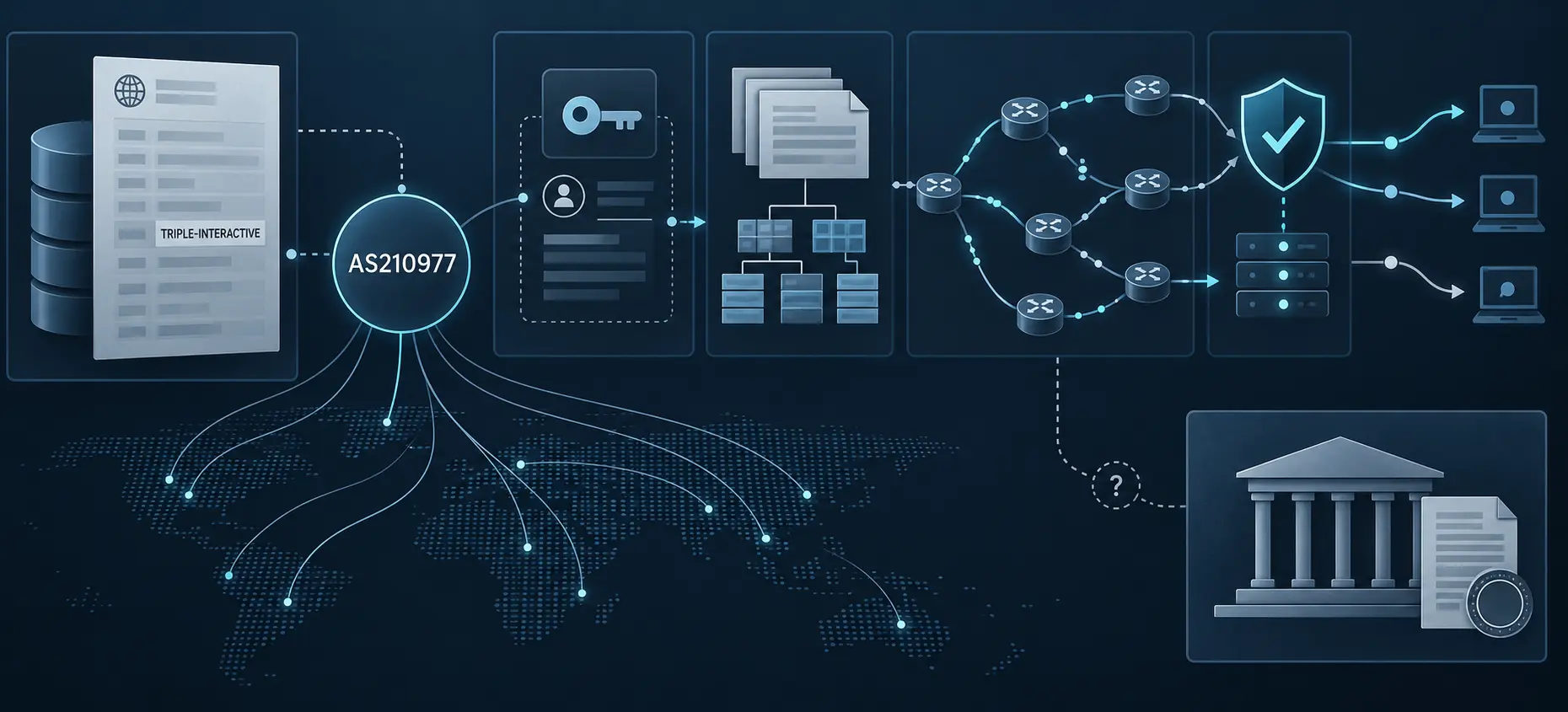
What AS210977’s Registry Record Can—and Cannot—Prove
What AS210977’s Registry Record Can—and Cannot—Prove intelligence summary explains the development, the public evidence available to readers, the organisations involved, the regional context, market exposure, and the infrastructure consequences that may follow. The Global…

Global Regional ISP
INFINITYWIFI: Three Different Meanings of Network Control
INFINITYWIFI: Three Different Meanings of Network Control intelligence summary explains the development, the public evidence available to readers, the organisations involved, the regional context, market exposure, and the infrastructure consequences that may follow. The Global…

Leaders
What AFRINIC’s Registry Records Can—and Cannot—Attribute to Maina Mukhangu Noah
A public registry listing connects Maina Mukhangu Noah to ORG-BITL1-AFRINIC, but the available record does not establish that he held institutional authority inside AFRINIC. The distinction matters because a contact field can guide operational communication without identifying…

Story
RIPE ABUSE: Who Controls the Next Step After a Report?
RIPE ABUSE is often described as a contact point. That is accurate, but incomplete. The published abuse-c field creates a route into a responsibility chain: a report can be addressed to a resource holder or designated organisation, the mailbox can be tested by RIPE NCC, and a…

Global Institutional Trends
RIPE ABUSE: A Reporting Route Is Not Proof of Repair
RIPE ABUSE: A Reporting Route Is Not Proof of Repair intelligence summary explains the development, the public evidence available to readers, the organisations involved, the regional context, market exposure, and the infrastructure consequences that may follow. The Global…

Story
AFRINIC's 8 September Snapshot Returned Four Old Resources to “Allocated.” It Cannot Say Why
Three ASNs and one /19 crossed AFRINIC’s public boundary together between two signed daily files. Their 2006 dates came back with them. That is evidence of a current state change, not evidence of a new allocation—and the distinction deserves a small public receipt.

Story
RIPE Database 1.124.1 Fixed Certificate Selection. Its “No Evidence” Finding Needs a Search Boundary
RIPE NCC was right to ship a reported authentication vulnerability without waiting for a routine test interval. The next duty is different: show members what time, traffic and registry history were actually examined before “no evidence of exploitation” became the public…

Story
APNIC’s WHOIS Archive Reports Two Totals for the Same Hour
The latest completed hour says APNIC received 3,192,583 WHOIS queries. Add the seven query types printed beside that total and the answer is 3,183,463. The missing bridge is not a rounding error; it is the meaning of the measurement.

Story
LACNIC's RDAP delegationSigned Records Parent DS Presence, Not DNSSEC Validation
A boolean in a registry response can look like a verdict on the security of a DNS chain. LACNIC's RDAP `delegationSigned` field answers a narrower question: whether the registration view reports DS records in the parent. It does not run a resolver, test the child keys or prove…

IETF
A Deprecation Date Retires an RDAP Label, Not Its Clients
An IANA registry can mark an RDAP extension obsolete. An operator can publish an end date. Yet somewhere beyond both records, a client may still ask for yesterday’s interface. That is not a contradiction. It is a map of divided authority—and a warning against treating one date as…

CASE FILE
A Holder-Designated RDAP Referral Extends Discovery, Not Registry Authority
A Holder-Designated RDAP Referral Extends Discovery, Not Registry Authority intelligence summary explains the development, the public evidence available to readers, the organisations involved, the regional context, market exposure, and the infrastructure consequences that may…

Story
LACNIC Says to Email the Bulk WHOIS Form. The Same Page Says Email Is Not Accepted
LACNIC’s public instructions give a Bulk WHOIS applicant two doors and no label for the threshold between them. The signed form is to be emailed first, the original is to be posted after approval, yet the same page ends by saying emailed forms are not accepted. The problem is not…

Story
RIPE Database Is Switching to OIDC. Maintainer Authority Does Not Move With the Session
RIPE NCC plans to replace a site-wide cookie with an OIDC session for interactive RIPE Database use. That can improve authentication, but the harder acceptance question begins after login: which `mntner` authorises this identity to change this entity, under which session regime…

IETF
James Gould and the Redaction Signal That Is Not Policy Proof
An empty place in an RDAP response can mean that no value exists, that a value was withheld, or that the question exposed a shape the server chose not to acknowledge. RFC 9537 gives one of those absences a machine-readable explanation. James Gould’s work on the specification…

Story
AFRINIC's upd-to Receives Failed Update Notices, Not Database Authority
An unexpected Whois update can place a complete rejected entity in somebody's inbox. AFRINIC's `upd-to` field explains why that person received the warning; it does not identify the sender, confer a credential or prove that the attempted change ever reached the registry.