
Topic
Software Lifecycle and Lock-in
Within the Topic facet, Software Lifecycle and Lock-in topic intelligence connects articles that share a specific subject, signal focus, or monitoring theme. The page gives readers a richer path through related reporting, source evidence, market actors, and infrastructure implications, with enough context to understand why the topic matters across company movements, governance decisions, regional exposure, and operational risk. Readers can compare recurring signals, affected organisations, public evidence, market context, service continuity, procurement, competition, compliance, and strategic planning questions behind the subject instead of stopping at a thin list of matching articles. It explains what the topic covers, which infrastructure actors or policies are involved, what evidence supports the coverage, and why the subject may matter for operators, customers, investors, and policy readers.

North America Regional ISP Trends
FirstLight made VETRO its network record. Field reality still has to reconcile
FirstLight says its VETRO migration is complete and the platform is now its official network system of record. The commercial test begins after that milestone: whether construction changes, service orders, capacity commitments and exceptions keep the map synchronized with the…

History
RFC 2066: The Character Set Was Already Right. The Reply Still Had to Arrive
Telnet had a rule for avoiding endless politeness: do not acknowledge a request for a mode already in effect. RFC 2066 made a narrow but consequential exception. A receiver already using one of the proposed character sets still had to send `ACCEPTED`, because silence would force…

History
The Namespace Arrived. Understanding Did Not: RFC 2153
RFC 2153 gave proprietary PPP extensions a shared outer address: Code or Type 0, an OUI, a Kind and vendor-defined values. That prevented private meanings from colliding in the public fields. It did not make those meanings public, prove that a peer understood them, or turn…

History
The Text Looked Readable. The Gateway Still Had Choices: RFC 2152
UTF-7 let a 1997 mail reader leave much of an ASCII message in plain sight while carrying the rest of Unicode through a seven-bit channel. That readability was useful, but it was never a preservation receipt: punctuation could take more than one legal route, shifted text could…

Global Institutional
Akvorado turns sampled flow records into operational network memory
Akvorado gives network operators a self-hosted way to retain, enrich and examine flow records over long periods. Its value lies in exposing the path from router export to operational decision; its central limit is that every chart still inherits the sampling, loss, timing and…

History
The Server Stopped Speaking It. The Client Still Had to Understand: RFC 2062
In December 1996, IMAP drew a line that software migrations still struggle to express. A new server could retire an old command without demanding that every client forget how to read it. RFC 2062 made compatibility directional: stop producing obsolete syntax, keep only the…
Creators
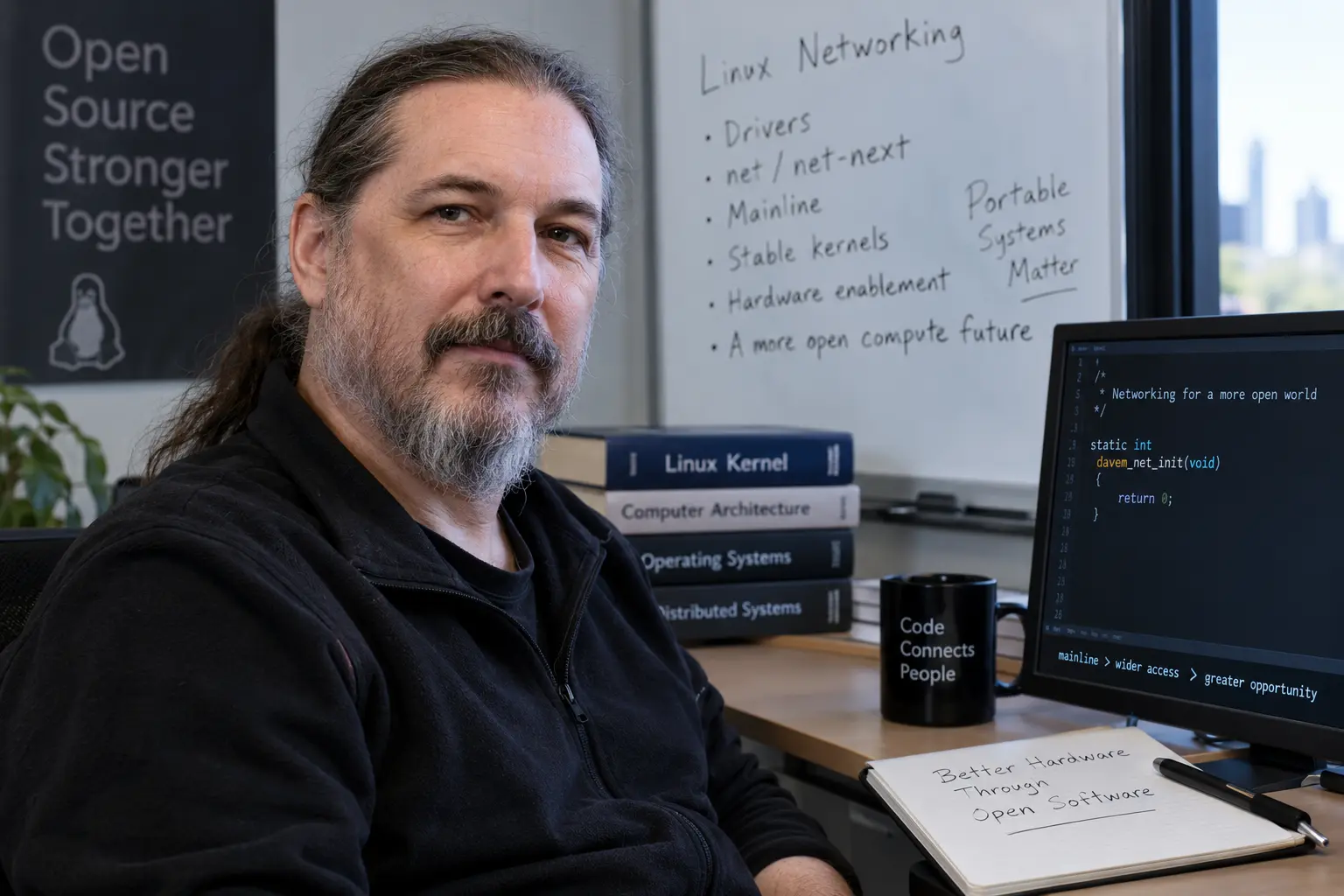
David S. Miller and the public process behind Linux networking
A networking patch can start as a few lines of code and end up affecting servers, routers, phones, cloud hosts and appliances around the world. David S. Miller has spent decades close to the point where those changes become shared Linux infrastructure, first through the SPARC…

Global Institutional
SNIA sets common storage rules but cannot impose them on the market
Since 1997, SNIA has tried to make storage systems from different vendors more comparable, manageable and predictable. Its specifications cover software management, cloud data, media sanitisation, energy use and hardware form factors, but any useful rule works only when companies…

CASE FILE
One Color Crossed Three ASes. It Never Became an SLA: RFC 9723
A low-latency color can survive every BGP hop and still fail to buy low latency. RFC 9723 gives SRv6 operators a compact way to propagate intent through colored locator prefixes; it does not merge the intent dictionary, route installation, packet path and customer outcome into…

Story
Rapport’s Forbidden-AKI Test Starts at Barry, Not at the Validator
A conformance test cannot prove that a validator rejected a forbidden certificate field until it proves that the field reached the certificate. A September correction to one LACNIC Rapport fixture makes that dependency unusually visible. The change replaces a scalar value that…

CASE FILE
RFC 9727 Put the APIs in a Catalog. It Did Not Put the Catalog in Charge
The most dangerous API inventory can be perfectly formatted. Its links validate, its cache is warm, and its obsolete interface is gone from the list. None of those facts says what is still listening on the network.

History
Abhay Bhushan and the Uniform Interface That Stopped at the Pathname
Before a file could cross the early network, its sender and receiver first had to admit how unlike they were. Abhay Bhushan’s work on the first File Transfer Protocol turned that awkward fact into a design method: discover capabilities, standardise a workable layer of operations…

CASE FILE
The Resource Disappeared. So Did the Diagnosis: RFC 9729’s Concealed Authentication Boundary
Concealed authentication removes a useful signal from an intruder: the server no longer has to advertise a challenge before an authorized client can prove itself. The same silence can also erase the evidence an operator needs when a key is revoked late, a gateway exports the…

IETF
RFC 9730 and the Evidence Boundary Between Distributed Recovery and Centralized Control
RFC 9730 matters less because it settles an architectural contest than because it makes a mixed-control reality explicit: transport networks can combine distributed GMPLS behavior with centralized coordination, and the operational challenge is therefore to distinguish who…

Global Institutional
SNIA writes shared storage rules without the authority to enforce them
Since 1997, SNIA has tried to make storage systems from different vendors easier to compare, manage and trust. Its specifications span management software, cloud data, media sanitisation, energy use and hardware form factors, but every useful rule still depends on companies…

History
Larry Masinter and the form that arrived in pieces
The history of multipart/form-data reveals a quiet source of software risk: a request can reach its destination intact while the application loses the distinctions it carried.

Global Institutional
SNIA writes common storage rules without the power to enforce them
Since 1997, SNIA has tried to make storage systems from different vendors easier to compare, manage and trust. Its specifications reach from management software and cloud data to media erasure, energy use and hardware form factors, yet every useful rule still depends on companies…

Creators
Jiří Pírko and the Linux interfaces exposing switch hardware
A physical switch can forward packets at extraordinary speed while revealing little about the tables, limits and failures inside it. Jiří Pírko's work on switchdev and devlink helped give Linux a common language for that hidden machinery, bringing forwarding state and device-wide…

Global Institutional
Akvorado turns sampled flows into a network’s working memory
Akvorado gives network operators a self-hosted way to retain, enrich and examine flow records across long periods. Its usefulness comes from making the path from router export to operational decision visible; its central limit is that every graph still inherits the sampling…

Europe and Middle East Institutional Trends
EU cyber reporting starts with 24-hour deadline
Manufacturers must notify authorities before an investigation is complete, then follow with fuller findings and remediation details as the technical picture develops.