
Summary
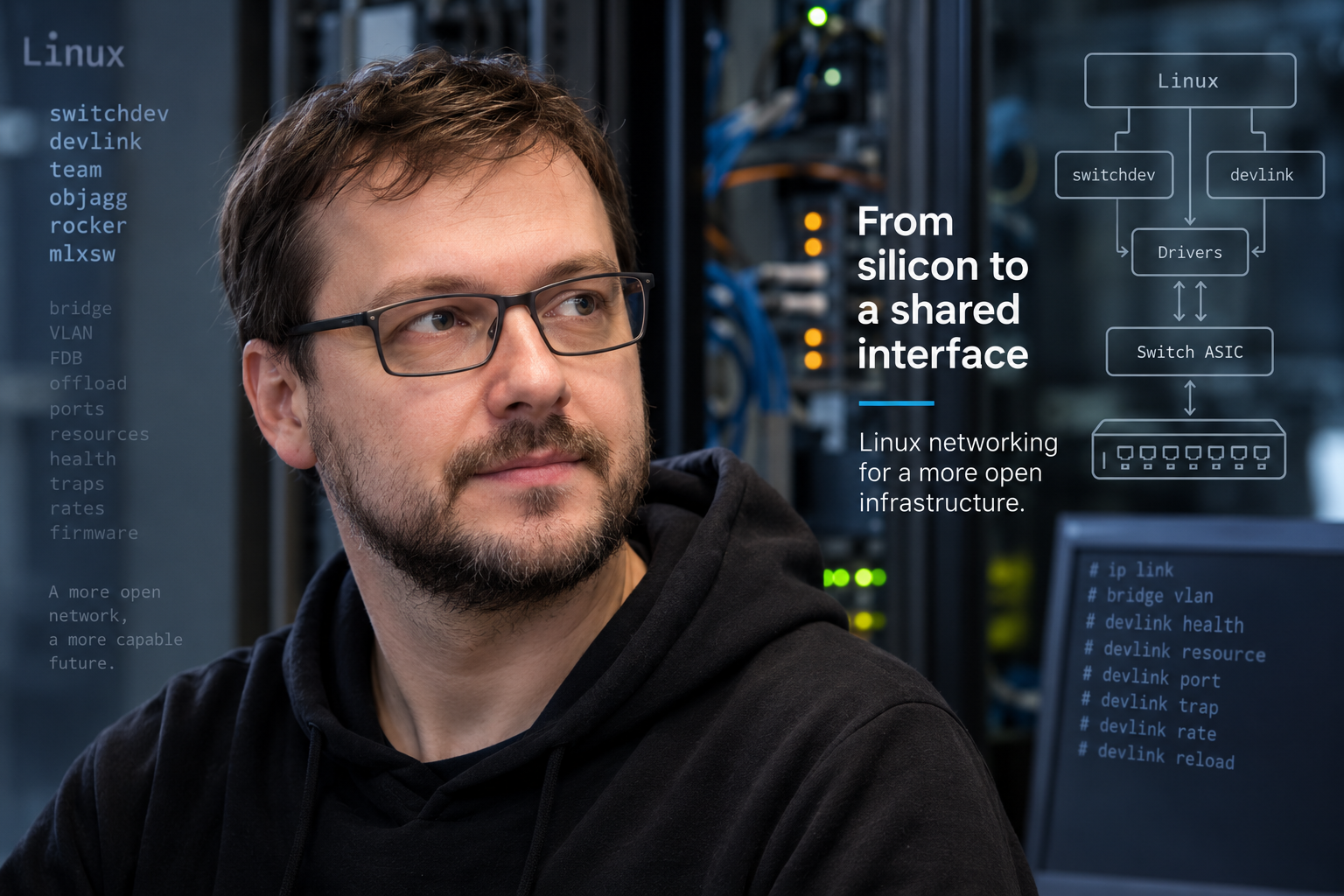
- Jiří Pírko is an active Linux networking maintainer whose current responsibilities include devlink, switchdev and several related subsystems, giving him significant but shared authority over hardware-facing network interfaces.
- switchdev lets ordinary Linux forwarding objects be offloaded into supported switch hardware, while devlink exposes device-wide ports, resources, health, traps, rates and selected firmware operations.
- His work is collective rather than proprietary: switchdev credits Scott Feldman alongside Pírko, while drivers, firmware teams, userspace developers, reviewers and operators determine whether the interfaces work in practice.
- The lasting test is portability with evidence: common Linux semantics can reduce dependence on private tools, but they cannot erase ASIC differences, firmware opacity, uneven driver support or concentrated maintainer knowledge.
A switch can look simple while hiding a private operating world
To an administrator, a switch port may look like one more Linux interface. Beneath that familiar name sits a specialised chip with forwarding tables, packet parsers, counters, schedulers and finite pools of memory. The chip may process traffic without involving the host CPU, yet many of the decisions that determine its behaviour have historically been reached through a vendor command line, a proprietary software-development kit or firmware-specific tooling.
That division made sense when a switch arrived as a complete appliance. The vendor supplied the hardware, operating system and management model as one product. It became more awkward as network operating systems began to run on disaggregated hardware and Linux moved from being merely the host beside a switch to the operating substrate expected to control it. A common operating system could see network interfaces, but it could not automatically understand the shared forwarding resources or failure modes behind them.
Pírko's work is best read against that gap. The goal was not to make silicon generic. It was to give Linux enough structured knowledge to manage what could be shared across devices, while leaving room for the real differences that drivers and hardware still had to handle.
Pírko's documented career is strongest in code and maintainer records
The public record is unusually rich about Pírko's technical responsibilities and unusually thin about his conventional biography. The Linux kernel's current MAINTAINERS file provides the strongest evidence: it identifies him as maintainer for DEVLINK, TEAM, OBJAGG and rocker, and as a co-maintainer of SWITCHDEV. Kernel documentation, mailing-list history and public repositories connect him to switchdev, devlink, libteam and the mlxsw driver lineage.
Historical evidence places his work in Red Hat and Mellanox engineering contexts, while present repository and email records indicate an NVIDIA affiliation. The research pack did not find a comprehensive current NVIDIA biography or a reliably verified exact title. It would therefore be misleading to build the profile around a guessed corporate rank, an education record that has not been established or a complete early-career chronology that public sources do not provide.
The evidence supports a different kind of profile, centred on a sustained engineering argument. Across interface aggregation, switch offload and device management, Pírko repeatedly favoured a thin, reviewable kernel mechanism paired with policy and orchestration outside it. The story lies in the interfaces and the institutions that maintain them.
Early interface teaming foreshadowed a preference for thin kernel mechanisms
Before switchdev and devlink became the centre of the record, Pírko worked on the Linux team driver and the accompanying libteam userspace library. Teaming combines several network interfaces so they can provide redundancy, load distribution or another policy-defined behaviour. Linux already had bonding, but the team design placed more of the policy in userspace "runners" while keeping the packet path and essential state in the kernel.
That separation anticipated a later theme. The kernel should expose stable objects and perform work that requires kernel proximity; userspace should be able to choose policy, inspect state and evolve control logic without turning every decision into a private kernel extension. The approach is not automatically superior in every environment because distribution packaging, compatibility with existing bonding configurations, link-detection timing and userspace failure all affect operations.
The design habit nevertheless matters. It shows Pírko's interest in interfaces narrow enough to review and general enough to support more than one product. switchdev and devlink would apply the same instinct to a much harder target: a switch ASIC shared by many ports, functions and forwarding objects.
Linux could manage an interface without understanding the switch behind it
The traditional Linux netdevice is an effective abstraction for a network interface. It gives the operating system a name, addresses, statistics, queueing controls and a place in routing and bridging. A switch ASIC, however, is not simply a collection of independent ports. It has shared tables, shared buffers, internal pipelines and device-wide firmware, so a change made through one port can consume a resource needed by another.
This mismatch became visible in disaggregated switching. A network operating system could create a Linux bridge, add VLANs and learn addresses, yet the hardware might implement those objects through tables with limits and behaviours that the kernel did not represent. A single netdevice could not naturally answer how many routing entries remained, why the ASIC trapped a packet to the CPU or whether the device's management processor had entered a bad state.
The problem was technical and institutional. Without common objects, each vendor's integration tended to grow its own control path. Operators could automate one platform but not necessarily transfer the same logic to another. Linux needed one vocabulary for forwarding offload and another for the device as a whole.
White-box networking made hardware abstraction a requirement
White-box and disaggregated switches changed who assembled the system. Instead of buying one vendor's sealed appliance, an operator or integrator could combine merchant silicon, a hardware platform and a network operating system. The promise was greater choice and faster software change. The practical burden was integration: the operating system had to translate generic networking intent into the particular tables and functions supported by each ASIC.
A userspace abstraction built around a vendor SDK could solve part of that problem. It also risked making the operating system dependent on a private API whose semantics, release cycle and diagnostic model differed by supplier. An upstream Linux model offered another route. If bridge state, ports, resource limits and fault reports could be represented through common kernel interfaces, a network operating system could build on public semantics rather than start again for every device.
That did not remove the vendor layer. Drivers still needed intimate knowledge of the chip, and firmware often remained proprietary. The change was in where the common contract lived: the Linux community could review it, userspace tools could expose it, and more than one driver could attempt to implement it.
switchdev made Linux forwarding objects candidates for hardware offload
switchdev addresses the forwarding half of the problem. Its model lets a driver take objects Linux already understands, such as bridge membership, VLAN configuration and forwarding-database entries, and programme supported equivalents into switch hardware. The kernel remains the control model; the ASIC becomes an offload target for the packet-processing work.
This is more subtle than calling switchdev a software switch. It does not itself forward every packet or define a complete network operating system. Linux bridge and related subsystems create and manage objects. Driver callbacks translate those objects into hardware operations, and the chip then forwards traffic at line rate where the relevant feature is supported.
The advantage is conceptual continuity. An operator can reason about a bridge, a port and a learned address using ordinary Linux tools even when the data plane is in silicon. The risk is semantic divergence: an object may be unsupported, only partly offloaded or constrained by a pipeline that does not match the software model. switchdev can provide a common path, but correct operation still depends on clear reporting of what entered hardware and what did not.
The original switchdev record belongs to Pírko, Scott Feldman and a wider community
The switchdev documentation carries Pírko's 2014 copyright and Scott Feldman's 2014-2015 copyright. That record supports describing Pírko as a primary architect, but not as a sole inventor. Feldman, driver authors, bridge maintainers, reviewers and later contributors all shaped the model as it moved from design into multiple implementations.
This attribution boundary is more than editorial courtesy. Kernel architecture emerges through patches and review. A proposal may introduce a useful division of responsibilities, while another contributor finds a race, adds a missing notification, adjusts a bridge rule or proves that a hardware assumption does not hold. The final subsystem is the accumulated result of those exchanges.
Pírko's influence is visible in the continuity of the design and in his present co-maintainer role. Maintainers assess changes, reconcile interfaces across drivers and help decide whether a vendor requirement belongs in a generic API. That is a powerful form of technical leadership, but it remains public and contestable. Code enters through the networking review process rather than through personal ownership of switchdev.
Bridge, VLAN and forwarding-database entries are the plain language of the model
A bridge connects several network interfaces at Layer 2. VLANs divide that shared environment into logical segments. A forwarding database, usually shortened to FDB, records which destination addresses are reachable through which port. These are familiar concepts to network engineers, and Linux already had mature ways to represent them before hardware offload became a central concern.
switchdev's importance lies in using that plain language as the control surface. When a port joins a bridge or an FDB entry changes, a capable driver can translate the event into the ASIC's own tables. The operator does not need to begin with a private command for each chip simply to express the intended topology.
Translation is not identity. An ASIC may combine several logical objects in one table, impose a fixed order of operations or support only a subset of bridge behaviour. Some changes may be rejected or handled in software. The common object model makes the request portable; it does not guarantee that every target can satisfy it in the same way or at the same scale.
Hardware offload works only when software and silicon stay coherent
Once forwarding moves into hardware, Linux and the ASIC must agree about the state of the network. A bridge entry shown by the kernel but missing from silicon can black-hole traffic. A hardware entry that survives after Linux believes it has been removed can violate policy. Silent fallback from hardware to software can also produce a sudden performance drop that looks like congestion somewhere else.
Coherence requires notifications, error reporting and disciplined driver behaviour. The kernel needs to know whether an operation succeeded. The driver needs to handle asynchronous events from hardware. Userspace needs enough evidence to distinguish a software path from an offloaded path. The details vary because chips differ in how they learn addresses, age entries and report failures.
This is where the appeal of a clean diagram meets production reality. Offload is not simply an on-or-off acceleration switch. It is a distributed state-management problem involving the kernel, driver, firmware and ASIC. switchdev makes that relationship reviewable in common code, but does not remove the need for target-specific testing.
rocker gave developers a switch model without requiring a physical ASIC
The rocker driver and associated software models provided an accessible environment for developing and testing switch APIs. A contributor could exercise ports, forwarding behaviour and offload control without owning a particular hardware platform or waiting for a vendor laboratory. Pírko remains listed as maintainer of the rocker driver.
That accessibility mattered during architectural formation. Generic interfaces need more than prose: they need an implementation that can expose incorrect assumptions and allow automated tests. A software model can help reproduce an object lifecycle, error path or change in bridge state. It also gives reviewers a common target when a physical device is unavailable.
Emulation has strict limits. It does not reproduce the exact timing, resource coupling, queue behaviour or firmware faults of a production ASIC. A feature that works in rocker can still fail when a hardware table fills or when a device performs operations in a different order. The model is therefore a development instrument, not evidence that real silicon has become uniform.
mlxsw forced generic ideas to survive contact with real Spectrum hardware
The mlxsw driver connected Linux networking abstractions to Mellanox Spectrum switch ASICs, later part of NVIDIA's networking portfolio. Pírko's public linux_mlxsw repository records part of that development lineage. The driver matters because it tests switchdev and devlink against hardware with real ports, tables, firmware and scale constraints.
A generic interface can look convincing until a concrete driver has to map it onto a chip. Resource hierarchies need to match actual memory pools. Trap names must correspond to proprietary reasons. Port representations need to reflect physical connectors and logical functions. Recovery operations have to work with firmware state that the kernel does not own.
mlxsw supplied that pressure. It helped reveal which concepts were genuinely reusable and which details needed qualification. It also shows why upstream APIs cannot be treated as detached from employers or hardware teams. Public kernel design benefits from engineers who can see real devices, run validation and bring operational failures back into review, even when some laboratory and firmware evidence remains private.
Real switch chips turned table capacity into an operational question
Switch ASICs hold routes, neighbours, access-control entries, learned addresses and other objects in finite memory. The limits are not always independent. Two logical tables may draw from the same physical pool, or a resource may be partitioned differently depending on the operating profile. An operator can therefore run out of one kind of entry even when another headline capacity number looks generous.
Before structured resource reporting, this information often lived in vendor documentation, private commands or support knowledge. That made automation difficult and could turn capacity exhaustion into a surprise incident. A common interface cannot create more silicon memory, but it can make the remaining capacity visible in a machine-readable form.
The operational value is planning. A network operating system can monitor occupancy and compare it with expected growth. The limitation is that the driver must describe the hardware honestly and completely. If shared couplings are hidden, a clean resource tree may provide false confidence. Visibility is only as good as the model beneath it.
devlink began with a simple observation: the device is larger than one netdevice
On 26 February 2016, Pírko posted the patch that introduced devlink. The design addressed properties and operations that belonged to the whole device rather than to a single network interface. That distinction created a durable home for management functions that had been awkward to attach to netdevices.
Over time, devlink expanded far beyond identification. It gained models for ports and functions, resources and occupancy, parameters, health reporters, traps, rate hierarchies, regions and snapshots, reload operations and selected firmware-related tasks. The breadth can make devlink look like one giant management protocol. Its unifying principle is narrower: expose device-wide networking state through a common kernel-to-userspace interface.
The interface did not arrive fully formed in 2016. It grew through driver needs, operational experience and review. That evolution is part of its significance. An upstream API can begin with a clear boundary and then acquire the vocabulary required to make real hardware manageable without placing every operation behind a vendor-only tool.
switchdev and devlink solve different halves of the same operating problem
The two names are often used together and can be confused. switchdev is mainly about forwarding behaviour: how Linux bridge, VLAN and related objects can be represented in hardware. devlink is mainly about the device: which ports and functions exist, how resources are divided, what failed, what a trap means and which parameters govern the hardware.
A network operating system frequently needs both. switchdev can express that a VLAN should be offloaded, while devlink can reveal whether the relevant table has room. switchdev can programme a forwarding object, while devlink health can report that firmware or a transmit path has failed. devlink can expose a port or function whose netdevice then participates in ordinary Linux networking.
The separation prevents one abstraction from carrying incompatible jobs. It also creates coordination work. An operator may need to correlate a bridge object, a devlink port, an ASIC resource and a physical connector. The architecture becomes useful only when those identities and error paths remain consistent across kernel, driver and userspace.
devlink ports describe hardware relationships an interface name cannot capture
A Linux interface name tells an operator how the operating system refers to one network endpoint. Modern hardware can have a more complicated internal structure: physical ports, split ports, switch-facing functions, PCI functions and representor interfaces for virtualised workloads. Not every relevant object maps neatly to one cable or one netdevice.
Devlink ports provide a device-centred representation. They can associate a logical or physical function with hardware attributes and, where appropriate, with the netdevice visible to normal networking tools. This becomes particularly important for switch ASICs, SmartNICs and DPUs, where one device may expose many functions to the host and to virtual machines.
The model does not remove naming complexity. Operators still need to understand which devlink port corresponds to which connector, PCI function or representor. Hardware can support different splitting rules and generations. A common schema improves discoverability, but accurate inventory still depends on the driver, firmware and network operating system presenting the relationships coherently.
Resource hierarchies make finite ASIC tables visible before they become an outage
Devlink resources allow a driver to expose capacity, occupancy and partitioning as a hierarchy. An operator can inspect how much space exists for routes, neighbours, access-control entries or other objects and, in some cases, alter how a shared pool is divided. The feature turns a hidden silicon constraint into an operational metric.
This is useful precisely because resource exhaustion rarely looks like a clean hardware failure. New routes may stop entering the ASIC, policy entries may fail or traffic may fall back to a slower path. If the platform reports occupancy early, automation can warn operators, reject a risky change or plan a reload with a different partition.
The API cannot flatten every physical relationship. One reported resource may share memory with another in ways that are difficult to model. Changing a partition may require a disruptive reload, while occupancy can change quickly during routing convergence. The hierarchy is a map of finite capacity, not a guarantee that every dependency has been captured.
Health reporters turn a hardware fault into a named failure domain
Devlink health reporters let a driver register a failure domain, collect diagnostic information and offer a recovery operation. A reporter might cover firmware, transmit queues, receive paths or PCI communication. Instead of leaving every failure behind a vendor log, the driver can expose it through a common command and event model.
The operational improvement is considerable. Monitoring can identify which reporter failed, retrieve a dump and trigger a documented recovery where that is safe. Support teams can begin from a shared vocabulary rather than a platform-specific screen, and network operating systems can build more consistent workflows across drivers that implement comparable reporters.
The evidence still comes from the device stack itself. A badly failed device may produce an incomplete dump, firmware may omit the information needed to find the root cause, and an automated recover command can reset a component and restore traffic while leaving the underlying defect unresolved. The interface improves the response loop; it does not make hardware self-healing in every case.
A successful recovery command is not the same as uninterrupted service
The word "recover" can sound stronger than the underlying operation. A health reporter may reset a queue, reload firmware or restart part of a device. The command can be successful from the driver's perspective even if packets were dropped, sessions were interrupted or the same fault returns later.
Operators therefore need more than a binary command result. They need timestamps, affected ports or functions, traffic impact, recurrence, pre- and post-recovery counters and, where possible, a root-cause indication. The service-level outcome belongs partly to the surrounding network: redundancy may hide a device reset in one design and turn it into an outage in another.
This is a useful example of the article's wider boundary. A common API can standardise how a recovery is requested and how diagnostics are retrieved. It cannot standardise the physical fault, firmware implementation or topology around the device. The safest claim is that devlink creates a shared recovery interface, not that it guarantees uninterrupted service.
Traps explain why hardware sent a packet to the CPU or dropped it
A switch ASIC may forward most packets entirely in hardware but send selected traffic to the CPU or discard it for many reasons: a control protocol, an unresolved neighbour, a policy rule, a parsing problem, a resource limit or a security exception. Without a structured explanation, an operator sees CPU traffic or drops without knowing which hardware decision produced them.
Devlink traps provide names, groups, actions and counters for these events. A driver maps the ASIC's proprietary reasons onto common concepts that userspace can monitor. This closes part of the gap between Linux policy and silicon behaviour. A network operating system can display why packets left the fast path and correlate changes with a configuration or incident.
The mapping remains imperfect. Not every chip exposes every reason, and two vendors may divide one concept differently. A counter identifies a category but may not identify the customer service affected. The value lies in replacing opaque exceptions with inspectable ones, while preserving driver-specific detail where the generic name is insufficient.
Trap policers stop the monitoring path becoming another overload
Sending exception packets to the CPU is useful until the exception stream becomes a flood. A malformed-packet storm, unresolved-neighbour condition or control-plane attack can overwhelm the host precisely because the ASIC is reporting what happened. Devlink trap policers provide a way to limit selected trap traffic before it consumes excessive CPU and queue capacity.
That creates an operational trade-off. A stricter policer can protect the control plane but discard diagnostic packets that would have helped explain an incident. A loose policer preserves visibility but may allow the exception path to become the failure. The right rate depends on device capacity, topology and expected control traffic.
A common interface makes the policy visible and automatable; it does not determine the correct threshold. Operators need normal baselines, burst behaviour and service priorities. The feature shows why observability and protection cannot be designed independently: the mechanism that explains a fault must itself survive the fault.
Rate objects translate shared hardware schedulers into a common hierarchy
Modern switches and DPUs may schedule traffic across physical ports, virtual functions and subordinate nodes. Devlink rate objects describe leaves and hierarchy nodes so userspace can express shared rate limits or shaping relationships at the device level. This is broader than configuring one ordinary qdisc on one netdevice.
The hierarchy is attractive because many hardware systems already allocate bandwidth through parent and child schedulers. A common model can let a network operating system manage several functions without using a separate vendor command for each one, while making the relationship between functions more visible.
Hardware schedulers differ in depth, queue count, supported algorithms and granularity. A requested rate may be rounded, a hierarchy valid on one device may not fit another, and congestion elsewhere can prevent a configured ceiling from becoming observed throughput. Devlink can carry the intent and report the object; the exact service behaviour remains a property of the driver and chip.
Parameters and reload operations admit that some settings cannot change live
Devlink parameters expose selected device settings through a common interface. Some values can change at runtime; others affect initialisation, resource partitioning or firmware behaviour and take effect only after a reload. The API makes that distinction explicit instead of pretending every knob is safely mutable on a live network.
A reload can reinitialise a driver or device so new parameters apply. From an engineering perspective, that is cleaner than hiding a disruptive reset behind a configuration write. From an operations perspective, it creates a maintenance event that needs redundancy, traffic planning and rollback.
The generic command does not make every reload equal. One driver may preserve more state than another, a firmware activation may take longer or fail, and a device shared by several functions can affect multiple services. Automation therefore needs capability discovery and platform-specific expectations. The common interface helps orchestrate change; it cannot remove the change's blast radius.
Regions and snapshots preserve evidence from inside the device
Devlink regions allow drivers to expose selected blocks of device information and create snapshots that userspace can retrieve. The data might represent a table, a memory area or another diagnostic view useful for investigating a fault. This provides a structured alternative to a private dump command.
Snapshots matter because failures are often transient. By the time an engineer logs in, the device may have recovered or overwritten the state that explains the event. A captured region can preserve evidence for later analysis and comparison. It can also support vendor investigation without forcing every diagnostic path through an opaque tool.
The mechanism is not a universal forensic format. Drivers choose what to expose, raw device data may still require specialised interpretation, and sensitive information and data volume need controls. A snapshot proves that a particular view was captured, not that it contains the complete cause. The feature improves evidence collection while leaving expertise and hardware knowledge essential.
Firmware remains inside the trust boundary even when management moves upstream
An open kernel driver and a common userspace interface do not make the whole device open. Firmware may initialise the chip, manage internal processors, enforce resource rules and produce diagnostics. Its source, release process and failure behaviour may remain under vendor control.
This is one of the clearest limits to the phrase "Linux governance". Linux can govern the API a driver presents and the code merged upstream. It cannot review firmware that is not available, nor can it guarantee that a device reports every internal state accurately. A health reporter may depend on firmware to create its dump; a reload may depend on firmware to restart safely.
The upstream interface still changes the balance. It gives operators a public contract above the firmware and makes omissions easier to identify. The proprietary boundary may move downward rather than disappear, so responsible adoption requires firmware provenance, update policy, security response and validation alongside the open API.
devlink changes the default control surface rather than replacing vendor SDKs
Vendor SDKs can expose deep chip-specific functions, development tools and diagnostics that a generic upstream API will never carry in full. They may be necessary to initialise silicon, implement specialised pipelines or support features unique to one product. Devlink is not a drop-in replacement for every one of those capabilities.
Its significance lies in making common operations available through Linux first. Ports, resources, health, traps and other shared concepts can be represented in a way that multiple drivers and tools understand. A network operating system can start from those semantics and use a vendor extension only where the common model genuinely ends.
That distinction affects lock-in. It does not create perfect portability, but it narrows the proprietary surface an operator must depend on. It also subjects requests for new generic capabilities to upstream review. The resulting API may be slower to expand than a private SDK, yet its maintenance and compatibility obligations are visible to a wider community.
iproute2 is the operator-facing half of the kernel contract
Kernel netlink interfaces are not how most administrators interact with switch hardware. The iproute2 suite turns those messages into commands, readable output and scripts. Its devlink utility is therefore an essential part of the operating model: the kernel defines objects and operations, while userspace presents them to people and automation.
This division allows the kernel and tool to evolve separately, but creates a compatibility obligation. A new kernel attribute needs userspace support before it becomes convenient. An older tool may not understand a new driver capability, while a newer tool may run against a kernel that lacks the operation. Distribution release cycles can leave operators with uneven combinations.
Good interfaces handle that mismatch through capability discovery, stable encoding and clear errors. The existence of a common kernel API is only half the portability story. The other half is whether tools, libraries, network operating systems and documentation expose the same meaning across versions.
Kernel and userspace version skew can fracture the common-interface promise
An operator may upgrade the kernel without upgrading iproute2, or run a containerised management process whose tools are newer than the host. In either case, devlink's objects can exist on one side and be invisible or misinterpreted on the other. The problem is not unique to devlink, but it matters when automation relies on detailed hardware state.
Version skew can appear as missing fields, rejected commands or changed text output. Scripts that parse human-readable output are especially fragile. Structured output and feature detection reduce the risk, but only if downstream systems use them correctly.
Release engineering therefore matters as much as interface design. Distributions, vendors and network operating systems need tested combinations. Operators need to know whether an absent field means "unsupported by hardware", "not exposed by the driver", "not understood by the tool" or "not present in this kernel". A common name is not enough; the delivery chain has to preserve its meaning.
Network operating systems consume the Linux model and add their own control planes
Linux-based switch operating systems can use switchdev and devlink as part of their hardware integration. The network operating system still has its own routing daemons, configuration database, orchestration, telemetry and upgrade process. Linux provides a lower-level contract; it does not become the entire product.
This layered use explains both the reach and the limits of Pírko's contribution. A common kernel interface can make it easier for several systems to support a driver, yet each downstream project decides which features to expose, which versions to pin and how to report failures to its users. A platform may add abstractions that hide devlink completely.
Public references show substantial downstream relevance but no complete deployment census. It would be wrong to attribute every SONiC, DENT or Linux-switch installation to one maintainer. The defensible claim is that these ecosystems benefit from the upstream hardware model and help test it under different operating assumptions.
Public deployment evidence shows relevance without supplying a global census
Kernel documentation and downstream projects demonstrate that switchdev and devlink are active infrastructure rather than abandoned experiments. Drivers use them, tools expose them and network operating systems build around Linux hardware abstractions. The current MAINTAINERS record confirms continuing governance.
What the public record does not provide is a complete count of devices, ports or operators. Vendors may ship the interfaces in commercial products without publishing fleet numbers. Operators may pin older kernels or use only selected features. A driver listed in source does not prove that every function is deployed at scale or supported by every downstream distribution.
That gap should not be filled with estimates. Infrastructure can be consequential without a public market-share figure. The strongest evidence is architectural embedding: when a driver, tool or network operating system depends on the interface, future changes must preserve that relationship. That maintenance obligation is itself a sign of adoption.
SmartNICs and DPUs broadened the problem beyond the top-of-rack switch
SmartNICs and data-processing units place programmable networking, acceleration and virtualisation functions on a device attached to a host. They can expose physical ports, embedded switch functions, PCI functions and representor interfaces. The device-wide state may affect applications, virtual machines and external traffic at once.
This makes devlink's model relevant beyond a conventional rack switch. Ports and functions need identities. Shared resources and rate hierarchies need management. Health and firmware operations need a control path that is not tied to one ordinary netdevice. Traps and diagnostics must explain why packets left the fast path.
The broader scope also raises the stakes. A DPU can become part of the host's security boundary and service chain, and a reload or firmware fault can affect several tenants. Common Linux interfaces improve visibility, but the underlying device may include more proprietary processors and software than a classic NIC. The same governance argument becomes more important and more difficult.
Representor ports blur the line between a hardware function and a Linux interface
A representor is a Linux-visible interface associated with traffic to or from another function on a device, such as a virtual function assigned to a workload. It gives the host a place to apply switching, policy and monitoring to traffic that may ultimately be forwarded by hardware.
Representors are useful because they let ordinary Linux tools participate in an accelerated environment. A bridge or traffic-control rule can refer to a familiar interface while the driver translates the operation into the embedded switch. Devlink port information helps connect that interface to the function and hardware it represents.
The abstraction can still be confusing. The representor is not simply the remote function's own interface, and traffic may take different paths depending on offload state. Names can change with enumeration. Operators need a clear inventory linking physical ports, PCI functions, netdevices and tenants. The interface makes control possible; it also demands disciplined explanation.
Hardware offload can free CPU while making the packet path harder to explain
Moving forwarding and policy into silicon can reduce host CPU load and increase packet rate. It can also make troubleshooting less intuitive. The packet may no longer traverse the software hooks an operator expects. Counters can be split between kernel and hardware, while a rule may be accepted in software but only partly offloaded.
switchdev, devlink traps and resource reporting are attempts to keep the accelerated path observable. They give the system a vocabulary for offload status, hardware exceptions and finite tables. That matters because performance without explanation becomes a reliability risk.
No interface can guarantee perfect visibility. Hardware may aggregate counters or hide pipeline stages, firmware may report a generic reason, and a vendor extension may still be required for deep diagnosis. The operational objective is not to make hardware behave like software, but to ensure that the speed gained from hardware does not require surrendering all evidence about what it did.
Common APIs expose limits without making ASICs interchangeable
Two switch chips can both support bridge offload and devlink resources while differing sharply in table size, parsing flexibility, queueing, recirculation and failure handling. A network operating system may use the same commands yet obtain different scale and behaviour.
That is not necessarily a failure of abstraction. A useful common interface can describe shared operations and report target-specific limits. Portability means the control plane can discover and adapt, not that every device has identical capability. Trouble begins when a common name encourages users to assume stronger equivalence than the driver can provide.
Operators therefore need capability matrices, conformance tests and real workload validation. Vendors need to document deviations and limits. Upstream maintainers need to decide whether a new feature is genuinely generic or should remain a specific extension. The Linux model creates a place for that negotiation; it does not settle the answer for every chip.
OBJAGG reflects a quieter problem: sharing hardware objects without losing accounting
OBJAGG, another area maintained by Pírko, is infrastructure for aggregating objects that can share underlying hardware resources. The precise use is less visible to general readers than switchdev or devlink, but the underlying problem is familiar: several logical objects may be represented by one physical entry, and the system must track references, limits and lifecycle correctly.
Sharing can save scarce ASIC resources. It can also create subtle ownership problems. Removing one logical object must not delete a physical entry still needed by another, and accounting must reflect both the aggregate and its users. Losing that relationship can produce leaks or premature removal.
The subsystem reinforces the profile's central theme. Hardware acceleration is not only about fast forwarding; it is about representing constrained, shared state in a way that software can manage safely. The most consequential engineering often lies in bookkeeping that users never see until it fails.
Maintainer authority means responsibility for review, not ownership
The MAINTAINERS file is strong evidence of current technical authority. It tells contributors who is expected to review changes, respond to issues and help sustain a subsystem. It does not grant private property rights or the power to merge any change without scrutiny.
Linux networking patches are discussed on public mailing lists and move through a wider maintainer hierarchy. Adjacent subsystem owners, driver maintainers, userspace developers and reviewers can challenge an interface or identify a regression. A maintainer's judgement matters because consistency across drivers is difficult, not because the process is personal rule.
This distinction is especially important in a profile. Calling Pírko "the owner of devlink" would erase both the community and the burden of his role. The more accurate picture is a custodian of shared semantics who has to weigh vendor urgency against long-term compatibility, and new capability against the cost every future implementation will carry.
Upstream review turns vendor requirements into a public negotiation
A hardware vendor often needs an interface because a real product has a new function or limitation. The easiest short-term answer may be a private command. Upstreaming asks a harder question: is the requirement common enough to deserve a stable Linux object, and can it be expressed without encoding one chip's internal design as the standard for everyone?
Review makes that argument visible. Other vendors can compare their hardware, userspace developers can assess the API and operators can point to missing diagnostics. The process can be slow, and a vendor may still maintain private extensions while the discussion proceeds. The delay is part of the cost of a shared interface.
Pírko's maintainer record places him inside that negotiation. His contribution is not only code already merged; it is the continuing work of deciding what Linux should promise. That institutional role is difficult to quantify, but it is central to whether the abstraction remains portable rather than becoming a collection of vendor-specific exceptions.
Employer support matters, but no employer owns the upstream record
Open-source kernel development requires time, hardware, laboratories and access to engineers who understand a device. Employers such as Red Hat, Mellanox and NVIDIA have provided relevant contexts in Pírko's documented career. Their support helps explain how abstract interfaces were tested against production-class hardware.
Employment does not transfer ownership of the public subsystem. Earlier work should not be retroactively credited to a current employer, and a corporate email does not prove that every patch reflects a company product decision. Contributions enter Linux under project rules and remain part of the shared codebase after people or corporate structures change.
The relationship is still material. If employer priorities shift, maintainer time and hardware access can shrink. A community may depend on in-kind support that is not visible in a project budget. Open governance distributes control over code, but it does not make the labour and validation infrastructure free.
Public source code does not reveal every validation lab or customer incident
The upstream record gives unusual transparency: patches, documentation, maintainers and much driver logic are public. It does not provide a complete view of how every device was validated or how every failure appeared in a customer network. Hardware qualification may use private test suites, unreleased firmware and confidential incident data.
This creates a familiar evidence asymmetry. The community can inspect the interface and review the code that translates it, yet vendors and large operators may hold the richest information about rare failures and scale limits. An upstream design can therefore be publicly governed while its operational evidence remains partly concentrated.
The appropriate conclusion is neither that public code guarantees correctness nor that private testing makes upstream review meaningless. Both are needed. The strategic question is whether enough conformance and failure evidence can be shared to keep a common API honest across vendors.
Device-health and resource APIs create a stronger operating contract
When a driver exposes a health reporter, resource hierarchy or trap, it makes a promise about what the device can reveal. Operators can incorporate that information into monitoring and capacity planning. Network operating systems can build a more consistent experience across platforms, while vendors can receive better-structured fault reports.
The contract also makes omissions visible. If one driver reports table occupancy and another does not, the difference becomes an operational feature gap rather than an invisible property of a private CLI. If a recovery action resets traffic, the platform has to document that effect. The common API creates a basis for comparison even when implementations differ.
That is an institutional gain. It moves discussion from "our SDK has a command" to "this device implements a public Linux semantic with these limits". The contract still depends on vendor engineering and firmware, but it gives customers and integrators a clearer way to ask for evidence.
A common interface can still collapse into the lowest common denominator
A generic API can be made portable by exposing only what every device shares. That produces compatibility at the cost of leaving advanced hardware features inaccessible. The opposite approach adds enough options to represent every vendor, eventually turning the common interface into a catalogue of special cases.
switchdev and devlink have to navigate between those outcomes. Some concepts, including ports, finite resources and health domains, are broadly reusable. Others depend on a particular pipeline or firmware architecture. Upstream review has to decide where a generic abstraction remains honest.
A lowest common denominator is not automatically useless. Stable basic operations can carry much of an operator's routine work. The risk arises when marketing presents the common layer as complete, or when innovation moves permanently into private extensions because the upstream model cannot evolve. The quality of the interface should be judged by how clearly it exposes both common capability and the boundary beyond it.
Vendor extensions can recreate the proprietary boundary beneath an open API
An operator may manage most routine functions through devlink and still need a vendor utility for specialised telemetry, pipeline programming or firmware diagnosis. The common interface then sits above a proprietary layer that remains essential during the hardest incidents.
This is not automatically avoidable. Chips have unique functions, and some details may not belong in a stable cross-vendor API. The concern is whether the extension is exceptional or becomes the real control plane while the open layer covers only basic inventory.
The boundary can also move into firmware. A driver may expose a generic operation whose implementation and error semantics are hidden below it. Open code at the top does not guarantee open behaviour at the bottom. Operators should therefore map which workflows are portable, which require private tools and which data can be exported if they change supplier.
Cross-vendor conformance is the missing proof behind the portability promise
A shared API is most valuable when independent implementations behave consistently. Documentation and code review provide part of that assurance. Automated tests across hardware generations and vendors would provide more. Public evidence for a complete cross-vendor conformance programme remains limited.
Conformance does not mean identical scale. It means that the same operation has a clear semantic, errors are reported predictably and capability differences can be discovered. Tests should cover normal configuration, exhaustion, recovery, reload, counter behaviour and version combinations. Rare failure paths are particularly important because those are where operators most need a common interface.
Without such evidence, portability can remain plausible but uneven. Each network operating system and vendor performs its own qualification, duplicating work and keeping results private. The next stage of Linux hardware governance may depend less on inventing new objects and more on proving that existing ones mean the same thing in several implementations.
Maintainer concentration can become a continuity risk even when the code is open
An open repository can be copied, but deep subsystem knowledge is not instantly transferable. devlink and switchdev cross kernel networking, drivers, firmware and userspace. A small group of maintainers may remember why an interface has a peculiar rule, which hardware exposed a past problem and which apparently simple change would break an older driver.
The current MAINTAINERS record confirms Pírko's continued responsibility across several related areas. That continuity is an asset and a reason to watch review workload, contributor breadth and succession. If one maintainer's available time declines, patches can queue and undocumented knowledge can become a bottleneck.
Healthy succession does not require removing experienced maintainers. It requires more reviewers, clear tests, rationale in documentation and shared responsibility for adjacent tools. Openness provides the legal and technical possibility of succession; institutions still have to fund and practise it.
The public record supports a technical profile more strongly than a conventional life story
There is enough evidence to explain Pírko's architecture, maintainership and institutional importance in detail. There is not enough to write a confident childhood-to-career narrative. The research pack did not establish a complete education history, current formal corporate title, personal finances or every early employer and project.
A weaker article might fill those gaps with social-profile fragments or generic statements about a "passion for technology". That would add colour at the expense of evidence. A stronger profile begins with the object he helped make visible: the switch ASIC inside a Linux system, and the recurring problems of offload, resources, health and governance.
This emphasis also serves general readers. Biography is not only a sequence of jobs. It can be the development of an idea through institutions. In Pírko's case, the idea is that hardware control should enter the same public review process as the operating system that depends on it.
Cloud, telecom and enterprise systems all benefit when hardware state becomes inspectable
The users of these interfaces extend beyond one type of network. Cloud platforms use accelerated switching and SmartNICs to isolate and connect workloads. Telecom systems depend on predictable forwarding, resource limits and recovery. Enterprises increasingly run Linux-based appliances and disaggregated switches. In each case, hardware hidden behind private tools complicates automation and incident response.
switchdev and devlink do not supply the full cloud or telecom product. They provide lower-layer semantics that products can consume. Their value becomes visible when an operator can use common tooling to inspect ports, recognise a resource threshold or retrieve a health dump instead of waiting for a specialised command path.
The deployment evidence is not complete enough to count every beneficiary. The infrastructure relevance is nevertheless broad because the same kernel interfaces appear wherever Linux is asked to control programmable networking hardware. The common problem is not market category; it is the need to align public software state with a fast, finite and partly opaque device.
The work changed institutional control more than the physics of forwarding
Packets did not become faster because Linux acquired a new word for a trap or a resource. The ASIC still forwards according to its circuits, queues and memory. The deeper change is who can describe and manage that behaviour. A public kernel interface lets operators, distributions, network operating systems and several vendors build against a shared contract.
That contract shifts some authority away from a private management plane. It allows upstream reviewers to question semantics and gives downstream systems a stable place to integrate. It also creates obligations: compatibility must be preserved, errors must be meaningful and maintainers must resist turning one product's implementation into everyone's API.
This is why Pírko's significance is difficult to express through a single benchmark. His work concerns the institutional shape of infrastructure. It makes hardware limits discussable in a common language while exposing how much power remains in drivers, firmware and validation environments below that language.
The lasting contribution is an interface that makes hardware limits discussable
The story ends not with a fully open switch, but with a more accountable boundary. switchdev allows Linux forwarding objects to become candidates for offload. devlink gives the whole device a vocabulary for ports, resources, faults, traps, rates and inspection. Concrete drivers such as mlxsw test those abstractions against real silicon, while tools such as iproute2 make them usable.
The result is neither complete portability nor the end of vendor differentiation. Hardware pipelines remain different. Firmware remains trusted. Some diagnostics and features remain private. Operator experience depends on specific driver versions and network designs.
What changed is that these differences no longer have to remain entirely outside the operating system's public model. They can be exposed, compared, reviewed and automated. Pírko's record is therefore a profile of infrastructure governance through code: a long effort to make the device behind the interface visible enough for Linux to manage, without claiming that visibility has made the device simple.
Member Briefing
Deeper Profile Context
Sign in with the right membership level to unlock the full briefing and source notes.
Only for Strategic Circle
Strategic Circle
Open to all readers. Unlock profile briefings after joining and signing in.
Join Strategic CircleOnly for Leadership Alliance
Leadership Alliance
For qualified IP-asset owners and management; sign in to unlock alliance briefings.
Join Leadership Alliance