
Summary
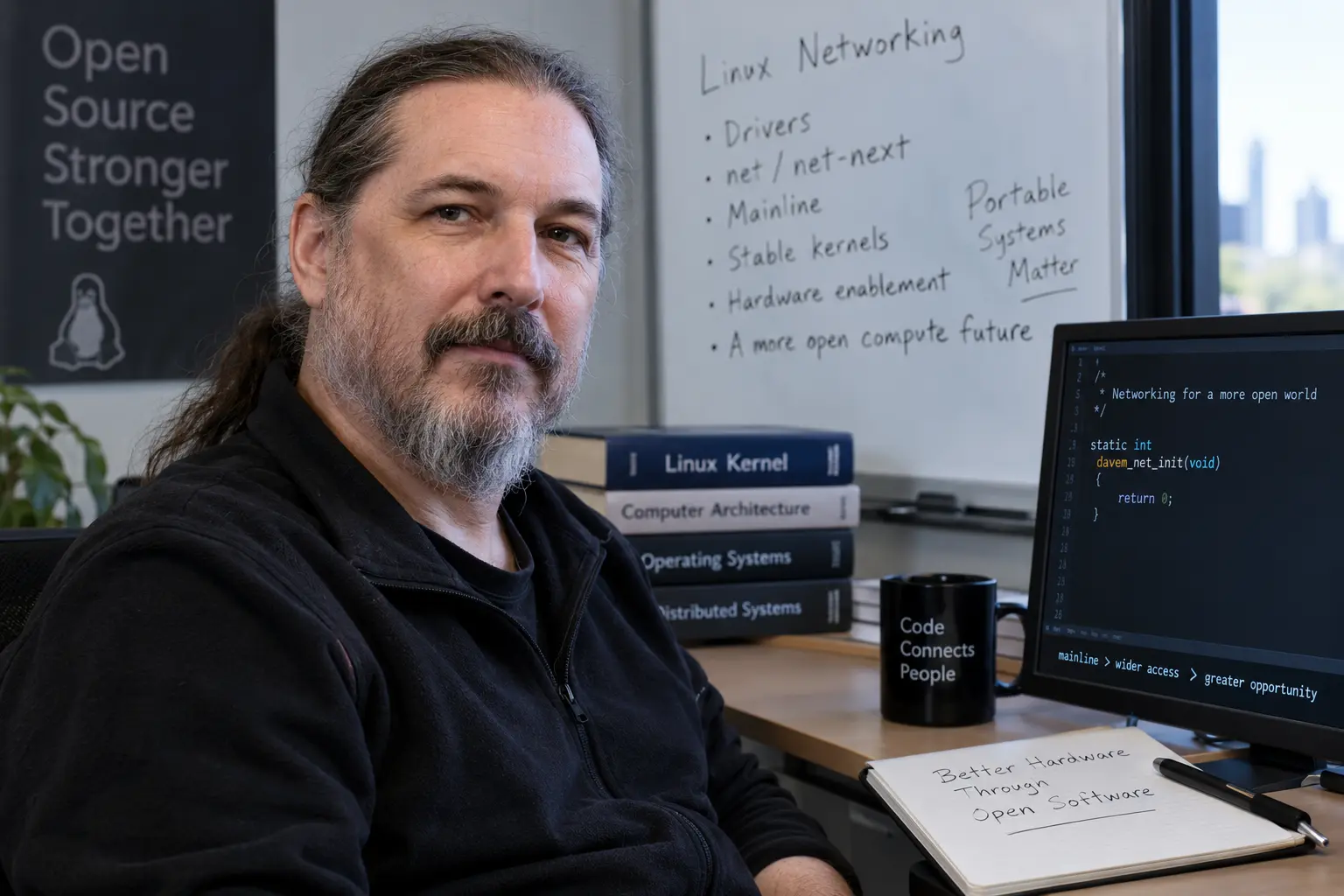
- David S. Miller is a long-serving Linux kernel maintainer whose responsibilities include general networking and networking drivers, but those areas are now shared with other maintainers and specialist reviewers.
- His earlier work on the Linux SPARC port helped expose assumptions that had been hidden while x86 was the main reference platform, turning portability into a practical engineering discipline.
- The
netandnet-nexttrees separate urgent repairs from future development, while public review, testing and the wider mainline process spread responsibility beyond any one patch handler. - Miller's lasting significance lies in integration: deciding when code, interfaces and maintenance obligations are ready to become common infrastructure, while making that judgement increasingly transferable to other people and tools.
A small patch can create a very long obligation
A vendor engineer can write a network-driver change in a day. A researcher can show that a new transport idea works in a controlled test. A cloud operator can prove that a fast path improves one chosen fleet. None of those achievements, by itself, makes the change part of Linux. The harder step is integration: deciding that the code and the interface are suitable for a kernel used by organisations that were not involved in the original design and may still depend on it years later.
That decision produces no consumer brand and usually no dramatic launch. What the outside world sees is a commit. Behind it can be weeks of discussion about naming, error behaviour, locking, security, compatibility, tests and whether one vendor's feature can be expressed in terms another device might also use. A maintainer may ask the author to split a patch series, reject an interface that is too narrow, insist on a more general design or simply say that the work is not ready for the next release cycle.
This is the most useful place to begin David S. Miller's profile. His importance does not rest on the claim that he personally invented every part of Linux networking or made every decision about it. It rests on a long record of carrying integration responsibility: first in architecture work that forced Linux to confront different hardware, and later in networking work where the cost of a poor decision could spread across an enormous installed base.
The governing question is therefore wider than biography. How did a role that once depended heavily on the judgement of a few experienced maintainers become a system in which authority is still real, but increasingly shared, reviewable and supported by tests? Miller's career provides a way to follow that change because it spans both the early period of Linux portability and the later period of large-scale public networking maintenance.
Miller's formal authority is broad, but it is no longer solitary
The Linux MAINTAINERS file is the clearest current record of Miller's formal technical responsibilities. At the 4 August 2026 research cutoff, it listed him among the maintainers for general networking and networking drivers. It also retained assignments in SPARC and UltraSPARC, IPsec, the crypto API and Kprobes. These entries identify areas where contributors can seek review and where maintainers carry responsibility for integration. They do not mean that the code is legally or technically owned by the people named beside it.
The same record makes the distribution of authority visible. General networking is shared with Eric Dumazet, Jakub Kicinski and Paolo Abeni, while Simon Horman is listed as a reviewer. Other parts of the network stack have their own maintainers, trees and mailing lists. Wireless, Berkeley Packet Filter work, traffic control, individual device drivers, cryptography and architecture code all have specialist communities that no one person could review in full.
That matters because the common shorthand that one person "runs Linux networking" is now too simple. Historical descriptions of Miller as the principal networking maintainer reflected a period when more responsibility was concentrated around him. The current record supports a more precise description: his influence remains unusually durable, but the daily work of review and integration is distributed among several maintainers and many specialists.
The exact division of work is not published as a complete workload ledger. MAINTAINERS tells contributors who is responsible for an area, not how many patches each person reads in a week, who handles the most difficult disagreements or how responsibility shifts during absence. That missing detail is itself relevant to succession. Formal names matter, but practical resilience depends on whether knowledge and authority are genuinely shared in day-to-day work.
SPARC exposed assumptions that x86 had allowed Linux to ignore
Linux began in an environment where x86 behaviour shaped many early implementation choices. Code could look generic while quietly depending on the way one processor family handled memory translation, caches, interrupts, atomic operations or boot firmware. Those assumptions were hard to see when the kernel mostly ran on machines that shared them.
Porting an operating system to a different architecture is a severe test of what "portable" actually means. A port asks whether a supposedly general interface really works when memory ordering changes, when a cache behaves differently, when interrupts arrive through another mechanism or when the firmware provides a different route into the machine. The work forces developers to separate policy that belongs in common kernel code from mechanisms that genuinely have to vary by architecture.
SPARC was an important target because it was not a toy platform. It was used in workstations and servers whose processor design, firmware and multiprocessor behaviour differed materially from x86 systems. Making Linux run there meant working close to the foundations of the kernel: boot, memory mappings, traps, interrupts, low-level assembly, device support and the interactions between those pieces.
For readers who do not work on operating systems, the practical point is simple. A kernel can appear portable until it meets a machine that breaks the assumptions hidden in its common code. The SPARC effort helped turn those hidden assumptions into explicit boundaries. Once the boundary is clear, later developers have a better chance of changing the common code without accidentally depending on one kind of hardware.
The 1997 SPARC record shows a creator working inside a team
USENIX records from 1997 identify David S. Miller and Miguel de Icaza as authors of work on the Linux SPARC port. The associated presentation examined design and performance problems encountered during the effort. That record supports direct credit for Miller's role while also making the collaboration impossible to ignore.
A successful architecture port involves much more than translating a few assembly routines. The kernel has to boot, establish memory mappings, handle traps and interrupts, communicate with firmware, drive hardware and keep higher-level facilities such as scheduling, networking and filesystems behaving correctly under the architecture's rules. After basic correctness comes another challenge: performance. A design can work and still be unusably slow because cache behaviour, page-table operations or interrupt paths differ from the assumptions in generic code.
It would therefore be inaccurate to present Miller as the sole creator of Linux on SPARC. The published work itself is co-authored, and a usable port necessarily relied on a wider group of testers, driver contributors and architecture specialists. A narrower conclusion is both safer and more meaningful: Miller and de Icaza were core authors of work that forced Linux to treat portability as a real systems problem rather than an abstract promise.
That experience helps explain why the SPARC chapter matters in a profile focused on networking. Network drivers sit close to hardware behaviour. Direct memory access, interrupts, cache coherence and packet-buffer handling all depend on architecture details. An engineer who has watched supposedly general code fail on a second processor family has direct reason to ask whether a new networking interface is genuinely general or merely reflects the assumptions of the first implementation.
Portability became a method, not a one-off achievement
The lasting value of an architecture port is not limited to the machines that continue to run it. Porting exposes places where common code is too tightly tied to one platform and encourages a cleaner split between generic policy and architecture-specific implementation. Those boundaries can then be reused by later architectures, drivers and subsystems.
The article should not claim that every networking judgement Miller made later came directly from the SPARC experience. The evidence does not support such a straight causal line. What the record does show is a continuity of method: test an abstraction against difficult hardware, identify which assumption failed, and move only the necessary difference behind a lower-level boundary.
That method is especially useful in networking because new hardware regularly arrives with capabilities that do not fit existing interfaces neatly. A vendor may want Linux to expose a feature exactly as its device implements it. Upstream maintainers have to ask whether the feature belongs in a common model, whether another vendor could implement the same meaning and whether applications can rely on the interface after the original device disappears.
In that sense, portability is not only about processor architectures. It is a discipline for keeping shared infrastructure from becoming a collection of private exceptions. The specific hardware changes, but the review question remains familiar: which difference is essential, and which is merely an accident of one implementation?
A successful port becomes a maintenance promise
Architecture work is often remembered through milestones: the first boot, the first conference paper, the first usable release. Maintenance begins after those moments. Compilers change, generic kernel APIs are refactored, hardware becomes harder to obtain and developers who understood the original design move on. A port that once proved Linux could reach another platform can later survive mainly because a small group still knows how to diagnose it.
Current MAINTAINERS entries continue to associate Miller with SPARC and UltraSPARC. Public material, however, does not provide a complete contemporary count of users, a full inventory of available test hardware or a map of which workloads still depend on the architecture. The responsible reading is therefore limited: the historical contribution is well documented, continuing responsibility is visible, and the present operational scale is uncertain.
That uncertainty is not a reason to dismiss the architecture. Older platforms can still provide useful portability pressure because they behave differently from the dominant machines on which most developers test. At the same time, code that nobody can run or diagnose can turn a nominal support promise into friction for everyone else. The difficult question is whether enough users, maintainers, hardware and documentation remain to make the promise credible.
This is an early example of a theme that later becomes central to Miller's networking work. Integration does not end when code is accepted. Acceptance creates a future obligation. The project has to decide whether it can continue to understand, test and repair what it has promised to support.
Networking expanded the reach of every integration decision
Architecture maintenance is deep but bounded by the machines that use the architecture. Networking crosses almost every platform Linux supports. Once Miller's responsibilities expanded into the network stack and network drivers, decisions made during review could affect servers, embedded systems, phones, routers, security appliances and cloud hosts at the same time.
The nature of the work also changed. A porting problem often asks how to express a known kernel facility on different hardware. Networking maintenance has to reconcile protocol standards, user-visible application programming interfaces, hostile input, performance demands, virtualisation, offloads and a vast device market. The code arrives from companies, researchers and volunteers with different priorities and different deadlines.
Public records do not provide a complete date-by-date account of every change in Miller's responsibilities. The broad sequence is clear enough to use without inventing a promotion date: he was involved in Linux in the early 1990s, worked on SPARC in the mid-1990s, and took on expanding networking and driver integration roles by the late 1990s and 2000s.
The significance lies in the change of scale. A mistake in architecture code can break an important platform. A mistake in a shared networking interface can become a compatibility promise that many unrelated products later depend on. That difference helps explain why review, delegation and evidence around the networking trees became so important as the subsystem grew.
Netdev turns technical authority into a public record
Linux networking development is organised around the netdev mailing list and related subsystem channels. A proposed change is posted for public review, where maintainers, driver authors, protocol specialists, operators and automated systems can respond. The result is an unusually visible form of infrastructure governance: much of the argument happens before a change is accepted, and the record remains available after the code has moved on.
That does not mean the mailing list is a vote in which every opinion carries the same weight. Expertise matters. Past contribution matters. The quality of the evidence matters. A reviewer who understands a protocol's failure modes can have more influence over the technical outcome than someone with a more senior company title. Maintainers can reject a patch or ask for substantial changes, but their reasoning can be challenged with code, tests and further review.
This public process is one of the strongest checks on personal authority. Miller's experience gives his judgement weight, but that judgement appears inside an archive where authorship, objections and revisions can often be traced. Private conversations and employer priorities still exist, and not every design decision is fully explained in public. Even with those limits, the system is very different from a vendor defining a private interface and presenting it to users as a finished fact.
The distinction matters for readers outside kernel development because upstream review affects what later becomes ordinary infrastructure. A tool, distribution or appliance may inherit an interface that was debated years earlier. The users of that interface may never read the thread, yet they depend on the fact that someone asked whether the behaviour was portable, observable and maintainable before it became difficult to remove.
net and net-next give fixes and features different paths
Linux networking uses two principal integration trees for different kinds of work. The net tree is primarily for fixes to code that already exists. The net-next tree is where new features, larger refactoring and development for a future release are collected. The names are easy to remember; the reason for the split is more important.
A bug fix may need to move quickly towards the current kernel and, under separate rules, into stable releases used by distributions and operators. A new feature needs a wider review window because it can create a new interface or maintenance obligation. Mixing the two makes risk harder to see. A large redesign labelled as a fix could reach users too quickly, while an urgent repair tied to a feature series could be delayed behind work that is not necessary to restore correct behaviour.
The boundary is not automatic. A patch can reveal an old defect while also changing visible behaviour. A feature series may contain preparatory clean-up that is safe on its own, or it may depend on a new contract that reviewers think is premature. Maintainers often ask contributors to separate these pieces so reviewers can see which change repairs the present and which change belongs to the future.
Choosing the tree is therefore part of technical judgement. It makes the expected risk explicit before a patch moves further. Miller's authority around the networking trees has included that kind of judgement: not simply deciding whether code works, but deciding what kind of promise the change is asking the project to make and when that promise is ready.
The merge window keeps product deadlines from becoming kernel deadlines
Linux mainline follows a recurring release cycle. New feature work accumulates before the merge window, while fixes move through their appropriate paths. Companies and project teams naturally have their own dates: a network card is launching, a cloud feature has a delivery target, or a new protocol capability is gaining attention. Those schedules matter to the contributor, but they do not automatically become the kernel's release schedule.
A maintainer can defer a series that arrived too late, has not received enough review or lacks the tests needed to make its behaviour understandable. That can be frustrating when a contributor has already shown that the code works in one environment. For Linux, however, a working demonstration is only the first question. The interface may have to remain usable after the first product generation, after the original development team has moved on and after another vendor tries to implement the same idea differently.
The public process therefore creates a deliberate mismatch between product urgency and infrastructure readiness. It can slow a launch, but it also protects the wider project from turning one company's immediate need into everyone else's permanent maintenance burden. This is one of the less visible ways upstream maintainers create value for organisations that never pay a licence fee for the kernel itself.
Miller's role in that system has involved defending this distinction over a long period. The important line is not between innovation and conservatism. It is between a feature that is ready for one product and an interface that is ready to become part of a shared operating system.
Applying a patch means accepting integration responsibility, not claiming authorship
Git records different roles in the life of a change. One person may write the code. Others may review it, test it, acknowledge it or sign off on it. A maintainer may be the person who applies the patch to a tree. Those roles overlap sometimes, but they are not interchangeable.
This distinction is essential when assessing Miller's record. A large number of networking commits may pass through a tree associated with his name, yet many of those changes were written by other developers. Applying a patch means taking responsibility for integrating it into the subsystem at that point. It does not make the maintainer the inventor of the idea or the author of every line.
The reverse problem also matters. Contribution statistics can understate maintainer influence because the most consequential work may leave no author line at all. A request to redesign an interface, an objection that prevents a regression, or a decision to split a series into safer pieces can shape the final code without appearing as an authored commit.
The fairest way to describe Miller's contribution is therefore functional. He can be credited directly for identifiable code and SPARC work, and he can be credited for long-running integration stewardship. The broader Linux network stack belongs to thousands of authors, reviewers, testers and operators. Neither a hero story nor the vague statement that "the community did it" explains how the work is actually divided.
Rejection and redesign are technical work even when they leave no commit
One of the most valuable things a maintainer can do is say that a patch should not be merged in its present form. A device vendor may expose a control that mirrors its firmware too closely. An application developer may request an option whose failure behaviour is unclear. A performance optimisation may bypass accounting, security or observability assumptions that another part of the kernel depends on.
The review response can force the underlying problem into a more general and understandable design. The author may be asked to introduce a shared helper, add tests, split the work into smaller steps or document what user space can rely on. The final patch can remain under the original author's name even though the design changed substantially because of objections raised during review.
That is why simple contribution rankings are misleading. Commit counts show one visible output. Sign-offs show participation in a delivery chain. Neither captures abandoned versions, explanations, conflict resolution or the time spent teaching a contributor how to fit a change into the upstream model.
For a profile of Miller, this invisible work matters as much as the visible code. His long-term influence has included helping decide which proposals became supportable shared interfaces and which needed to be reshaped before the kernel accepted their future cost. The absence of a neat numerical measure is not a gap that should be filled with an estimate. It is evidence that integration work is partly institutional rather than countable.
Mainline adds another boundary above the networking trees
A networking maintainer does not release the Linux kernel alone. Changes accumulated in a subsystem are eventually presented to Linus Torvalds through pull requests that describe the work and the expected risk. The mainline boundary can still question, defer or reject a submission.
That matters because network changes can reach far beyond the network directory. They can interact with memory management, architecture code, security, tracing and application-visible behaviour. A change can make sense inside the networking subsystem and still create a problem elsewhere in the kernel. Cross-subsystem discussion and the mainline merge provide another point at which those interactions can be challenged.
This wider release path also limits the idea of a single gatekeeper. Miller can carry a networking pull request, but he does not control the complete life of the kernel release. Architecture maintainers, Berkeley Packet Filter maintainers, cryptography specialists, Torvalds, stable maintainers and downstream distributions all make separate decisions at later stages.
The result is a chain of authority rather than one command centre. That structure can be slower and sometimes messy, but it means a networking maintainer's decision is important without being absolute. The project preserves several opportunities for disagreement before a change reaches the systems that finally run it.
Stable kernels make backporting a separate judgement
Once a networking fix reaches mainline, it may also be considered for older stable kernels. That is a second decision, not an automatic reward for having reached the latest code. Older branches have different surrounding code, different dependencies and, in many cases, less access to current test coverage.
A fix that is correct in the newest kernel can be risky when rewritten for an older version. A dependency may not exist there, a helper may behave differently or the backport itself may introduce a new regression into systems that value predictability more than new features. Stable maintainers therefore have to weigh the benefit of the repair against the risk of changing a branch that users expect to remain conservative.
This separation is important for operators. A cloud provider, appliance maker or Linux distribution may run a kernel that looks very different from the latest mainline version because it contains selected backports and vendor changes. Miller cannot guarantee what every downstream kernel contains, nor can any upstream maintainer control when a distribution certifies and ships a fix.
His strongest influence sits at the upstream integration boundary. What happens after that is shaped by another set of maintainers, product teams and operators. Understanding that boundary prevents an infrastructure profile from confusing upstream authority with control over every deployed Linux system.
Network drivers translate incompatible hardware into common behaviour
A modern network interface card can expose multiple transmit and receive queues, hardware offloads, embedded processors, firmware controls, reset sequences and detailed error reporting. Two devices can perform the same broad job while presenting very different mechanisms to the operating system. Linux drivers have to hide some of that difference without pretending the hardware is identical.
The easiest short-term solution is often to mirror one product's controls directly into a new kernel interface. That can make a launch faster because the software maps closely to the device's design. The long-term problem appears when a second vendor arrives with a different implementation. Applications and tools then have to learn product-specific branches, while the kernel inherits compatibility obligations for an interface that may never have been truly general.
Driver review therefore asks a wider question than whether the device works. Maintainers need to know whether the proposed model is coherent, how failures will be reported, whether user-space programmes will see stable behaviour and who will maintain the code after the original launch team has moved to another product.
Miller's assignment in networking drivers places him in this recurring negotiation between product urgency and shared infrastructure. The value of the role is not that every vendor is forced into identical hardware. It is that the differences have to be expressed without turning Linux itself into a permanent catalogue of private control schemes.
A useful common interface rarely gives one vendor everything it wants
A generic kernel interface often disappoints every vendor a little. It may not expose every private feature in the exact form a device team prefers. Instead, it asks contributors to describe capabilities in terms that another implementation could understand and that a common tool could operate.
That compromise has real value for operators. If statistics, queue controls, offload capabilities and recovery behaviour share stable meanings, the same operational tooling can work across a mixed fleet. A hardware buyer has more freedom to compare devices without replacing the entire management model. Vendors can also benefit because accepted interfaces connect their hardware to an ecosystem of distributions and applications that already know how to use Linux.
There is a risk on the other side. A generic interface can become a lowest-common-denominator design that hides useful differences or delays genuinely new hardware capabilities. Good review therefore has to leave enough room for extension without allowing an endless series of vendor-specific exceptions.
There is no simple formula for that balance. It depends on evidence from hardware, competing implementations and the clarity of the proposed semantics. This is one reason experienced integration judgement matters: the maintainer has to price both the cost of saying no to a useful feature and the cost of saying yes to a contract that the project may regret for years.
An open driver cannot make closed firmware transparent
Linux can require an open-source driver while the network device itself runs proprietary firmware. The driver may send commands to an embedded processor whose internal scheduling, recovery behaviour and failure states are only partly documented. From the kernel's point of view, a reset may complete successfully while the device remains degraded in a way the driver cannot fully observe.
Maintainers can still demand a clear kernel-facing contract. They can require error handling, reject unsafe assumptions and ask vendors to expose enough status for operators to understand failures. What they cannot do is inspect or repair every defect inside closed firmware, nor can they force a hardware company to maintain an old device indefinitely.
This boundary is important because upstream acceptance is sometimes mistaken for a warranty. It is better understood as a statement about integration on the Linux side: the code has passed the project's review process and meets the expectations applied to that subsystem at the time. The behaviour of the complete deployed product still depends on firmware, hardware, vendor support and local operations.
Miller's authority therefore stops at a real technical boundary. He can influence the driver's contract with Linux. He cannot make every hidden component beneath that contract behave correctly. The distinction keeps the profile focused on where upstream governance is strong and where operators still need independent evidence.
Long-lived APIs protect users and preserve mistakes at the same time
Applications and operational tools depend on socket options, netlink attributes, device statistics, traffic-control objects and command behaviour. Netlink is one of the main message-based interfaces through which Linux networking tools exchange information with the kernel. Once these interfaces are widely used, changing them can break systems far beyond the developers who created them. Compatibility is one of Linux's greatest practical strengths, but it also turns early design choices into long-term obligations.
For that reason, maintainers pay close attention to names, data types, privilege rules, extension space and error semantics before an interface is merged. A poor choice can create years of compatibility code. A later clean-up may require a parallel API, a translation layer or a long deprecation period so users have time to move.
The immediate cost of saying "not yet" is visible to the contributor who wants a feature. The delayed cost of saying "yes" to a weak contract is spread across future maintainers, distributions, tools and operators. That time difference is one of the reasons upstream review can appear conservative from the outside.
Miller's integration role sits close to this delayed risk. The task is not to predict every future device or application. It is to demand enough clarity, testability and room for extension that the first implementation does not trap the ecosystem around assumptions that later become expensive to escape.
Network code turns ordinary bugs into remote security problems
Linux networking processes information sent by systems that may be faulty, misconfigured or deliberately hostile. Packet parsers and protocol state machines have to handle truncated data, contradictory options and sequences that normal applications would never generate. A memory-safety error or a bad state transition can therefore affect a machine even when no local user chose to run the malformed input.
Review has to consider more than whether the protocol works under normal conditions. Bounds checking, integer behaviour, reference counts, locking and object lifetime can all matter to security. Automated fuzzing systems such as syzbot help by generating unusual calls and states that human reviewers are unlikely to imagine on their own.
A machine-generated report still needs human work. Someone has to reproduce the failure, identify the responsible code, design a fix and decide whether older kernels need a backport. Security response can also involve separate embargoed channels before the public record appears, so the visible mailing-list history is not always the complete chronology.
The lesson is not that automation makes maintainers less important. It changes where their judgement is used. Tools can search for classes of failure at a scale people cannot match. Maintainers still decide how the fix fits the wider subsystem and whether the new behaviour is safe enough to become another long-lived promise.
Shared maintainership is how a subsystem this large avoids one human bottleneck
The current general-networking roster reflects a broadening of responsibility that has taken place over time. Eric Dumazet, Jakub Kicinski and Paolo Abeni now share the general networking role with Miller, while Simon Horman is listed as a reviewer. Their public records show different concentrations of experience: Dumazet is closely associated with TCP, sockets and performance; Kicinski with patch handling, process and continuous integration; Abeni with shared general maintainership; and Horman with review and institutional coordination. Each has a wider record than a one-line description can capture.
The structure itself is clear: Linux networking no longer depends on one individual reading and carrying every important patch. This is more than a ceremonial distribution of names. A subsystem spanning transport protocols, routing, device drivers, traffic control, virtual networking, security and new hardware would become unmanageable if one person had to understand every change in detail. Co-maintainers can divide patch handling, consult one another on difficult series and provide continuity when one person is unavailable.
Delegation does not eliminate authority. It creates overlapping areas of authority, with experienced maintainers able to route a patch towards the specialist who knows the relevant failure modes. The system becomes more resilient when contributors know where to seek review and when several people can carry work through the integration path.
The remaining question is practical rather than formal. Shared names reduce concentration only when shared knowledge and merge responsibility follow them. A roster can look distributed while difficult decisions, credentials or hardware access remain concentrated in one person's hands. That is why succession has to be judged by visible work, not by a list alone.
Specialist maintainers provide depth that a central patch handler cannot reproduce
General networking maintainers work above a large layer of specialists. Wireless, Berkeley Packet Filter code, tunnelling, traffic control, protocol families and individual drivers all contain details that no central reviewer can keep fully in mind. File-level maintainers and specialist reviewers supply the depth needed before a change reaches broader integration.
This layered arrangement can look bureaucratic to a contributor who wants a patch merged quickly. In practice, it is a scaling mechanism. Without specialist review, a central maintainer would face two bad choices: become a bottleneck or approve work without enough understanding of the area it affects.
The structure also creates a path for new maintainers. A reviewer can build trust in a narrower subsystem, learn its failure modes, show that they can judge other people's work and then take on broader responsibility. That gradual transfer is important in a project where formal authority is earned through technical contribution and sustained review rather than assigned by one employer.
The weak point appears when specialist knowledge has only one active owner. A vendor can stop funding a driver maintainer. A volunteer can leave. An old protocol area can lose attention. The general networking team can help coordinate and recruit, but it cannot instantly replace years of device or protocol knowledge. Orphaned code is therefore a governance problem as much as a programming problem.
Patch volume makes the single-gatekeeper model impossible in practice
Recent netdev retrospectives by Jakub Kicinski describe thousands of patches moving through multiple releases, supported by a large contributor base, expanding test infrastructure and shared patch handling. Those records are useful because they make the scale visible without turning it into a personal productivity score.
A subsystem processing that volume cannot rely on one person reading every line with equal depth. The work depends on specialist review, automated reports, contributors who revise their series, maintainers who know which questions to ask and patch handlers who coordinate the final flow into the appropriate tree.
Volume creates its own risk. More automation can catch build failures, known regressions and formatting problems, but the scarce resource remains architectural judgement. A system can process more patches while becoming less healthy if experienced reviewers do not have enough time to ask whether a new interface will remain understandable and supportable.
This is why Miller's long tenure should not be measured by how many changes passed through his hands. The more important question is whether the process around those changes became capable of handling increasing scale without requiring him to be the memory and decision point for everything. The growth of co-maintainers, specialist review and testing suggests a move in that direction, while the continuing concern about maintainer capacity shows the work is not complete.
Automated checks have become part of the review, not a ceremony at the end
Modern networking patches encounter a collection of automated systems before and after integration. Builds cover different kernel configurations. Static checks flag common mistakes. Continuous-integration systems run tests. Kernel selftests exercise expected behaviour. Fuzzers search for crashes and unusual state transitions. Reports then feed back into the same public review process used by human reviewers.
The best automation produces a specific failure that a developer can reproduce. A report pointing to a broken configuration, race or selftest regression gives the author and reviewer something concrete to investigate. A noisy system that produces failures nobody can interpret has the opposite effect: it consumes reviewer time and teaches people to ignore the signal.
The purpose is not to replace judgement with a pass or fail score. Automation removes recurring checks from human memory so reviewers can spend more attention on design, compatibility and security. It can tell the project that an existing expectation was violated; it cannot decide whether a new expectation is the right one to create.
Miller's generation of maintainers began when much of this machinery did not exist. The present review system combines the experience of people who remember years of interfaces and regressions with machine-generated evidence that can be repeated by others. That combination makes the process less dependent on one person's memory without pretending memory has become unnecessary.
Selftests turn remembered failures into instructions the code can execute
A Linux networking selftest does more than show that a feature works once. It can describe expected behaviour for routing, sockets, traffic control, virtual devices or a particular protocol edge case and then run again after later changes. When a bug fix arrives with a test, the project gains a durable reminder of the failure.
Tests are also a way to clarify an interface. Writing one forces the contributor to state what user space should observe, which error is expected and how the feature behaves when something goes wrong. If a behaviour is very difficult to express in a test, that difficulty can reveal that the contract itself is unclear.
No test suite can represent every Linux deployment. Timing varies, firmware varies, hardware varies and networks differ in topology and workload. The useful standard is therefore progressive capture rather than completeness. Each known failure should become easier to reproduce, and common behaviour should be exercised across enough configurations to catch ordinary regressions before users find them.
This kind of executable memory is particularly important for succession. A new maintainer may not remember why an old mailing-list argument ended the way it did, but a test can at least show the behaviour the project decided to protect. The reasoning still needs documentation, yet the system no longer depends entirely on someone recalling a conversation from many years earlier.
Syzbot supplies the kind of hostile creativity human reviewers cannot sustain
Syzbot and related fuzzing systems explore unusual kernel behaviour by generating combinations of calls and state transitions. Networking is a rich target because it mixes concurrency, remote input, many protocol families and complex object lifetimes. A human reviewer can understand a design deeply and still fail to imagine the sequence that makes a rare race or memory error visible.
Automated fuzzing can search that space continuously. It can discover crashes, leaks and lifetime problems that ordinary functional tests do not exercise. The reports can also be difficult: some depend on artificial configurations, some are hard to reproduce and some point to symptoms far from the root cause.
The maintainer's role begins rather than ends when the report arrives. Someone must decide which area owns the failure, whether the reproducer is valid, what the fix should protect and whether older kernels need the same repair. A hurried change can close one report while creating a different regression elsewhere.
This is another reason the idea of an infallible gatekeeper is unhelpful. Quality comes from layers that fail in different ways. Human review sees design context. Fuzzing sees strange states. Selftests remember previous bugs. Downstream users reveal workloads no public test lab can reproduce. Miller's authority works inside that system of overlapping checks, not above it.
Linux cannot reproduce every network device in one laboratory
The Linux kernel supports an enormous mix of network cards, firmware revisions, processor architectures, virtual devices and deployment topologies. Even a large technology company cannot reproduce every combination. Public continuous integration can cover software configurations widely, while hardware testing often depends on vendors or organisations that own the relevant equipment.
That creates an unavoidable asymmetry. A vendor may be the only party able to reproduce a failure on one device, yet upstream still has to decide whether the proposed fix is safe for everyone else. A cloud operator may discover a regression that appears only at a scale or under a workload that maintainers cannot access directly.
The quality of collaboration therefore becomes part of the evidence. Maintainers need useful bug reports, reproducible tests where possible and enough detail to understand whether a change is fixing a generic problem or one private configuration. Vendors need confidence that reporting a difficult failure will lead to technical review rather than a demand to expose information they cannot legally or practically provide.
There is no public list of every active network test platform available to upstream. That gap helps explain why shared funding for continuous integration and hardware testing matters. Community resources can reduce dependence on any one company, but they cannot eliminate the physical diversity of the systems Linux claims to support.
The public archive creates accountability without capturing every reason
Mailing-list threads, commit messages and pull requests make Linux networking unusually auditable compared with many commercial infrastructure projects. A reader can often identify who proposed a change, which concerns were raised, what failed in testing and how the patch series evolved before acceptance.
The archive is still incomplete. Some ideas are discussed privately before a public series exists. Employers decide internal priorities outside the mailing list. A reviewer can reject an approach in a conversation that leaves no searchable record. Even a detailed thread may rely on assumptions that experienced participants understand but never explain for newcomers.
Searchability is not the same as accessibility either. Years of compressed technical language can make an apparently public decision difficult to understand without deep context. A future maintainer may find the thread and still struggle to reconstruct why one design was considered unsafe while another was accepted.
This limitation matters most during succession. Public process is a much stronger institutional memory than private product management, but it does not automatically become a usable handbook. Retrospectives, documentation and explicit explanations for recurring decisions help turn the archive into knowledge another maintainer can apply.
Maintainer capacity is a production constraint even without a service contract
Linux networking can appear healthy while depending on a small group of people to review a growing stream of patches, reproduce failures and prepare pull requests. The queue is not administrative overhead. Slow review can delay device support and bug fixes. Rushed review can create an interface that remains costly long after the deadline that encouraged the shortcut has passed.
Burnout is difficult to measure from public data. Patch counts, response time and unreviewed series are incomplete because maintainers may be handling security issues, mentoring contributors or discussing designs outside a particular thread. There is no formal service-level agreement that guarantees a company a response within a set number of days.
The lack of a contract does not make capacity irrelevant. Hardware companies plan launches around upstream support. Distributions depend on the quality of accepted fixes. Operators inherit the reliability of the interfaces and drivers that emerge from the process. Review attention is therefore a real infrastructure resource even when nobody sells it as a service.
The practical answer is redundancy: more reviewers with genuine authority, better prepared submissions, shared pull-request duties, useful automation and funding for work that does not create a marketable feature. Miller's long tenure shows what sustained commitment can provide. It also shows why personal endurance cannot be the continuity plan for a global software dependency.
Private forks buy time and create a reconciliation bill
A vendor can carry a private networking patch when upstream review is too slow or a proposed interface has been rejected. That freedom can be valuable when hardware must reach customers on a fixed schedule. It also creates a second code path that the company must carry forward.
Every later kernel release can conflict with the private change. Security fixes may have to be reconciled manually. User-space tools can begin to depend on behaviour that other distributions do not recognise. The original engineering team may move on, leaving a patch that once looked temporary embedded in a product line.
Private forks can also be useful experiments. Running a design in production can provide evidence that helps a later upstream proposal. The risk appears when the experiment becomes the permanent architecture and the organisation loses the ability to rebase or redesign it.
From upstream's point of view, successful use inside one product does not prove that an interface belongs in Linux. From the vendor's point of view, rejection does not prove that upstream is indifferent to customers. The two sides are managing different risk horizons. Good governance makes that conflict explicit instead of pretending the interests are identical.
Downstream adoption turns an upstream interface into economic infrastructure
Most people who rely on Linux networking never participate in a netdev review. They meet the result through a cloud image, a distribution kernel, a router, a phone, an industrial system, a consumer device or a security appliance. Once an interface is upstream and widely adopted, its behaviour can influence companies that never knew who reviewed the original patch.
The benefit is spread widely. Hardware vendors can build on a common network stack instead of maintaining an entire private implementation. Cloud providers can improve parts of the kernel and share changes upstream. Applications can rely on common interfaces across different devices. End users receive fixes without needing to understand the review path that produced them.
The cost is distributed too. A regression can propagate through distributions and product updates. A weak interface can impose years of compatibility work. A security flaw in shared parsing code can affect many unrelated systems at once. Upstream decisions therefore have consequences that are both technical and economic.
This is why Miller belongs in a digital-infrastructure profile even though he owns no fibre route, data centre or customer contract. Integration decisions inside the kernel shape the software layer through which many physical networks are operated. The value is indirect, but the dependency is real.
Corporate funding supplies time without buying the networking trees
A large share of Linux development is performed by engineers paid by companies. Sustained review requires salaries, test equipment and working time that cannot always be supplied by volunteers after hours. Historical records have associated Miller with Red Hat, while current networking development is funded by a range of employers across the industry.
Corporate support creates influence because an organisation with more engineers can test more ideas, maintain more code and participate in more discussions. That influence should not be confused with ownership. A company does not receive an automatic right to merge a patch because it employs a maintainer or pays for the engineering work.
Public review, co-maintainers and the mainline boundary remain checks on company priorities. Another reviewer can argue that an interface is too narrow. A competitor can implement the final common interface. A funded patch can still be rejected. The project is shaped by corporate participation without becoming a collection of company-owned trees.
The balance is not perfectly visible. Public records cannot show exactly how an individual's judgement interacts with private employer goals or how working time is allocated internally. A responsible profile should acknowledge the incentives without inventing hidden control. The governance mechanism is strongest where technical proposals and the reasons for accepting them remain public.
Red Hat belongs to Miller's public history, not to a guessed current title
Historical records associate Miller with Red Hat, a company that has long funded Linux kernel engineering. That context helps explain how architecture and networking maintenance could be sustained at professional scale rather than treated only as spare-time work.
The association does not make the networking trees Red Hat property. The repositories, mailing lists and release process belong to the Linux project. Co-maintainers work for different organisations, and competitors can review, use and contribute to the same code under the kernel's licence.
The evidence supplied for this profile does not establish a reliable current corporate biography for Miller or a precise present job allocation. That limitation should remain visible. Converting a historical employer relationship into a current title would make the article appear more complete while making it less accurate.
His present technical status is better described through project records that can be checked: the MAINTAINERS assignments and his role on the Netdev Foundation's Technical Steering Committee. Those records say where responsibility is visible without pretending to describe private employment arrangements they do not disclose.
The compiler connection shows that portability reaches below the kernel
Miller has also been associated with the GNU Compiler Collection steering committee. The current or historical status of that role should be tied to the live project record rather than treated as an office that can never change, but the connection is technically relevant to his broader systems work.
Kernel architecture support depends on compilers understanding instruction sets, calling conventions, optimisation rules and low-level code that ordinary applications rarely touch. A compiler change can expose a kernel assumption. A new architecture port can need toolchain work before the kernel can even be tested meaningfully.
This does not make Miller the sole link between GCC and Linux. Many engineers work across the toolchain boundary. It does add another layer to the record: hardware, compiler, kernel and networking abstractions are connected, and portability can fail at any point in that chain.
The same habit of making assumptions explicit appears here. A kernel interface is only portable if the compiler can produce correct code for the architecture, the architecture layer can express the mechanism and the higher-level subsystem does not accidentally depend on one machine's behaviour. Portability is a property of the whole path, not one repository.
The Netdev Foundation funds shared capacity without controlling code acceptance
The Netdev Foundation, announced in 2025 under Linux Foundation supervision, provides a formal route for funding continuous integration, tools, research and community work around Linux networking. Miller is listed on its Technical Steering Committee.
The foundation addresses a familiar open-source problem. Companies receive large benefits from a common network stack, but work such as shared tests, documentation, research and community tooling can sit awkwardly between product budgets. A pooled funding body can support projects that improve the common infrastructure even when no single sponsor wants to own them alone.
Its role is separate from upstream merge authority. A foundation grant can pay for a useful test system or development project, but code still has to pass through normal review, subsystem maintainers and mainline if it is to become part of Linux. Funding changes what the community can afford to build; it does not create a private route around technical scrutiny.
That separation is important to the legitimacy of both systems. Sponsors can support common capacity without buying a guaranteed technical outcome. Maintainers can use better tools without turning the foundation into a product council. Miller's presence in both settings makes the boundary visible rather than erasing it.
Sponsor diversity matters because funding can concentrate even when code governance stays open
Foundation materials list sponsors including Alibaba, Fastly, Google, HAProxy Technologies, Jump Trading, Meta and Red Hat. The mix shows that the Linux network stack matters to clouds, content platforms, trading systems and software companies with very different commercial interests.
Their support can finance public goods that benefit organisations far beyond the sponsors themselves. It can also influence which problems receive proposals and which organisations have enough staff to participate. The available evidence does not show sponsors controlling individual patch decisions, and the article should not turn ordinary funding influence into an unsupported ownership claim.
The more useful question is whether support remains diverse, transparent and connected to needs the wider community can see. Broad sponsorship can reduce dependence on one employer. A narrow funding base could leave the project formally open while practical test capacity and maintainer time follow a smaller group of corporate priorities.
This is a recurring theme in open infrastructure. Legal openness protects access to the code, but practical independence depends on people, equipment and time. Funding does not have to control a repository directly to shape what the community is able to test and maintain.
The Netdev Foundation and the NetDev conference do different jobs
The names are similar enough to cause confusion. The Netdev Foundation is a Linux Foundation-supervised funding body. The NetDev technical conference is operated by the separate NetDev Society, a Canadian nonprofit. They serve overlapping communities, but they are not the same institution and do not carry the same authority.
The distinction matters because different institutions control different things. A conference can bring engineers together and provide a place to present work. A foundation can finance projects. A maintainer can integrate a patch. Mainline can merge it. A stable team or distribution can decide whether and when the change reaches an older or production kernel.
Open infrastructure often contains several adjacent organisations with similar participants and names. Treating them as one body creates a false picture of control. Clear institutional description tells readers where a decision can actually be made and which organisation cannot make it.
For Miller's profile, this is more than an administrative footnote. His influence comes from participation in several connected systems, each with different rules. Understanding those boundaries is the difference between describing a network of institutions and inventing a single centre of power that does not exist.
Compatibility debt can cost more than an obvious outage
A broken patch often fails quickly enough for tests or users to notice. A weak interface can be more dangerous because it works. Applications adopt it, vendors document it and distributions promise support. Years later, maintainers may discover that the interface cannot describe new hardware, puts responsibility in the wrong place or leaves failure behaviour ambiguous.
By then the mistake is no longer local. Fixing it may require a second interface, translation code or a long period in which old and new behaviour have to coexist. The original design can remain functional while quietly increasing the cost of every future change.
This is why upstream interface review sometimes looks unusually cautious. The project is trying to price a future obligation that a contributor's benchmark or product deadline cannot show. The cost of delaying an interface is immediate and visible. The cost of accepting the wrong one may be spread across a decade of maintenance.
Miller's integration record is relevant because maintainers sit closest to that delayed risk. They cannot know every future use, but they can ask whether the first design has clear failure semantics, enough room to extend and more than one plausible implementation. Compatibility protects users, but compatibility around a bad abstraction can become its own form of lock-in.
Reliability comes from several imperfect checks, not one perfect reviewer
Human review can catch a conceptual mistake that no test yet expresses. A build system can find a configuration break that a protocol expert never runs locally. A selftest can preserve behaviour after the original author forgets the details. A fuzzer can discover a sequence nobody thought to write. A vendor laboratory can expose a firmware interaction, while a cloud or appliance fleet can reveal scale effects missing from public infrastructure.
Every layer has blind spots. Automation can produce noise. A vendor can withhold proprietary details. A large operator can optimise for a workload that does not represent smaller systems. A senior maintainer can misjudge a device or application they have never seen.
Linux networking is resilient when these checks overlap and can challenge one another. A failure that escapes one layer may still be caught by another, and the public process gives the project a way to revert, repair and add a new test after the miss is understood.
That is the strongest answer to the myth of the infallible gatekeeper. Miller's experience matters precisely because no individual can see every failure. The durable achievement is a process in which personal judgement is surrounded by independent evidence and in which a mistake can become new institutional memory rather than only a private lesson.
SPARC now tests Linux's technical memory as much as its portability
The SPARC port once tested whether Linux could escape assumptions tied to its early x86 environment. Decades later, the architecture poses a different question: how does a long-lived project preserve the knowledge needed to support a platform after its commercial importance and available hardware have changed?
Some of that knowledge is written in code and documentation. Some is preserved in old discussions. Some remains tacit: a maintainer remembers why a workaround exists, which machine exposes a particular failure or why an apparently cleaner design was rejected years ago.
As the active hardware population shrinks, test access and reviewer attention can become harder to maintain. Generic kernel changes may break an architecture that few developers can run. Yet retaining code without credible tests can also create an illusion of support, making other work harder while offering users little practical assurance.
The evidence supplied for this profile does not establish that SPARC is about to be removed, nor does it provide a current deployment census. It supports a more measured conclusion: SPARC remains a useful indicator of how Linux handles ageing architectures, and Miller's long association with it makes documentation and succession especially important.
Retiring an architecture would not erase the value of the original port
If a platform is eventually deprecated, that does not mean the engineering effort that brought it into Linux was wasted. A port can expose hidden assumptions, improve generic interfaces and train maintainers long after the platform's commercial peak. Those effects can survive even when the original hardware becomes rare.
Historical importance, however, is not enough to justify an indefinite support promise. A project has to consider whether active users remain, whether maintainers can still diagnose failures, whether builds and tests are healthy, whether security problems can be fixed and how much friction the architecture imposes on common code.
A mature retirement decision therefore needs criteria that other contributors can understand. It should not look like one maintainer deciding that old hardware no longer matters, nor like history preventing any code from ever being removed.
Miller's story makes the distinction concrete. He helped create the SPARC support and remains associated with it, yet the project has to make that knowledge portable beyond him. Preserving the technical lessons of an architecture and promising to support that architecture forever are related questions, not the same one.
Succession is the real test of whether experience became an institution
Long-serving maintainers develop judgement that is difficult to write down. They remember which interfaces aged badly, which shortcuts created years of repair work, which vendors remained engaged after launch and which failure patterns deserve suspicion even when a patch looks small.
That experience is valuable. It can also become a risk if too much of the subsystem depends on one person's habits or memory. The healthiest succession does not wait for a dramatic departure. It spreads patch handling, review, hardware access and difficult decisions gradually, giving newer maintainers time to learn while experienced people are still available to explain the history.
Linux networking already has mechanisms that support this transfer: co-maintainers, file-level owners, public archives, selftests, retrospectives and shared funding for infrastructure. Each converts a piece of personal knowledge into something other people can inspect or run. None guarantees that all the reasoning accumulated over decades has been captured.
A good outcome would be ordinary rather than theatrical. Miller could handle fewer daily patches while remaining available for difficult questions, and other maintainers could carry more of the routine integration load. The warning sign would be a sudden change that reveals unowned drivers, undocumented credentials or disputes that only one person knew how to resolve.
Contribution statistics cannot price the value of integration authority
It is tempting to count commits, lines changed, patches applied or sign-offs and use the result as a measure of impact. Those numbers answer narrower questions. They can show activity, identify code areas and make subsystem scale visible. They cannot measure an interface that was redesigned before merge or a review that stopped a regression from becoming a release problem.
The economic value downstream is even harder to allocate. Linux networking sits inside products and services worth enormous sums, but public evidence cannot divide that value cleanly among authors, reviewers, employers, distributions and operators. There is no audited revenue stream attached to Miller's upstream role, and the article should not estimate personal compensation or wealth from industry norms.
The strongest assessment is institutional. Miller has carried integration responsibilities whose output is a coherent, portable and long-lived networking stack. That contribution can be described through mechanisms: public review, generic interfaces, tree management, shared maintainership and the discipline of accepting future support cost.
A leaderboard would make the story simpler and less accurate. The value of a maintainer is partly found in code that exists and partly in mistakes that never became permanent interfaces because somebody insisted on another round of review.
Miller's influence has clear limits
The boundaries of Miller's authority are as important as the authority itself. He does not own Linux networking. He does not decide every patch alone. He cannot control proprietary network-card firmware, dictate what every distribution backports or guarantee the behaviour of every appliance, cloud host or phone that includes the kernel.
His role on the Netdev Foundation's Technical Steering Committee does not make the foundation the owner of upstream networking, and the foundation does not control the separate NetDev conference. Applying a patch does not make him its original author. A MAINTAINERS entry identifies responsibility, not sovereignty.
What he can do is narrower and still substantial. Within assigned areas, he can review code, ask for changes, apply accepted work and help represent the subsystem as it moves towards mainline. Reputation adds informal weight because other contributors know the history behind that judgement.
Those powers matter because so many downstream systems depend on the common result. Their legitimacy comes from being exercised through a process that other maintainers, reviewers and later release boundaries can challenge. Describing the limits makes the authority more credible, not less important.
Linux gains economic value when maintainers resist private interfaces
A hardware or cloud company can always carry a private patch. That may be the fastest way to ship a product or optimise one fleet. The cost appears later: the company must keep rebasing the code, reconcile security fixes, train staff on behaviour that other Linux systems do not share and maintain tools that understand the private interface.
Upstream acceptance can spread that maintenance across a common project and make the interface usable by competitors and customers. In return, the contributor has to expose enough of the design for public review and accept that the final API may be more general than the original product team wanted.
The bargain is not automatically favourable in every case. Upstream can be slower. A generic interface may postpone a useful hardware feature. Some private changes will remain justified because the use case is too specialised. The value of the upstream path is that the long-term cost is debated before it becomes everybody's dependency.
Miller's career sits inside that bargain. His authority is most useful when it protects shared, interoperable operation and least defensible if it were detached from evidence or future maintenance responsibility. The practical principle is simple: running code matters, but so does who will understand and support the interface after the first successful demonstration.
New accelerators will put more pressure on the same old abstraction problem
Smart network cards, data-processing units, programmable switches, device memory, eXpress Data Path and busy-polling techniques move more packet-processing work across the boundary between host CPU, kernel, firmware and hardware. Vendors want the performance benefits without forcing every application to understand one proprietary device.
These technologies make review of networking and driver interfaces more important. An API accepted today can determine how user space requests offload, discovers capability, observes errors and falls back when hardware cannot perform an operation. A design tied too closely to one product can create another vendor silo. A design so abstract that nobody can predict behaviour can be just as hard to operate.
The supplied evidence does not attribute these technologies to Miller, and the profile should not do so. They are better understood as the next environment in which the review system he helped steward will be tested. Co-maintainers and specialist communities will carry much of the direct work.
The observable test is implementation diversity. An interface becomes more credible when several independent drivers can implement the same meaning and when operators can observe how the system behaves when acceleration is unavailable or fails. The future challenge is not simply making packets move faster; it is keeping that speed inside contracts that remain understandable.
User-space networking changes the comparison rather than making the kernel irrelevant
High-performance frameworks can move packet processing into user space or into specialised hardware, bypassing parts of the conventional kernel path. For selected workloads, that can reduce overhead and provide more direct control over queues and memory.
Those designs also move responsibility. An organisation may have to manage dedicated cores, memory allocation, security boundaries, device binding, telemetry and a separate operational model. The kernel may still provide device drivers, control-plane functions, virtual interfaces or fallback behaviour even when the fastest data path sits elsewhere.
Linux networking therefore competes with and supports these approaches at the same time. Technologies such as XDP and device-memory work also try to keep high-speed processing inside a kernel environment with common governance and tooling.
The useful question is not whether the kernel will "win" against user-space networking. It is where a particular service gets the best balance of performance, portability, security, observability and maintainability. Miller's integration history matters because every boundary eventually produces the same kind of decision: which behaviour should Linux promise as a common interface, and who is prepared to maintain it?
The public record is stronger on work than on biography
Miller is unusually visible through code governance and comparatively difficult to describe through the normal material used in executive profiles. The evidence for this article includes maintainer records, tree archives, foundation governance, conference work and technical project pages. It does not provide one authoritative biography covering education, complete employer history, current allocation of working time, private finances or every career transition.
That imbalance should shape the article rather than be repaired with inference. The profile can state what responsibilities the Linux project assigns, what the 1997 SPARC work documents and how the networking integration path operates. It should not turn an old employer association into a current title or use commit totals as a substitute for a personal narrative.
For infrastructure journalism, a profile built around public work is not a second-best form. Maintainers often exercise their greatest influence through records that look procedural: a responsibility file, a review objection, a pull request, a regression test or a tree that has to remain usable release after release.
Those records offer less personality than a founder memoir, but they are closer to the mechanism that matters. They show how authority is exercised and where it stops, which is more useful to readers trying to understand the infrastructure than an invented account of private motives.
The answer to "who decides?" is a chain, not a title
A contributor decides what to propose. Reviewers decide which concerns to raise. File and subsystem maintainers decide whether a design is ready for their area. Patch handlers decide whether work belongs in net or net-next and whether it is ready to enter those trees. Linus Torvalds decides whether to merge a subsystem pull request into mainline. Stable maintainers decide whether fixes belong in older releases. Distributions and operators decide when and how to deploy the result.
Miller occupies several important points in that chain, but not all of them. His reputation can shape a discussion, and the ability to apply patches creates real leverage. The same system constrains him through public review, co-maintainers and later release boundaries.
That distributed answer is less dramatic than a story about one gatekeeper. It is also more useful. It tells a hardware vendor why an upstream "no" is not necessarily the final word on the idea, an operator why mainline acceptance is not the same as production deployment and a reader where responsibility can be investigated when something goes wrong.
Linux networking works because these authorities overlap without becoming identical. The system is imperfect, but the separation makes it possible to distinguish who proposed, who reviewed, who integrated, who released and who finally chose to run the code.
Miller's legacy is a method for turning code into supportable public infrastructure
The SPARC port forced Linux to see assumptions that its early x86 environment had concealed. Networking maintenance later forced hardware vendors, protocol designers and operators to express new capabilities in interfaces that could survive changing devices, workloads and development teams. The common thread is integration under constraint.
Miller's role has lasted for decades, but one sign of success is that the role is no longer singular. Co-maintainers share general networking. Specialists own narrower areas. Automated systems provide evidence. The Netdev Foundation can fund common tools. Mainline, stable releases and downstream distributions remain separate decision points.
The remaining risks are equally visible. Maintainer burnout, loss of tacit knowledge, opaque firmware, incomplete hardware testing, concentrated funding and rushed accelerator interfaces can all weaken the system. None is solved by treating one experienced maintainer as permanent infrastructure.
The more durable test is whether the judgement accumulated around Miller can continue to move into other people, tests, documentation and review practices without losing the discipline that made the stack supportable. His legacy is therefore not simply a body of code. It is a public method for asking whether a change that works today is ready to become somebody else's dependency tomorrow.
Member Briefing
Deeper Profile Context
Sign in with the right membership level to unlock the full briefing and source notes.
Only for Strategic Circle
Strategic Circle
Open to all readers. Unlock profile briefings after joining and signing in.
Join Strategic CircleOnly for Leadership Alliance
Leadership Alliance
For qualified IP-asset owners and management; sign in to unlock alliance briefings.
Join Leadership Alliance