
Topic
Network-resource Evidence
Within the Topic facet, Network-resource Evidence topic intelligence connects articles that share a specific subject, signal focus, or monitoring theme. The page gives readers a richer path through related reporting, source evidence, market actors, and infrastructure implications, with enough context to understand why the topic matters across company movements, governance decisions, regional exposure, and operational risk. Readers can compare recurring signals, affected organisations, public evidence, market context, service continuity, procurement, competition, compliance, and strategic planning questions behind the subject instead of stopping at a thin list of matching articles. It explains what the topic covers, which infrastructure actors or policies are involved, what evidence supports the coverage, and why the subject may matter for operators, customers, investors, and policy readers.

Global Cloud Services Trends
Packet capture needs a bounded question
A network monitor can reveal what crossed an interface. Capturing everything without a hypothesis creates privacy risk and more noise than evidence.

Global Cloud Services Trends
A private IP is not a security boundary
Private addressing conserves public space and organises internal networks. It does not authenticate a device or make its traffic trustworthy.
Global Cloud Services Trends
IP address management needs one source of truth
A spreadsheet can list addresses. It cannot reliably reconcile leases, DNS, routing, cloud inventory and the people accountable for change.
Global Cloud Services Trends
A firewall rule needs an expiry date
A firewall can enforce policy, but it cannot decide whether yesterday’s exception still serves a business need. Unowned rules quietly become permanent exposure.

Global Cloud Services Trends
Changing an IP address needs a dependency inventory
The routing change may take minutes; hidden allowlists, DNS records, certificates, reputation systems and support procedures can take far longer to follow.
Global Cloud Services Trends
A static IP is an identifier, not a security control
A stable address simplifies hosting, monitoring and partner allowlists. It also gives attackers a durable target and does not authenticate the system behind it.

Story
Resolution 201106.118 created an Institutional Member class without number resources or Board voting
AFRINIC’s June 2011 record is unusually concise: the Board said it was creating an Institutional Member status with the rights of a full member, except for Board voting and numbering resources. That sentence is important, but it is not self-executing proof of authority…

Latin America and Caribbean Institutional
BELLA II’s five-country expansion is still a design process
RedCLARA has moved from market soundings to structured supplier dialogue, but Peru and four Central American priority countries should not yet be treated as new operational backbone nodes.
Number Resource Society
NIX at the University of Oslo: Reading AS44997 and AS203515 as Separate Network Records
NIX at the University of Oslo: Reading AS44997 and AS203515 as Separate Network Records intelligence summary explains the development, the public evidence available to readers, the organisations involved, the regional context, market exposure, and the infrastructure consequences…

Africa Institutional
UbuntuNet's 10 Gbps Core Still Relies on Campus Networks
UbuntuNet's 2023 report notes upgrades to 10 Gbps core links and added PoPs and peering. Whether these regional improvements reach researchers depends on national networks, campus facilities, commercial carriers, and the sustained operational funding that must continue after each…

Africa Institutional
UbuntuNet’s 10 Gbit/s Core Still Depends on Campus Networks
UbuntuNet's 2023 report describes core links upgraded from about 2.5 to 10 Gbit/s, with new points of presence and peering. This regional progress only reaches researchers if national networks, campus systems, operators, and recurrent funding extend it beyond each AfricaConnect…

Africa Institutional
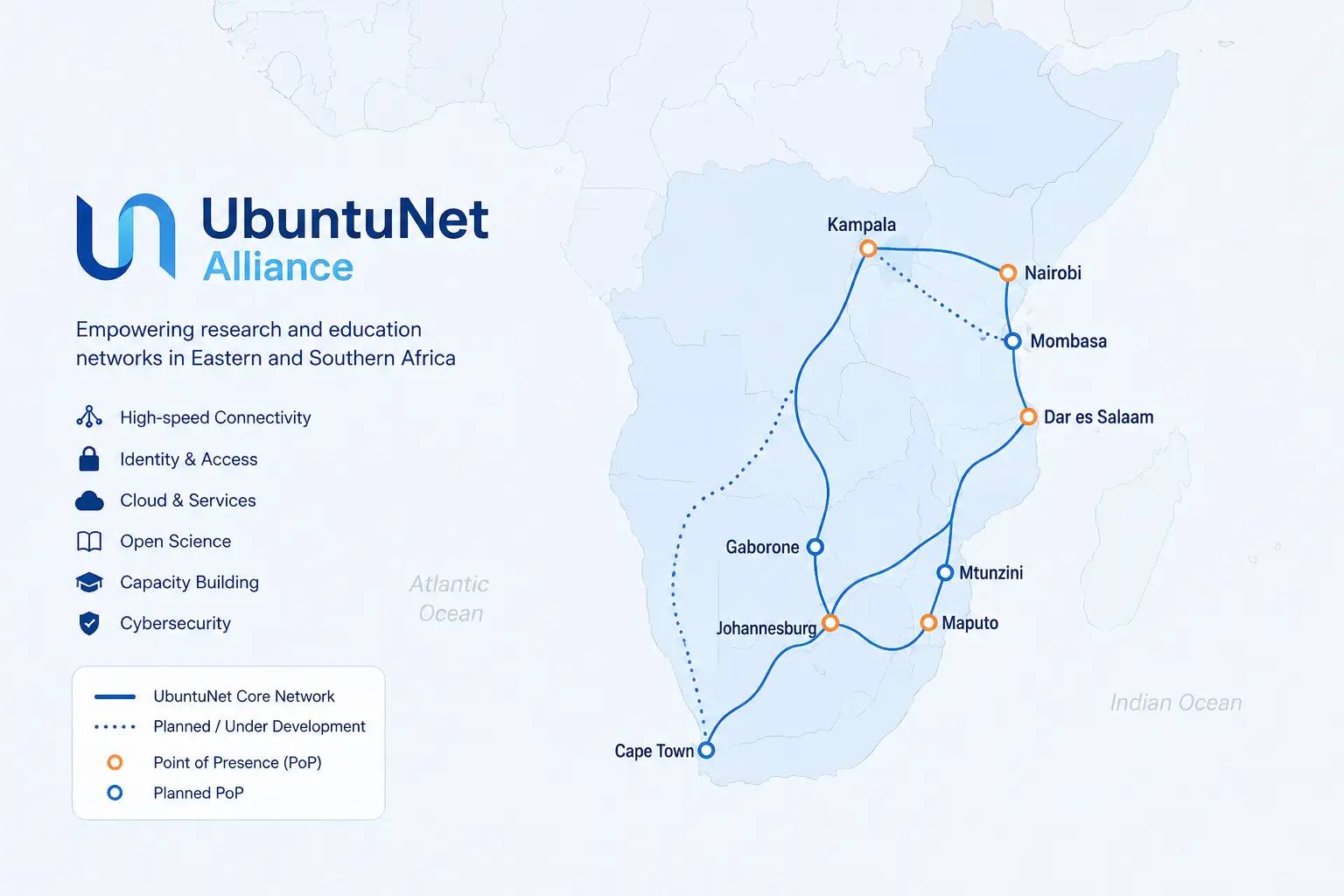
UbuntuNet's 10 Gbps core still depends on the campus edge
UbuntuNet's 2023 report described expanded backbone links from around 2.5 to 10 Gbps, along with new points of presence and peering. That regional advance only reaches researchers when national networks, campus systems, operators, and recurring funding can sustain it beyond each…
Africa Institutional
UbuntuNet’s 10 Gbit/s core still depends on campus networks
UbuntuNet’s 2023 report describes core links upgraded from around 2.5 to 10 Gbit/s, complemented by new Points of Presence and peering. This regional progress reaches researchers only if national networks, campus infrastructure, carriers and recurring funding carry it beyond each…

Africa Institutional
UbuntuNet’s 10 Gbps backbone still depends on university networks
The 2023 UbuntuNet report described upgrading core links from around 2.5 to 10 Gbps, with new points of presence and peering. Yet this regional improvement reaches researchers only if national networks, campus systems, carriers and recurring funding can carry it past each…
Africa Institutional
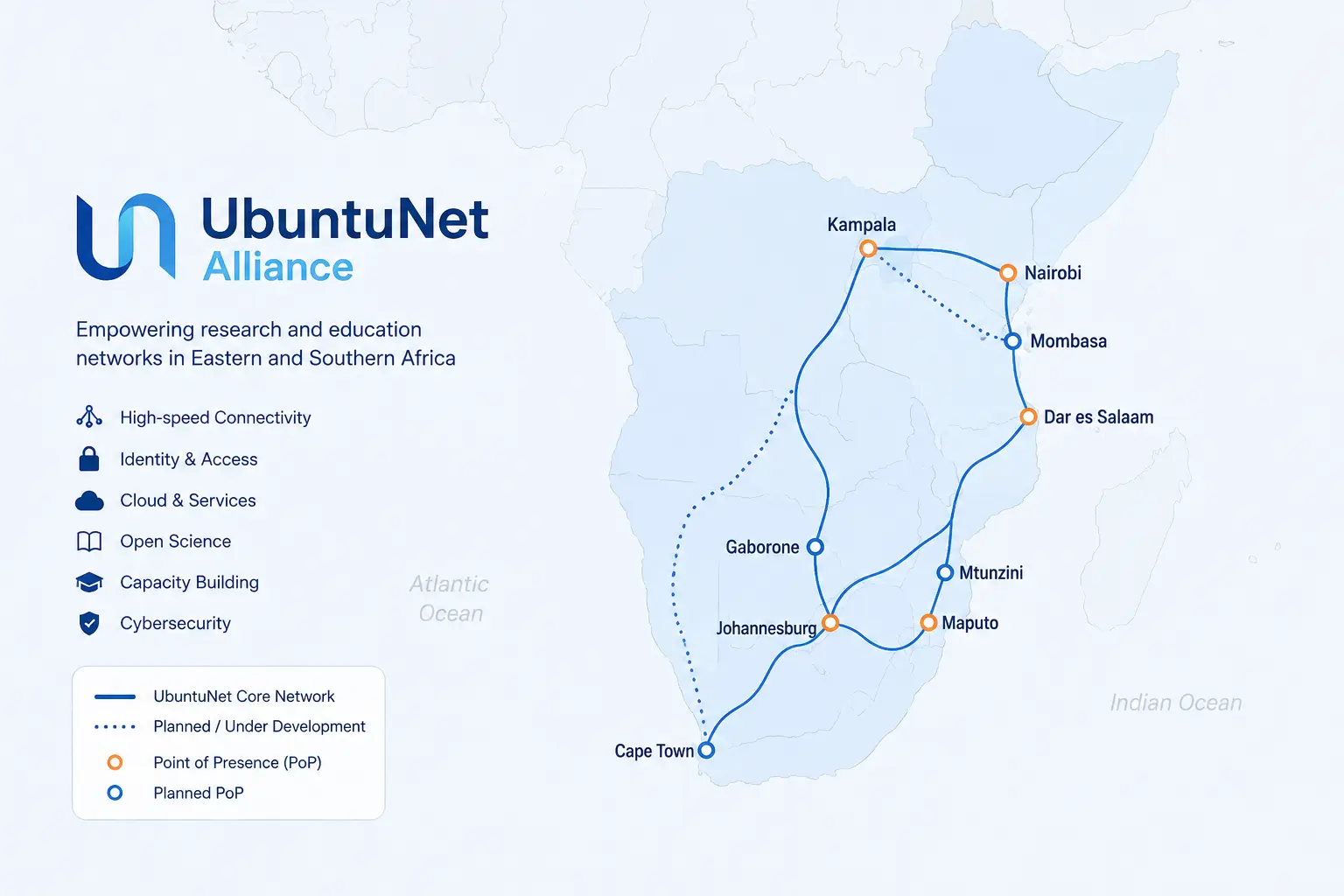
UbuntuNet’s 10 Gbps core still depends on the campus edge
UbuntuNet’s 2023 report described core links upgraded from about 2.5 Gbps to 10 Gbps, with new points of presence and peering. That regional gain reaches researchers only when national networks, campus systems, carriers and recurring finance can carry it beyond each AfricaConnect…

Academics
Nick Feamster: making networks explain themselves, and exposing the limits of measurement
In 2005, a checker he co-developed reported over 1,000 previously undetected faults in 17 autonomous systems. Since then, his effort to make hidden infrastructure explainable has extended to spam, broadband, censorship, smart homes, and machine learning, repeatedly showing that…

Leaders
Pim van Pelt and the Decision to Sunset SixXS
Many infrastructure stories celebrate the moment a system starts. Pim van Pelt's more instructive story turns on the moment he and fellow operator Jeroen Massar decided that SixXS should stop. The service had helped people reach IPv6 when their providers did not offer it…

Global National Telecom
Arelion’s AS1299: Tier-1 Reach Requires Constant Renewal
Arelion’s AS1299: Tier-1 Reach Requires Constant Renewal intelligence summary explains the development, the public evidence available to readers, the organisations involved, the regional context, market exposure, and the infrastructure consequences that may follow. The Global…

Story
AFRINIC called the ASN amendment implemented before it became global policy
AFRINIC called the ASN amendment implemented before it became global policy intelligence summary explains the development, the public evidence available to readers, the organisations involved, the regional context, market exposure, and the infrastructure consequences that may…

Academics
Nick Feamster Created Tools to Explain Networks — and Exposed Their Limits
In 2005, a co-authored verifier reported over 1,000 previously undetected faults in 17 autonomous systems. The same effort to make hidden infrastructure legible later extended to spam, broadband, censorship, connected homes, and machine learning — and repeatedly showed that an…