
Topic
Network-resource Evidence
Within the Topic facet, Network-resource Evidence topic intelligence connects articles that share a specific subject, signal focus, or monitoring theme. The page gives readers a richer path through related reporting, source evidence, market actors, and infrastructure implications, with enough context to understand why the topic matters across company movements, governance decisions, regional exposure, and operational risk. Readers can compare recurring signals, affected organisations, public evidence, market context, service continuity, procurement, competition, compliance, and strategic planning questions behind the subject instead of stopping at a thin list of matching articles. It explains what the topic covers, which infrastructure actors or policies are involved, what evidence supports the coverage, and why the subject may matter for operators, customers, investors, and policy readers.

History
Permission Was Not Acceptance: Why HTTP Added 100 Continue
HTTP 100 Continue let a server reject from headers before a large body crossed the network, while keeping interim permission separate from final acceptance.

Story
RIPE's IPv6 PI Draft Has a Trigger but No Transition Receipt
Nine `/48` assignments can remain a valid deployed state while nothing changes. The next request for address space is different: it can activate a next-nibble decision, a contiguity test, a new prefix and a six-month return clock. Proposal 2024-01 names that trigger but does not…

Story
LACNIC's Anti-Fake-IXP Log Has No Event Column
LACNIC has made a scarce IPv4 reserve unusually visible. Its public file can show who holds an issued interval and how much of the pool remains reserved. What it cannot say in one row is what happened. A log commissioned to cover assignments, recoveries and returns still…

Story
ARIN's ISP/LIR Claim Needs a Predicate Ledger
One card asks what a company sells. Another asks whether it receives and redistributes Internet number resources. Draft Policy ARIN-2025-1 wants every holder of the first card to fit inside the second. Its proposed definitions do not yet make that containment rule true.

Story
APNIC Would Remove `/23`; Three Prefix Sizes Still Need Names
One bit separates a `/23` from a `/24`. It also separates 512 IPv4 addresses from 256. APNIC's current initial-LIR test can ask for immediate need for the smaller block and a one-year plan for the larger one. Prop-169 would repair that mismatch. Its replacement noun now needs an…

Story
AFRINIC Draft 2 Can Waive 90%; “Sufficiently Documented” Has No Fields
AFRINIC recorded the second-data-centre trap in 2018. An End User wanted another `/24` for redundancy, had used less than 90% of its existing space and was therefore ineligible. Draft 2 finally names that class of problem, then leaves the proof inside two words: sufficiently…

Story
Khipu's Local Archive Preference Creates an Evidence Expiry Boundary
A historical Khipu view can reach farther back than the archive shelf available on the workstation opening it. Once the number of local `ip2asn`, `ixp`, `ip2country` and `asn2country` snapshots is a preference, reproducibility has an expiry boundary that the measurement date…

History
The Silence That Wasn't a Failure: Why TCP Keepalive Stayed Optional
An established TCP connection can say nothing for hours and still be correct. Keepalive was the attempt to question that silence without pretending to understand it: send a probe likely to provoke an ACK, collect bounded evidence, and leave the application responsible for…

History
Who Opened TCP's Window Too Soon? The Cost of Immediate Permission
An early TCP receiver could publish every byte of newly freed capacity, and a sender could consume each offer at once. That openness looked exact and cooperative. Repeated quickly, it made the connection spend most of its effort on tiny packets. The historical repair assigned…
Global Institutional
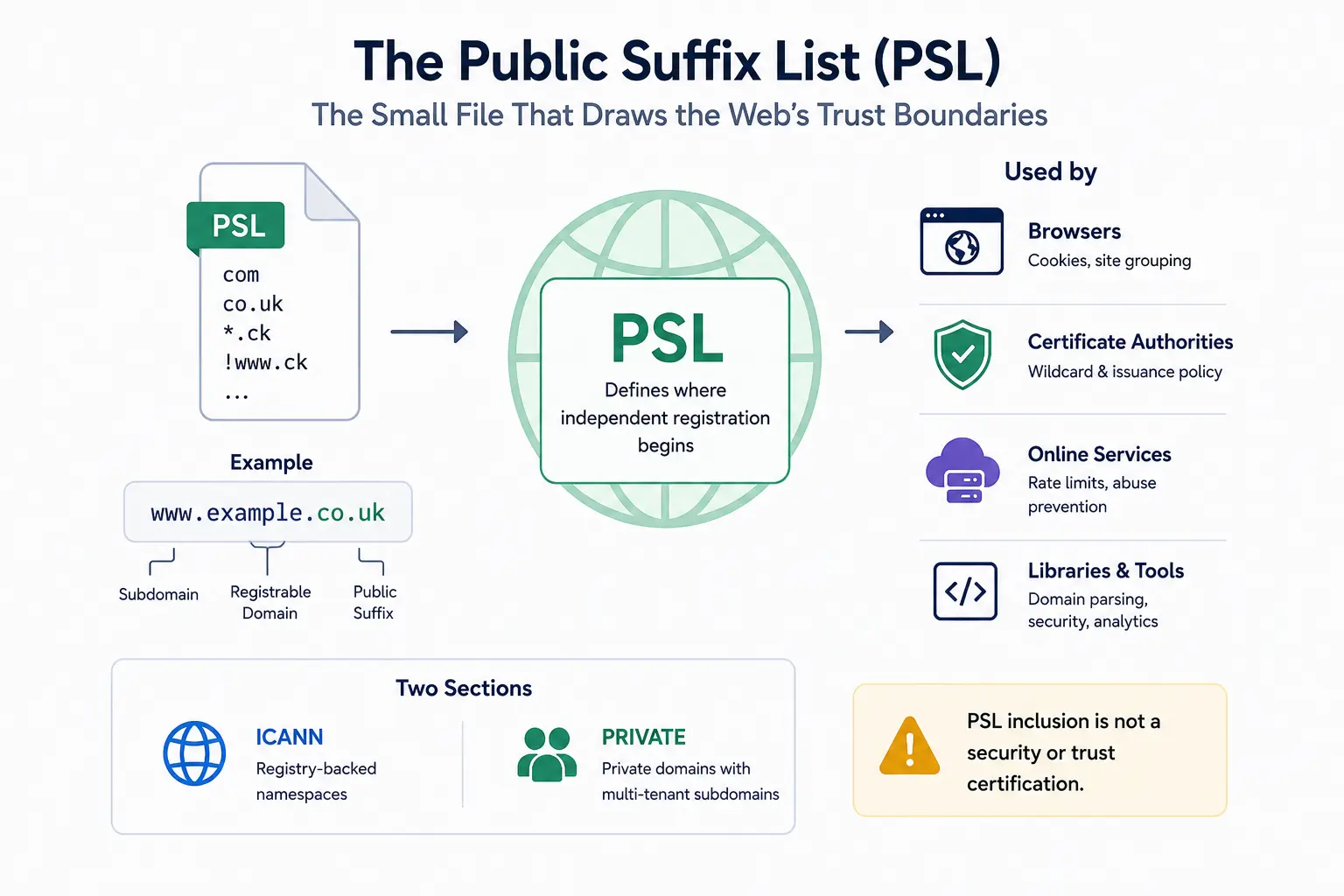
Public Suffix List: The File That Draws Web Trust Boundaries
DNS can show that shop.example.co.uk sits beneath co.uk; it cannot tell a browser where independent registration begins. The Public Suffix List supplies that missing policy map. A volunteer-maintained text file now informs cookies, site grouping, certificates and service limits…

History
The Window Update That Could Vanish: Why TCP Learned to Persist at Zero
A TCP receiver can say “send nothing” and remain healthy. The harder problem begins when it later says “continue” in an ACK that may disappear. TCP's persist mechanism turned that fragile permission into a recoverable conversation, while leaving the application—not a transport…

History
The Verdict UDP Withheld: Who Owned the Risk Behind Zero?
In UDP, zero was not a favourable checksum result. It was a notice that the sender had withheld the verdict. The history from IPv4 to IPv6 is therefore about more than arithmetic: it asks who may remove shared evidence, and when the party saving the work must also own the…

Story
RIPE's First-ASN Proposal Removes One Test but Leaves Three Records Open
RIPE's First-ASN Proposal Removes One Test but Leaves Three Records Open intelligence summary explains the development, the public evidence available to readers, the organisations involved, the regional context, market exposure, and the infrastructure consequences that may…

History
When Both Ends Called at Once: Why TCP Simultaneous Open Was Not a Collision
The familiar TCP handshake casts one endpoint as caller and the other as listener. TCP's original design was less hierarchical. If two processes called each other at once, their SYNs could cross, both stacks could change role without asking a coordinator, and one connection would…

History
The Price of Tolerance: How Receiver Leniency Turned Bugs into Protocol Law
The Internet's most famous rule for imperfect software began as a way to keep unlike implementations talking. Its receiver absorbed ambiguity so the network could start. Kept forever, the same bargain hid defects, made quirks contractual and charged every future implementation…

History
The Pointer That Was Never Out of Band: How TCP Urgent Split from Its Own Stream
TCP offered applications a way to interrupt ordinary processing without creating another connection. The wire carried one ordered stream and a pointer into it; decades of software turned that boundary into a mythical side channel, then made the myth too widespread simply to…

History
The Message the Internet Learned to Ignore: Why ICMP Source Quench Lost Its Authority
The early Internet allowed an overloaded gateway to send a separate command telling a distant source to slow down. Three decades of operational evidence reversed that bargain: congestion still required feedback, but a bare ICMP order no longer deserved the power to change a…

Story
Three National Registers Expose the Gap Behind LACNIC's No-Consensus Result
Brazil calls an individual entrepreneur a natural person doing business in their own name. Argentina opens its simplified tax register to `personas humanas`. Uruguay describes a one-person monotributo business as a natural person registering before economic activity begins.…

History
The Sum That Had Two Zeros: How the Internet Checksum Bounded Error, Not Trust
The Internet checksum made damaged packets easier to reject by making a deliberately small claim. Its strangest corner case—two representations of zero—shows why even cheap evidence must preserve an exact boundary.

Story
One Document Store Put Five RIPE NCC Workflows on Hold
A resource transfer can wait because a policy question is unresolved, because evidence is incomplete, or because the filing cabinet is being upgraded. On 22 August, RIPE NCC members encountered the third case. The distinction matters: a planned administrative pause is not a…