
Topic
Network-resource Evidence
Within the Topic facet, Network-resource Evidence topic intelligence connects articles that share a specific subject, signal focus, or monitoring theme. The page gives readers a richer path through related reporting, source evidence, market actors, and infrastructure implications, with enough context to understand why the topic matters across company movements, governance decisions, regional exposure, and operational risk. Readers can compare recurring signals, affected organisations, public evidence, market context, service continuity, procurement, competition, compliance, and strategic planning questions behind the subject instead of stopping at a thin list of matching articles. It explains what the topic covers, which infrastructure actors or policies are involved, what evidence supports the coverage, and why the subject may matter for operators, customers, investors, and policy readers.
CASE FILE
The BFD Counter Rose. The Service Path Was Still Unproven: RFC 9978 and Stability Evidence
A BFD session can stay Up while control packets disappear inside its Detection Time. RFC 9978 makes that early deterioration observable. It does not turn a control-packet counter into proof of data-plane loss, a failed route, or a customer-facing outage.

Story
LACNIC's Board Is Nine Members. Its Public Description Still Says Seven
A public governance page can be right in its detailed account and wrong in the sentence built to travel furthest. LACNIC's current English Board record offers that small but revealing split: its description says the honorary Board has seven directors; the record's body says nine…
CASE FILE
The Flag Said Several Routers Meant This Prefix. It Did Not Name a Working One: RFC 9983 and Anycast Evidence
An OSPF control plane can state that a prefix is meant to be advertised by several routers. That is useful coordination. It is not a statement that any particular replica is reachable, selected, healthy, authorised to serve, or able to complete the transaction a packet…
CASE FILE
A Cookie Matched the Request. It Did Not Prove the Decision: RFC 10025 and Ambient Authority
A browser can attach the right-looking cookie to the right-looking request at the exact moment a consequential button is pressed. That still leaves four questions open: who caused the request, whether the server still accepts the session, whether this action is allowed now, and…

History
The Byte That Meant “Start Over”: SLIP, RFC 1055, and the Cost of Recovering a Serial Frame
On a quiet serial line, the difference between a valid packet and yesterday’s noise could be one byte. RFC 1055’s SLIP convention used `END` to finish an IP datagram, but it also recommended an `END` before the next datagram. That extra byte did not repair the wire or certify the…

History
The Cutover Was Not One Cutover: How RFC 897 Separated Renaming from DNS Resolution
On 14 March 1984 a host could acquire an official name ending in `.ARPA` while the program using that name still consulted a local copy of a centrally maintained table. The new namespace could arrive through the old lookup machinery. RFC 897 made that apparent contradiction a…

Story
APNIC Reissued Four Expired ASPAs. Its Repair Needs a State Receipt.
APNIC has reported a bounded correction: automatic renewal did not run, four ASPA entities expired, and the entities were reissued and published at 11:03. That is useful operational disclosure. It is not yet a measurement of what every repository, validator, router or customer…
CASE FILE
A Ciphertext Reached the Key. It Did Not Name Its Sender: RFC 9180 and the Authority Missing from HPKE Base Mode
A team can receive an HPKE ciphertext, open it with the intended private key and still be unable to say who sent it, what outer request it belonged to, whether it is fresh, or whether anyone was entitled to act on its plaintext. RFC 9180 makes the cryptographic transition…
CASE FILE
An MPLS Action Is Not an Admission Decision: RFC 9994
A packet can arrive with a perfectly formed MPLS Network Action Sub-Stack, an opcode that an engineer can name and ancillary data that a parser can read. That packet has not yet proved that the next node supports the action, that the action belongs on this path, that its data…

History
The Dash That Grew With Every Forwarding: RFC 934 and the Cost of Recursive Quoting
In 1985, a message digest faced an apparently small problem: a line of ordinary mail text could look exactly like the line chosen to separate enclosed messages. RFC 934 answered by adding characters on the way in and removing them on the way out. That made the boundary…

Story
ARIN Kept Five Services Running Without Updates. Its Service-Level Report Has No Freshness Column
A registry can answer a question and still have nothing new to say. ARIN's planned July maintenance made that distinction visible: five reader-facing services remained operational while updates were not being published. The public service-level report measures availability well…
CASE FILE
The Packet Declared a Haptic Effect. The Device Still Had to Decide Whether to Render It: RFC 9993
A remote session marks one haptic unit as high priority. The packet is valid, the stream is negotiated and the receiver can decode it. None of that tells an actuator where on a body it may act, whether the requested amplitude is within the device’s envelope, whether a temperature…

History
The LANs the Host Was Not Meant to See: RFC 925 and the Cost of Hiding a Topology
An early Internet site could either expose every cable to the wider network or arrange its cables so that a host believed it lived on one large local network. RFC 925 chose the second illusion. It kept the host's ARP unchanged and made an intermediary discover, remember and…
CASE FILE
A Key Could Cross the Fabric. It Could Not Decide the Route: RFC 9992 and RIFT Authority
Two Top-of-Fabric nodes lose contact, each advertises the same RIFT key with a different value, and a leaf sees both. It must select one. A deterministic result is useful; it is not a declaration that the winning value is the current truth, that any receiver may act on it, or…

History
The Carrier Was Not the Connection: How RFC 892 Separated Transport State from the Network Path
One network connection could carry several transport conversations. One transport conversation could, in the most capable class, ride several network connections. RFC 892 treated those as inverse mappings rather than a contradiction: the carrier moved protocol units, while peer…
CASE FILE
The Private Key Never Left. Its Authority Did: RFC 9987 and the Transitive Trust of SSH Agent Forwarding
An engineer forwards a workstation’s SSH agent to a bastion. A process on that bastion cannot copy the private key, yet it may still ask the distant agent to sign a new authentication request. “No key exfiltration” is therefore an incomplete incident verdict: material custody and…

IETF
Gavin Brown and the Successful Create That Did Not Yet Register a Domain
The server said the command had completed successfully. In the same breath, it said the action was still pending. RFC 8334 makes that apparent contradiction useful: an accepted application is evidence, but it is not yet a registered domain.

CASE FILE
SC100’s Draft Draws DNSSEC’s Boundary at the Primary Perspective. The Receipt Must Name It
SC100 passed its vote by unanimity among the members who participated, but on 31 August 2026 it was still an accepted draft under intellectual-property review. Its most useful clarification is not that “DNSSEC is required.” That duty already exists. It is that the duty belongs to…

IETF
Russ Housley and the MAC Address a Certificate Could Name but Not Make Unique
Six bytes can fit cleanly inside a certificate. The difficult part begins after they leave it: who assigned them, what interface is using them now, who observed that use, and why a local network should permit an action.
History
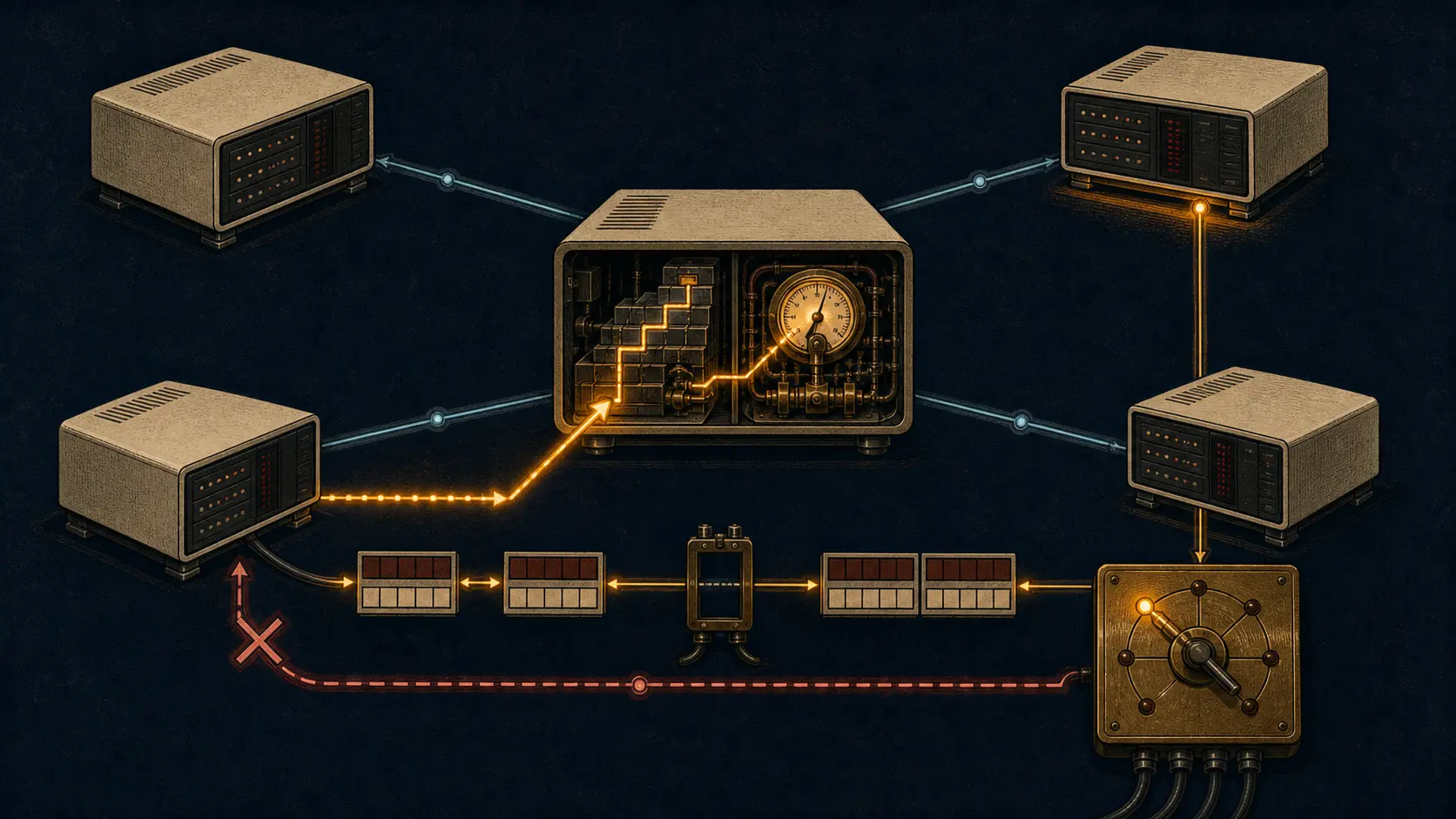
The Fastest Path Carried the Clock. It Did Not Choose the Master: How RFC 891 Bound Routing and Time to One HELLO
In the Fuzzball network, one HELLO could change both the route to a host and the clock offset associated with that route. The economy was deliberate, but authority remained divided: measured delay selected a path, configuration named the master, and the local clock decided…