
Topic
Network-resource Evidence
Within the Topic facet, Network-resource Evidence topic intelligence connects articles that share a specific subject, signal focus, or monitoring theme. The page gives readers a richer path through related reporting, source evidence, market actors, and infrastructure implications, with enough context to understand why the topic matters across company movements, governance decisions, regional exposure, and operational risk. Readers can compare recurring signals, affected organisations, public evidence, market context, service continuity, procurement, competition, compliance, and strategic planning questions behind the subject instead of stopping at a thin list of matching articles. It explains what the topic covers, which infrastructure actors or policies are involved, what evidence supports the coverage, and why the subject may matter for operators, customers, investors, and policy readers.

Europe and Middle East Regional ISP
Explorer Servizi S.R.L and the price of owning network reliability
Explorer Servizi S.R.L and the price of owning network reliability intelligence summary explains the development, the public evidence available to readers, the organisations involved, the regional context, market exposure, and the infrastructure consequences that may follow. The…

Europe and Middle East Regional ISP
Extlikes Solutions LTD and the price of owning network reliability
The commercial question behind Extlikes Solutions LTD is not whether a company can appear in the resource-governance layer of the internet. It can. The harder question is whether a sparsely disclosed Cyprus-linked operator can persuade enough customers to pay for reliability…

North America Regional ISP
Faction Group Two, LLC and the capital recovery test behind local network control
Faction Group Two, LLC sits in an awkward geography for a network economics story: a United States legal entity is visible in RIPE NCC membership records, the service-area record points to Germany and the United Kingdom, and the most concrete public IP signals cluster around…

Europe and Middle East Regional ISP
FIBRA A LA PORTA, S.L. and the margin risk below cloud scale
FIBRA A LA PORTA, S.L., trading publicly as Biartel in Biar, looks less like a speculative network-resource story than a small local telecom economics case: the company has public evidence of real access demand, a local service office, bundled fiber, television, fixed voice…

Europe and Middle East Regional ISP
FIBRA VILLARRUBIA S.L. and the price of owning network reliability
Reliability is only valuable when somebody is willing to pay for it before the outage arrives. FIBRA VILLARRUBIA S.L. sits in that hard economic space: a Spanish local-network company with public RIPE NCC membership evidence, a narrow visible footprint and little public pricing…

Europe and Middle East Regional ISP
Fichtner GmbH & Co. KG and the Capital Recovery Test Behind Local Network Control
Fichtner GmbH & Co. KG has enough public network-resource evidence to make local control relevant to its infrastructure-consulting story, but not enough to make carrier scale the centre of the case. The economic question is whether that control earns its cost as a resilience and…

Europe and Middle East Regional ISP
Five9 Inc., UK Limited and the margin risk below cloud scale
Five9 Inc., UK Limited gives Five9 a British legal, registry and network-resource foothold, but the economics that matter are still those of the listed parent: a cloud contact-centre software company trying to prove that its voice control, AI tooling and enterprise integrations…

Europe and Middle East Regional ISP
FMMR Technologies GmbH and the Price of Owning Network Reliability
Reliability becomes a business only when a customer can point to a specific operator, a specific failure mode and a specific economic loss that is worth preventing. FMMR Technologies GmbH has the legal identity, RIPE NCC member footprint and technical signals of a small German…

Europe and Middle East Regional ISP
FRANCE MEDIAS MONDE SA and the capital recovery test behind local network control
FRANCE MEDIAS MONDE SA is not a local broadband challenger trying to win households from Orange, Free, Bouygues Telecom or SFR. It is a French public international media group whose network choices sit inside a harder economic question: whether owning and steering enough…

Europe and Middle East Regional ISP
FRITZ! Technology GmbH and the margin risk below cloud scale
FRITZ! Technology GmbH sits in an awkwardly valuable part of the broadband economy: close enough to the home network to influence user experience, security, telephony, Wi-Fi coverage, and device loyalty, but far below the scale and recurring revenue profile of cloud platforms…

Europe and Middle East Regional ISP
Fsas Technologies GmbH and the price of owning network reliability
Fsas Technologies GmbH sits in a difficult place for public analysis: the legal identity is clear, the Fujitsu connection is well evidenced, and the RIPE NCC member record gives it a concrete role in Internet number-resource administration, but the public record does not show a…

Global Cloud Services
F5 made management-plane exposure a load-balancer accountability test
The F5 BIG-IP CVE-2022-1388 record is most useful when it is treated as a management-plane accountability case. A load balancer can quietly support critical application traffic for years, but if the administrative plane is exposed and exploitable, the system that keeps services…

Global Cloud Services
Ubiquiti made insider extortion a cloud-device disclosure test
Ubiquiti's 2021 incident should not be remembered only as a strange insider-extortion story. Its lasting value is sharper: when cloud credentials, device-management infrastructure, customer notice, public-reporting pressure, and later prosecution records collide, accountability…

Global Cloud Services
GitHub token exposure made Slack repair a cost-transfer accountability test
Slack's 2022 GitHub-token incident was not only a source-code access story. It was a test of how collaboration platforms, developer platforms, employee credentials, repository permissions, and customer notice divide responsibility when one integration secret moves risk across…

History
Estonia made DDoS response a public-service detection accountability test
Estonia's 2007 DDoS attacks should not be remembered only as a geopolitical cyber milestone. They were also an early public test of whether a digital state could preserve service continuity, communicate uncertainty, coordinate across networks, and prove that online public…

CASE FILE
YouTube showed how BGP route leaks can outrun the platform contract
The 2008 YouTube reachability failure is not only a routing incident. It is a durable accountability example of how users can experience a platform outage even when the decisive control sits outside the direct platform-user contract, in route announcements, upstream filtering…

Story
RIPE NCC showed why ROA mistakes can become common-mode routing dependencies
RPKI and Route Origin Authorizations improve routing security, but they also turn registry data, operator choices, validation state, and rollback discipline into shared dependencies. A bad or overly narrow ROA does not automatically cause a global outage, yet it can become a…

ICANN
ICANN made the DNSSEC root key rollover a readiness-evidence problem
The first DNSSEC root Key Signing Key rollover was not a story about a global outage. It was a story about how a global maintenance event should prove readiness before it touches the trust anchor that validating resolvers depend on. ICANN's postponement in 2017 and completion in…

CASE FILE
Meta made BGP and DNS outage cost transfer visible at platform scale
Meta's October 2021 outage was a network-control failure with social, commercial, and operational consequences far beyond the engineers who touched the backbone. It showed how an internal maintenance command, DNS reachability, BGP withdrawal, employee access, advertisers…
Global National Telecom
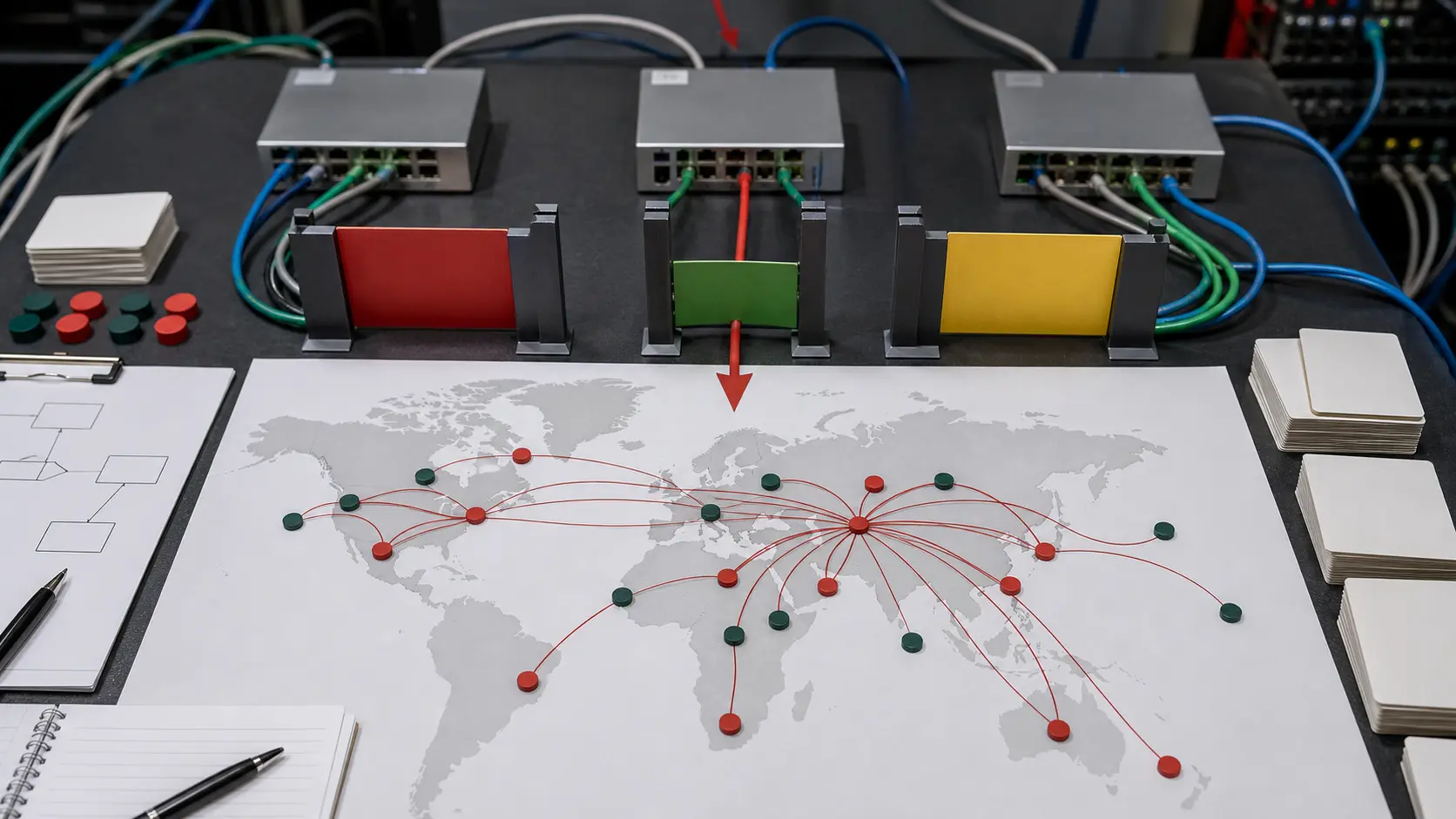
Pakistan Telecom made upstream route filtering the missing control in YouTube reachability
The 2008 YouTube route hijack remains a routing-accountability case because a domestic control route announced by Pakistan Telecom became a global reachability failure only after upstream acceptance and propagation turned a local network decision into an internet-wide disruption.