
Summary
- RFC 1316 modeled a character-stream port as a physical or virtual attachment that can support one or more sessions; the port and its sessions therefore have related but separate management records.
- The MIB distinguishes the desired administrative state of a port from its actual operational state, and it distinguishes port-wide character counters from each session's subset of those counters.
- A reset or kill control is a request defined by the MIB. It is not, by itself, a complete account of a person, remote partner, transcript, delivery, receiver action or application outcome.
A connector was not the whole conversation
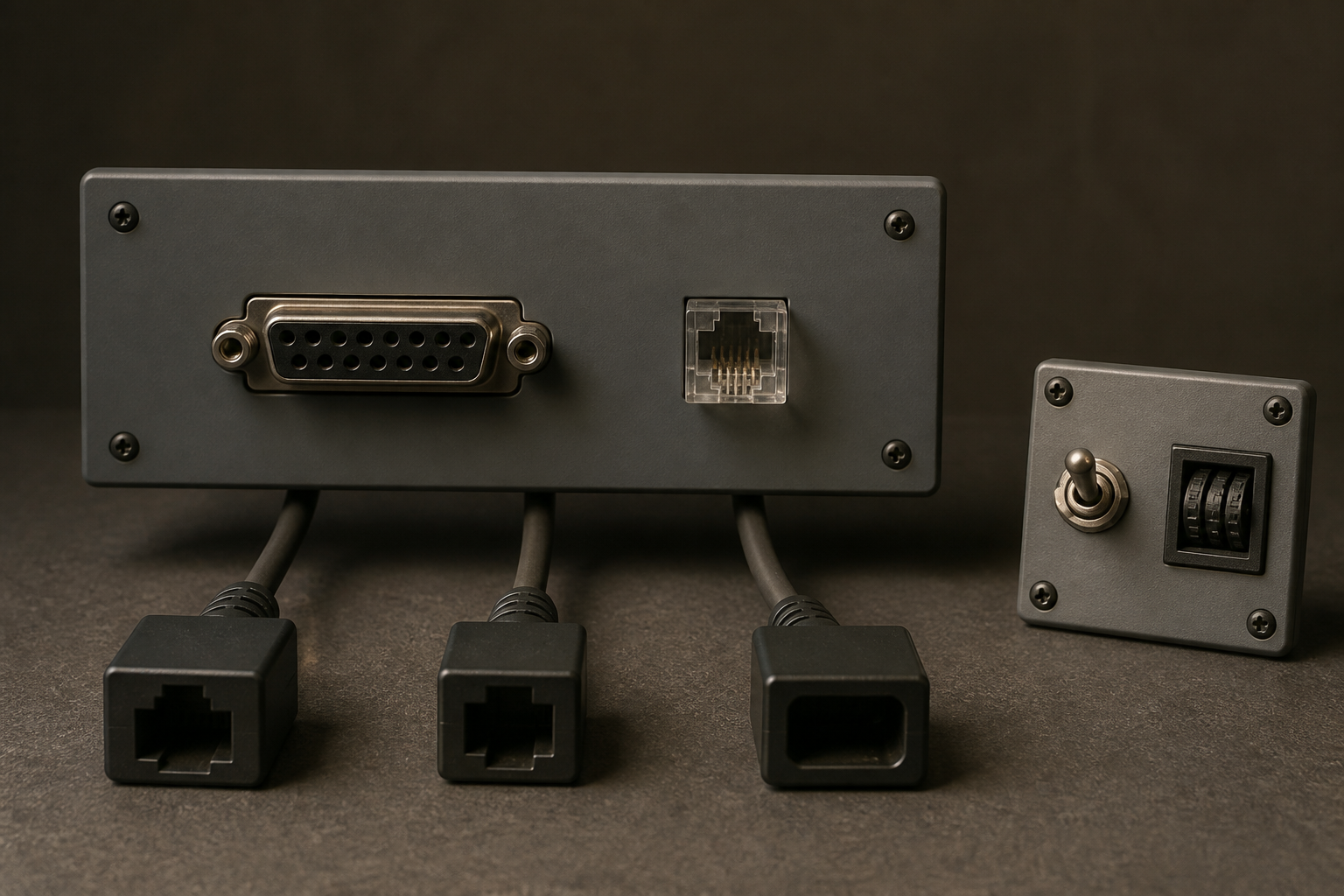
The machines RFC 1316 had in view make the distinction easy to overlook. A terminal-server rack might expose hardware RS-232 ports. A host might expose a parallel printer connection. A remote console could appear as a virtual terminal port with no physical connector at all. All could carry a stream of characters, and all could tempt an operator to regard the visible attachment as the unit that mattered.
The Character MIB began by making the port a unit worth naming. A physical port corresponded one-to-one with hardware; a virtual port was a software entity analogous to hardware but without its connector. That was already a useful boundary. A port name could have local administrative significance. A port index could identify a row. Neither was a human identity, an account, a transcript or a universal name outside the agent that exposed it.
Then the RFC introduced a second unit: the session. Each port could support one or more sessions. A session was a virtual connection that carried characters between the port and some partner, often through a protocol stack such as Telnet over TCP. The point was not simply to list more fields. It was to stop one layer's facts from impersonating another's.
Imagine an operator seeing a port with activity. That observation can answer a bounded question about the managed port. It cannot reveal how many sessions made the aggregate interesting, which session supplied a particular character, what a remote partner meant by those characters, or whether a screen, printer, application or person later did anything with them. The MIB made the separation available before an incident report tried to erase it.
Desired state and operational state answer different questions
RFC 1316 gave the port both charPortAdminStatus and charPortOperStatus. Their proximity is precisely why they must not be merged.
The administrative object records the desired state, independently of flow control. Enabled permits characters and new sessions. Disabled still permits characters but no new sessions. Off permits neither characters nor sessions. Maintenance marks a mode exclusive of normal operation, such as a test. This is a control or policy surface: it says what the port is administratively allowed to do under the agent's model.
The operational object records the actual operational state, also independently of flow control. Its values include up, down, maintenance, absent and active. The RFC describes active as up with a user present, for example logged in. That is more specific than a bare green light, but it is still an operational classification within this MIB. It does not identify a particular person, authenticate that person, establish intent, preserve what was typed, prove that a remote peer accepted anything or describe an application consequence.
The difference becomes practical when the two fields do not tell a tidy story. An administrative instruction can exist while an operational condition remains different. A port can be disabled for new sessions without making its already permitted characters disappear from history. A maintenance value is not a completed test report. An active condition is not a record of authorization, successful work or reader attention. The value of the pair is that it prevents a dashboard from answering a question it was never asked.
Aggregate counters have a boundary too
Counters are especially persuasive because they look numerical and cumulative. RFC 1316 defined input and output character counters for the port, but it carefully described what they include. Input can include framing, flow-control characters such as XON and XOFF, BREAK conditions, locally processed input and input sent to all sessions. Output can include the analogous control and locally created output as well as output received from all sessions.
Those details make a port total a rich operational observation, not a transcript. A growing port counter does not identify a single session. It does not say which bytes were ordinary data rather than framing or flow control. It does not establish a semantic command, a receipt, a display, a print job, a remote action or a business event.
The session table provides a narrower record. Its input and output counters are explicitly subsets of the port's corresponding counters. That relation is useful for attribution inside the agent's model: a manager can ask how a known session contributes to a port total. It does not turn the subset into end-to-end proof. The MIB's session index is local to its port; the same number can be reused on another port. A counter with a familiar index needs its port context, observation time and agent context before it can be compared responsibly.
This is an early lesson in observability design. Aggregation is not a flaw. A port-wide total is exactly the right answer to some questions. The mistake begins when its convenience is used to replace the per-session record, and when the per-session record is used to replace evidence from a remote system or an application.
A connected session was a bounded condition
RFC 1316's charPortSessionNumber counts sessions in connecting, connected or disconnecting state. The session table then gives charSessState those same broad stages. Connected means character data could flow on the network side of the session. Connecting and disconnecting describe motion into or out of that condition.
That wording is deliberately smaller than a success story. “Could flow” does not say that a particular character did flow. It does not establish the content of any exchange, a preserved transport transcript, a correct remote program, a human at the other end or the acceptance of a request. Nor does a session count say that each session is equivalent. The counter includes three states, including transition; it is an inventory of managed session conditions, not a list of completed interactions.
The RFC offers several clues without making them an identity system. charSessOperOrigin may say only unknown, network or local. charSessProtocol names the network protocol used by the session. A connection identifier may refer to additional local MIB information, preferably in the highest relevant MIB, but an agent without such information returns a null object identifier. These fields improve correlation. They do not manufacture an endpoint identity, an authenticated principal or an outcome from missing evidence.
The most durable practice is to retain the linkage rather than collapse it: port index; session index in that port; observation time; port administrative and operational values; session state; the available protocol or connection reference; and separate measurements from the partner or application when a broader claim is needed. A record becomes more useful, not less, when it says exactly which layer it belongs to.
Execute was a control value, not a retrospective narrative
The MIB's two command-like objects show why controls require especially careful reading. charPortReset has ready and execute values. Reading it always produces ready; setting execute causes a reset intended to force the port into a clean initial state in hardware and software and to disconnect existing sessions. charSessKill follows the same pattern for one session: a read returns ready, while setting execute causes termination.
These specifications are operationally important. They identify a control surface and state the intended action in the managed system. But a later observation of ready is not a receipt for every consequence someone might imagine. Because ready is the value returned by a read, it cannot alone be treated as a durable log proving who set execute, which session was present at that instant, what remote party observed the transition, whether a user lost work, whether a reconnect happened or whether a service recovered.
The control should therefore sit beside, not inside, the outcome record. Preserve the set request, its actor and authorization evidence where available; retain the port and session state before and after; capture remote or application evidence separately; and record uncertainty when the agent has no transaction audit. The RFC supplies an object model for a managed action. It does not convert management syntax into a complete account of the world.
The historical lesson is a vocabulary of restraint
RFC 1316 emerged when terminals, serial hardware, virtual consoles and remote sessions all needed a common way to be managed. Its achievement was not a grand theory of users. It was a workable vocabulary that gave different observations different homes: a port, a session, a port-wide total, a session subset, an administrative intention, an operational state and a control.
That vocabulary survives as a method. When an operational system reports that a port is active, ask whether the question is really about the port, a session, a remote partner, an identity, a transcript or an application. When a counter rises, ask what the counter includes. When a reset is issued, ask what evidence shows the request, the local state change, the remote effect and any recovery. Management becomes more accountable when it stops treating a single object as a shortcut through all those boundaries.
Sources and evidence limits
This article relies on RFC 1316, Definitions of Managed Objects for Character Stream Devices (April 1992). It supports the Character MIB's physical/virtual port distinction, one-or-more session model, port administrative and operational states, aggregate and per-session counters, session stages/origin/protocol/correlation reference, and reset/kill controls. It does not establish a live port, named person, credential, authority, exact partner, transcript, packet delivery, displayed output, application result, audit completeness or an actual reset/termination event.
Member Briefing
Deeper Profile Context
Sign in with the right membership level to unlock the full briefing and source notes.
Only for Strategic Circle
Strategic Circle
Open to all readers. Unlock profile briefings after joining and signing in.
Join Strategic CircleOnly for Leadership Alliance
Leadership Alliance
For qualified IP-asset owners and management; sign in to unlock alliance briefings.
Join Leadership Alliance