
Topic
Network-resource Evidence
Within the Topic facet, Network-resource Evidence topic intelligence connects articles that share a specific subject, signal focus, or monitoring theme. The page gives readers a richer path through related reporting, source evidence, market actors, and infrastructure implications, with enough context to understand why the topic matters across company movements, governance decisions, regional exposure, and operational risk. Readers can compare recurring signals, affected organisations, public evidence, market context, service continuity, procurement, competition, compliance, and strategic planning questions behind the subject instead of stopping at a thin list of matching articles. It explains what the topic covers, which infrastructure actors or policies are involved, what evidence supports the coverage, and why the subject may matter for operators, customers, investors, and policy readers.

History
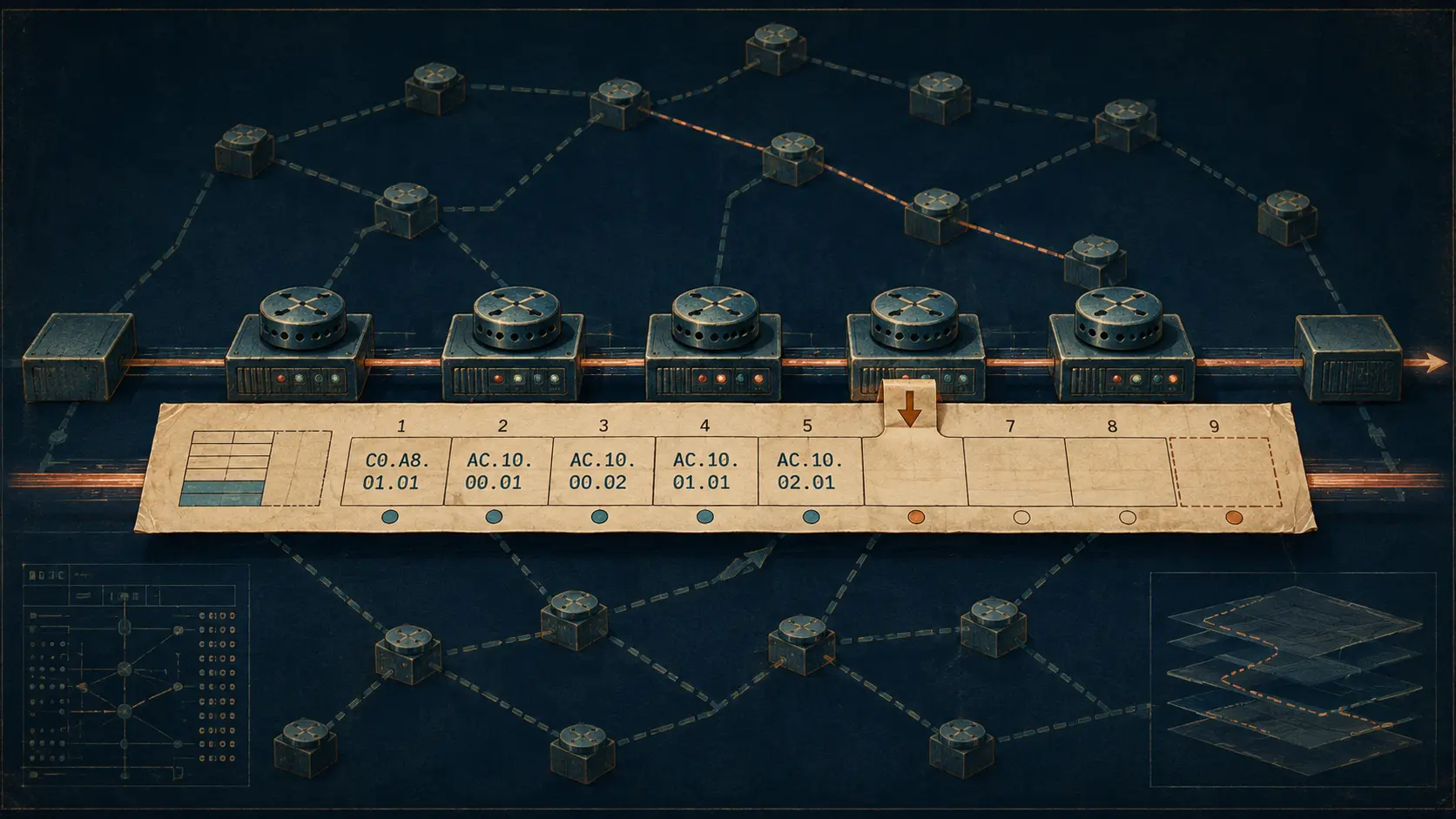
The Mailbox Accepted the Voice. It Could Still Forget the Message: RFC 1911
A voice mailbox could accept an Internet message, store its sound and still forget part of what made it an Internet message. RFC 1911 did not hide that cost. Its minimum profile joined telephone-keypad systems to MIME and ESMTP while exposing the distance between accepted bytes…
History
The Address Book a Packet Filled Along the Way: IPv4’s Record Route Option
IPv4 once let a packet carry an empty address book. Routers could add their own addresses as it passed, turning forwarding into a voluntary act of testimony. The bytes were exact; the resulting story of the path was not.

IETF
Brian Haberman and the 40-Bit Global ID That Was Not an Allocation Receipt
A locally generated IPv6 prefix can be extraordinarily unlikely to collide with another one and still carry no guarantee. Brian Haberman’s work on RFC 4193 makes that distinction operational: probability reduces coordination cost, but only an inventory, a route decision and a…

Europe and Middle East Regional ISP Trends
Regional Information Technologies: turn the registry map into a verification schedule
Regional Information Technologies: turn the registry map into a verification schedule intelligence summary explains the development, the public evidence available to readers, the organisations involved, the regional context, market exposure, and the infrastructure consequences…

Story
ARIN’s Whois Retirement Proposal Is a Protocol Transition, Not the End of Directory Data
Three dates in ARIN’s latest consultation can look like shutdown deadlines. They are not. The registry is asking how to retire three older access protocols in favour of RDAP, with separate dependencies and earliest dates for each path. The proposal changes how registration data…

History
The Clock a Packet Asked Routers to Sign: IPv4’s Internet Timestamp Option
IPv4 once gave a datagram a small ledger and asked machines along its path to write down the time. The Internet Timestamp option was precise about the writing procedure, but far less powerful as evidence than its name suggested. Its history shows how a cooperative diagnostic…

History
The Address Changed. The References Did Not: RFC 1900 and the Hidden Cost of Renumbering
In 1996, the Internet Architecture Board described a task that sounded almost clerical: replace one set of IP addresses with another. Then RFC 1900 followed the old numbers out of the router and into configuration files, applications, licences and human-maintained lists. The…

CASE FILE
The Draft Was New. Its Dependency Had Expired Six Years Earlier
Revision 09 gave an L2VPN snooping draft a fresh date without changing its mechanism. The document can still be useful, but its own import graph shows why leaders must demand an executable dependency receipt before treating standards activity as implementation readiness.

IETF
IETF’s PROBE Revision Admits Its Ping Analogy Misled Both Code and Eyes
A new deployment appendix records an unusually candid standards lesson: a familiar analogy can become an undocumented instruction, first for implementers and then for operators reading the result.

History
The Old Address Fit Inside IPv6. Its Routing Model Did Not: RFC 1888
A twenty-octet address can be placed beside a sixteen-octet one, sliced, tagged and reconstructed. That arithmetic says nothing about whether the route hierarchy survives the move. RFC 1888 recorded this distinction in 1996: its encodings could preserve address bits, while the…

Europe and Middle East Regional ISP Trends
Regional Digital Telecommunication Company: a licence list does not identify the recovery chain
A detailed licence list can make a regional provider look unusually legible. It names regulated service classes and gives a buyer identifiers to check. But it does not reveal which network components deliver a specific contract, who detects a failure, who restores service, or…

Global Regional ISP Trends
A RACK Loss Mark Is Not Proof a Packet Was Dropped
Imagine an original TCP segment taking a slower ECMP path. A later segment is acknowledged first, RACK’s reordering budget expires, and the sender marks the missing range lost and retransmits it. Then both copies arrive and a DSACK reports the duplicate. Recovery was rational…

Story
LACNIC Whois routing-c Can Register Routing Policy, Not Prove Who Operates BGP
LACNIC Whois routing-c Can Register Routing Policy, Not Prove Who Operates BGP intelligence summary explains the development, the public evidence available to readers, the organisations involved, the regional context, market exposure, and the infrastructure consequences that may…

History
The Test Address Came With Its Eviction Notice: RFC 1897 and the 6bone
In 1996, an IPv6 address could be useful, globally coordinated and routable across an experimental backbone while still carrying no promise of permanence. RFC 1897 made that distinction explicit: its addresses were for prototype testing, would be reclaimed and required their…

CASE FILE
A Celestial Name Is Not a Network Address: The Authority Split TIPTOP Has to Preserve
One entity can be discovered under a temporary tag, receive several provisional designations, gain a permanent number and acquire a name years later. A route cannot afford to mistake any one of those labels for proof of where a packet should go.

History
The Route the Sender Tried to Choose: How IPv4 Source Routing Lost Its Default Trust
IPv4 once carried a small, mutable itinerary inside the packet itself. The history of source routing is the history of how that sender-supplied path changed from a protocol feature into an explicitly configured exception.

History
The Peer Returned a DNS Address. It Had Not Proved Names Would Resolve: RFC 1877
The useful answer in a 1995 dial-up exchange could begin with a deliberately useless address. A PPP client placed zero in an IPCP name-server option precisely so the remote peer would reject the value and suggest another. That suggestion could become negotiated configuration only…

History
The Address That Meant Everyone: How IPv4 Broadcasts Chose Ones Over Zeroes
IPv4 did not gain broadcasting through a new flag. It gained it by teaching hosts and gateways that some destination values did not name one machine at all. A field of ones came to mean everyone within a scope, while receivers carried an awkward obligation to understand the…

Europe and Middle East Regional ISP Trends
Region Svyaz Konsalt: matching registry records still leave the service controller to prove
Region Svyaz Konsalt: matching registry records still leave the service controller to prove intelligence summary explains the development, the public evidence available to readers, the organisations involved, the regional context, market exposure, and the infrastructure…

IETF
Radia Perlman and the Appointed Forwarder That Had to Stop Forwarding
A TRILL switch may still hold the appointment for a VLAN while its safest legal action is to drop the native frames it would normally handle. That is not a contradiction in the standard. It is the moment when recorded authority and permission to act must be read as separate…