
Topic
Institutional Legitimacy
Within the Topic facet, Institutional Legitimacy topic intelligence connects articles that share a specific subject, signal focus, or monitoring theme. The page gives readers a richer path through related reporting, source evidence, market actors, and infrastructure implications, with enough context to understand why the topic matters across company movements, governance decisions, regional exposure, and operational risk. Readers can compare recurring signals, affected organisations, public evidence, market context, service continuity, procurement, competition, compliance, and strategic planning questions behind the subject instead of stopping at a thin list of matching articles. It explains what the topic covers, which infrastructure actors or policies are involved, what evidence supports the coverage, and why the subject may matter for operators, customers, investors, and policy readers.

IETF
A Gateway May Decline the Purpose. A Transit Proxy May Not Speak for the Origin
An HTTP response can make a purpose-based refusal visible without revealing the rule behind it. A new HTTPbis draft now draws the more important boundary: an origin may make that decision, and a gateway may relay it on the origin’s behalf, but an independent proxy does not…

ICANN
ICANN’s Authority Is a Chain, Not a Sovereign Grant
ICANN can shape the global identifier system without possessing a general public-law mandate over the internet. Its authority changes form as it moves from corporate purpose to Bylaws, from multistakeholder policy to contractual obligation, and from contract to technical…

Global Institutional Trends
ISC’s control chain: what public evidence shows about prevention, detection and durable repair
ISC’s public record presents a recognizable operational control chain: vulnerability information is coordinated, supported software releases are published, high-availability behavior is documented and tested, service status is exposed, and F-Root operations are described across…

IETF
IETF-W3C Is Not One Institution: Authority Depends on the Instrument
The label IETF-W3C suggests a single governance center. The public record describes something more fragmented: the IETF standards process, the IETF Administration LLC, and W3C’s technical and membership structures assign different powers to different bodies. That distinction…

IETF
A Live Debate Can Test Command. It Cannot Set the Author Record
An unscripted exchange can reveal whether a person understands a technical proposal. It cannot reveal who supplied each paragraph, where software assistance ended, or who accepted responsibility for the final text. A new Internet-Draft brings that distinction into the IETF’s…

History
No Memo Could Command the Network: RFC 1958 and the Right to Change
The most durable sentence in a document about architectural principles may be its warning that the principles will not endure. RFC 1958 treated the Internet less as a monument to be defended than as a city whose streets had to remain open while each block was rebuilt.

Global Institutional Trends
Utherverse Network Operations: What AS33169 Can—and Cannot—Show About Continuity
A forensic examination of the public record around Utherverse Network Operations finds a network identity, but not yet an auditable picture of who controls prevention, detection, response or durable repair.

IETF
RFC-to-be 10040 Can Sign a Map-Reply. It Cannot Verify the Location
A coordinate can arrive in a reply whose sender and contents are cryptographically authenticated, yet still lack an answer to the most physical question in the exchange: who actually measured the place? RFC-to-be 10040 is nearly through the publication workshop. Its governance…

ICANN
ICANN’s Remedies Are Not One Appeal: Who Can Stop, Review or Reverse a Decision?
ICANN’s accountability system does not place every objection on one appellate ladder. It distributes authority among the Board, the Empowered Community, ICANN’s staff-facing reconsideration process and an independent review panel. The practical question is therefore not simply…

Global Institutional Trends
RIPE ABUSE: A Reporting Route Is Not Proof of Repair
RIPE ABUSE: A Reporting Route Is Not Proof of Repair intelligence summary explains the development, the public evidence available to readers, the organisations involved, the regional context, market exposure, and the infrastructure consequences that may follow. The Global…

History
RFC 10028 and the Institutional Boundary of IPv6 Multicast
RFC 10028 did more than tidy an IPv6 registry. It shows how an IETF decision becomes operational authority: a standards document changes the allocation map, and IANA gives that decision a durable administrative surface. The result is a cleaner boundary between multicast uses—but…
Number Resource Society
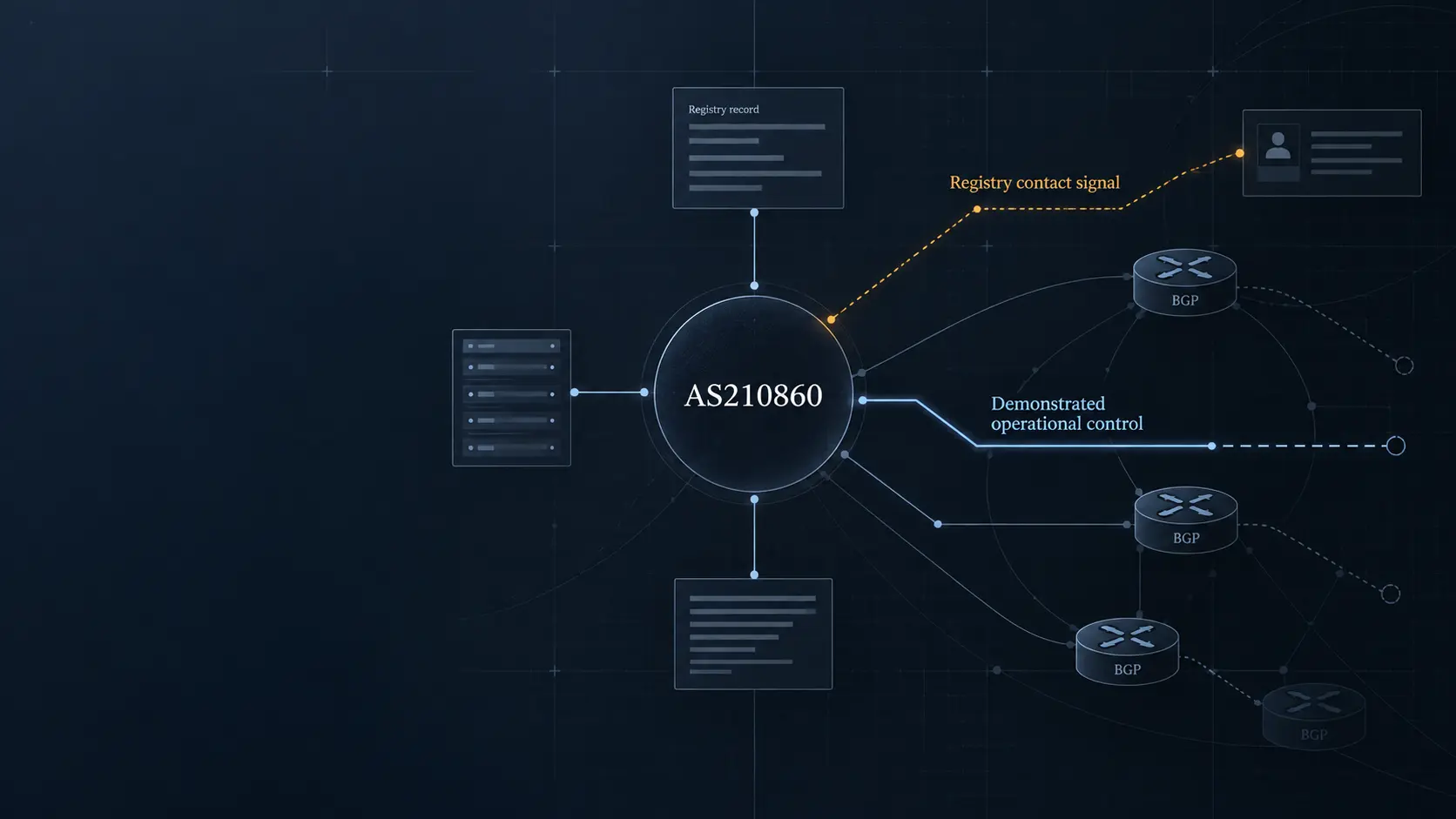
DFINFRA and AS210860: the registry signal still stops short of operational control
DFINFRA and AS210860: the registry signal still stops short of operational control intelligence summary explains the development, the public evidence available to readers, the organisations involved, the regional context, market exposure, and the infrastructure consequences that…

Leaders
Osipenko Alexander Nikolaevich: The Control Question the Public Record Still Cannot Answer
Osipenko Alexander Nikolaevich: The Control Question the Public Record Still Cannot Answer intelligence summary explains the development, the public evidence available to readers, the organisations involved, the regional context, market exposure, and the infrastructure…

Global Institutional Trends
AS210057: What the Public Record Can—and Cannot—Prove About Routing Control
A forensic briefing on the difference between registry records, routing authorization, observed BGP visibility and durable operational control around the frozen INFINITYWIFI directory entity.

Story
AFRINIC’s Two-Day Service Clock Opens on Three Different Maps
AFRINIC promises an effective response within two working days. Yet a correspondent choosing where to send a request meets twelve queue labels, sixteen specialist addresses, or three broad contacts and a general form. The commitment needs a public map between the front door and…

ICANN
IAB Reappoints David Lawrence; Its ICANN Handoff Notices Disagree
Three public notices now describe one liaison transition. The first put ICANN87 in November. The second put it in October. The third named David Lawrence for another term but did not say when that term takes effect. ICANN’s own calendar and Bylaws resolve most of the puzzle, yet…

ICANN
At ccNSO, Nominating a Colleague Can Still Be Self-Nomination
Five Council seats are entering selection. The rules distinguish an institution putting someone forward from support that comes from outside it.

CASE FILE
IGF’s 80-Workshop Baseline Has Two Weighting Stages—and a Human Decision After Them
The September programme papers make selection more intelligible. They also show why a ranking, a recommended slate and an approved agenda need separate records.

Leaders
Osipenko Alexander Nikolaevich: What the Registry Shows—and What It Does Not
Osipenko Alexander Nikolaevich: What the Registry Shows—and What It Does Not intelligence summary explains the development, the public evidence available to readers, the organisations involved, the regional context, market exposure, and the infrastructure consequences that may…

Asia-Pacific Institutional Trends
SOI Asia Signs a Wider Mission in Bandung as Work Spreads Across Campuses
The 2026 declaration puts social resilience alongside academic networking. The collaboration’s earlier equipment retirement offers a practical test of what can endure.