
Summary
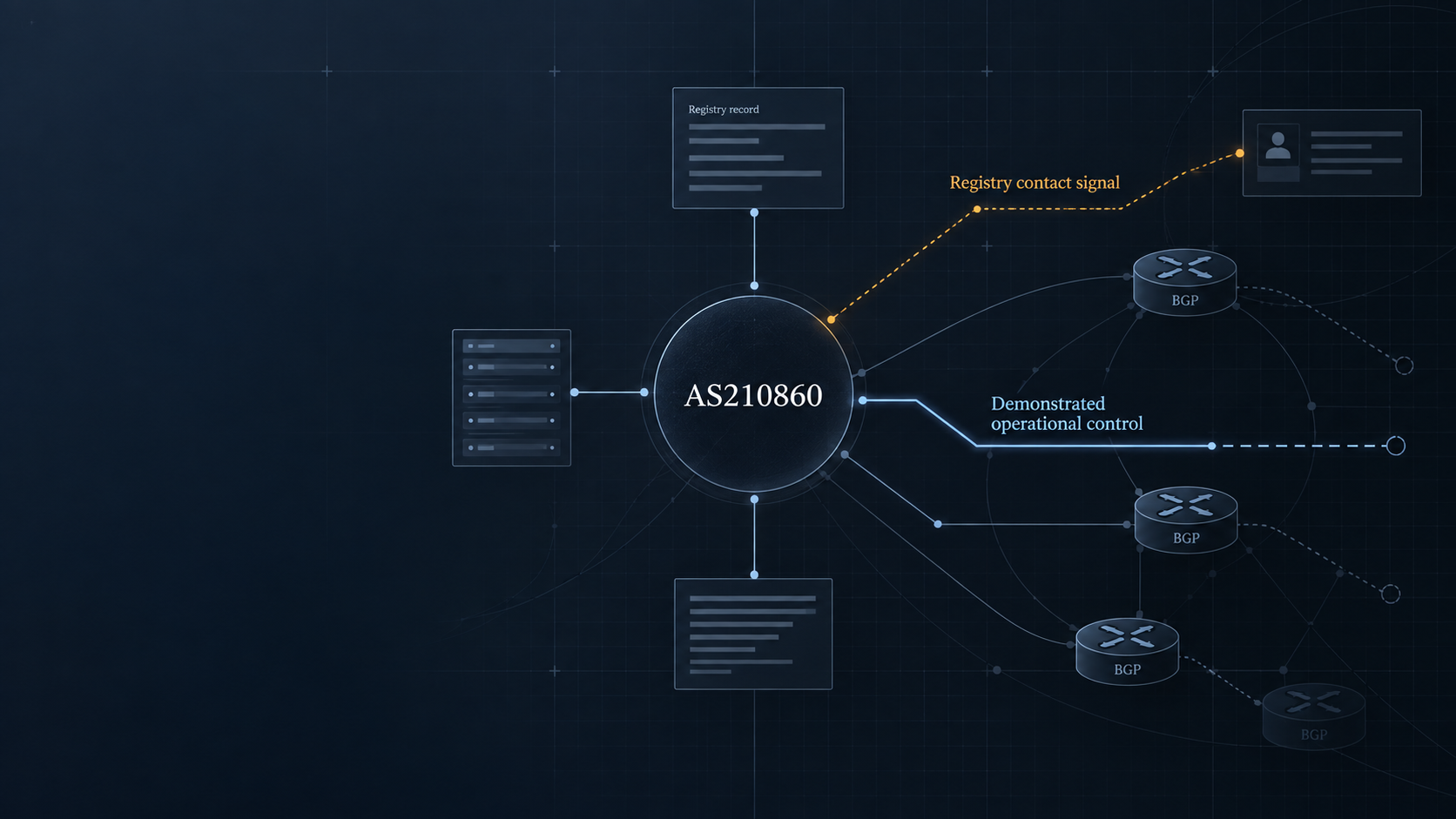
- DFINFRA’s appearance as an administrative and technical contact associated with AS210860 is a valid registry signal, but the signal does not establish a legal entity, owner, operator or current controller.
- A defensible control finding would require the registry identity to connect across authorization records, maintenance rights, route objects, announced prefixes and independently observed BGP activity. The current source package records those verification endpoints, while its deployed projection does not expose their field values.
The state difference is evidentiary, not operational
The new finding is easy to misstate. Nothing in the current package demonstrates that DFINFRA has gained control of AS210860, lost control of it, or operates it today. What has changed is the level of the investigation: prior coverage explained why a registry contact should not be treated as proof of control; this review tests the next link by mapping the independent evidence that would have to agree before such a conclusion could be made.
The distinction matters for anyone assessing a network as an institution rather than merely as a label. A registry entry can provide a name, an identifier and a place to look. It can support a monitoring decision. It can also become economically relevant if the associated party controls records, authorizations or routing decisions. But the entry alone does not reveal which of those functions, if any, the named party performs.
The current package preserves a timestamped RIPE aut-num source for AS210860, an inverse-origin search for route and route6 objects, RIPEstat data endpoints for an AS overview, announced prefixes, routing status, routing history and first/last seen, together with PeeringDB, bgp.tools and Hurricane Electric BGP views. Those sources cover different layers of the control question. They should not be collapsed into a single claim simply because they all refer to the same ASN.
The RIPE aut-num record is the starting point for interpreting the number-resource registration. It can indicate how an autonomous system is described in the registry and which administrative relationships are recorded there. It cannot, without corroboration, settle whether the named contact is a corporation, a service provider, an agent, a former administrator or merely a point of contact preserved in a record that has not been independently tied to present operations. The relevant record is available at RIPE Database aut-num data.
The inverse-origin route search addresses a different question: whether route objects associated with AS210860 appear in the relevant registry search. A route object can be part of an authorization and coordination structure, but its existence would still need interpretation alongside the holder of the underlying address space, the maintainer relationship and observed origin activity. The search endpoint is preserved at RIPE’s inverse-origin route search.
RIPEstat’s overview, announced-prefixes and routing-status endpoints provide further potential checks. The overview can help identify the network-level profile; announced-prefixes can show what prefixes are associated with an origin observation; and routing status can indicate whether an ASN is visible in the relevant routing data at the time of retrieval. These are operational observations, not legal title. They are preserved at RIPEstat AS overview, RIPEstat announced-prefix data and RIPEstat routing-status data.
Routing history and first/last-seen data add a time dimension. A current observation may establish visibility at a particular point, while historical endpoints can show whether the ASN has been observed across an interval. Neither endpoint, by itself, identifies who made the operational decisions behind a route. They are evidence about network behaviour, not a complete corporate-control record. The relevant references are RIPEstat routing history and RIPE RIS first/last-seen data.
PeeringDB, bgp.tools and the Hurricane Electric BGP Toolkit provide additional public views that may help compare descriptions, connectivity information and routing observations. Agreement across independent systems would strengthen a finding that a network is active or that a description is widely propagated. Disagreement would be equally important: it could indicate different update cycles, stale data, a limited observation window or a distinction between a registry relationship and actual routing activity. The current package preserves PeeringDB network data, bgp.tools AS210860 data and the Hurricane Electric BGP Toolkit view.
The control chain has several break points
The economic mechanism is a chain rather than a single lookup. First, a registry contact must map to an identifiable party. Second, that party must have authority over the relevant resource records or maintenance relationships. Third, those rights must connect to route authorization or another recognized mechanism for managing announcements. Fourth, the same party, or a clearly related operating structure, must be connected to prefixes actually originated or managed in BGP. Only then does a public contact become evidence of effective operational control rather than an administrative association.
Each link changes what an analyst may reasonably infer. If the first link fails, DFINFRA may be a label with no verified legal identity. If the second fails, the name may be present without maintainer authority. If the third fails, registry visibility does not establish the ability to authorize or alter routes. If the fourth fails, authorization records do not demonstrate that the party is operating the network in practice. A conclusion about control must therefore state which links are evidenced and which remain conditional.
This is also why a route observation should not be treated as a corporate fact. BGP shows an origin relationship as seen by monitoring systems. It does not automatically prove ownership of the address space, possession of a commercial customer base or authority over the legal entity named in a registry. Conversely, a lack of an exposed route value in this review cannot be converted into proof that AS210860 is inactive. The package explicitly preserves that boundary.
What the current review establishes—and what it does not
The evidence supports a narrow current statement: existing BTW coverage reports DFINFRA as an administrative and technical contact associated with AS210860 in the RIPE Database, while treating the association as insufficient to establish a legal entity, owner or operator. The current review also establishes that a structured verification effort was directed at the relevant registry, authorization and routing layers, with timestamped source snapshots created on 2026-09-09.
The review does not establish the current AS name, organisation, maintainer, route-object values, announced prefixes, routing status, routing history, first/last-seen values, neighbours or PeeringDB fields. The reason is specific. The deployed artifact projection exposes the source metadata and URLs but omits the retrieved payload contents needed to inspect those fields. That is an evidence-access limitation, not an observation that the fields are empty, false or unchanged.
This wording is more demanding than saying that “nothing was found.” Nothing was found is a conclusion about the world. The present record supports only a conclusion about what could be verified from the available source payloads. A future retrieval may show that the records are stable, that DFINFRA has a clear institutional identity, that AS210860 has observable routing activity, or that the layers do not align. All of those outcomes remain open.
The public directory entry is therefore best used as a pointer to the subject of the inquiry, not as a certificate of control. Readers can follow the DFINFRA directory record while keeping the registry signal separate from the unresolved operational question.
Why this distinction has economic value
For investors, infrastructure buyers, policy readers and network operators, the difference between a contact and a controller affects how much weight to assign to any apparent change. A new contact may be an early warning of organisational movement, but it may also reflect a service arrangement, a delegated administrative function or a routine record update. A new route may demonstrate activity without proving a transfer of ownership. A consistent identity across registry, authorization and routing layers would be materially stronger than any single record.
The control chain also determines what can change in practice. A party with only a contact role may influence communications but not resource policy. A maintainer with recognized authority may change registry objects but not necessarily operate the network. An origin visible in BGP may affect reachability while leaving legal title elsewhere. These distinctions bear on continuity risk, incident response, abuse handling, customer obligations and the ability to make or reverse routing decisions.
The most consequential mistake would be to treat a name as a balance-sheet asset or operating capability before the rights and activity behind it are identified. In a market where Internet-number resources, routing relationships and infrastructure capacity can carry strategic value, the evidence has to follow the rights. The name is the beginning of that work, not its conclusion.
The next observable condition
The next useful test is a fresh, inspectable retrieval of the same evidence layers. The investigation should compare the AS record with maintainer and organisation relationships, check route and route6 objects, identify any announced prefixes, review current and historical routing observations, and reconcile those findings with PeeringDB and independent BGP views. The central question is whether one identifiable party appears consistently across authorization and operational layers.
A positive result would not automatically prove legal ownership, but it would materially strengthen the case for effective operational control. A mismatch would be equally informative. It could show that DFINFRA remains only a contact signal, that the ASN is managed through another party, that routing activity is unrelated to the visible name, or that the public records are stale or incomplete.
Until that comparison can be made from inspectable values, the bounded conclusion is the only defensible one: DFINFRA’s association with AS210860 is an investigable registry signal. It may point toward an institutional or operational relationship, but the current evidence does not demonstrate legal ownership, maintainer authority or control of routing. The economic meaning of the record depends on what the next independently verifiable layer shows.
Member Briefing
Deeper Profile Context
Sign in with the right membership level to unlock the full briefing and source notes.
Only for Strategic Circle
Strategic Circle
Open to all readers. Unlock profile briefings after joining and signing in.
Join Strategic CircleOnly for Leadership Alliance
Leadership Alliance
For qualified IP-asset owners and management; sign in to unlock alliance briefings.
Join Leadership Alliance