
Profile
Research
Research profile intelligence connects person, company, institution, and other entity coverage for readers comparing the subjects behind BTW.MEDIA reporting. The page helps compare public profiles, related events, evidence packs, role changes, operating footprints, governance exposure, organisational links, and market relevance while keeping organisation and people records distinct from ordinary news chronology. Readers can understand the subject behind the headline, the evidence supporting that profile, and the infrastructure or market relationships that make the profile relevant. They can see who or what the profile represents, which public sources support it, how it connects to companies, markets, governance bodies, or events, and what changes may deserve continued attention as the subject evolves.

CASE FILE
Three Records, One Exchange: Seattle Internet Exchange Between Registry, Operator and Aggregator
Three Records, One Exchange: Seattle Internet Exchange Between Registry, Operator and Aggregator intelligence summary explains the development, the public evidence available to readers, the organisations involved, the regional context, market exposure, and the infrastructure…

Afrinic SAGA
Who Directs Africa's Registry? The Authority Gap Inside the AFRINIC Record
A directory can establish that an organisation exists, where it is registered, and that someone lists it as a member. It cannot establish who may lawfully direct that organisation's decisions. For African Network Information Center - (AfriNIC) Ltd, the record collected on 17…

Latin America and Caribbean Regional ISP
Three Names on One Autonomous System: What the Giga+ Fibra Record Actually Verifies
Three Names on One Autonomous System: What the Giga+ Fibra Record Actually Verifies intelligence summary explains the development, the public evidence available to readers, the organisations involved, the regional context, market exposure, and the infrastructure consequences that…

CASE FILE
What a Registry Membership Actually Certifies
A dated read of the public record for Aria Shatel PJSC shows a precise pattern: the registry-identity document is specific about who is registered and where they say they operate, and silent about the network resources most readers assume it proves. That silence is the finding.

Leaders
The Africa Field That Outran the Record: Michael Lim, NextHop and Three Separately Registered Australian Businesses
A directory card places a person across a continent his inspectable corporate record does not cross. The useful question is not whether the classification is embarrassing but what the underlying record actually proves about who holds the network, who bears regulatory…

Story
AFRINIC's Receiver Is Overseeing a Registry That Still Vouches for Itself
On 14 May 2026 the Supreme Court of Mauritius appointed a Receiver over AFRINIC. Four months on, the registry's own front page reads as though nothing structural has changed — and that gap, rather than any outage, is the accountability problem.

Global Institutional
The IGF's Permanent Turn: What A/RES/80/173 Changes — and What It Leaves Untouched
For twenty years the Internet Governance Forum existed on borrowed time. Each time its term ran out, its survival depended on a fresh decision by the United Nations General Assembly. That arrangement has now ended. The more useful question is what replaced it — and whether the…

Europe and Middle East Cloud Services
Mistral Compute: The Gap Between an Announced Build-Out and an Observable Network
Mistral says it will own its own compute, not rent it. A French corporate identity carried in BTW's directory names the vehicle for that ambition, but the register page would not render and no routing record exists under its name. Both halves of that sentence are the story.

Europe and Middle East Institutional
Georgia's Digital Governance Agency: mandate, ministry and missing instrument
A state agency that digitises public services and guards information security is a body whose authority other parties have to be able to check. Georgia's Digital Governance Agency describes itself in its own published material as working inside the Ministry of Justice's system…

Story
Who Held the Handover? The RIPE NCC → AFRINIC Transition and the Missing Record of Verification
In 2005 AFRINIC became the fifth Regional Internet Registry, and registry services and responsibilities covering the African region were migrated from the RIPE NCC to AFRINIC as part of that recognition ([RIPE NCC news archive — AFRINIC becomes the fifth…

History
Honduras Opened Internet Service to ISPs, but Kept Leased-Line Sales
Hondutel said five internet service providers and four organisations were directly connected in March 1996. A year later, one provider said private firms could sell dial-up but not dedicated service—an opening shaped by who controlled the circuit.

Europe and Middle East Regional ISP
ASK4 Network Infrastructure Team: A UK Regional ISP Team Behind AS41230, Traced Through Public Records
ASK4 Network Infrastructure Team: A UK Regional ISP Team Behind AS41230, Traced Through Public Records intelligence summary explains the development, the public evidence available to readers, the organisations involved, the regional context, market exposure, and the…

History
Guyana’s University Email Stayed Online Through Storms and Voltage Failures
Before Guyana had a field of commercial providers, a university mail gateway linked users to Puerto Rico. Its reach depended on a local phone bill, scarce hardware and one lecturer who volunteered to keep the system working.

History
NIHERST Sent Research Email via Puerto Rico—and Allocated Costs by Volume
A research institute’s route to Puerto Rico ran through a head-office modem. In 1996, NIHERST said its Institute of Marine Affairs shared that path, with local phone costs allocated by the volume of mail sent and received.
History
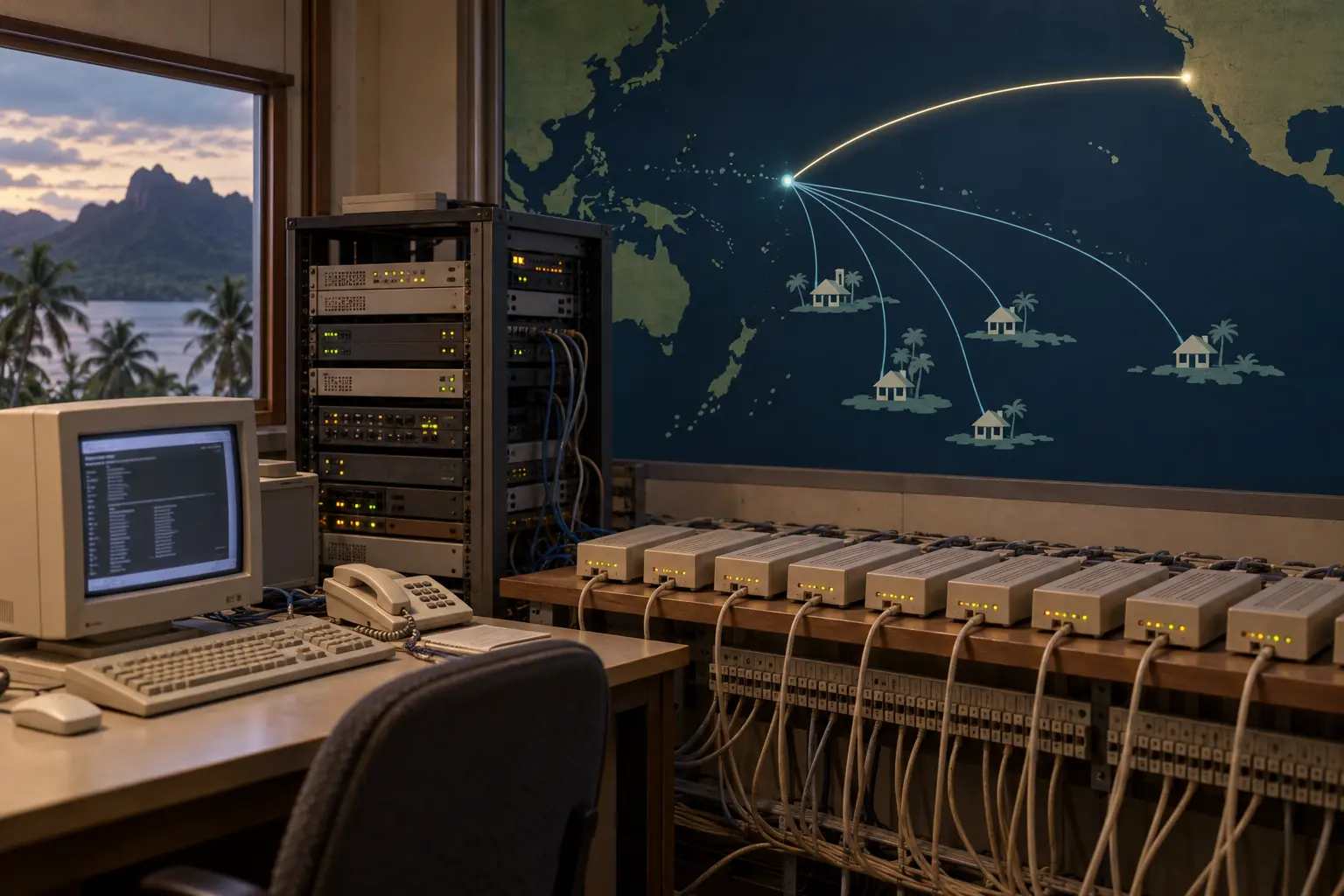
280 Customers, No Dedicated Line: FSM Telecom’s Internet in 1997
FSM Telecom reported 280 customers across the Federated States of Micronesia in February 1997, but said none had a direct connection. They dialled into a shared service carried over a 128 Kbps Sprint link from Pohnpei to California. The same report put a dedicated 64 Kbps line at…

History
One UK Traceroute Reached American Samoa Through Sacramento in 1997
Two PEACESAT messages described American Samoa as lacking a live link in 1995 and 1996. A year later, one UK operator traced a path to a Samoatelco server. The records mark a change in observable reachability, not a proven launch date or a map of who could connect.
History
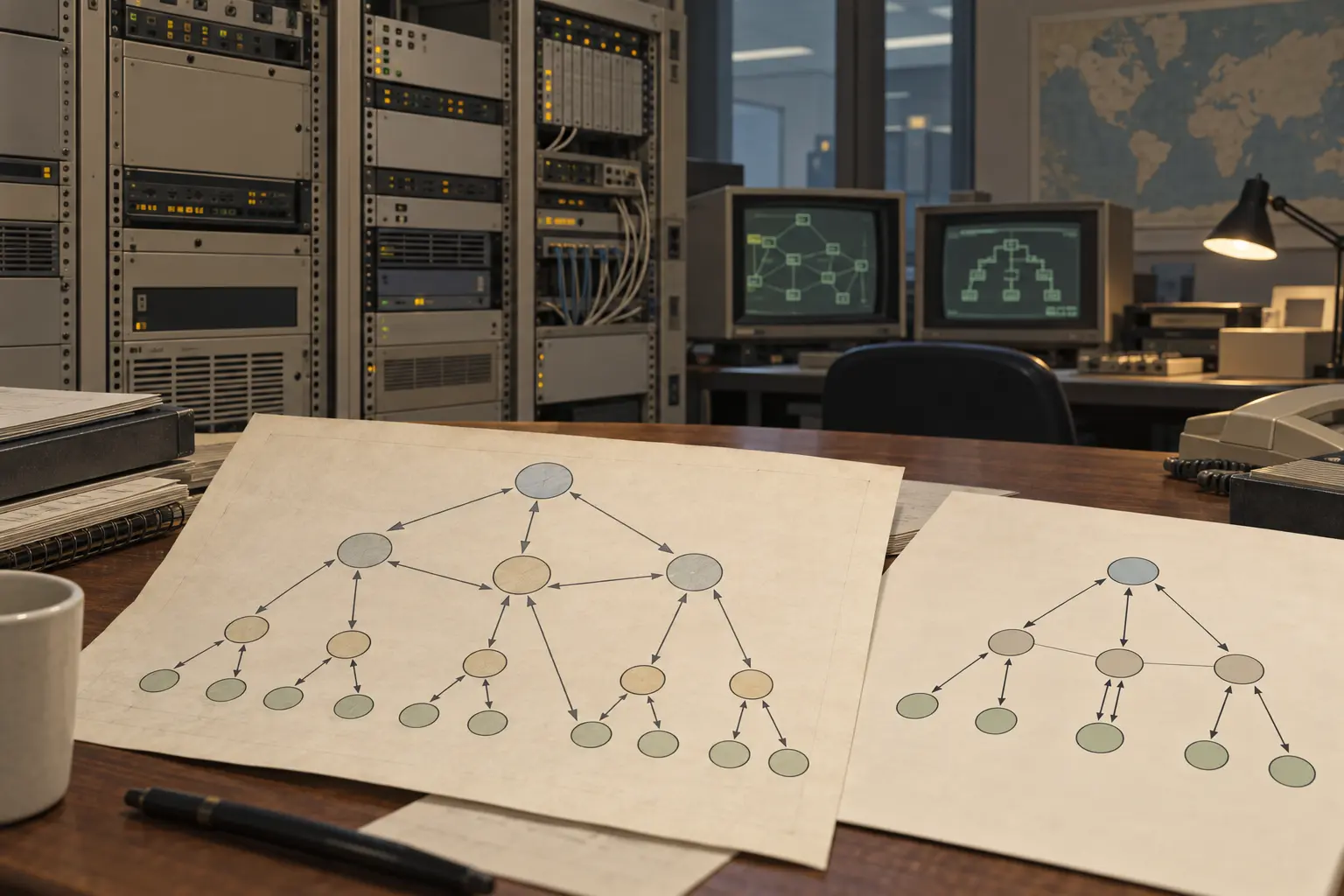
BGP Was Already Running in Cisco and NSFNET in 1989
By the time BGP appeared in an RFC, Cisco routers and NSFNET’s Nodal Switching Systems already had implementations. The June 1989 document captured a protocol still taking shape; a year later, its successor was a proposed standard that openly invited deployment experience to…

History
Two Exits, One X.25 Workaround: Ireland’s Internet Routes in 1991
In 1991, Trinity College Dublin and University College Dublin did not reach the Internet by the same route. One used a low-speed EUnet line through Britain and Amsterdam; the other carried IP across X.25 and IXI to an Amsterdam gateway.

History
A Stable Link Was Still Prohibitive: AUB’s Internet Route through Paris, 1992–95
At the American University of Beirut, a working Internet path did not mean an affordable service. A 9.6-kbps X.25 link could be described as stable while cost, bandwidth limits and a pending telephone-agreement kept access narrow.

History
A London Poll, a Washington Mail Run: Sierra Leone’s Two Email Routes, 1994–95
Before a browser could make the Internet feel continuous, Sierra Leone’s early users reached it through scheduled mail exchanges. Contemporary accounts describe several gateways with different operators, costs and operating states—not one national switch being turned on.