
Profile
Research
Research profile intelligence connects person, company, institution, and other entity coverage for readers comparing the subjects behind BTW.MEDIA reporting. The page helps compare public profiles, related events, evidence packs, role changes, operating footprints, governance exposure, organisational links, and market relevance while keeping organisation and people records distinct from ordinary news chronology. Readers can understand the subject behind the headline, the evidence supporting that profile, and the infrastructure or market relationships that make the profile relevant. They can see who or what the profile represents, which public sources support it, how it connects to companies, markets, governance bodies, or events, and what changes may deserve continued attention as the subject evolves.

Story
A Scan Found 4,611 Exposed BGP Routers in APNIC. It Cannot Say Why They Were Open
At APNIC 62, researchers put a regional number on a quiet control-plane problem: 4,611 routers across 1,343 APNIC-region autonomous systems answered an unsolicited BGP OPEN exchange in a February IPv4 scan. That is firmer evidence than a port banner, but it is neither a breach…
Number Resource Society
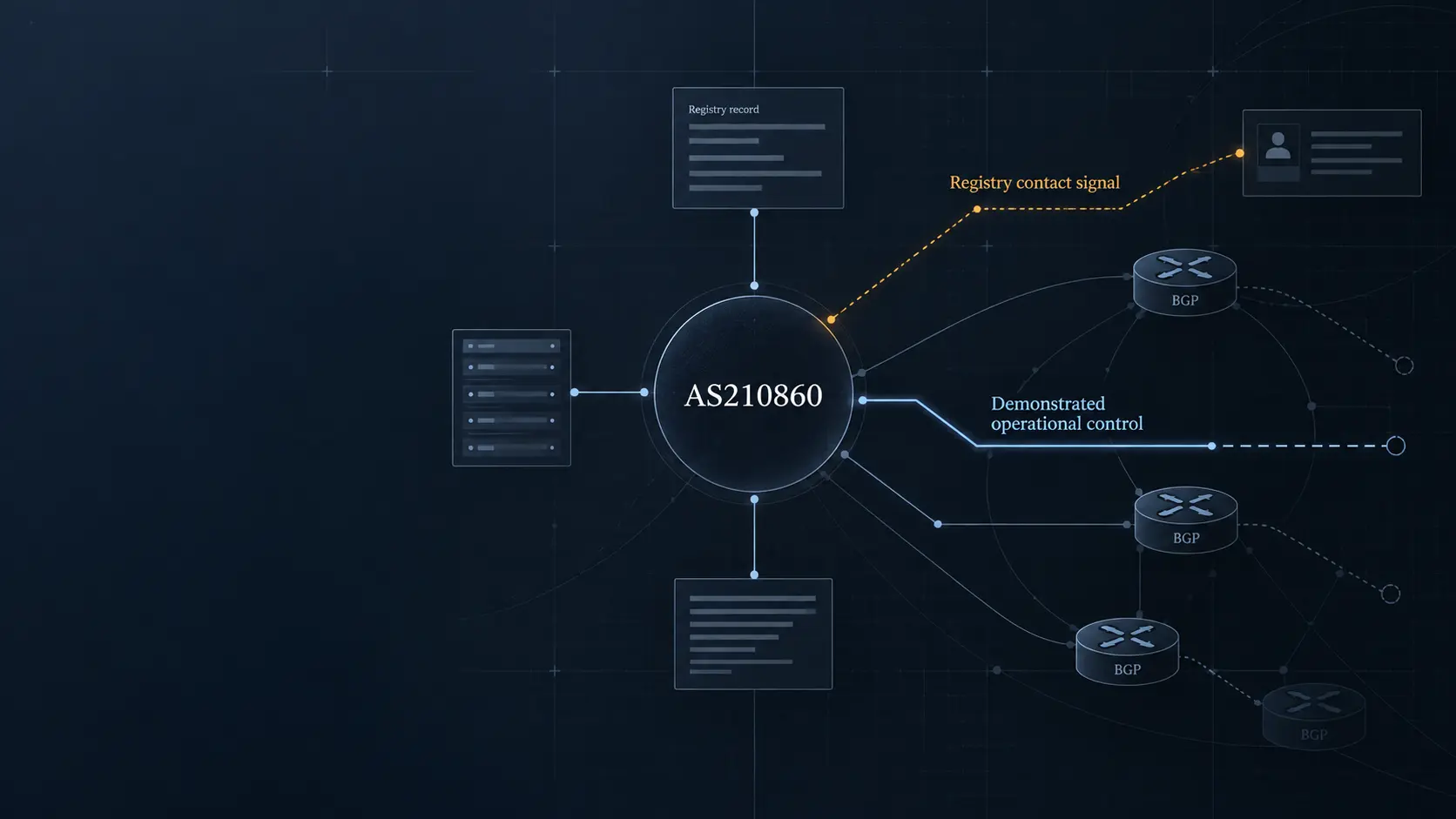
DFINFRA and AS210860: the registry signal still stops short of operational control
DFINFRA and AS210860: the registry signal still stops short of operational control intelligence summary explains the development, the public evidence available to readers, the organisations involved, the regional context, market exposure, and the infrastructure consequences that…

IETF
A D-PATH Stops Loops Only When Gateways Agree on the Domain
A BGP attribute can carry a domain history, but it cannot decide what a domain is. RFC 10039 makes that prior decision operationally consequential: the same configured identifier that lets a gateway reject a returning route can also discard a legitimate route when the gateways…

Leaders
Osipenko Alexander Nikolaevich: The Control Question the Public Record Still Cannot Answer
Osipenko Alexander Nikolaevich: The Control Question the Public Record Still Cannot Answer intelligence summary explains the development, the public evidence available to readers, the organisations involved, the regional context, market exposure, and the infrastructure…

IETF
The Route Carried a Domain Path. The Tenant Still Needed Proof: RFC 10039
RFC 10039 arrives with a practical answer to a dangerous ambiguity: when tenant reachability is re-originated between EVPN and IPVPN domains, redundant gateways need a way to recognize that a route has come back. Its new D-PATH attribute records the declared domain sequence and…

IETF
RFC 7506 Is Historic. Router Alert 69 Can Still Be on the Wire
A standards register can retire a behavior without touching a single router. RFC 7506 is now Historic, its MPLS OAM Router Alert value is deprecated, and RFC 9570 says new LSP Ping implementations must not set it. None of those facts proves that value 69 has disappeared from an…

IETF
A NAT64 Mapping Is Not a Filtering Policy
A repeatable public tuple can prove how a stateful NAT64 translator allocates an address and port. It cannot prove which IPv4 sources are allowed to use that state on the way back. Treating those two facts as one control turns an interoperability test into a security verdict it…

IETF
The disclosure rule that does not travel alone
An incident report can inherit its sharing conditions from the structure around it. Turning that report into a convenient extract is therefore a policy decision, even when none of its factual fields changes.

Story
AFRINIC's 8 September Snapshot Returned Four Old Resources to “Allocated.” It Cannot Say Why
Three ASNs and one /19 crossed AFRINIC’s public boundary together between two signed daily files. Their 2006 dates came back with them. That is evidence of a current state change, not evidence of a new allocation—and the distinction deserves a small public receipt.

Leaders
Osipenko Alexander Nikolaevich: What the Registry Shows—and What It Does Not
Osipenko Alexander Nikolaevich: What the Registry Shows—and What It Does Not intelligence summary explains the development, the public evidence available to readers, the organisations involved, the regional context, market exposure, and the infrastructure consequences that may…

IETF
The cost of a stateless relay lives elsewhere
A PANA relay can avoid keeping a record for every client without making network admission cheap, ownerless or continuously available. The useful economy is a placement decision: which component remembers the path, which validates the exchange, and which team must restore it.

IETF
One Operator Does Not Make One SRv6 Trusted Domain
A merger puts two routing estates beneath one legal owner. The new diagram draws a single box around them, and an automation team proposes removing the filters at the seam. The diagram may be administratively correct. It proves nothing about whether the two SRv6 instances share…
Europe and Middle East Institutional Trends
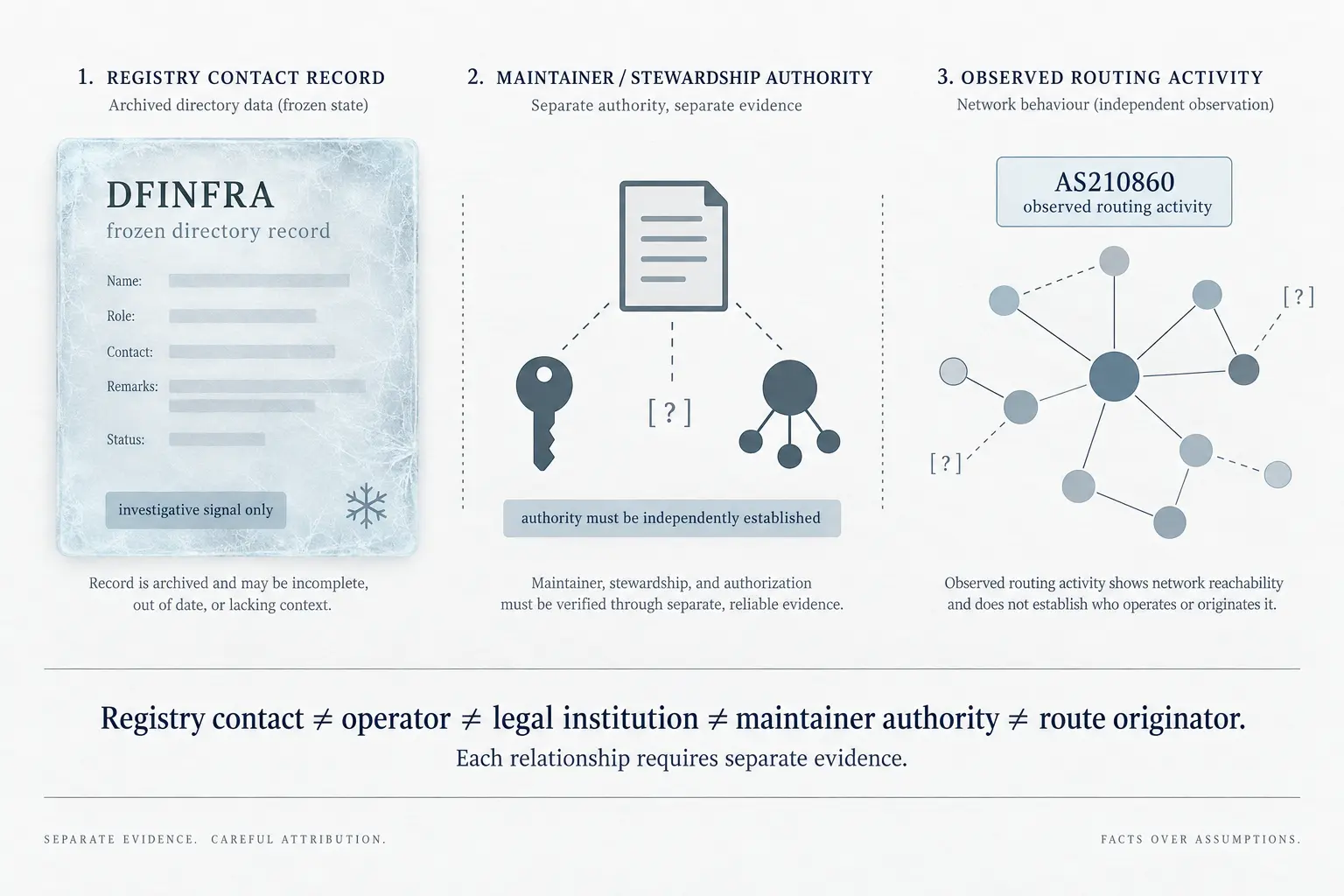
DFINFRA Is a Registry Signal, Not Yet Proof of an Operator
DFINFRA Is a Registry Signal, Not Yet Proof of an Operator intelligence summary explains the development, the public evidence available to readers, the organisations involved, the regional context, market exposure, and the infrastructure consequences that may follow. The Europe…

Global Institutional Trends
Who can challenge ISC’s practical authority?
ISC’s public pages show where its stewardship matters. They do not, by themselves, show who can contest consequential decisions or what remedy follows.

IETF
A migration measured in readable objects
Moving an old MIB into YANG can make a device easier to observe without moving the obligations attached to changing it. RFC 6643 makes that limited bargain explicit. The risk begins when a migration programme buys the first capability and declares the second complete.

Europe and Middle East Regional ISP Trends
AS210837’s Continuity Gap: What the Routing Record Can—and Cannot—Show
A documented historical network footprint has become a continuity question. For ROYA Communications and Internet Services Company Ltd, the difference between registry identity, historical routing visibility and current route evidence is more important than any single prefix…

Story
DATAMATIX and AS210973: What Public Routing Evidence Can—and Cannot—Prove
DATAMATIX and AS210973: What Public Routing Evidence Can—and Cannot—Prove intelligence summary explains the development, the public evidence available to readers, the organisations involved, the regional context, market exposure, and the infrastructure consequences that may…

IETF
Factory defaults can remove the way back
A factory reset can do precisely what its specification requires and still leave an operator unable to manage the device. RFC 8808 separates a return to preset configuration from two outcomes that the phrase “back to factory” tends to imply: a usable route back in, and data that…

IETF
A Cleared Incident Does Not Prove Which Command Cleared It
An incident client sends one `incident-resolve` request containing several incident numbers. Later, separate notifications arrive. Two records now say `cleared`; another remains `updated`. The network view is useful, but the decisive question has vanished between the command and…

IETF
The old address plan survived the IPv6 launch
6rd let an operator introduce IPv6 without first replacing its IPv4 access network. The shortcut also gave an older address plan a continuing say over the size, lifetime and eventual migration of the new service.