
Primary Domain
Technology
Within the Primary Domain facet, Technology intelligence groups reporting by primary domain so readers can follow a focused area of internet infrastructure, governance, connectivity markets, or digital capital. The page brings together related articles, public evidence, institutions, companies, people, regional exposure, operating dependencies, and market context that may otherwise sit across separate category pages. It explains the domain, the likely actor class, the market or governance context, and the source material readers should use when comparing signals. Operators, analysts, and governance readers can see how the same domain appears across events, profiles, market shifts, public-source evidence, regional dependencies, and longer-cycle infrastructure decisions over time.

Global Institutional
LibreNMS and the operating cost of seeing the network clearly
LibreNMS gives operators a transparent, self-hosted way to discover devices, poll counters, build inventory and turn network state into alerts. Its credibility does not come from a promise that open source is automatically safer or cheaper. It comes from an operating bargain: the…
Global Institutional
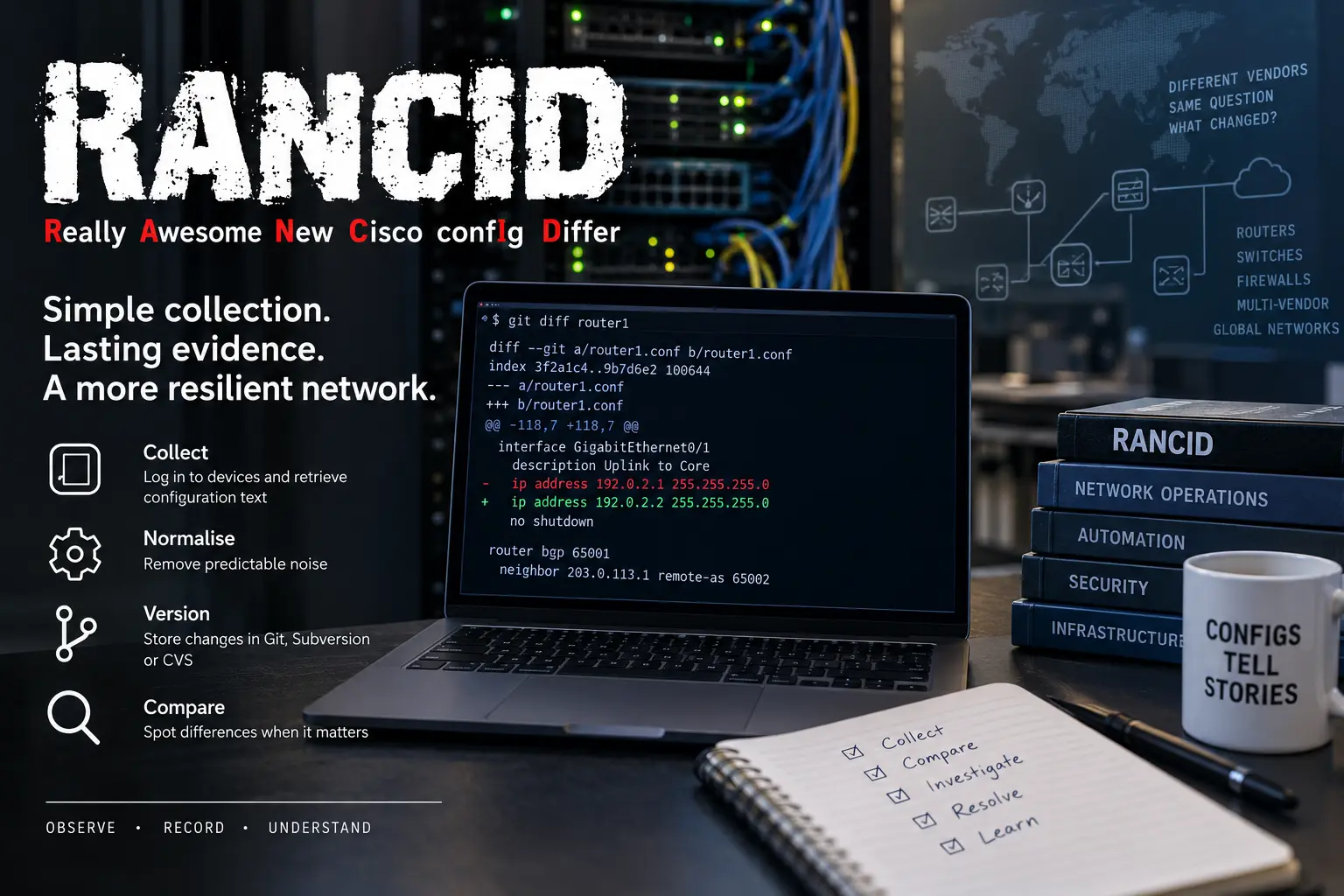
RANCID and the enduring value of a one-line network diff
RANCID preserves a form of evidence that large management platforms can easily blur: configuration text reported by a device at a particular moment, and the difference from the previous observation. It does not represent the full intent model, every event or causality. That…
Global Institutional
RANCID and the enduring value of a one-line network diff
RANCID has survived successive eras of network management by doing one narrow job: logging into devices, collecting selected configuration text, removing predictable noise and committing the result to version control. It does not model intent, approve changes or reconstruct every…

History
Rob Pike and the 9P Walk That Opened Nothing
A client walks a name in 9P and receives every qid it expected. The path has resolved, yet no file has been opened and no byte has moved. The distinction at the heart of Rob Pike’s naming work is useful far beyond Plan 9: a protocol receipt is strongest when it is allowed to…

History
The Page Had One Character Universe, Whatever Bytes Carried It: RFC 2070
Two HTML files could carry different octets and still present the parser with the same character. RFC 2070 made that result architectural rather than accidental: `charset` selected the decoder for the concrete resource, while HTML kept one abstract UCS document character set.…

IETF
Marshall T. Rose and the SNMP SetRequest That Changed Every Variable or None
A maintenance console sends one SNMP SetRequest containing several variable bindings. The agent answers `noError`. That is a useful receipt—but only for a deliberately narrow claim. The early SNMP design associated with Marshall T. Rose’s working-group leadership helps show why a…

History
The Password Left the Wire. Its Equivalent Stayed in the File: RFC 2069
“We do not store passwords,” an administrator might have said in 1997. “We store only their digests.” RFC 2069 made the first half of that reassurance meaningful on the network: a client could prove knowledge of a password without sending it in cleartext. It also made the second…

History
The Version Number Promised the Next Message, Not This One: RFC 2068
In January 1997, an HTTP message that began with `HTTP/1.1` was making a carefully bounded promise. The label described the sender’s message format and the highest HTTP capability it could support in further communication. It did not say which HTTP/1.1 features this particular…

History
RFC 2067: The Standard Deleted Three Legal Packet Shapes
In 1997, Internet engineers advanced IP over HIPPI by making the specification smaller. Three packet forms allowed by RFC 1374 disappeared: a short burst could no longer come first, the D1 area could no longer contain fill, and the D2 offset could no longer be nonzero. RFC 2067…

History
RFC 2066: The Character Set Was Already Right. The Reply Still Had to Arrive
Telnet had a rule for avoiding endless politeness: do not acknowledge a request for a mode already in effect. RFC 2066 made a narrow but consequential exception. A receiver already using one of the proposed character sets still had to send `ACCEPTED`, because silence would force…

Europe and Middle East Institutional Trends
FLEX and Sentinel-3C prepare for Vega-C launch
The two Earth-observation missions will fly together, but routine use depends on commissioning and data that can be compared with existing records.

History
RFC 2065: The DNS Reply Crossed an Ordinary Server. Its Signature Carried the Trust
In January 1997, RFC 2065 proposed a security upgrade that did not require every machine carrying a DNS answer to become its judge. A security-aware resolver could retrieve signed records through a server that knew little about the new machinery and verify the evidence itself.…

Asia-Pacific Institutional Trends
ASML gains broader backing for High NA tools
ASML's High NA tools are gaining customers, but their economics will be decided on the production line rather than by the machine price alone.

Global Institutional
Akvorado turns sampled flow records into operational network memory
Akvorado gives network operators a self-hosted way to retain, enrich and examine flow records over long periods. Its value lies in exposing the path from router export to operational decision; its central limit is that every chart still inherits the sampling, loss, timing and…

Global Institutional
SNIA sets common storage rules but cannot impose them on the market
Since 1997, SNIA has tried to make storage systems from different vendors more comparable, manageable and predictable. Its specifications cover software management, cloud data, media sanitisation, energy use and hardware form factors, but any useful rule works only when companies…

Global National Telecom Trends
SES launches CORE for hybrid media delivery
SES CORE brings satellite, fibre and IP delivery into one interface, but broadcasters will still need to test how those controls work across their actual distribution routes.

Global Institutional
SNIA writes shared storage rules without the authority to enforce them
Since 1997, SNIA has tried to make storage systems from different vendors easier to compare, manage and trust. Its specifications span management software, cloud data, media sanitisation, energy use and hardware form factors, but every useful rule still depends on companies…

Global Institutional
SNIA writes common storage rules without the power to enforce them
Since 1997, SNIA has tried to make storage systems from different vendors easier to compare, manage and trust. Its specifications reach from management software and cloud data to media erasure, energy use and hardware form factors, yet every useful rule still depends on companies…

Global Cloud Services Trends
Avid brings Media Composer into the browser
Avid and Google Cloud have connected browser-based editing with searchable media while keeping high-resolution assets and computing inside the customer's cloud environment.

History
RFC 2063: The missing minutes inside a recovered total
When a reader stops while its meter keeps running, accumulated traffic may remain recoverable. The missing collections still leave a hole in the history of when that traffic passed.