
Content Type
Briefing
Within the Content Type facet, Briefing intelligence gathers BTW.MEDIA articles that share the same editorial format, helping readers compare briefings, profiles, risk notes, market analysis, and event coverage without mixing different kinds of evidence. The page explains how this content type frames internet infrastructure events, company movements, governance decisions, operational signals, and public evidence across the site. Readers can compare which actors or infrastructure systems appear most often, how source quality changes interpretation, and whether the material is a durable profile, a time-sensitive event, a strategic market signal, or a governance development. The result is a useful search page for operators, investors, customers, analysts, and policy stakeholders who need to understand the consequence, timing, and evidence behind similar article formats.

Latin America and Caribbean Regional ISP Trends
Gilat signs $14m Ayacucho fibre agreement
Gilat will deploy more than 1,060km of fibre and equip 273 public institutions under an 18-month broadband project in southern Ayacucho.

Europe and Middle East National Telecom Trends
Kyivstar and Ukrtelecom launch reciprocal fibre access
Kyivstar and Ukrtelecom will sell fibre over each other's networks, separating retail service from physical network ownership in an initial three-region rollout.
Asia-Pacific Datacenter Trends
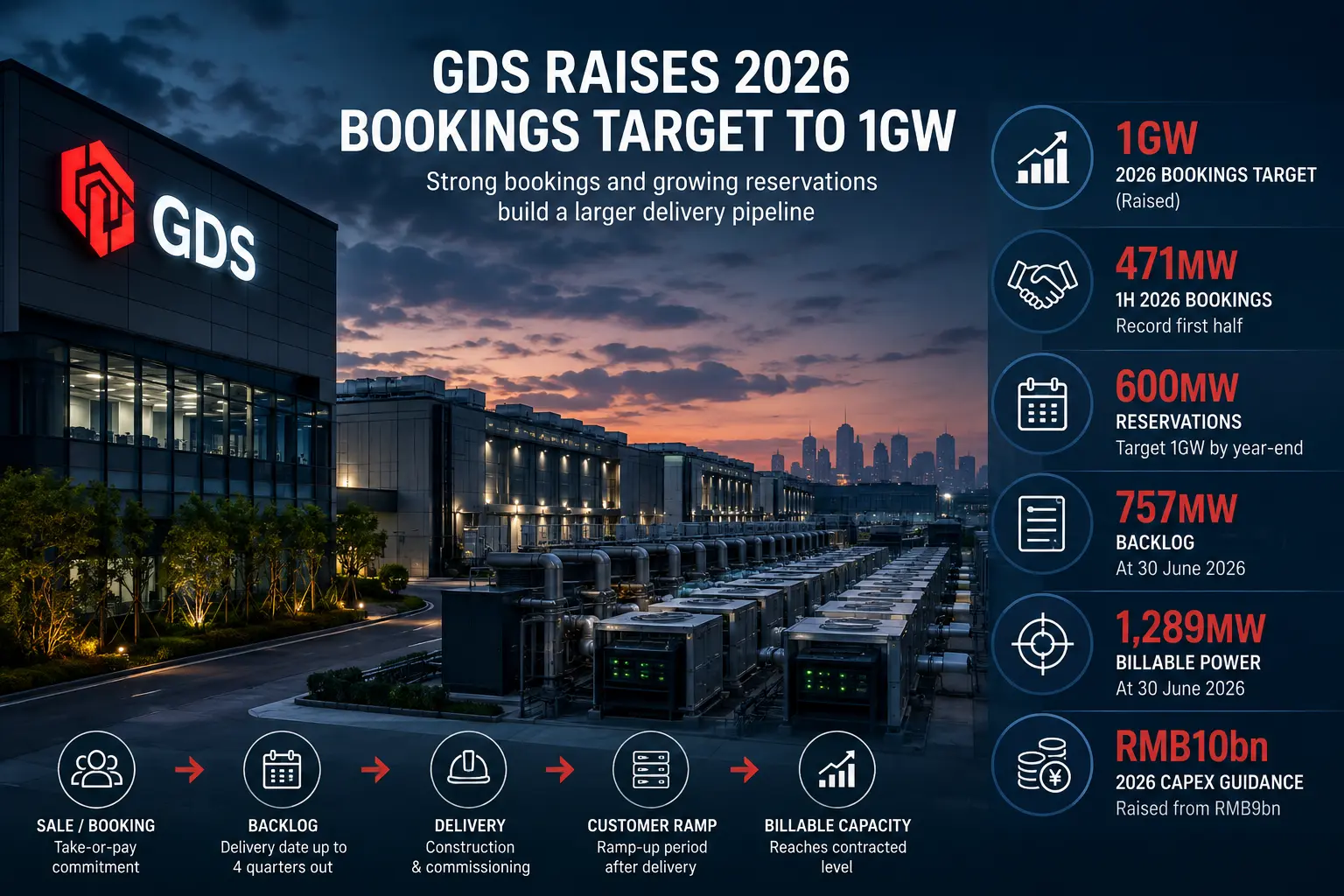
GDS raises 2026 bookings target to 1GW
GDS's record first-half bookings expand its delivery pipeline, while 600MW of reservations could add further capacity if converted into contracts.

Global National Telecom Trends
Lynk and Omnispace merge to form Elveo Mobile
Elveo combines Lynk's LEO platform with Omnispace spectrum, while SES expands investment and access to its multi-orbit space and ground infrastructure.

North America Datacenter Trends
Blue Energy, GE Vernova Hitachi advance 2.5GW Texas project
The Victoria gas-to-nuclear project is moving into safety analysis and licensing work, with a 2027 investment decision still required before construction.

Europe and Middle East Datacenter Trends
Nebius to lease Vantage capacity in Newport
Nebius is adding another UK location for its AI cloud infrastructure through leased data-centre capacity at Vantage's Newport campus in South Wales.

IETF
IETF Records a FAR Fault-Avoidance Routing Revision for Data-Centre Networks
Revision 26 of the FAR Internet-Draft is a design note about dealing with failures in regular data-centre fabrics. It does not establish an IETF standard, a vendor implementation, a deployment, or a measured operational result.

IETF
IETF FARE Draft Brings Multi-Plane Route Choice to the RNIC
The new FARE-in-MPSON Internet-Draft treats the network interface as a routing decision point when scale-out AI fabrics are split into isolated planes. It is a work in progress, not an approved IETF feature, a deployment announcement or a performance result.

IETF
IETF Updates Its BGP FARE Adaptive-Routing Draft
The latest FARE text places an operational constraint beside BGP-based adaptive routing in a CLOS fabric: a weighted ECMP decision depends on comparable path-bandwidth information across the whole equal-cost set. It is an Internet-Draft, not an IETF-approved routing feature or a…

IETF
IETF Updates Its Encrypted PDMv2 IPv6 Diagnostics Draft
The IETF’s current PDMv2 draft asks a governance question inside an IPv6 diagnostics mechanism: who may see timing and endpoint information, and under what prior authorization? It is an active draft, not a deployed encryption product or an approved standard.

IETF
IETF Updates Its SR-MPLS STAMP Measurement Draft
The IETF’s latest SR-MPLS STAMP draft turns a familiar operations question into explicit protocol work: whether a probe is assessing the path that traffic is actually engineered to use. It remains a draft, not a deployment announcement or a new standard.

Story
India’s Routing-Security Coverage Is Rising Faster Than Invalid-Route Filtering
APNIC’s latest India ecosystem review points to rapid gains in RPKI coverage alongside a much smaller reported share of networks filtering invalid announcements. The gap is a monitoring problem, not a verdict on national resilience.

IETF
IETF Updates Erik Sync Draft for RPKI Publication
An updated IETF Internet-Draft describes a relay-based way to distribute RPKI publication data. It is a current design proposal, not a new Internet standard or a deployment announcement.

IETF
The Public ENUM Response Date Has Passed. The Decision Has Not.
An ITU-T consultation on possible closure of E.164 country-code delegations in `e164.arpa` named 15 August 2026 for Member State responses. The public record still does not state an outcome.
Story
ARIN consults on retiring legacy directory services in favour of RDAP
ARIN has opened a consultation on a roadmap to consolidate four directory-service protocols around RDAP. The proposal is not a shutdown notice: it asks users how the retirement of older interfaces should be staged, with different earliest dates for each service.

Story
AFRINIC draft opens a wide advice channel without an advice register
The proposed Article 16 would replace the Council of Elders with flexible committees and let the Board seek nonbinding input from almost any interested person or body. Its committee safeguards are detailed; its separate advisory-engagement trail is not.

Story
AFRINIC draft creates an acting CEO office without a maximum term
Proposed Article 17.5 would require an appointment after a vacancy or temporary incapacity, but it does not say how long an acting chief may remain, whether the office carries Board Seat 9, or which removal and conflict rules apply.

Story
AFRINIC draft drops the CEO nationality ban but leaves the Board to define disqualifying conflict
Proposed Article 17.3 replaces a blanket exclusion with a more defensible individual test. It still does not say what evidence the Board must use, who must recuse, what the candidate may answer, or how a disputed decision can be reviewed.

Story
AFRINIC draft puts employee pay behind a Board policy that members may never see
Proposed Article 17.4 adds a real budget and policy check on the CEO’s remuneration power, plus a written-delegation rule. It does not require publication, exception records, conflict controls, monitoring reports or a route for an affected employee to challenge a decision.

Story
AFRINIC retains a six-vote route to remove its CEO without making the Board’s record visible
Draft Article 17.2 leaves the existing CEO-removal power unchanged: on a full nine-seat Board, six of the eight other directors can end the appointment, subject to labour law. The same draft adds “justifiable cause” elsewhere but does not require a non-confidential reason, tally…