
Content Type
Briefing
Within the Content Type facet, Briefing intelligence gathers BTW.MEDIA articles that share the same editorial format, helping readers compare briefings, profiles, risk notes, market analysis, and event coverage without mixing different kinds of evidence. The page explains how this content type frames internet infrastructure events, company movements, governance decisions, operational signals, and public evidence across the site. Readers can compare which actors or infrastructure systems appear most often, how source quality changes interpretation, and whether the material is a durable profile, a time-sensitive event, a strategic market signal, or a governance development. The result is a useful search page for operators, investors, customers, analysts, and policy stakeholders who need to understand the consequence, timing, and evidence behind similar article formats.

North America Datacenter Trends
PPL's $11m aid bill starts at 69,000 volts
From January, PPL Electric Utilities will assign $11 million a year of household-assistance costs to its LP-6 large-load class. Voltage, demand and a classification petition determine which projects enter that paying group.

IETF
Two Keys Can Land on One IPv6 /64. Who Gets the Address?
A 27 October IETF proposal would derive a workload’s IPv6 subnet from its public key. It sounds like an address that carries its own identity card. The draft says a different key can match the same /64 subnet bits in about 2^16 trials under a /48 aggregate. The operator still has…

Global Institutional Trends
Parsons put $495 million on the contract. It booked $37 million.
A contract ceiling looks splendid on a slide. Parsons' third-quarter list places a $495 million national-security award beside $37 million actually booked during the quarter. The distance between those figures is where the customer still holds the pen.

Story
LACNIC's New Policy Referee Could Be a Version Number
Jordi Palet Martinez says he is correcting the language of LACNIC's policy process. The registry's own staff says his proposal changes who gets to judge a policy's evolution. That is a fight over the entity of a decision, tucked into a change labelled clarification.

IETF
The Agent Got a Fast Lane. The User’s Approval Was on a List
A 27 October IETF proposal would let a personal AI agent get access to a service without interrupting its user each time. The switch is a pre-approved list held by an Agent Authorization Center. The service can receive a valid token even when the token does not say whether a…

IETF
Oblivious CoAP Hides the Sender. The Proxy Can Still Press Send Twice
A 28 October IETF proposal would let small devices make protected CoAP requests without telling the destination which device sent them. Its relay cannot read the payload, but it can repeat the envelope. The draft puts the replay decision at the receiving server—precisely where a…

Europe and Middle East National Telecom Trends
KPN passed six million homes. Its wholesale broadband book still shrank.
The cable is in the street; the invoice has farther to travel. KPN crossed six million fibre homes passed in the Netherlands during the third quarter, yet its wholesale broadband base lost 11,000 lines. The gap between reach and use is where the next return on construction must…

IETF
Erase the Agent’s DNS Badge. Its OAuth Client Is Still the Off Switch
An October IETF proposal would let a service check whether an agent’s operator still stands behind it. The public DNS record points to an OAuth client; the operator’s authorization server issues the proof. Removing the pointer can make a new receiver ask fewer questions.…

IETF
The Agent Needs Help. DAWN Asks It to Name the Helper First
DAWN is building a way to discover AI agents and services. A 28 October paper finds a catch at the door: a client may know what it wants done without knowing the capability name it must search for. The fixes move the bill between the client, a local catalog and a broker—and move…

IETF
RPKI's New Push Alarm Rings. The Data Still Takes the Slow Lane
A 28 October Internet-Draft promises faster delivery of route-security changes. Its urgent message contains a serial number and a warning, while the packet that actually carries changed data runs on a negotiated schedule. The existing RTR protocol already has an unsolicited…

Global Cloud Services Trends
Cloudflare gives a million R2 reads a 1,000GB budget
Its Infrequent Access example totals $29.90. Make every read return the whole 1GB entity and the published rates produce $10,019.90. The missing input is the size of a read.

Story
RIPE NCC Keeps the Chain After an Address Moves
The resource can leave its holder. The registration trail stays. RIPE NCC's new privacy clause explains why it keeps that history after a return or transfer, while giving no fixed end date for the trail.

Global Cloud Services Trends
CoreWeave's network gets a 2027 clock. Its Asian compute gets 2028.
A network point can open a door to a cloud long before the local GPU hall is ready. CoreWeave's latest expansion puts those two dates on the same page: seven new Middle East and Asia-Pacific access points are due by mid-2027, while the announced India and Indonesia sites point to…

IETF
Platform Support Is a Name Anyone Can Type. Who Gets to Wear It?
A new Internet-Draft brings sender impersonation inside job boards and marketplaces, where the platform controls the inbox and the trust label. Its two sharpest traps are technical: a Unicode skeleton match can miss a lookalike, and a validator can return a host name with an…

Story
RIPE NCC’s New EU Evidence Door Comes Without Member Notice
Eight binding Dutch requests crossed RIPE NCC’s desk in 2025. Its new procedure gives EU authorities a second route for electronic evidence, and closes member notification on that route.

Global Datacenter Trends
Seagate lists 44TB. Someone still has to own the write queue.
Broadcom's adapter qualification opens a wider path for Seagate's dense storage. The economic prize goes to buyers who can make the software behave: extra capacity arrives with a job that needs an owner and a budget.
Number Resource Society
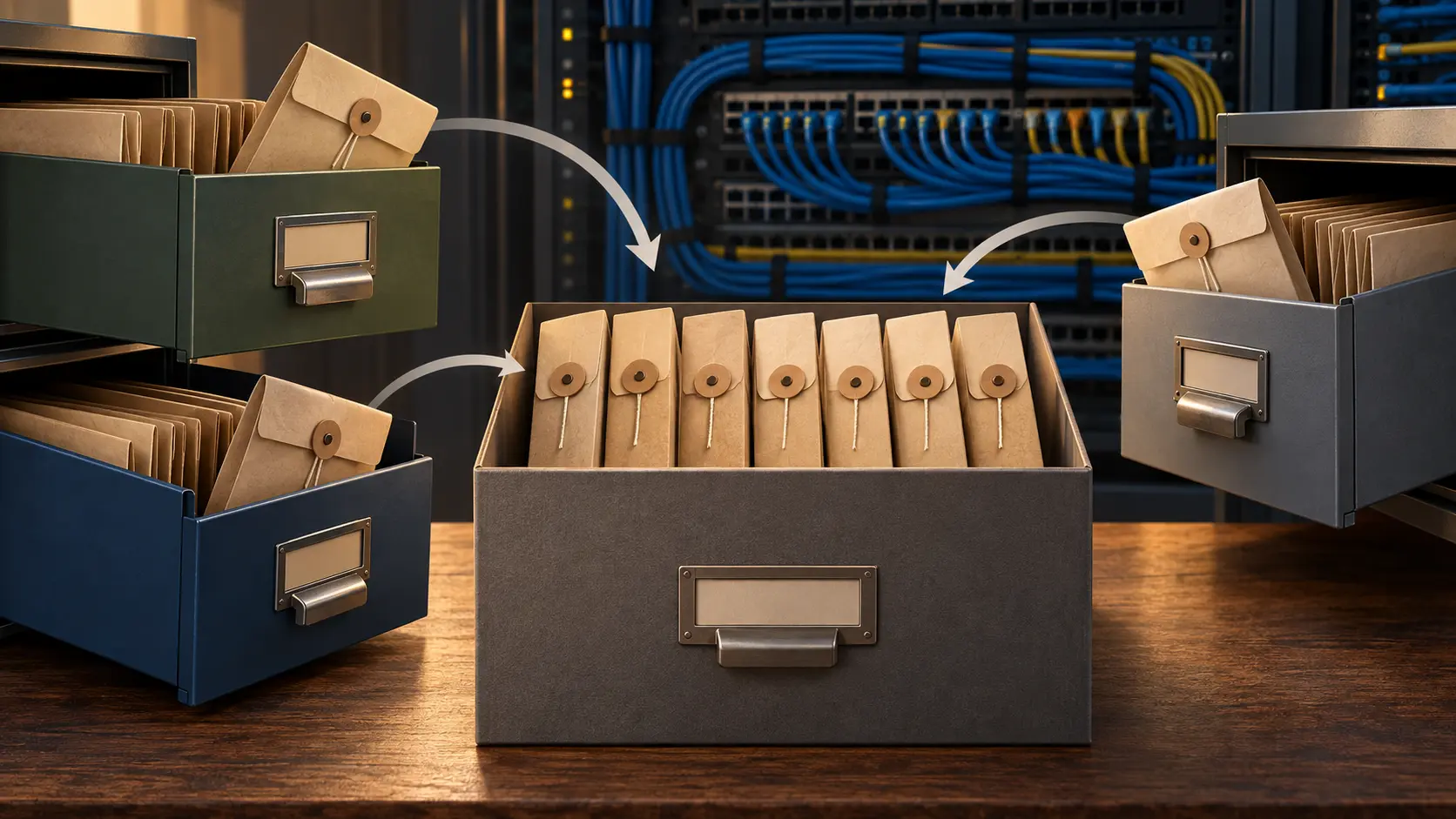
Seven IPv4 blocks, three senders, one name: Homepage Universe
RIPE NCC's daily transfer list can look like a trading screen. On 27 October, seven of its ten IPv4 entries went to Homepage Universe. Every one followed the register's merger or acquisition category. Their shared destination is the day's market signal.

IETF
TLS Changed Its Key Schedule. The Authenticator Next Door Needs the Memo
A TLS cipher suite can keep its familiar hash label while a separate extension chooses a different key schedule. The 27 October XOF draft revision makes the resulting handoff explicit: an identity check running outside the TLS library needs to know which KDF was negotiated, and…

Story
RIPE NCC Can Reject a Sponsor for a Public Argument
A new sponsorship rule reaches beyond money and influence. A public dispute with RIPE NCC, its management or another RIR can put a would-be sponsor outside the room.

Global Cloud Services Trends
AWS can lock a future RDS booking before the meter starts
A project can move on the calendar while its database capacity keeps the old appointment. Under AWS's new RDS reservation rules, an accepted future booking enters a state where cancellation is closed and billing has yet to begin. The purchasing decision happens before the first…