Summary
draft-ietf-opsawg-ipfix-quic-header-00proposes seven IPFIX Information Elements for QUIC header, Connection ID, packet-number, frame-type and stream observations; three protected fields require decryption.- A populated field proves only what a named exporter recovered under a particular configuration. It does not prove complete connection identity, lawful key use, continuity across migration, endpoint processing or application outcome.
An operator opens a flow record and finds a QUIC Destination Connection ID, Packet Number and Stream ID. The record is structured. The names are standardised. The collector accepted it without complaint.
The temptation is to call it a connection record.
That is one inference too many. The proposed Information Elements can make observations portable without making the observer omniscient. A record still begins at a particular Observation Point, passes through a particular parser and metering policy, and reaches a collector through an export path that can itself lose data. The field is useful precisely when its authority remains narrow.
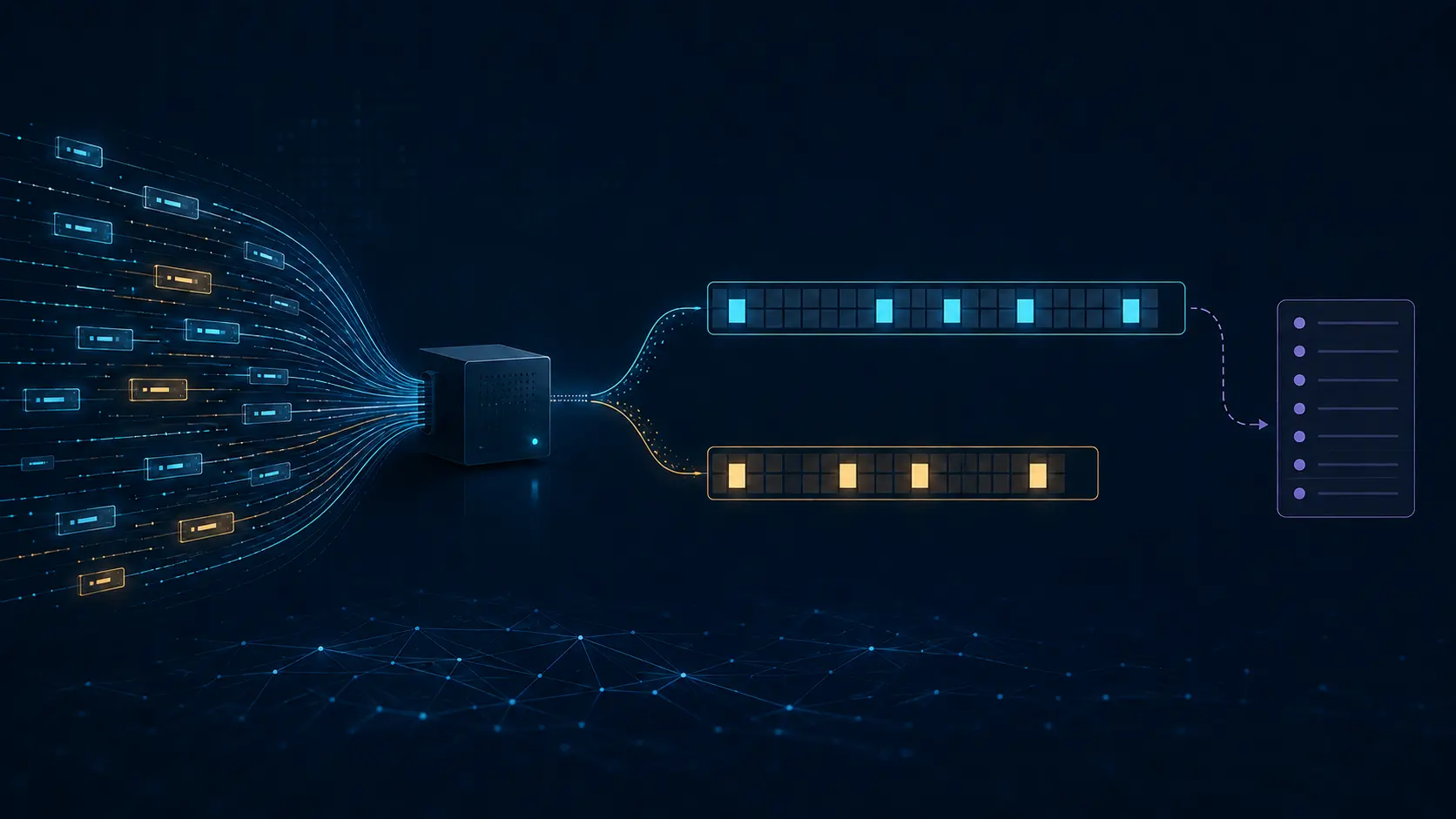
The OPSAWG working-group draft, published on 10 September, proposes seven elements: quicHeaderFlag, quicVersion, quicDestinationConnectionID, quicSourceConnectionID, quicPacketNumber, quicFrameType and quicStreamID. Flags, version and Connection IDs from long headers include wire-visible material. Packet Number, Frame Type and Stream ID are protected. Recovering those three requires successful QUIC decryption at an endpoint or a capable on-path device.
Even the visible set has conditions. A QUIC short header does not carry the length of its Destination Connection ID. An intermediate parser therefore needs the identifier or its length from external configuration. If that assumption is missing, stale or applied to the wrong traffic, a syntactically populated field can still be a bad interpretation. The configuration is part of the evidence, although it is not contained in the value.
The word “flow” adds a second boundary. The draft explicitly uses the IPFIX meaning, not a QUIC-native one. RFC 7011 defines a Flow around packets observed at one Observation Point over an interval with common properties. A Metering Process may sample, select, timestamp and derive properties before exporting a Flow Record. That object is not automatically coextensive with a QUIC connection.
QUIC is designed to break the convenient equivalence. A connection can survive an address or port change. Endpoints issue, rotate and retire Connection IDs. Different paths may expose different five-tuples while the same connection continues. Conversely, a Connection ID is a routing handle inside the issuer's context, not a globally stable name for a person, device or customer session. Joining records across those changes is an analytical act that needs its own receipt.
Packet numbers are equally contextual. QUIC maintains distinct number spaces for Initial, Handshake and Application Data, with direction also material. A gap in one exporter’s sequence may be packet loss. It may also reflect sampling, a second path, a late observation start, missing keys or an export record dropped under pressure. RFC 7011 expressly permits selection and describes Data Record loss at an exporter; the exporter must account for loss, but the mere presence of neighbouring records does not establish completeness.
Frame Type and Stream ID do not close the gap. A frame type identifies the grammar to apply after packet protection is removed. It does not establish that type-specific fields were captured, that the peer processed the frame or that an application accepted its consequence. A Stream ID is unique only within its connection. Without a validated connection context, endpoint evidence and application correlation, it cannot name a durable request or transaction.
Decryption must also be split into capability and authority. Successful removal of QUIC protection can authenticate a packet within the relevant key context. It does not answer who authorised the exporter to hold the keys, which fields it may disclose, which collector may retain them, how long they may persist or which automated decision may consume them. A technical ability is not a governance receipt.
The draft's revision-00 security section adds no considerations beyond the IPFIX registry specification. Operators should therefore not read silence as absence of risk. RFC 7011 treats exporter and collector authentication, message integrity, traffic confidentiality, privacy and false-template attacks as real concerns. These controls sit around the Information Element; the value cannot carry them on its own.
A defensible evidence chain names the Observation Point and Observation Domain, exporter identity, parser version, short-header CID assumption, sampling and filter policy, decryption context and authority, template revision, packet-number space, export-loss counter, collector and retention policy. It then records every join across five-tuples, Connection IDs and streams before comparing the result with endpoint and application logs.
That chain does not diminish the proposal. Common Information Elements can reduce private schemas and let tools exchange bounded observations. The current document is nevertheless an Internet-Draft at revision 00. Its Datatracker state is I-D Exists; no RFC, implementation prevalence or operational benefit follows from that standing.
The clean leadership rule is simple: let an IPFIX record attest to what the configured exporter observed. Require later systems to earn every broader claim. A field can say that a value was recovered at one point. Only additional evidence can say that a connection remained continuous, a stream reached its peer, an application processed a request or a business event occurred.
Sources
- OPSAWG draft revision 00
- Current Datatracker record
- Datatracker revision history
- RFC 7011: IPFIX protocol specification
- RFC 7012: IPFIX Information Model
- RFC 9000: QUIC transport
- RFC 9001: QUIC TLS
- RFC 9312: Manageability of the QUIC Transport Protocol
- IANA IPFIX Information Elements registry
- IANA QUIC registry
- Heng Lu: reality layers and symbolic power
- Heng Lu: running-code primacy
- Heng Lu: minimum initial specification
- Heng Lu: reality, not advocacy
Member Briefing
Deeper Profile Context
Sign in with the right membership level to unlock the full briefing and source notes.
Only for Strategic Circle
Strategic Circle
Open to all readers. Unlock profile briefings after joining and signing in.
Join Strategic CircleOnly for Leadership Alliance
Leadership Alliance
For qualified IP-asset owners and management; sign in to unlock alliance briefings.
Join Leadership Alliance