
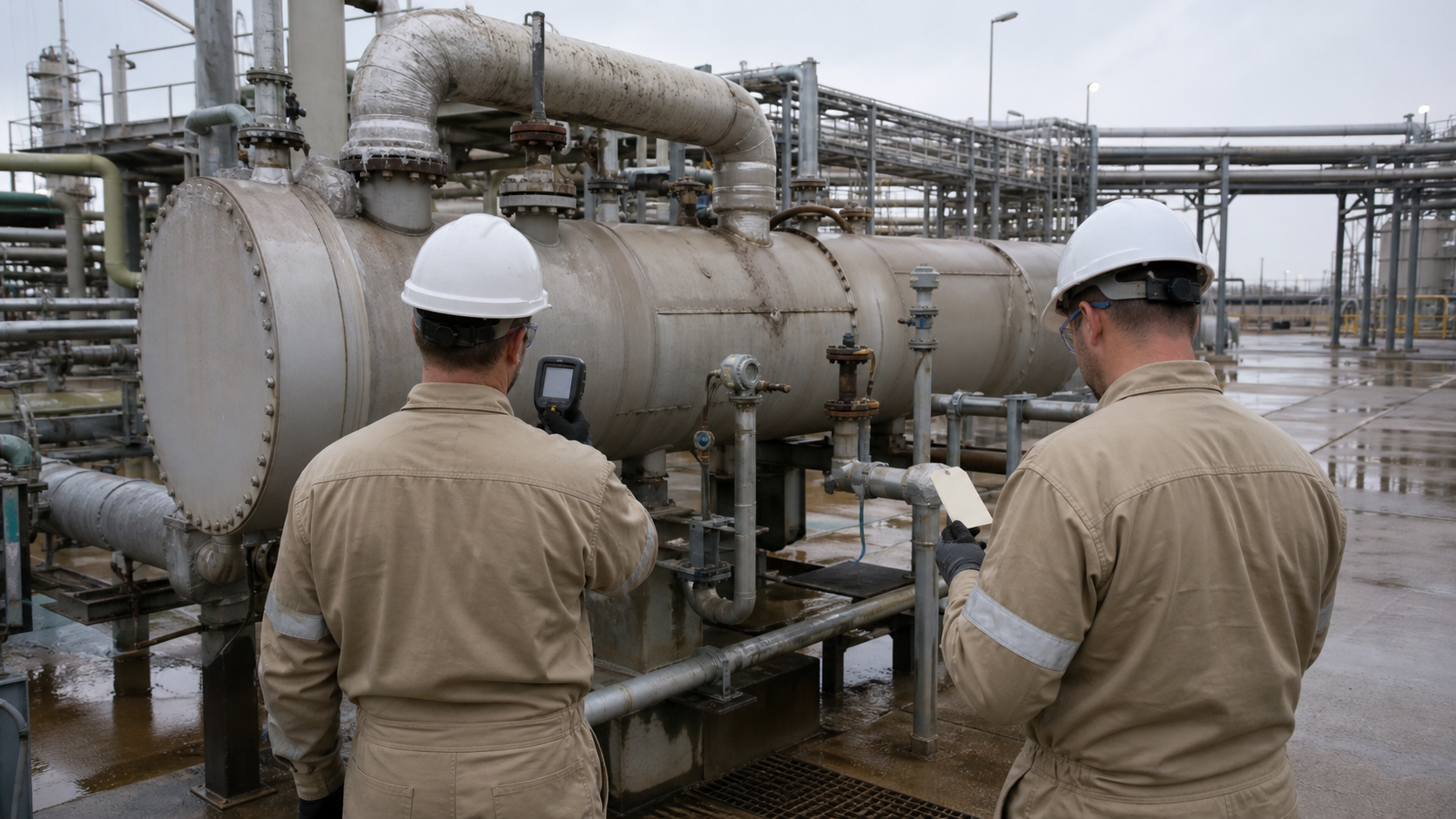
Summary
- On 25 September 1998, a process upset in Gas Plant 1 at Esso's Longford complex stopped the circulation of hot lean oil. Cold process liquids chilled equipment that had not been designed for such temperatures. When warm lean oil was reintroduced, the severely cold GP905 heat exchanger ruptured by brittle fracture. Released hydrocarbons ignited, killing Peter Bubeck Wilson and John Francis Lowery and injuring eight other people.
- The Longford Royal Commission treated the fracture mechanism and the organizational cause as connected but distinct. The plant lacked an adequate hazard-identification study for the scenario. Operators had not been trained in the low-temperature danger and did not have suitable procedures. Reduced on-site engineering and supervision increased reliance on operational knowledge that the company had not supplied. The Commission did not make every design or staffing criticism an independently sufficient cause.
- The fire disabled more than the oldest gas plant. Interconnections and escalating damage forced all three gas plants and the crude-stabilisation system out of service. A facility supplying about 98 per cent of Victoria's gas requirements became a statewide dependency. Restoration was staged: production began returning before every customer was safely reconnected, and official records use both a roughly two-week shorthand and a 19-day full-restoration period.
- Accountability followed separate legal routes. The Commission was an inquiry, not a criminal court. In 2001 a jury convicted Esso Australia Pty Ltd of 11 Occupational Health and Safety Act offences and the Supreme Court imposed A$2 million in fines; that was not a manslaughter conviction. Later statutory victim compensation, civil liability findings and a court-approved group settlement answered different questions and must not be combined into one damages figure.
- Victoria subsequently adopted a major-hazard-facility safety-case regime and strengthened supply contingency arrangements, including interconnection, alternative contracts and storage. Those reforms provide a control model, not automatic proof of enduring performance. Current assurance requires verified hazard registers, effective critical controls, competent people at the plant, tested emergency isolation and evidence that a prolonged Longford outage can be managed without unsafe curtailment or restart.
The initiating upset was physical, but the accountability question was organizational
The most authoritative reconstruction is the Longford Royal Commission's report. Gas Plant 1 used a circulating lean-oil system to absorb heavier hydrocarbons from raw Bass Strait gas and to move heat through the process. The lean oil was not merely a product stream. Its return flow supplied heat to vessels including the GP905 reboiler and the nearby GP922 exchanger. That thermal role made loss of circulation a process-safety condition, not just a production interruption.
On the morning of 25 September, operating difficulties and pump trips stopped the circulation of hot lean oil. Cold condensate and rich oil continued to affect the process. Without the normal heat input, GP905 and other equipment became extraordinarily cold; ice on exposed metal provided a visible symptom, but not an intelligible diagnosis for the people responding. GP905 reached about minus 48 degrees Celsius, far below the temperature for which its carbon-steel shell had been designed.
The plant response sought to regain circulation and warm the affected equipment. When warm lean oil again entered the chilled exchanger, a large temperature difference imposed thermal stress on steel whose fracture toughness had been reduced by the cold. The Commission's metallurgical conclusion was not that normal internal pressure alone burst the vessel. It found brittle fracture with localized ligament failure and concluded, on the balance of probabilities, that the additional stress arose from the temperature difference created during the attempted return of hot lean oil.
The rupture released hydrocarbons into the plant. A vapour cloud moved through the site and ignited, producing an initial flash fire or deflagration and then a severe fire at the release point. Escalation damaged other hydrocarbon systems. “Explosion” remains the conventional name for the disaster, but it should not be read as proof that GP905 detonated from overpressure. The physical distinction matters because prevention had to control low temperature, thermal shock, material limits, inventory isolation and escalation—not merely pressure relief.
Peter Bubeck Wilson and John Francis Lowery died and eight other people were injured. Those consequences anchor the accountability inquiry. The statewide supply loss was immense, but public inconvenience must not eclipse the workplace deaths. Conversely, treating the event only as an occupational fatality would miss why process design at one private facility became an essential-service governance problem for millions of people.
GP905 crossed a material limit that the operating system did not make visible
A heat exchanger can remain within pressure limits while becoming unsafe for another reason. Carbon steel that performs adequately at ordinary process temperatures can lose toughness at sufficiently low temperature. At Longford the dangerous state was therefore a combination: cold process inventory continued to chill the exchanger after its heating stream disappeared, the vessel metal moved outside its intended temperature envelope, and later temperature differences supplied the stress needed for fracture.
An accountable control system would have translated that mechanism into several independent protections. Design information should have specified a minimum allowable metal temperature for each vulnerable vessel. Instruments should have measured or reliably inferred the temperature that governed material integrity. A low-temperature trip should have stopped cold feed, blocked a hazardous restart or required engineering authorization. Restart logic should have limited temperature gradients rather than treating restored flow as an uncomplicated return to normal.
Longford did not give operators that full control model. The alarm and operating information told them that the process was abnormal, but not that a large vessel was entering a brittle regime. Frosting was observable, yet observation without the right causal knowledge could support the wrong recovery action. An operator cannot be expected to derive fracture mechanics from ice on a flange while stabilising a complicated gas plant. The organization that owns the design basis must convert it into alarms, procedures, training and stop criteria.
The design boundary also extended beyond GP905. The plants had evolved over decades, with shared pipe racks and interconnections supporting efficient operation and high availability. Once fire impinged on critical pipework, those connections allowed a local loss of containment to threaten common systems. Emergency shutdown isolated some external feeds but did not instantly segment every inventory that could sustain the fire. Reliability architecture based on interconnected spare capacity can become escalation architecture unless isolation zones are designed and tested for a major incident.
That is why “operator error” is an incomplete frame. Operators made decisions, and some operating practices could be criticized, but the decisive question is what a trained, supervised person could reasonably know and control. If the vessel's low-temperature limit is absent from procedures, if the alarm does not communicate the material hazard, and if restart is not constrained by an engineered barrier, the worker becomes the last point of defence against information the enterprise has not delivered.
Hazard identification recorded activity, but it did not find the decisive scenario
Gas Plant 1 dated from an era before systematic hazard and operability studies were standard in process design. Age did not exempt it from later review. A mature high-hazard operator must revisit older equipment when knowledge, operating conditions, modifications or analytical methods change. The Commission concluded that Esso had not performed a HAZOP or another adequate process that identified the danger created by loss of lean-oil flow in GP1.
The missing scenario was not abstract. A useful review would have asked what happens when the hot circulation pumps stop while cold material continues moving; which vessels can fall below their design temperature; how quickly the metal cools; what alarms show the state; how feed is isolated; and what conditions must be met before heat is restored. It would also have traced escalation through shared pipework, inventories and fire exposure. Each answer should have produced a named control with an owner and a performance test.
Longford demonstrates the difference between a safety-management system as documentation and as operational knowledge. Esso had a corporate Operations Integrity Management System and a record of safety programs. The Commission nevertheless criticized the system's complexity and implementation. A framework cannot protect a vessel merely because it contains sections on risk assessment, training and audit. It must cause the particular cold-temperature hazard to be identified, assigned, communicated and controlled at the equipment where it can occur.
The formal publication history also deserves a boundary. Victoria enacted the Longford Royal Commission (Report) Act 1999 to deal with the report's formal status and use. The Act is part of the institutional record, but it is not an independent engineering finding. The report supplies the forensic analysis; the statute does not convert every submission, allegation or possible factor considered by the inquiry into a proved cause.
The Commission's terms of reference were also limited. They asked whether specified factors contributed to the accident and what steps should prevent recurrence or lessen supply disruption. They did not authorize a general determination that Victoria's occupational-safety regulator or every government supply decision caused the event. It would therefore be wrong to use the report either to absolve all public oversight or to claim that it adjudicated regulatory blame it was not commissioned to decide.
A warning event mattered as knowledge, not as a second cause
Evidence about an earlier low-temperature episode on 28 August 1998 became important in the criminal trial. In an evidentiary ruling, DPP v Esso Australia Pty Ltd [2001] VSC 104, the Supreme Court considered material offered to show prior knowledge and warning concerning loss of lean-oil flow and frosting. The judge also cautioned that the earlier matter could not become a distraction from the offences charged for 25 September.
That ruling supports a disciplined accountability claim. The August event was potentially a missed learning opportunity. It did not physically trigger the September rupture. The appropriate question is whether reporting, investigation and organizational learning should have exposed the hazard in time to change procedures, training or equipment. Calling the earlier episode “the cause” would collapse evidence of notice into the later causal chain.
Near misses and abnormal events require a structured response precisely because their meaning is not always obvious at the time. A strong system preserves process trends, interviews the crew, identifies equipment outside design limits, checks whether an alarm or trip performed its intended function and asks whether similar units share the condition. Findings then need technical review and a closeout standard based on changed risk, not on completion of a memo.
This is also a knowledge-management problem. The safest explanation may exist in an old commissioning procedure, a design calculation, a specialist's memory or a record held away from the operating site. None is a dependable barrier unless the current crew can use it under time pressure. Plant changes and staff transfers make that translation harder. They also make it more necessary to maintain a controlled design basis, searchable abnormal-situation guidance and a clear route to competent engineering advice.
An incident-learning system should classify repeated frosting, failed circulation and excursion below minimum temperature as precursor signals. It should establish whether the equipment remains fit for service after the excursion and whether rewarming is itself hazardous. Until those questions are answered, conservative isolation is not overreaction; it is the operational recognition that uncertainty has replaced a proven safe envelope.
Training failed because the necessary mental model had not been taught
The Commission identified Esso's failure to equip employees with appropriate knowledge as the ultimate organizational cause. Operators were not adequately trained to understand that loss of lean-oil circulation could expose vessels to dangerous low temperatures. Suitable written procedures did not tell them how to respond. Their actions therefore have to be assessed within the informational environment the company created.
Competence in a complex plant is more than knowing the normal line-up or memorising a start sequence. It includes the ability to recognize when several ordinary indications form an extraordinary state. At Longford, loss of heating, continued cold flow, frosting, failed restart attempts and leaking equipment needed to resolve into one message: material integrity may be compromised, and uncontrolled warming may fracture the vessel. Without that mental model, restarting flow can appear remedial rather than dangerous.
Training should connect theory to decisions. A competent program would show how the absorber, rich-oil and lean-oil circuits exchange heat; identify vulnerable vessels and their temperature limits; simulate pump loss; require the trainee to isolate cold feed; and prohibit restart until temperatures and gradients satisfy an approved recovery plan. Assessment should test performance in an abnormal scenario, not attendance at a presentation. Refresher triggers should include plant modification, role change and any excursion that reveals a gap.
Procedures must carry the same logic. A useful abnormal-operating procedure states initiating conditions, immediate safe actions, prohibited actions, required measurements, decision authority and escalation thresholds. It also tells the crew when the procedure is no longer adequate and engineering analysis is required. A generic instruction to restore circulation cannot safely govern a vessel that may already be brittle.
Supervision supplies a further barrier, but only when the supervisor has both process expertise and authority to stop recovery work. The Commission found that engineers had been moved from Longford to Melbourne and that supervision at the plant had been reduced. It regarded the reduction as probably contributing, while saying a direct connection could not be precisely discerned. That qualification should be preserved. The evidence supports concern about weaker access to expertise; it does not quantify how one staffing decision alone produced the rupture.
Organizational separation turned remote expertise into a fragile safeguard
Moving technical staff away from a facility can produce efficiencies in routine work. It can also create latency in abnormal work. A remote engineer may not see frost, hear the sequence of alarms, know which temporary configuration is in place or participate in the moment when a restart decision is framed. Operators then carry greater interpretive responsibility even when their training and procedures have not expanded to match it.
Accountability requires mapping each safety-critical decision to a competent role available at the required time. Who can declare a vessel outside its safe envelope? Who approves warming after a cold excursion? Who checks the metallurgy, temperature data and isolation boundary? Who can require a full plant shutdown despite supply consequences? If the answer depends on finding an individual in another city, the control needs tested communication, response times, deputies and an explicit default to the safe state.
Production and continuity pressure complicate that authority. Longford was the dominant source of Victorian gas, so a shutdown had consequences far beyond the fence. That importance makes conservative process decisions more—not less—necessary. A crew that knows hospitals, factories and households depend on its plant may feel pressure to restore operation. The enterprise and government must prevent that pressure from being transferred into an unsafe restart choice.
The remedy is not simply to place more people on every shift. It is to put the right knowledge at the point of decision and verify that the system works. On-site competence matrices, remote-call tests, abnormal-situation drills and incident-command exercises can show whether an operator receives qualified advice in time. Audit sampling should begin with real decisions: choose a recent excursion, identify who authorized recovery, and inspect the evidence they used.
Worker consultation is equally important. Operators often know where procedures diverge from actual plant behaviour, which alarms are normalized and which isolation steps are impractical. Their knowledge must feed hazard studies without shifting ownership of design risk onto them. Consultation is a source of evidence; the operator of the facility remains responsible for converting it into controls and safe systems of work.
The fire escalated through shared systems and difficult isolation
The initial release did not remain confined to one exchanger. Fire affected a critical pipe-rack area and exposed connected hydrocarbon systems. Local inventory could sustain the first period, while flows and inventories elsewhere in the interconnected complex prolonged and expanded the emergency. The layout that helped three plants share services and maintain supply also complicated physical separation during a major incident.
Emergency isolation must therefore be designed by scenario. A general shutdown button is not sufficient if it leaves large inventories connected or requires a person to approach equipment under severe radiant heat. For each credible rupture, the safety case should identify the smallest isolatable inventory, the valves that create that boundary, their closure time, their fail-safe state and whether they remain accessible after escalation. Remote operation needs independent power and proof testing.
The emergency also required responders to understand a plant that had changed over many years. Accurate drawings, current inventory information and a shared incident map are safety controls. When pipework is a hybrid of original design and later modification, an outdated plan can be more dangerous than no plan because it gives false confidence. Configuration management must keep engineering drawings, field labels and emergency plans aligned.
The Country Fire Authority's 25th-anniversary operational account records the scale of the firefighting effort. Local brigades worked with Esso personnel, appliances came from numerous districts and one pumper operated continuously for almost two days. It also records an important restoration milestone: supply from the Longford facility remained shut until 4 October. That date describes the production shutdown, not the completion of safe reconnection to every customer.
Emergency assurance should test both the industrial fire plan and the service-continuity plan. A site exercise might prove that responders can isolate and cool equipment. A statewide exercise must also prove that distributors can curtail demand, communicate with vulnerable users, keep essential facilities supplied and later relight a very large network without introducing gas into unsafe customer installations. Longford required both systems at once.
One plant failure became a statewide essential-service emergency
The Longford complex supplied approximately 98 per cent of Victoria's gas requirements at the time. All three gas plants shut down after the fire, along with associated liquids processing. Within about 36 hours, consumers were instructed to turn off gas at their premises. The Victorian Parliament's later critical-infrastructure review records that most Victorian gas consumers were without service for 19 days.
The number is more than a measure of inconvenience. Gas heated water and buildings, cooked food and supplied industrial kilns, boilers and production lines. Hospitals and other essential services needed priority arrangements. Small restaurants, laundries, accommodation businesses and manufacturers could not readily substitute another fuel. Employees were stood down when employers could not operate. The dependency propagated from one process vessel through commercial and public-service networks.
Official summaries differ in wording: some say the interruption lasted two weeks, others 19 days or roughly three weeks. These are not necessarily factual contradictions. Gas production began returning before the whole distribution system was restored. Reconnection had to be staged, with attention to network pressure, air ingress, customer valves and appliance safety. A plant restart date, initial supply date and full customer restoration date answer different questions.
The Australian Institute for Disaster Resilience's national disaster record reports about 1.4 million properties and 89,000 businesses affected and cites an estimated A$1.3 billion economic cost. That figure is a broad estimate, not a court award, an insurance payout ledger or the State's direct expenditure. It should be used to convey scale while remaining separate from criminal fines, statutory compensation and the later class-action settlement.
Continuity planning failed the practical substitution test. A paper plan can list alternative sources, but resilience exists only if enough gas can physically reach the affected network at required pressure, contracts permit its use, operators can schedule it, and priority rules are understood. In 1998 the dominant production source and limited interconnection left too little usable diversity when Longford stopped.
The State's continuity response mixed emergency aid with accelerated infrastructure
The Victorian Auditor-General's 1998–99 review of government finances separates several consequences that are often merged. It records emergency assistance arrangements and State expenditure, while also describing a Winter 1999 supply-security program. GASCOR expected to spend about A$51 million on measures including an upgraded New South Wales interconnect, the south-west pipeline, equipment and new supply contracts.
The Auditor-General also described acceleration of private development for underground storage near Port Campbell. Accuracy requires a counterfactual boundary: alternative-source, pipeline and storage work had not all been invented after the explosion. Some projects or concepts already existed. Longford exposed their urgency and caused government and industry to accelerate, coordinate or reprioritize them for winter security.
The Victoria 1999–2000 Budget Statement gives the operational logic. The New South Wales–Victoria interconnect brought emergency gas south after the Longford disruption, helping maintain hospitals and network pressure. The contingency program combined capacity upgrades, faster pipeline work, alternative supply contracts and demand management for industrial and commercial users. Resilience was not a single spare plant; it was a portfolio of physical capacity, commercial rights and controlled demand reduction.
Demand management needs explicit accountability. Curtailment priorities determine which factories stop, which services continue and how economic burdens are distributed. Plans should identify essential loads, safe shutdown requirements, minimum notice, compensation rules and the authority to direct reductions. SMEs need usable communication because they may lack energy managers or dual-fuel equipment. A priority list hidden inside an emergency manual is not continuity capability.
Restoration is itself hazardous. If air enters distribution pipes or customer installations, simply reopening supply can create an explosive mixture or allow unlit gas to escape. The continuity metric should therefore not reward speed alone. It should track safe reconnection, vulnerable-customer welfare, verified appliance relight and the number of premises remaining isolated. Longford's staged recovery illustrates why “gas flowing” and “service restored” must remain separate milestones.
The Royal Commission, prosecution and sentence answered different questions
The Royal Commission gathered evidence and made public findings about cause and prevention. It did not convict Esso. Criminal legal accountability came through a jury trial under the Occupational Health and Safety Act 1985. In DPP v Esso Australia Pty Ltd [2001] VSC 263, the Supreme Court recorded convictions on 11 counts: ten concerning duties to employees under section 21 and one concerning risk to non-employees under section 22.
Justice Cummins imposed fines totalling A$2 million. The sentencing reasons emphasized hazard identification, safe plant and systems, training, foreseeability and general deterrence. They also rejected a framing that displaced organizational responsibility onto the workers. The legal subject was Esso Australia Pty Ltd, the company prosecuted for the operating failures. This article's directory subject, Esso Australia Resources Ltd, reflects the institutional entity specified for the series; the names should not be treated as interchangeable legal defendants in every proceeding.
The convictions were occupational-health-and-safety offences. They were not convictions for corporate manslaughter, and the judgment did not convict an individual executive. The A$2 million was a criminal fine payable under the sentencing disposition, not compensation distributed among families, injured workers or gas customers. Those distinctions are essential when comparing remedies.
Victim compensation then followed a separate statutory route. DPP v Esso Australia Pty Ltd [2003] VSC 222 dealt with compensation orders under section 85B of the Sentencing Act based on the OHS convictions. The court considered injury including psychiatric harm, grief and distress suffered by employees and non-employees. These orders were connected to victims of the offences; they were not a statewide scheme for business interruption.
Each institution therefore produced a different kind of record. The Commission supplies the strongest integrated causal reconstruction. The jury verdict and sentence establish specified criminal statutory breaches and penalties. The section 85B proceeding addresses eligible victim harm. None alone resolves the tort question of which gas users could recover property damage or pure economic loss.
Civil remedy drew a boundary around ripple losses
The loss of gas produced claims from industrial and business users, domestic users and workers who had been stood down. The scale created a difficult negligence question: when an operator interrupts an essential input to an entire State, how far does a duty extend through the resulting chain of economic loss?
The common-issues judgment in Johnson Tiles Pty Ltd v Esso Australia Pty Ltd [2003] VSC 27 did not award every affected person the economic value of the interruption. It distinguished a duty to avoid a stoppage causing property damage from a proposed duty to avoid pure economic loss. The representative and sample claims, contractual setting, vulnerability, causation and the potentially wide class all mattered. Some property-damage-related claims could proceed while broad pure-economic-loss claims faced legal limits.
That boundary is uncomfortable but precise. A business whose kiln or goods were physically damaged occupied a different legal position from a business that lost sales while closed, and both differed from an employee who lost wages because an employer shut down. Foreseeability alone did not make every downstream loss compensable in negligence. Reporting that “Esso was liable for the gas crisis” without identifying the category of loss would obscure the judgment's central work.
The litigation later settled. In Johnson Tiles Pty Ltd v Esso Australia Pty Ltd (No 4) [2004] VSC 466, the Supreme Court approved the settlement under Victoria's group-proceeding law after considering the interests of group members. Approval protected the class process; it did not turn every original allegation into a tried finding or erase the earlier distinctions between loss categories.
A Federal Court judge's later official review of Australian class actions records the settlement at A$32.5 million after judgment in part for the plaintiffs and appeals by both sides. That amount is not comparable to the A$1.3 billion broad economic estimate. Nor is it interchangeable with the A$2 million criminal fine or the victim-compensation orders. They represent different claimants, legal bases and purposes.
The safety-case regime changed what a major-hazard operator had to demonstrate
Longford became a central reference point in Victoria's regulation of major hazard facilities. WorkSafe's safety-management-system guidance explains that later regulatory requirements were designed in response to lessons from the Royal Commission. The current model requires a comprehensive, integrated safety management system supporting a facility-specific safety case.
That model changes the burden from possessing general safety policies to demonstrating control of major incidents. The operator must identify major-incident hazards, select controls, define performance standards and show that the controls are implemented and functional. Knowledge management, management of change, training, supervision, consultation, emergency planning, monitoring and audit become connected parts of one prevention argument.
Safe Work Australia's 2003 national major-hazard-facility report places the change in time. It records that the national standard had not been implemented by any Australian jurisdiction when the 1998 event occurred, and that Victoria's MHF regulations took effect in 2000. By 2003, safety cases had been assessed and licences issued. This later regime must not be projected backwards as if its exact duties governed Esso in September 1998.
The safety-case approach is powerful because it can join design knowledge to operations. The cold-temperature scenario would need to appear in the hazard register; GP905's material limit and protective functions would need performance standards; procedures and competency would need to match the scenario; and audit would need to verify the barrier in the field. A regulator can challenge the whole argument rather than inspect isolated compliance documents.
But a safety case can become another impressive file. Durable assurance requires sampling the evidence beneath it: calibration and trip-test records, minimum-temperature alarm response, operator assessments, restart authorizations, isolation-valve closure tests, drawing accuracy and closeout of hazard-study actions. The lesson from Longford is not that a system's name guarantees integrity. It is that system claims must change what people know and what equipment does during an upset.
Later incidents and current licence conditions prevent an easy closure narrative
The continued operation of Longford provides evidence that regulation and plant systems changed, but it also allows those systems to be tested. A WorkSafe serious-incident report on a 2009 Longford gas release described inadequate job planning for work on high-pressure piping, trapped pressure and hydrogen-sulphide hazards. WorkSafe issued an improvement notice and directed review of the relevant safety-case material.
That later event was not a repetition of the 1998 brittle-fracture disaster. It involved different equipment, work and consequences. Its relevance is narrower and useful: a licensed safety-case facility still needs effective task planning, hazard communication and review of operating assumptions. A regulatory regime creates a mechanism for correction; it does not eliminate the possibility that familiar work will be under-analyzed.
Current licensing is similarly specific. WorkSafe's register of licensed major hazard facilities lists Esso Australia Pty Ltd's Longford licence through 10 December 2028 with conditions. Those conditions require review of fire-protection and safety studies, assessment of detection and protection performance, revision of emergency manuals and recurring senior compliance meetings addressing hazard-register verification, procedures and performance standards.
The conditions are not proof of current non-compliance with every listed subject, nor are they a declaration that all Longford risks have been eliminated. They are transparent, enforceable assurance requirements. Their value lies in the evidence generated: deviations identified, action deadlines, test results, improvement implementation and senior accountability. Public visibility also makes it harder to substitute a general corporate assurance for facility-specific proof.
The strongest closure record would connect these modern conditions to measurable outcomes. It would show that firewater and foam meet scenario demand, manually operated equipment remains accessible under radiant-heat conditions, critical isolation works within its required time, hazard-register records match field configuration, and operators can diagnose and safely recover from low-temperature excursions. A licence expiry date alone proves none of those facts.
Supply resilience improved, but Longford remains a material system dependency
Later outages provide a practical test of the post-1998 gas system. AEMO's 2017 annual report describes a six-hour unplanned total outage at Longford on 1 October 2016. AEMO intervened in the Victorian gas market, issued a threat-to-system-security notice and used scheduling and operational responses to conserve pressure. Customers did not lose supply, although contractual pressure levels were breached at several points.
The contrast with 1998 is meaningful but bounded. Market coordination, linepack, alternative injections and intervention helped manage a short outage. That does not prove the system could absorb a 19-day winter loss of Longford without curtailment. Duration, season, storage inventory, pipeline availability and competing interstate demand determine whether alternatives remain adequate.
Resilience evidence should therefore be scenario based. The system operator and government should model full Longford loss at peak demand, with another material asset unavailable, and publish the assumptions that can safely be disclosed. The model should identify how long linepack lasts, which sources can inject, pipeline constraints, storage withdrawal capability, priority users and the point at which controlled curtailment becomes necessary.
Contracts matter alongside pipes. An interconnector without firm gas supply or transport rights may offer less emergency value than its name suggests. Storage without sufficient inventory cannot cover a prolonged event. Demand-response agreements need tested contacts and safe shutdown plans. Hospitals may have backup fuel, but fuel quality, delivery and equipment readiness must be verified. SMEs need predefined assistance because many cannot finance unused dual-fuel plant solely for a rare statewide emergency.
Proof also needs a safe restoration plan. Distribution businesses should know which zones can be re-pressurized, how premises are verified and how customers receive consistent instructions. Exercises should include misinformation, inaccessible premises and vulnerable residents. The objective is not merely continuity of commodity flow; it is continuity of safe service.
Durable accountability is a chain of evidence from vessel metallurgy to customer relight
Longford's accountability test spans two systems that organizations often govern separately. Process safety asks whether the initiating loss of lean oil is detected, cold feed is isolated, a brittle vessel cannot be warmed unsafely and fire escalation is contained. Public-service continuity asks whether alternative gas can reach Victoria, priority demand can be managed and millions of customer installations can be restored safely. Failure in the first activated weaknesses in the second.
For the facility operator, durable evidence begins with a complete hazard register for low temperature, thermal stress, loss of utilities and common-mode escalation. Each scenario needs a control owner, performance standard and impairment rule. Temperature protection, trips, remote isolation and fire systems require proof tests. Procedures must state safe recovery limits. Competency assessments must demonstrate diagnosis, not attendance. Changes in equipment, feed composition, staffing or remote support must reopen the analysis when they alter the assumptions.
For WorkSafe, assurance means more than accepting a safety case every licensing cycle. Inspectors need to trace selected major-incident scenarios from claimed control to field performance, interview operators without management scripting, inspect overdue actions and test whether executive compliance meetings produce closure. Conditions should remain visible until the regulator has verified the required result. A closed action needs measured effectiveness, not only a revised document.
For government, AEMO, distributors and retailers, continuity proof includes stress tests, deliverable alternative supply, storage inventory, curtailment rules, protected services, emergency communications and restoration drills. Public reports should explain what scenario was tested, which constraints were assumed and what gaps remain, while protecting security-sensitive detail. A plan that cannot reveal any performance evidence cannot earn public confidence.
Remedy records must remain equally clear. Worker fatalities and injuries, statutory safety offences, victim compensation, property damage, pure economic loss and emergency aid are different harm categories. Keeping them separate is not legalistic bookkeeping. It shows who was recognized, who was excluded, which institution supplied relief and where residual loss remained with workers, households or businesses.
The enduring lesson is that safety knowledge must be usable before the upset and continuity capacity must be deliverable before the outage. Longford was not unknowable chemistry. It was an unrecognized interaction among cold process flow, material limits and restart. Victoria's dependence was not invisible either, but alternatives were not ready at the scale required. Accountability is proved when those two gaps stay closed under real operating pressure.
The next abnormal signal must be allowed to stop both production and complacency
An organization can commemorate Longford, maintain a corporate safety system and still miss the lesson if abnormal conditions are treated as production problems first. Frost, failed circulation, contradictory temperatures or an unexplained leak must have power to change the operating state. The default response should preserve material integrity and isolate inventory until competent analysis establishes a safe path.
That response depends on incentives. Operators must be able to stop work without carrying the political or commercial weight of Victoria's gas supply. Supervisors must be judged on conservative decisions as well as availability. Engineers must remain accessible to the plant. Executives must see leading indicators such as operation outside design limits, overdue hazard actions and impaired critical controls—not only injury rates and production volumes.
Public institutions face the same test. A successful six-hour outage response should not become proof that a multiweek contingency is solved. A current licence should not become proof that every control is effective. A court-approved settlement should not become proof that every affected business was made whole. Each record answers a limited question, and the gaps between records are where accountability work remains.
Longford ultimately changed Victorian process-safety regulation and gas planning because it exposed how organizational knowledge and infrastructure concentration can fail together. The most credible legacy is not a claim that the system is now safe. It is a maintained body of evidence showing that a cold vessel is protected, a crew understands why, an emergency can isolate the fuel, a regulator has verified the controls, and the State can sustain essential service while recovery proceeds safely.