
Summary
- DMG says it has contracted two telecom providers for two 100Gbps paths and committed material capital to Christina Lake, although its proposed 50MW tenant agreement is still not definitive.
- The investment case advances only when separate receipts close: physical route diversity, permit approval, final engineering, financing, servers, energisation, acceptance, utilisation and recognised colocation revenue.
The money is moving before the contract
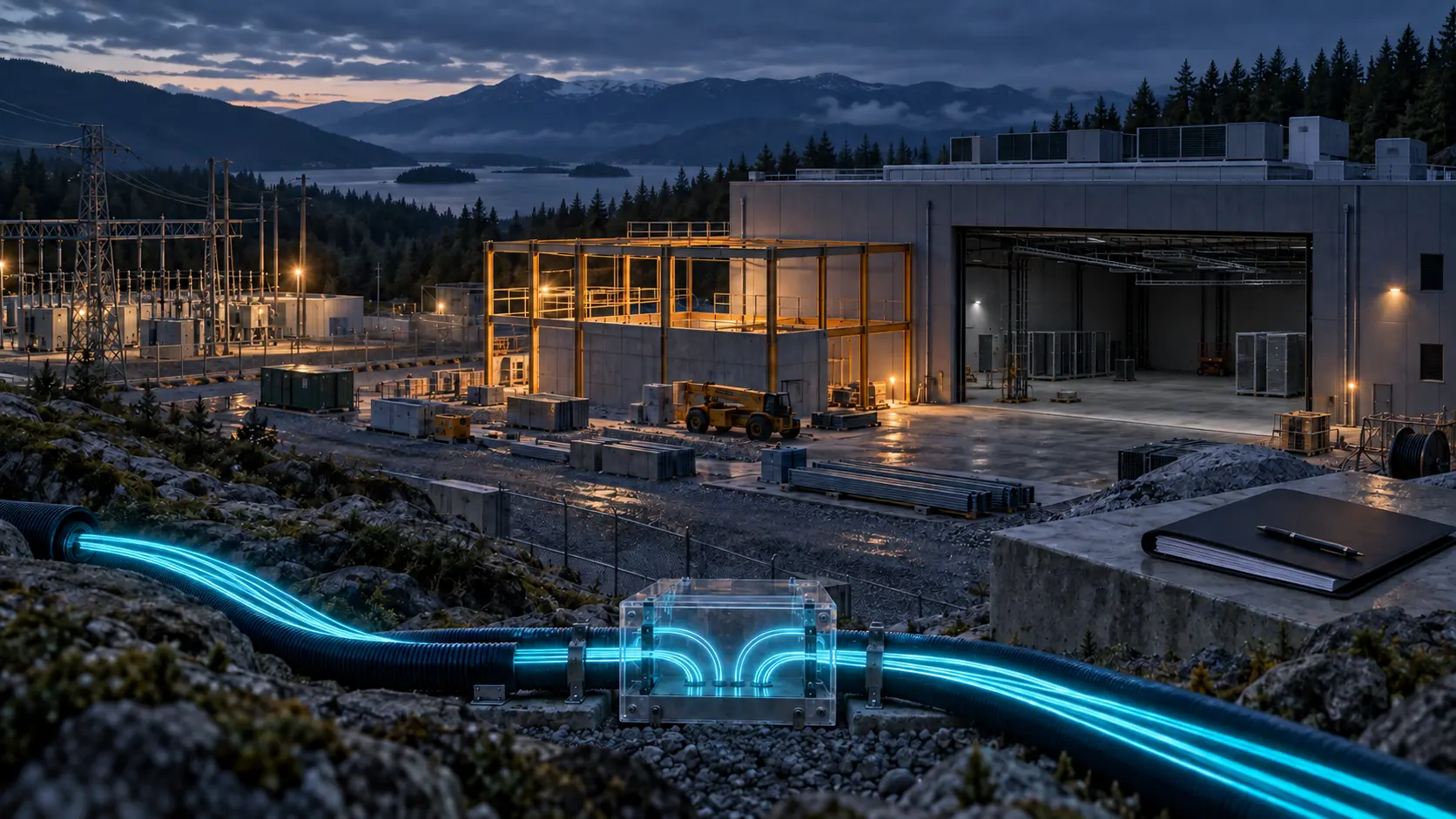
Christina Lake is no longer just a presentation about converting a Bitcoin mine into an AI data centre. DMG Blockchain Solutions says it has contracted two telecom providers, selected an architect, secured some electrical firms and applied to extend the existing building. Connectivity, the company says, has already consumed material capital because a remote site cannot wait until the last minute for fibre.
The customer side is less advanced. DMG is still negotiating the definitive agreement contemplated by its June letter of intent for one confidential tenant and 50MW of critical IT load. The LOI described a 12-year initial term, phased delivery, monthly recurring charges and annual escalations, but did not disclose the prices. Outside its right of first refusal, confidentiality and non-circumvention provisions, DMG called the LOI non-binding. In September it again said there was no assurance that a final agreement would be signed.
That mismatch is the market fact. Early work can shorten the route from signature to service and make the site more credible to a tenant or lender. It can also tie cash to a design before the customer, financing and acceptance criteria are fixed.
Seventy-five megawatts is an input, not an AI service
DMG says Christina Lake now has contracts for 60MW of non-firm power and 15MW of firm power, and that its company-owned substation can support the combined 75MW load. At a stated worst-case PUE of 1.5, 75MW of facility power corresponds to 50MW of critical IT load. The arithmetic is clear; the service is not yet delivered.
The company believes cooler weather, newer servers and alternative energy for chillers might support more than 50MW. Those are design possibilities. They are not measured operating PUE, installed compute or accepted tenant capacity. A separate application for up to 150MW of firm power is also just that: an application. DMG expects significant capital cost and says progress would follow a definitive tenant deal; any combination with the existing non-firm supply would depend on utility transmission capacity.
The building follows another clock. DMG says the location has long carried data-centre zoning, but it has only applied for a permit for an addition that could roughly double building capacity and support up to 60MW of critical IT load. Existing zoning does not issue that permit. An application does not complete construction, inspections or occupancy approval.
Two providers do not publish two physical routes
DMG describes contracts with two telecom providers for two diverse 100Gbps fibre paths and says it is evaluating a third line. This is stronger than an aspiration to seek connectivity. It is still not the same as public proof that the two services lack a shared failure point.
The release does not name the providers or show route maps, conduit and pole ownership, local-loop hand-offs, building entrances, meet-me points, common civil works or failover testing. Two suppliers can still share ducts, poles, bridges, exchanges or the final approach to a remote facility. The word “diverse” is therefore a company description awaiting physical-route and acceptance evidence.
The possible future upgrade to 400Gbps sits on a later clock again. Upgradeability is not an order for 400Gbps ports, optics, spectrum or service. Until capacity and delivery dates are contracted and accepted, 100Gbps is the disclosed service state.
The schedule has already moved
The June LOI aimed to deliver a first phase by 31 December 2026. DMG now says an end-of-year server start always depended partly on reaching a definitive agreement quickly and that a 2027 energisation schedule is more realistic. This is a revision in execution timing, not proof of a new guaranteed date.
Contractor and engineering work also remains staged. A general contractor was still being selected; an electrical engineering firm was planned, an architectural firm selected, and mechanical candidates under review. Those steps can retire uncertainty without constituting a final design, equipment order, completed cooling system or commissioned electrical path.
Financing is similarly open. DMG says it is discussing rated bonds, credit lines, equity and convertible debt with several institutions. Its June-quarter accounts showed C$41.6 million of cash, short-term investments and digital assets, but only C$2.8 million was cash; the same balance sheet carried C$19.7 million of current loans. Company-wide property-and-equipment additions of C$1.6 million for the nine months to June do not disclose how much has since been committed to this conversion.
The right reading is neither “nothing has happened” nor “50MW is secured”. DMG has made concrete long-lead commitments. What it has not yet shown is the sequence that turns them into an earning service: a definitive tenant agreement, final financing, issued permits, design freeze, ordered equipment, installed servers, energisation, integrated commissioning, customer acceptance, utilisation and recognised AI-colocation revenue.
Sources
Member Briefing
Deeper Profile Context
Sign in with the right membership level to unlock the full briefing and source notes.
Only for Strategic Circle
Strategic Circle
Open to all readers. Unlock profile briefings after joining and signing in.
Join Strategic CircleOnly for Leadership Alliance
Leadership Alliance
For qualified IP-asset owners and management; sign in to unlock alliance briefings.
Join Leadership Alliance