
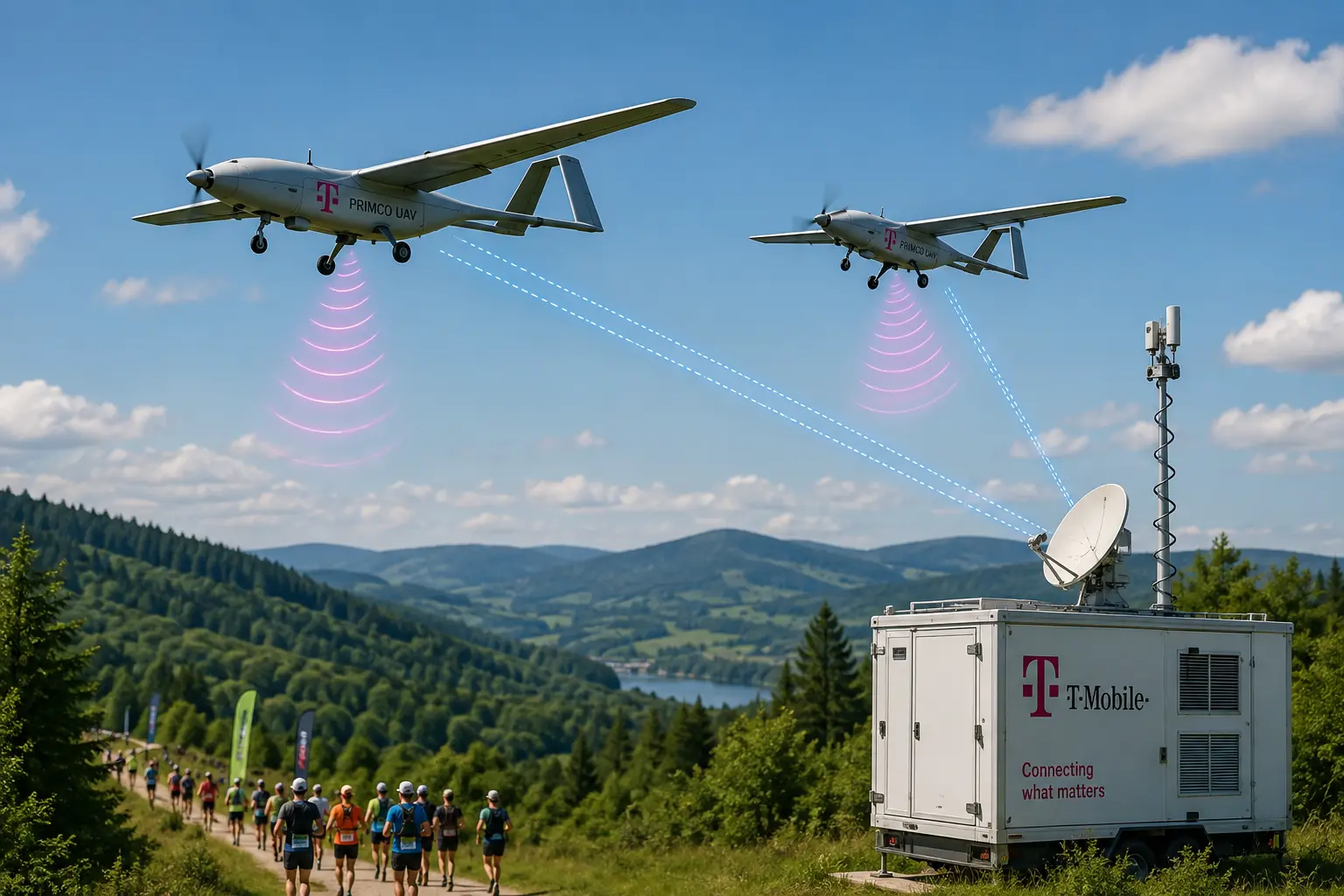
- Smartphones automatically connected to the active airborne cell as the two aircraft switched roles during the event
- Satellite backhaul linked both UAVs directly to the mobile core, while one aircraft remained in operation as the other refuelled
The fact
Deutsche Telekom, T-Mobile Czech Republic, and Primoco UAV tested two unmanned aircraft as alternating flying mobile base stations during the Běhej lesy trail-running event in the Czech Republic. Deutsche Telekom said smartphones automatically connected to the active mobile cell as the aircraft switched roles, allowing calls and data connections to continue while one aircraft returned for refuelling. Around 1,900 runners attended the event.
A compact portable cell tower covered the start and finish areas, while the two aircraft provided coverage along the race route. Both UAVs used satellite backhaul to connect directly to the mobile core without an additional ground station. Deutsche Telekom said they flew at altitudes between two and three kilometres, covered up to 20 square kilometres and achieved data rates of up to 100 Mbit/s using a 10 MHz channel.
The assessment
The two-aircraft setup does not remove the UAV’s endurance limit; it changes how the operator works around it. Instead of relying on one aircraft to stay aloft, the operator has to schedule refuelling and aircraft changes so one UAV continues providing the mobile cell while the other is on the ground. Keeping coverage available therefore depends on repeating that rotation without interrupting service.
The Czech event demonstrated the approach under planned conditions. Deutsche Telekom did not say how many aircraft changes were completed or how long uninterrupted airborne coverage was maintained, while Primoco’s claim that the setup can support 24/7 service has not yet been demonstrated over repeated operating cycles. Longer deployments would require the same changeover to keep working as the aircraft repeatedly land, refuel and return to service. For BTW readers, the second UAV allows coverage to continue while the first aircraft lands to refuel.
The next test is whether operators can repeat those changeovers reliably during a longer temporary or emergency deployment.
What to watch
Longer trials should report total continuous coverage time, the number of aircraft rotations and any service interruption as one UAV replaces the other. Repeated refuelling cycles would provide stronger evidence that the two-aircraft design can sustain temporary coverage. A round-the-clock trial would directly test Primoco’s claim that the system can support 24/7 service.
