
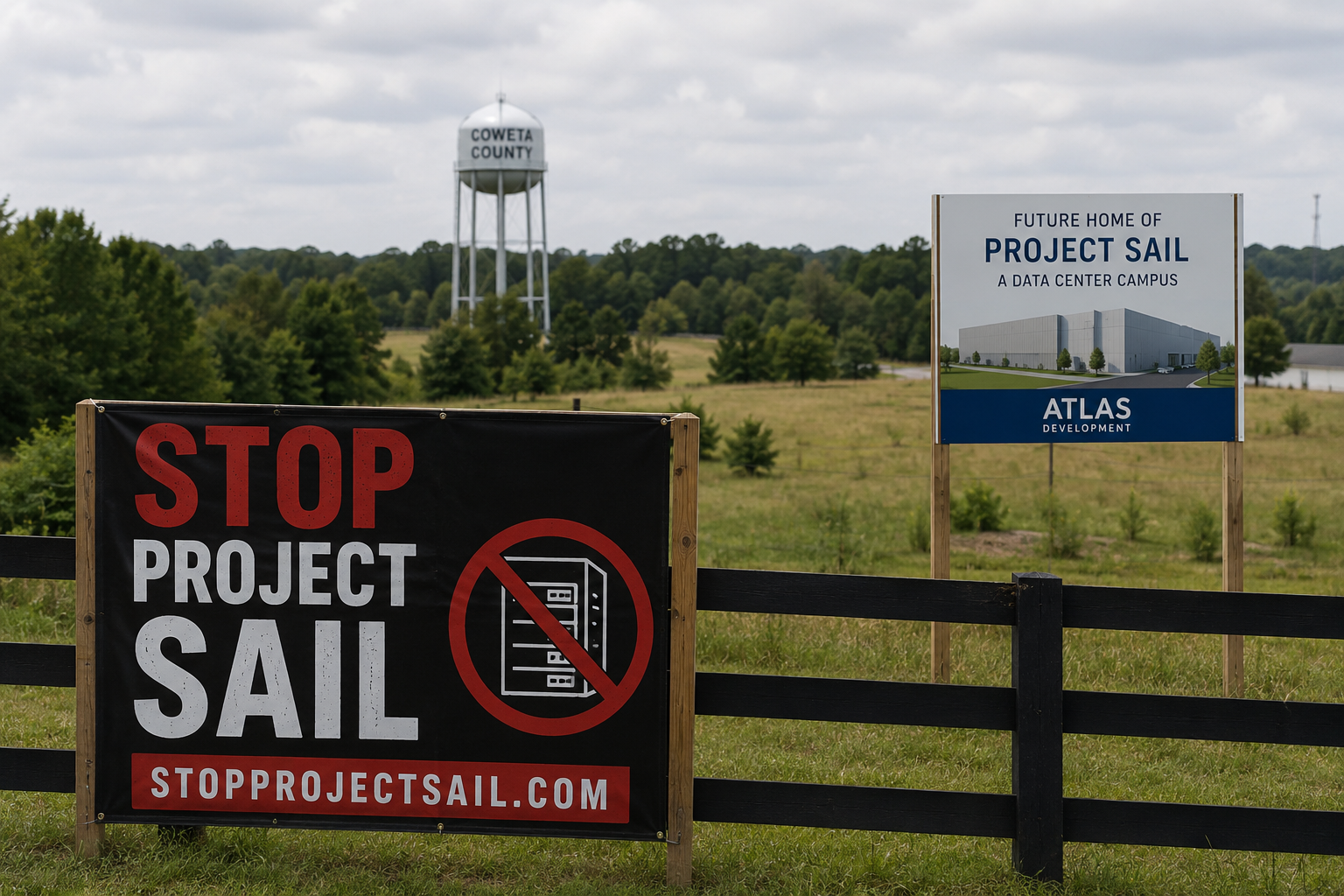
•Coweta County imposed a moratorium on new data-centre proposals after approving rezoning for the 4.9 million-square-foot Project Sail campus
•More than 8,000 people have joined a campaign opposing the project over concerns including water, construction and land use
The fact
Coweta County commissioners approved rezoning for Project Sail in April, voting 3–2 to allow industrial use of the roughly 830-acre site. Atlas Development’s proposal includes 13 data-centre buildings covering about 4.9 million square feet. The county later imposed a moratorium on new data-centre proposals. Atlas has not disclosed the campus’s planned power capacity or how it would be supplied.
A resident campaign called Stop Project Sail has attracted more than 8,000 members and is pursuing legal action against Coweta County and Atlas Development. Residents cited concerns about well water, construction, traffic and changes to the surrounding rural area, according to TIME. Four more data-centre projects were proposed after Project Sail received rezoning approval, prompting the county to introduce the moratorium in May. The pause does not reverse Project Sail’s rezoning approval.
The assessment
Project Sail secured rezoning before the moratorium, giving it a planning position that later proposals lack. But rezoning is not a building permit—Atlas must still secure power, water and construction approvals before work can begin.
Coweta County is not an isolated case. Across the US, communities are pushing back against hyperscale data centres over water use, electricity costs and land use. New York passed the first statewide moratorium in June; Arizona and Illinois paused data-centre tax incentives. The pattern is clear: local approval is becoming harder to win, and the window for fast-tracking data-centre projects is closing.
For BTW readers, the question is whether Atlas can convert a zoning win into a buildable project before opposition hardens into legal or regulatory blockage.
What to watch
Watch for Project Sail permit applications, utility agreements, a construction timetable, and rulings in the legal challenge. Disclosures on power supply, water use, and supporting infrastructure would clarify what Atlas still needs before the proposed campus could move into construction.