
Summary
- CoreWeave announced a planned 240 MW deployment at AdaniConneX’s Taloja campus, divided into three 80 MW buildings, with the first phase expected in mid-2028.
- That headline is not yet a measure of grid power, commissioned cooling, installed accelerators, customer-ready compute or India revenue. Each conversion step needs separate evidence.
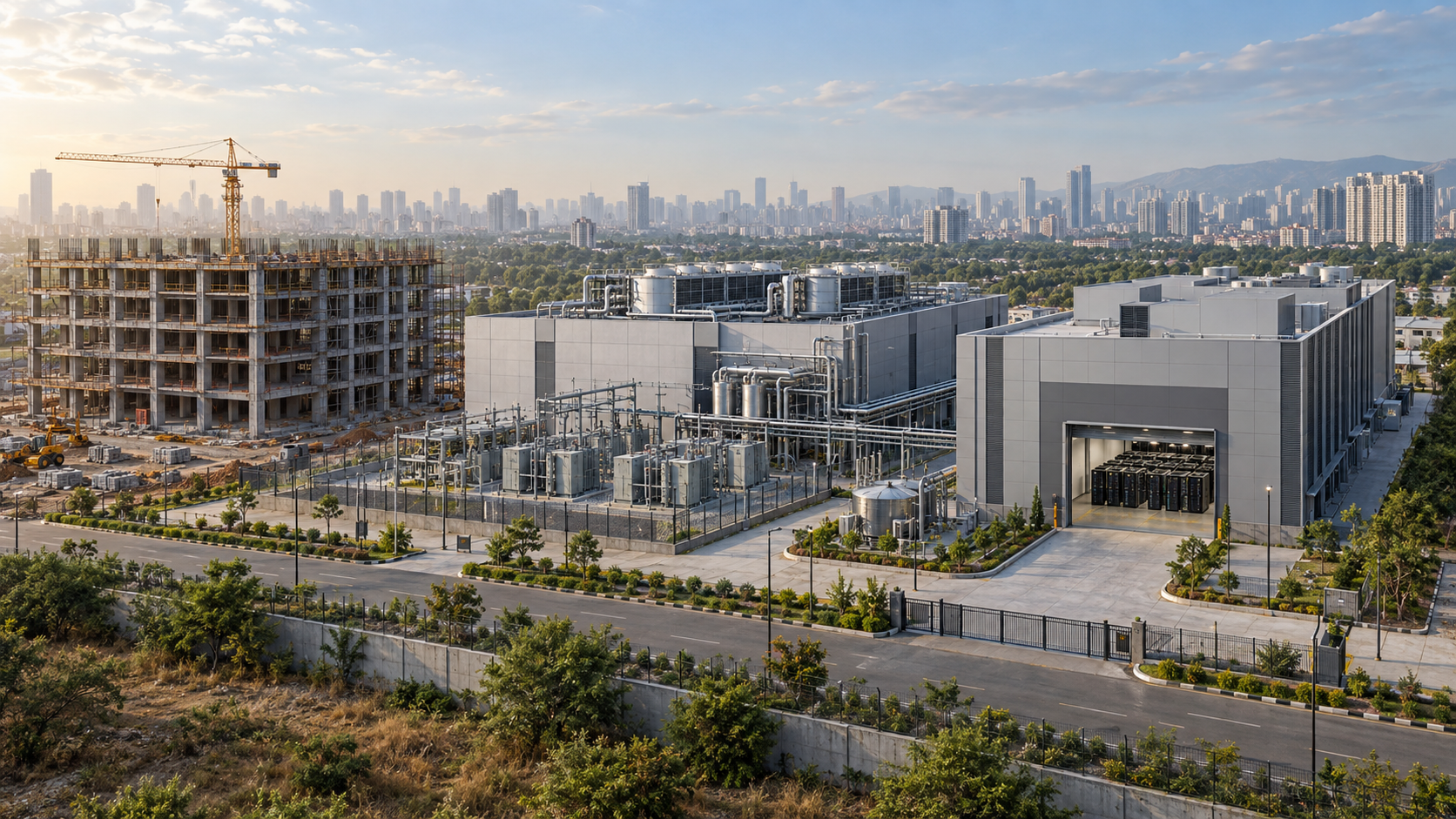
The most important word in CoreWeave’s India announcement is not “240”. It is “planned”. On 7 October, the AI-cloud provider said it would develop three 80 MW buildings at AdaniConneX’s Taloja campus in Navi Mumbai. The first phase is expected to be available in mid-2028; further capacity is to come in stages. The campus could be expanded by another 240 MW, but that is an option described by the company, not operating capacity. CoreWeave’s announcement
For investors and customers, “capacity” can describe very different things: a site plan, a building’s electrical envelope, grid supply, installed IT load, or compute that has passed acceptance and can be rented. The announcement gives a headline campus figure and a schedule, but it does not define the 240 MW as IT load or disclose the project’s grid milestones, power purchase terms, capital allocation, per-phase megawatts, GPU orders, utilization or customer contracts. None of those omissions proves a problem. They define what remains unverified.
The design details sharpen the delivery test. CoreWeave says it intends to use NVIDIA’s Vera Rubin platform and describes high-density infrastructure with direct liquid cooling and a non-evaporative chilled-water system. Those are engineering plans, not confirmation that the equipment is installed or that a measured water or efficiency result has been achieved. NVIDIA said Vera Rubin entered full production in May; that industry-wide milestone does not establish a Taloja allocation or shipment. NVIDIA’s production update
India’s scale makes the announced number notable, but not self-underwriting. A parliamentary response from the Ministry of Electronics and Information Technology put installed national data-centre capacity at about 1,575 MW in August 2026, up from 375 MW in 2020. A 240 MW plan is roughly 15% of that snapshot if the definitions are comparable. They may not be: the country’s installed base will also change before the first Taloja phase is expected. The ministry says operators weigh demand, operating costs, power availability, staffing and long-term viability; the response gives no Taloja-specific forecast. MeitY response
CoreWeave’s balance sheet and demand figures offer context, not project economics. It reported US$2.575 billion in second-quarter 2026 revenue, a US$626 million GAAP net loss and around US$104 billion of global backlog as of 30 June. A September update said global contracted power was about 4.2 GW as of 11 August. Those numbers cannot be assigned to India: the company has not disclosed Taloja-specific offtake, customer pricing or revenue. Its first-half cash paid for property and equipment was US$14.1 billion, evidence of the capital demands of the broader buildout, not proof of who funds this campus. Q2 results · September update · Form 10-Q
So the useful scorecard is a chain, not a single megawatt figure: construction completed; grid capacity available; electrical and cooling systems tested; accelerators delivered and commissioned; service opened; workloads sustained; invoices collected. The first public checkpoint is mid-2028, but the release does not specify phase sizes or acceptance criteria. Until those appear, 240 MW describes the ambition and scale of a proposed build—not compute customers can schedule today.
Sources
Member Briefing
Deeper Profile Context
Sign in with the right membership level to unlock the full briefing and source notes.
Only for Strategic Circle
Strategic Circle
Open to all readers. Unlock profile briefings after joining and signing in.
Join Strategic CircleOnly for Leadership Alliance
Leadership Alliance
For qualified IP-asset owners and management; sign in to unlock alliance briefings.
Join Leadership Alliance