
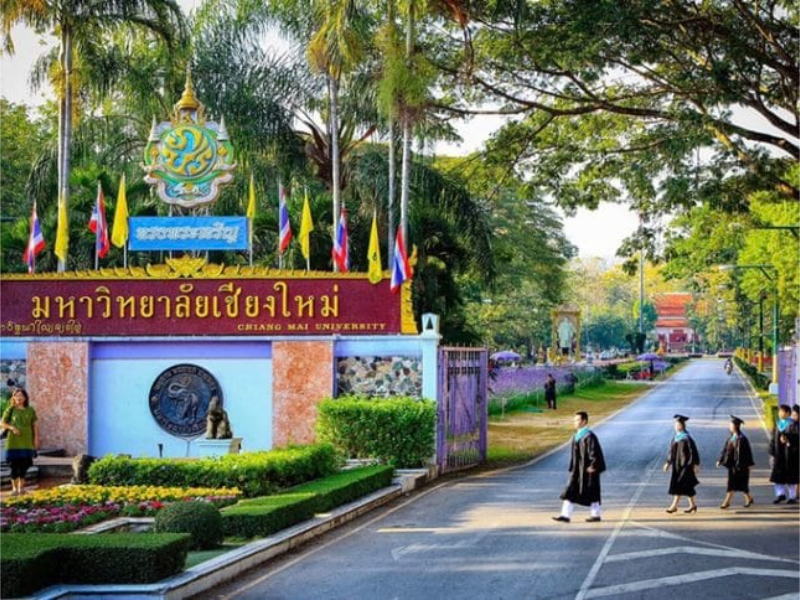
- Northern Thailand’s first public university with a strong multi-disciplinary foundation since 1964.
- Home to extensive international research collaborations and a diverse student body across 20 faculties.
Advancing higher education in Northern Thailand
Chiang Mai University (CMU) was established in 1964 as the first higher education institution in Northern Thailand and has since developed into one of the region’s most comprehensive public universities. It was originally founded with just three faculties—Science, Social Sciences, and Humanities—but now comprises 20 faculties, one college, and four campuses, serving over 36,000 students. Its main campus, located between central Chiang Mai and the slopes of Doi Suthep, blends urban accessibility with a tranquil, forested learning environment.
With a mission to foster academic excellence, ethical integrity, and social responsibility, CMU plays a critical role in regional development and policy discourse. The university’s academic ecosystem supports a broad curriculum that includes agriculture, engineering, health sciences, and social innovation. Each faculty operates with a high degree of autonomy, enabling targeted research and responsive pedagogy.
CMU promotes a research-driven culture underpinned by strong national and international partnerships. It has achieved recognition in areas such as environmental health, smart farming, renewable energy, and digital transformation. Its integration of academic freedom and data-based innovation reflects a long-term vision aligned with both national strategies and global sustainability goals.
Also read: NIDA: Shaping leaders for sustainable development
Also read: PTT Digital Solutions: Driving innovation in Thailand’s energy sector
Research partnerships and regional impact
Chiang Mai University is deeply invested in global academic exchange. Through its network of more than 400 partner institutions worldwide, CMU maintains robust programmes for joint research, academic exchange, and co-publication. Its strategic collaborations with universities such as the University of Minnesota have resulted in groundbreaking research in air pollution control, public health policy, and biomedical innovation. These projects tackle pressing regional challenges and bridge scientific insights with local community needs.
The university is also a key member of academic alliances including the ASEAN University Network and the NOHA Network on Humanitarian Action, which provide platforms for transnational education and development. Through such initiatives, CMU amplifies its influence beyond Thailand, contributing to shared knowledge systems across Asia and the Global South.
With a strategic emphasis on innovation, sustainability, and regional engagement, Chiang Mai University is not only preserving its academic legacy but also redefining it for the next generation of thinkers and practitioners.