
Summary
- CDS Mioduszewski is the existing BTW directory company object, and the first-party site identifies the same Koszalin business. The company says it began operating in 1991 and joined the Bosch-Service network in 1996; those are historical company statements rather than an independent audit.
- The public CDS site describes diagnostic-equipment distribution, ESI software, technical training, a hotline, vehicle service, and warranty and post-warranty equipment repair. These establish a capability surface, not a measured repair rate, response time or service-quality result.
- Automotive diagnostics is an operating system rather than a single tool. Hardware interfaces, software versions, vehicle coverage, protected-data access, identity, documentation, training and physical inspection have to remain aligned for a workshop to obtain a dependable result.
- Product capability, production reliability and customer outcome require different evidence. A tester may support a function, yet a particular workshop can still encounter an unsupported vehicle, expired access, a failed interface, incomplete documentation or an ambiguous fault. Even a reliable diagnostic process does not by itself prove faster repair or lower customer cost.
- Supervision, integration, maintenance and exception handling form a substantial part of total operating cost. Workshops need trained people, access administration, update discipline, safe procedures, repair support, inventory and business-system coordination, and a recovery path when normal diagnosis does not settle the case.
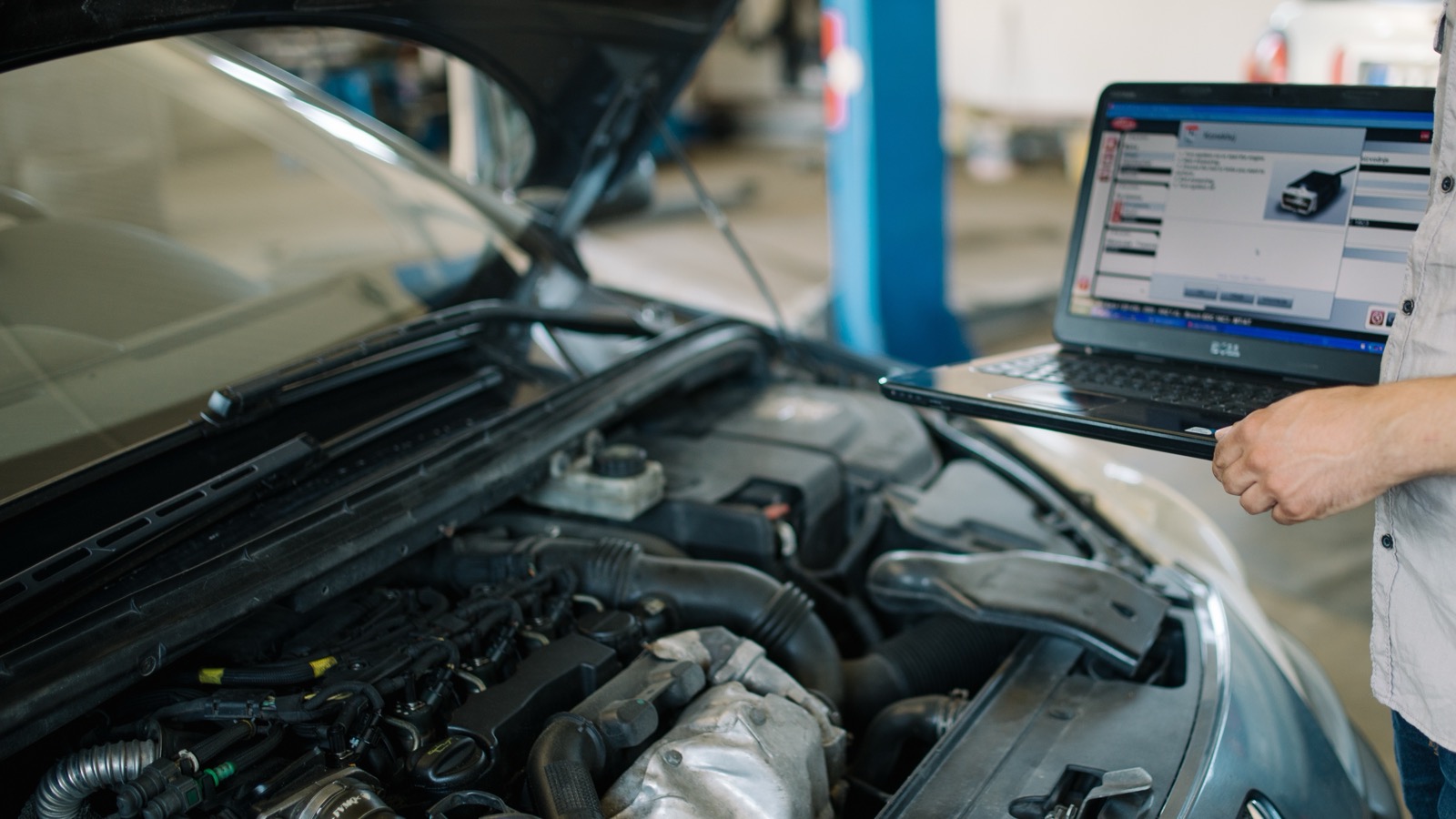
- The retained public sources contain no CDS benchmark, uptime result, defect rate, named customer deployment, measured saving or independently verified architecture. The featured photograph is generic automotive-diagnostics context and does not depict CDS, its staff, premises, customers or equipment.
Automotive diagnostics is often presented through the most visible object in the workshop: a tester, laptop, interface or measurement device. That object matters, but it is only one layer. The useful result depends on the vehicle being correctly identified, the right software and documentation being available, protected functions being accessible, the physical connection being sound, the operator understanding the evidence, and the repair process being able to handle an exception. When any of those conditions fails, a capable product can produce an incomplete operating outcome.
CDS Mioduszewski is a useful company through which to examine that distinction. Its public site spans diagnostic hardware, ESI software, updates, technical training, support, equipment repair and automotive-business software. It also maintains an archive of technical and product notices. This is broader than a simple catalog. It suggests that the commercial relationship can extend from initial equipment selection into access, maintenance, learning and service. The public material nevertheless remains company and manufacturer material.
It does not prove how often the offered functions work in customer environments or what business results customers obtain.
That boundary is not a reason to dismiss the offer. It is a reason to evaluate the work attached to it. A workshop buying diagnostic capability is also accepting a version lifecycle, an identity and access process, documentation dependencies, equipment-care obligations, staff-learning requirements and exception costs. Those duties may be shared among the workshop, CDS, Bosch and other product or vehicle manufacturers. The allocation has to be made explicit because a general promise of diagnostics does not say who owns each failure state.
This article therefore evaluates CDS at three separate levels. Capability concerns what the public product and service pages say is available. Production reliability concerns whether the selected combination remains usable, current and recoverable in a real workshop. Customer outcome concerns whether that dependable process reduces diagnostic uncertainty, rework, elapsed repair time or another agreed business measure. The sources support the first level in some detail. The second and third require deployment-specific evidence that is not present in the retained public record.
1. Exact company scope and the evidence boundary
The BTW directory record establishes the exact company object used for this coverage. The CDS contact page ties the first-party site to CDS Mioduszewski in Koszalin and to diagnostic-equipment distribution. These identity links matter because the site also carries partner and manufacturer product material. Resolving the company does not convert every product statement into a company performance result; it only establishes whose public commercial surface is being examined.
CDS's history page says the business began operating in 1991 and became part of the Bosch-Service network in 1996. It describes activity in vehicle diagnostics, technical training and automotive software. Those statements can be reported as the company's own history. They should not be stretched into claims about current headcount, market share, installed base, revenue, geographic reach or uninterrupted activity. None of those measures appears in the retained source set.
The business-activities page describes distribution of diagnostic equipment, ESI software, training, a technical hotline and service. The contact material gives a current public path to the business, while the equipment and software pages show the subjects around which the site is organized. Together they support a coherent picture: CDS presents itself as an automotive-technology intermediary whose work includes products, software access, technical knowledge and post-sale support.
There are still important evidentiary limits. A company page can establish an offer and the company's account of its practice. A manufacturer page can explain a product requirement or access model. Neither is an independent measurement of CDS response time, equipment reliability, diagnostic accuracy or customer value. A long technical archive can show continuing publication and lifecycle topics, but archive depth is not a contractual support commitment and is not evidence that every customer installation is current.
The same limit applies to product catalogs. A KTS page can describe functions associated with equipment offered to workshops. It cannot show that every function is available with every device, license, software version, vehicle make or model year. Automotive diagnostic coverage changes over time, and protected functions can depend on separate authorization. A buyer must verify the exact combination rather than treating a product-family label as a universal entitlement.
Historical material requires particular care. An older ESI update can explain how Secure Diagnostic Access and Bosch ID were described at that time. A later page may describe new versions or changed requirements. The older page remains useful for understanding lifecycle and migration, but it is not automatically the current rule. Workshops need a dated configuration record that identifies which requirement applies to their active software and equipment.
The retained sources also do not establish a CDS-owned software architecture. The Integra page describes modular automotive-business software for service, sales, inventory, finance and reporting. It should be treated as a product or partner description. It does not prove that CDS wrote every component, operates a particular customer's environment or controls every dependency in the software.
No source names a CDS customer, reports a controlled trial, publishes a benchmark or gives a measured customer result. This article does not fill those gaps with examples presented as fact. Any workshop scenario used below is an evaluation scenario: a way to identify supervision, integration, maintenance and exception costs before purchase. It is not a report of a CDS deployment or incident.
The evidence boundary is therefore narrow but useful. CDS is an identifiable Koszalin business with a long company-stated history and a public offer spanning diagnostic equipment, software, support, training and service. The sources provide enough material to examine the operating model. They do not justify a ranking of CDS quality or a claim that a particular workshop achieved an outcome.
2. Diagnostic equipment is capability, not outcome
Diagnostic hardware creates a path into vehicle systems, but it does not replace diagnosis. A tester can communicate with supported control units, retrieve information and expose functions described by its software. The operator still has to confirm the vehicle, select an appropriate procedure, judge whether the data is plausible, connect electronic evidence with physical symptoms, and decide what to test next. The equipment extends observation and action; it does not own the final technical judgment.
The CDS KTS material describes public offers and functions associated with Bosch diagnostic equipment. That is capability evidence. A workshop considering a purchase should turn the catalog into a specific support matrix: exact hardware, interfaces, operating software, license, vehicle coverage, protected-function access, included accessories and update rights. The matrix should have a date because compatibility and entitlements change.
Production reliability begins only after that matrix is converted into a working configuration. The workshop needs a supported computer environment, stable physical connections, maintained cables and interfaces, current software, authorized identities and a procedure for recording results. A device that powered on during delivery can later be unavailable because of a damaged connector, incompatible update, expired license, changed access requirement or unsupported vehicle case. These are general operating risks, not reported CDS failures.
Customer outcome is a third question. A reliable diagnostic tool may shorten one part of fault isolation while the repair still waits for a part, documentation, specialist decision or customer authorization. It may reduce uncertainty without reducing total elapsed time. It may also expose more potential causes and create additional investigation. The buyer should define the intended outcome and measure the full process rather than treating acquisition of the tool as the outcome.
The distinction changes procurement. If the goal is coverage, the workshop should test representative vehicle and function combinations against the proposed package. If the goal is speed, it should measure end-to-end handling time, including setup, access, interpretation, physical checks and rework. If the goal is quality, it should define what a correct and sufficiently documented diagnostic conclusion looks like. A product demonstration can contribute evidence but cannot substitute for acceptance criteria.
Supervision cost appears immediately. Someone must decide who may operate the equipment, who maintains the computer and account, who reviews unusual results and who can authorize higher-risk functions. A workshop with several technicians needs consistent profiles and records. A smaller workshop may depend on one experienced operator, creating a coverage risk when that person is unavailable.
Integration cost appears where the diagnostic result enters other work. Vehicle identity, job number, customer complaint, measured data, technician notes, parts decisions and final work order need to remain connected. Manual re-entry can introduce mismatches. Automated transfer can fail silently or map fields incorrectly. The interface needs ownership, validation and reconciliation even if both systems work separately.
Maintenance cost covers more than software updates. Equipment needs inspection, storage, calibration or other care where applicable, cables and accessories need replacement, host computers need security maintenance, and documentation must follow the installed version. A workshop should know which work it owns, which work CDS offers, what evidence is supplied and what happens when equipment must leave the site for repair.
Exception handling determines whether the capability remains useful under pressure. An unsupported control unit, intermittent communication, unclear code, suspected mechanical fault or failed access request needs a safe next step. The answer may be another test method, a documentation check, escalation, a physical inspection or a decision not to proceed. The operating value lies partly in making that next step predictable.
The KTS pages therefore establish a legitimate product surface without proving a workshop outcome. The buyer's task is to transform that surface into a dated and testable operating package. Capability is what the package is designed to do. Production reliability is evidence that the exact package remains usable. Customer outcome is evidence that the workshop process improves after all added work and failure modes are counted.
3. Software and protected-data access as an operating layer
Modern diagnostics depends on software as much as on the visible interface. The CDS ESI and update pages make this lifecycle visible. They discuss updates, software evolution, original-document access and protected diagnostic functions. An earlier update page and the manufacturer Secure Diagnostic Access page also connect workshop operation to identity, two-factor authentication and access to protected vehicle data.
This access layer changes the economics of diagnostics. A workshop is not only buying information or a device. It is maintaining a chain of authorization: an organization relationship, user identity, credentials, second factor, software entitlement, supported system and permitted vehicle function. Each link can expire, change or become unavailable. The chain has to be supervised because a fault at one link can look like a diagnostic-tool failure at another.
Identity administration is a real operating task. The workshop needs a named owner for account creation, role changes, departure, recovery and periodic review. Shared credentials may appear convenient but make accountability and recovery weaker. Personal accounts improve traceability, yet they require a process when a technician changes role or loses access. The public material establishes that identity and protected access are relevant; it does not establish a particular CDS-managed identity service.
Two-factor authentication adds a dependency on a device or method that must be available at the point of work. A workshop should consider lost phones, changed numbers, unavailable staff, damaged devices and account recovery. The correct response is not to weaken authentication. It is to design a controlled recovery path and test it before an urgent diagnostic task depends on it.
Software version is another dependency. A new release can expand coverage or change access while also introducing compatibility work. An older release may remain familiar but lose support or access to current functions. The workshop needs a release policy: which updates are mandatory, which can be staged, who checks prerequisites, how representative work is verified and what fallback exists if the update disrupts service.
The CDS archive is useful evidence of this continuing lifecycle. It shows equipment, software, update, modernization and service notices over time. The important conclusion is not that every notice applied to every customer. It is that diagnostic capability changes after purchase. A buyer should include review and update work in total cost instead of treating the initial equipment price as the complete investment.
Original-document access also has an operating boundary. Documentation can improve fault isolation and procedure selection, but only when the material matches the exact vehicle and task, is accessible to the operator, and is interpreted correctly. Search, language, version and entitlement can affect usefulness. A document can be authoritative for a product while still being misapplied to the wrong variant.
Protected-data access creates a separation between product capability and permission. Hardware may be technically able to communicate with a function while the workshop is not authorized to execute it. That is not necessarily a defect; it can be a security control. Procurement should record which functions require registration, which identities are eligible, what approval time is expected, how access is audited and what work can proceed when permission is unavailable.
Reliability should be measured at the workflow level. It is not enough to say the software launched. The useful indicator is whether an authorized technician can complete the supported procedure for a representative vehicle, capture the evidence and hand the result into the repair process. Access failures, repeated login, missing documentation and version mismatch belong in the reliability record because they affect the delivered diagnostic service.
Customer outcome again needs a baseline. Better documentation or access may reduce searching or enable a protected function, but a buyer should measure the total handling effect. An access process that enables more work can also add administration. An update that expands coverage can require training. The net result depends on volume, case mix and the workshop's existing process.
Exception handling must distinguish causes. A failed action might arise from user authorization, organization registration, license, software version, operating system, network reachability, vehicle state, interface connection or product support. Treating every failure as one category increases time and encourages unnecessary changes. A structured decision tree should use observable evidence to narrow the cause and preserve the state needed for escalation.
Maintenance records should identify the installed versions, active licenses, user roles, second-factor recovery route and last representative check. These records need not be elaborate, but they should be accessible when the normal operator is absent. They turn an invisible access dependency into something the workshop can manage.
The public ESI and SDA pages support a clear conclusion: identity, version, operating environment and protected-data access are part of automotive diagnostics. They do not establish that every CDS customer uses the same configuration or receives the same coverage. Buyers should treat software and access as a maintained operating layer, with explicit ownership and recovery, rather than as a one-time accessory to hardware.
4. Repair, documentation and lifecycle work
CDS says it provides warranty and post-warranty service for diagnostic equipment it offers, using trained specialists, test tools, software and repair documentation. That statement is operationally significant because diagnostic equipment itself can become a point of failure in the workshop. A repair path can reduce the risk of an unusable asset, but the public page does not publish response time, fix rate, spare-unit policy or measured availability.
A buyer should therefore separate the existence of service from the reliability of the service arrangement. The first is supported by the CDS page. The second requires practical terms: how a fault is logged, what evidence is needed, where the equipment goes, who pays transport, how warranty status is decided, what updates or configuration may be affected, and whether a temporary alternative exists.
Fault isolation is especially important. A communication problem could be in the vehicle, cable, interface, host computer, software, license, account or network. Sending hardware for repair without narrowing the failure can extend downtime and return the equipment unchanged. Conversely, repeatedly changing software when a connector is damaged can consume time and introduce new variables. A useful support intake should preserve symptoms, versions, identifiers and steps already taken.
Documentation reduces this ambiguity. Repair documentation helps the service team work consistently, while the workshop's own records provide context. Serial numbers, purchase and warranty information, installed versions, accessories, fault observations and recent changes should travel with the case. The public source supports that CDS uses tools, software and documentation in its service description; it does not reveal the exact intake or reporting format.
The lifecycle archive suggests another cost: older equipment and software do not remain frozen while the vehicle population changes. Modernization can involve new interfaces, computer requirements, licenses, accessories or procedures. A workshop should ask how CDS distinguishes a repairable fault from an end-of-support or compatibility issue and what evidence supports a replacement recommendation.
Downtime planning belongs in procurement. If one diagnostic device supports a large share of work, losing it can create a queue. The workshop can consider a backup device, alternative procedure, shared capacity or priority rule. The correct choice depends on case volume and consequence. This article does not claim that CDS supplies a loan unit; that question needs an explicit answer.
Data handling can matter during service. A diagnostic computer may contain vehicle records, customer details, credentials or configuration. The workshop should know what is sent with the equipment, what should be removed, whether storage is encrypted, who can access it and how returned equipment is checked. The public repair page does not answer these questions, so they remain diligence items rather than allegations.
Acceptance after repair should test the relevant failure, not merely confirm that the device starts. A representative communication task, accessory check, software launch and account path may be necessary. If the repair changes software or configuration, the workshop should record the new baseline. This is how service capability becomes production reliability.
Customer outcome can then be measured honestly. A successful repair restores diagnostic capacity. It does not by itself prove that downstream vehicle repair became faster or more accurate. The workshop should measure equipment downtime, repeated faults, queue impact and rework if those are the intended benefits of the service relationship.
The presence of warranty and post-warranty service is a meaningful part of CDS's offer. Its value depends on scope, evidence, turnaround, continuity and safe data handling in the exact arrangement. Buyers should obtain those details instead of inferring a service level from the existence of a repair page.
5. Training, hotline and human supervision
CDS's public business descriptions include technical training and a hotline. These are important because diagnostic equipment does not remove the need for judgment. Training can build a shared method, and a hotline can provide an escalation route. Neither source provides a measured learning outcome or support response target, so their production value must be established in use.
Training should begin with the operating tasks the workshop expects staff to perform. Equipment setup, vehicle identification, software navigation, access, measurement, documentation and safe use may require different skills. A general product introduction can be useful without making a technician competent in every procedure. The workshop should define which tasks require supervised practice and who can sign off readiness.
Knowledge decays when tools or procedures change. ESI updates, protected access and new equipment notices mean that one course cannot settle the lifecycle. The workshop needs a way to identify material changes, decide who must learn them, and check that work instructions remain aligned. Refresher work is part of maintenance cost, not evidence that the original training failed.
The hotline can support exception handling when normal documentation and local expertise do not settle a case. Its value depends on scope and handoff quality. The caller needs to supply the vehicle context, product and software versions, exact symptoms, access state, observed codes or measurements, recent changes and steps already taken. Poor context turns a specialist conversation into repeated discovery.
Support boundaries should be explicit. A hotline might address use of offered equipment, software access, a diagnostic procedure or equipment fault, but not every mechanical or customer-service decision. The public pages establish a hotline capability without defining those boundaries. Buyers should ask what is included, during which hours, through which channel and with what escalation.
Human supervision also protects against automation bias. A diagnostic code or software recommendation can become too persuasive when presented through a trusted tool. The technician still needs to compare it with symptoms, physical evidence and procedure. A system can report a condition without establishing the root cause. Training should reinforce the difference between observed data, a possible explanation and an authorized repair decision.
Workload matters. If every exception depends on one senior technician or an external call, ordinary volume can create a bottleneck. The workshop should measure escalation rate, wait time and repeated questions. This is not a CDS performance claim; it is a way to determine whether the support design matches the workshop's case mix.
Supervision has a cost, but removing it can create larger exception cost. A second check on a high-consequence procedure may be justified. Routine, low-risk steps can be standardized. The control should match the potential harm and the uncertainty of the evidence rather than treating all diagnostic actions identically.
Documentation from training and support should feed maintenance. Frequently encountered access errors, damaged accessories, version mismatches or misunderstood procedures can become checklists and preventive actions. Without that loop, the hotline repeatedly absorbs the same work. With it, support evidence improves local reliability.
Customer outcome should include the cost of supervision and escalation. A new tool can reduce some diagnostic time while increasing learning and account administration. A hotline can reduce unresolved cases while adding wait and handoff time. The net benefit should be measured over a representative period, with rework and exception volume included.
CDS's training and hotline offer can therefore be valuable components of a workshop operating model. The public record does not prove their responsiveness or effect. Buyers should define skill expectations, support scope, escalation evidence and learning maintenance so those capabilities can be evaluated as part of production reliability.
6. Integration with automotive business workflows
The Integra page describes modular automotive-business software functions across service, sales, inventory, finance and reporting. This expands the evaluation beyond a diagnostic station. A workshop result has commercial value only when it is attached to the correct vehicle, customer request, work authorization, parts decision, invoice and record. The public page describes the software surface; it does not prove a CDS-owned architecture or a customer result.
The first integration question is identity. Vehicle registration, vehicle identification number, customer, job, technician, equipment session and invoice each have identifiers. If systems use different identifiers or allow duplicates, a correct diagnostic result can be attached to the wrong job. A buyer should define the authoritative record and how mismatches are reconciled.
The second question is workflow state. A job can be booked, accepted, diagnosed, awaiting authorization, awaiting parts, under repair, checked or complete. Diagnostic information may arrive while the job is in another state. Automation should not advance a commercial process merely because a technical record exists. The rules need to distinguish evidence collection from authorization and completion.
The third question is data quality. Free text can carry useful nuance but is difficult to reconcile. Structured fields make reporting easier but can force an uncertain result into an overconfident category. A practical design preserves observations, interpretations and decisions separately. The technician should be able to record uncertainty without losing the ability to search and report.
The fourth question is error handling. A transfer can time out after the receiving system accepted it. A retry can create a duplicate. A field can be rejected. A user can correct one system but not another. Reliable integration requires stable identifiers, idempotent behavior where possible, status evidence and a queue for cases that need human resolution.
The fifth question is access. Diagnostic data and customer records may have different permissions. A technician may need technical history without access to financial data. A service adviser may need status without the ability to execute protected diagnostic functions. Role design should follow work rather than convenience, and departures or role changes should be reflected across connected systems.
The sixth question is maintenance. Modules, exports, operating systems and external interfaces change. A connection that worked at launch can degrade after an update. Owners need a list of dependencies, representative regression checks, change notice and rollback or manual fallback. The public Integra material does not establish how a particular integration is delivered, so these requirements need contract-specific confirmation.
Reporting is another boundary. A dashboard can count jobs, parts or diagnostic categories, but a count does not automatically explain quality. Fewer recorded faults might mean better repair, lower volume or incomplete capture. Faster closure might reflect efficiency or premature completion. Customer outcome measures need interpretation and a baseline.
Integration cost should be visible in the business case. Configuration, data cleanup, migration, staff learning, access review, exception handling and report validation can exceed the visible license or interface price. A modular system can reduce unnecessary scope, but modules still share identities and process assumptions. Buyers should price the operating connection, not only the feature list.
The workshop should preserve an exit route. It needs to know which data and documents can be exported, in what form, how identifiers map, and how long access remains available. Diagnostic history can become valuable over time. Portability should be checked before dependency grows, not only when a migration is urgent.
CDS's public material supports the conclusion that automotive diagnostics can sit within a broader business-software workflow. It does not establish a universal integration or measured improvement. The buyer should make data ownership, state transitions, access, exception handling, maintenance and exit explicit for the selected modules.
7. Exception handling and safe diagnostic procedure
The CDS page for the SMT 300 smoke generator provides a bounded example of diagnostic work involving equipment-specific operating and safety constraints. It should not be generalized to every CDS product or procedure. Its value here is analytical: it shows that a diagnostic capability can depend on setup, physical conditions, correct use and interpretation, not only a software command.
An exception can begin before the test. The vehicle may not be in the required state, the environment may be unsuitable, the equipment may be incomplete, or the operator may not have the right procedure. A robust workflow checks prerequisites and allows a safe stop. Pressure to produce an immediate result should not convert an unmet prerequisite into an improvised method.
An exception can occur during connection. A loose cable, damaged interface, unstable power or unexpected vehicle state can produce intermittent evidence. Repeating the same action without controlling variables may create noise. The operator needs a method to preserve what was observed, change one condition at a time and recognize when escalation is safer than continued experimentation.
An exception can also be interpretive. A code, measurement or visible sign may be consistent with several causes. Diagnostic software can narrow possibilities without establishing causation. The workflow should separate raw observation from hypothesis and repair decision. This reduces the risk that a plausible explanation becomes an unsupported conclusion.
Protected access adds another class of exception. A denied function might reflect permission, identity, software version, operating environment or vehicle support. The safe response is to classify the failure and follow the relevant recovery path. Disabling controls or borrowing credentials would create security and accountability problems without proving the underlying technical cause.
Equipment service is part of recovery. When the diagnostic tool itself is suspect, the workshop needs criteria for local checks, support escalation and repair intake. Continuing to use unreliable equipment can contaminate later decisions. Removing the only device from service can also stop work. Continuity planning should decide which risk is acceptable and what alternative exists.
Documentation can fail operationally even when it exists. The operator may have the wrong edition, an inaccessible account, an ambiguous vehicle variant or a procedure that does not cover the observed state. The process needs a way to mark uncertainty and seek authoritative clarification. A copied fragment without date or context should not become the permanent workshop rule.
Business-system integration creates partial-failure scenarios. The diagnostic work may complete while the job record fails to update. The work order may close while an unresolved note remains elsewhere. Reconciliation should identify mismatched state and prevent an incomplete record from being treated as a completed customer outcome.
Communication is another control. A technician, service adviser, customer and support specialist may each understand the case differently. A clear handoff should identify the complaint, evidence, uncertainty, action already taken, decision needed and consequence of delay. This is part of exception cost and can determine whether technical evidence leads to a correct commercial decision.
Bounded failure modes should be recorded without turning them into allegations. Representative evaluation scenarios include unavailable protected access, unsupported coverage, failed equipment communication, incomplete documentation, a software update that changes behavior, a repair delay, an integration mismatch and an ambiguous diagnostic result. None is reported here as a CDS incident. Each is a condition the buyer should be able to detect and recover from.
Recovery evidence should match the failure mode. Account recovery does not prove equipment recovery. Equipment repair does not prove software compatibility. A successful software launch does not prove vehicle communication. A complete diagnostic session does not prove that the business record is correct. The workshop needs small, targeted checks at the relevant boundaries.
The objective is not to eliminate every exception. Automotive repair contains uncertainty, varied vehicles and physical conditions. The objective is to keep uncertainty visible, prevent unsafe escalation and make the next responsible action predictable. CDS's public combination of equipment, software, support and service gives buyers several possible recovery paths, but the exact ownership and service level must be agreed.
8. Maintenance and switching-cost model
The CDS technical archive makes one economic fact hard to ignore: automotive diagnostic capability has a lifecycle. Equipment releases, software updates, access changes, modernization and service topics continue after purchase. A cost model that includes only initial hardware and license price will understate the work required to keep the capability useful.
Direct recurring cost may include software rights, updates, support, accessories, repair and training. The retained sources do not provide a complete price schedule, so no amount is claimed here. The buyer should identify which items are included, optional, time limited or dependent on a separate manufacturer relationship.
Internal maintenance cost includes account administration, host-computer upkeep, update review, representative checks, documentation, equipment inspection and staff learning. These tasks may be small individually. Together they determine whether the tool remains available when a vehicle arrives. A workshop should assign owners and expected time rather than hiding this work inside general overhead.
Version coordination can create lock-in without any improper conduct. A workshop may accumulate procedures, records, trained habits, accessories and integrations around one product family. Changing the core diagnostic platform can require data mapping, retraining, parallel operation, new access registration and new exception handling. These are switching costs arising from dependence, not evidence of a CDS practice.
Protected access can deepen the dependency. Identities, organization registration and manufacturer permissions may not transfer automatically to another tool. The workshop should distinguish portable credentials and data from product-specific entitlements. It should also know which records it must retain independently for audit and continuity.
Business-software integration adds another layer. Vehicle and job identifiers, inventory links, reports and financial records can become embedded in processes. An export that preserves rows but loses relationships may be insufficient. Buyers should test a representative export, document field meanings and preserve the mapping needed to reconstruct history.
Documentation and training can be partly portable. Diagnostic reasoning, safe procedure and evidence discipline remain useful across tools. Product navigation and specific workflows may not. A good training strategy separates durable technical method from product-specific instruction, reducing the cost of future change.
Maintenance debt raises switching cost. If versions, accounts, records and procedures are already inconsistent, migration begins from an uncertain baseline. Regular maintenance therefore supports both current reliability and future choice. A buyer should see portability as an operating control, not a one-time exit clause.
Supplier service can reduce some maintenance burden if scope is explicit. CDS's public pages describe updates, training, hotline and equipment repair, all of which may support lifecycle work. The evidence does not establish that every task is included for every buyer. A proposal should state what CDS monitors or initiates, what the workshop must request, and what evidence marks completion.
Total cost should include exceptions. A delayed access recovery, unsupported vehicle, failed cable, incompatible update or service shipment can stop revenue-producing work. The expected cost depends on frequency, duration, alternative capacity and job consequence. Buyers can estimate scenarios without claiming that any has occurred.
Customer outcome should be calculated after these costs. More coverage or better information can create value, but administration, learning, integration and downtime are part of the denominator. The strongest business case compares the current process with the proposed operating model over a representative period and records uncertainty.
Switching should also be considered at contract renewal, not only at failure. The workshop can review data exports, active accounts, equipment condition, current versions, documentation and alternative methods. This keeps choice credible and reveals maintenance gaps while there is time to address them.
CDS's broad support surface may help buyers manage lifecycle work, but it does not make lifecycle cost disappear. The defensible conclusion is that equipment, software, access, service and business workflow form a dependency system. Buyers should price and govern the system as a whole.
9. Bounded failure modes and recovery questions
A failure-mode review is most useful when it names observable conditions, ownership and recovery evidence. It should not speculate about hidden defects or convert generic risk into a report about CDS. The following categories arise from the public capability surface and apply to evaluation of the proposed arrangement.
The first failure mode is identity or access unavailable. The observable condition may be failed authentication, missing role, unavailable second factor or denied protected function. The owner could be the workshop account administrator, product support or another authorization party depending on cause. Recovery evidence should show that the correct user can regain authorized access without sharing credentials or disabling controls.
The second failure mode is software-version mismatch. The tool may launch while a vehicle function, document or interface behaves differently after an update. Recovery requires a known version baseline, release information, representative checks and a supported next step. A rollback may not always be available or appropriate, so the workshop should not assume one.
The third failure mode is equipment communication failure. The observable state may involve no connection, intermittent connection or inconsistent data. The workflow should distinguish vehicle state, cable, interface, host computer and software before declaring the equipment defective. Escalation evidence should preserve identifiers, versions, symptoms and controlled checks.
The fourth failure mode is coverage absent or ambiguous. A product family can have broad coverage without supporting every vehicle and function. Recovery might involve another supported procedure, current documentation, another tool or a decision that the work cannot proceed. Sales material should not be used to override the exact support matrix.
The fifth failure mode is diagnostic interpretation uncertain. Several causes may fit the evidence, or electronic data may conflict with a physical symptom. The safe state is not a forced answer. It is a recorded uncertainty, additional test plan or specialist review. Supervision should focus on the consequence of an incorrect action.
The sixth failure mode is documentation inaccessible or inapplicable. The operator may lack access, have the wrong version or face a vehicle variant outside the material. Recovery requires confirming identity and context, obtaining current material and recording which source supports the action. Informal fragments should not silently become authority.
The seventh failure mode is equipment service delay. A repair path exists publicly, but actual continuity depends on intake, transport, diagnosis, parts, return and acceptance. The workshop should ask what alternative capacity is available and which jobs receive priority. No turnaround is claimed from the retained page.
The eighth failure mode is business-record mismatch. Diagnostic evidence may be attached to the wrong vehicle or job, duplicated or left outside the final record. Reconciliation should compare identifiers and workflow state. A technically correct session can still create a poor customer outcome if the commercial record is wrong.
The ninth failure mode is update-induced workflow change. New software or access requirements may alter steps, permissions or host requirements. Recovery includes communication, training, updated instructions and verification. The archive shows that change is part of the environment; it does not prove a particular disruption.
The tenth failure mode is support dependency concentrated in one person. A workshop may rely on one experienced technician or administrator. The same could apply to any small operating team. Coverage requires documented procedures, alternate roles and a tested escalation route. Public sources do not establish CDS staffing, so the diligence question should be asked without assumption.
The eleventh failure mode is safety prerequisite not met. The smoke-generator example shows why equipment-specific conditions matter. The correct response can be to stop and correct the setup rather than continue. Training and supervision should preserve that authority even when a customer is waiting.
The twelfth failure mode is exit data incomplete. A workshop may discover that diagnostic and business history cannot be reconstructed easily outside the active system. Recovery is preventive: test representative exports, preserve identifiers and document dependencies before exit is urgent.
For each category, the buyer should ask five questions. What observable evidence identifies the state? Who owns the first decision? What action is prohibited while uncertainty remains? What fallback keeps work safe? What record demonstrates recovery? These questions convert a general service promise into an operating control.
The answers need not all come from CDS. Some belong to the workshop, Bosch, a vehicle manufacturer, a software provider or another service partner. The important requirement is that the boundary is explicit. Unassigned failure modes tend to produce delay and blame when the normal path breaks.
10. Buyer diligence before trusting an outcome
The first diligence step is identity and scope. The buyer should confirm that the contracting party, equipment supplier, software licensor, support path and repair provider are named correctly. The BTW directory and CDS contact material establish the company identity used here, but the exact commercial roles can differ by product.
The second step is a dated configuration schedule. It should list hardware, accessories, host requirements, software, license, update rights, supported functions, protected-access prerequisites and documentation. Broad family names should be supplemented by exact identifiers. Changes after acceptance should update the schedule.
The third step is representative capability acceptance. The workshop should select vehicle and task cases that reflect intended work and verify the full path: identification, connection, access, documentation, evidence capture and handoff. Results apply to the tested configuration and date. They should not be generalized into a universal product or CDS benchmark.
The fourth step is a responsibility matrix. Account administration, software updates, computer maintenance, equipment care, documentation, training, diagnostic judgment, safety, support escalation, repair shipping, data handling, business-system reconciliation and exit each need an owner. Shared duties should specify the handoff.
The fifth step is support evidence. The buyer should obtain hours, channels, included scope, information required at intake, escalation and target communications. A hotline and repair capability are publicly described, but no response or resolution metric is established by the retained sources.
The sixth step is access recovery. The workshop should test a controlled recovery for a user account and second factor, confirm who can approve changes and document an alternate administrator. This should be done without weakening individual accountability.
The seventh step is update governance. The parties should define notification, prerequisite review, staging where feasible, representative verification, documentation change and treatment of an unsuccessful update. Mandatory security or access changes may require a different timetable from optional features.
The eighth step is equipment continuity. The buyer should identify common accessories and failure points, decide what can be checked locally, record repair intake, and determine whether critical work has an alternative. A single device can be economically rational if the accepted downtime is explicit.
The ninth step is integration control. Vehicle, customer, job and invoice identifiers should be reconciled. Automated transfers need error state, duplicate control and manual recovery. Reports should be validated against source records before they are used as customer-outcome evidence.
The tenth step is data and access governance. The workshop should classify diagnostic and customer information, limit roles, protect credentials, know what leaves the site during support or repair, and preserve required records independently. The public pages do not establish a deployment-specific data architecture.
The eleventh step is lifecycle cost. Initial price, updates, licenses, training, support, computer maintenance, accessories, downtime, administration and integration should be included. Scenario estimates should identify assumptions. A cheaper product can be more expensive to operate, and a more expensive service can be worthwhile if it removes measurable work.
The twelfth step is outcome measurement. The buyer should define a baseline and select measures such as unresolved-case rate, elapsed diagnostic time, rework, equipment downtime, access exceptions or record mismatch. The measure should cover the complete process and distinguish volume or case-mix changes from tool effect.
The thirteenth step is portability. Representative diagnostic and business records should be exportable with identifiers and meaning intact. Account and license dependencies should be documented. Staff should retain durable diagnostic method rather than only product navigation.
The fourteenth step is periodic review. Vehicle mix, software, access, staff, equipment and business workflow change. The workshop should revisit scope, exceptions, support evidence, training and portability on a schedule and after a material change.
A buyer can use three decision levels. A capability pass means the selected package performs the agreed supported functions in acceptance. A production reliability pass means it remains available, maintained and recoverable over an agreed observation period. A customer-outcome pass means the workshop's defined measure improves after supervision, integration, maintenance and exception costs are included.
CDS can contribute equipment, software, knowledge, repair and support to those levels, based on its public offer. The buyer still owns the decision about business consequence. No public catalog or company history removes the need for evidence in the exact workshop configuration.
Verdict
CDS Mioduszewski has a coherent public identity and a company-stated history extending back to 1991, with Bosch-Service participation stated from 1996. Its public site describes a broad automotive-technology offer: diagnostic equipment, ESI software, updates, protected access, technical training, a hotline, equipment service and modular business software.
That breadth is meaningful because automotive diagnostics is not a one-device purchase. Hardware, software, identity, documentation, operator judgment, physical procedure, repair support and business records form one operating system. CDS's pages provide evidence that the company addresses several of those layers.
The public record does not establish production reliability or customer outcome. It contains no measured CDS response time, equipment availability, fix rate, benchmark, named deployment, customer saving or independently verified architecture. Product and manufacturer descriptions should not be reported as independent performance evidence. Historical pages should retain their dates and should not be treated as current entitlement without verification.
The buyer's central task is to convert capability into a dated configuration and responsibility model. That means exact equipment and license scope, protected-access administration, representative acceptance, update governance, training, support intake, equipment continuity, safe exception handling, data control, business-workflow reconciliation and exit.
Supervision, integration, maintenance and exception handling are not secondary costs. They determine whether the visible diagnostic tool remains useful under ordinary change and unusual cases. A capability can be real while reliability remains unproven. A reliable process can still fail to improve the customer's business measure. Those distinctions protect both buyer and supplier from unsupported claims.
CDS should therefore be evaluated as an established automotive-diagnostics supplier and support business whose public offer is technically relevant but whose production value must be demonstrated in the selected workshop. The fair question is not whether a catalog lists enough functions. It is whether the complete operating arrangement stays current, produces traceable evidence, fails safely and improves an agreed outcome after all lifecycle work is counted.
Sources
- BTW directory record
- CDS company history and operating scope
- CDS business activities
- Diagnostic equipment service
- CDS contact and diagnostic distribution
- Bosch KTS diagnostic equipment catalog
- ESI update 2023/1
- CDS technical archive
- SMT 300 smoke generator
- Bosch Secure Diagnostic Access
- Current CDS ESI and diagnostic updates
- Integra Software page
- ESI update 2021/3
Member Briefing
Deeper Profile Context
Sign in with the right membership level to unlock the full briefing and source notes.
Only for Strategic Circle
Strategic Circle
Open to all readers. Unlock profile briefings after joining and signing in.
Join Strategic CircleOnly for Leadership Alliance
Leadership Alliance
For qualified IP-asset owners and management; sign in to unlock alliance briefings.
Join Leadership Alliance