Summary
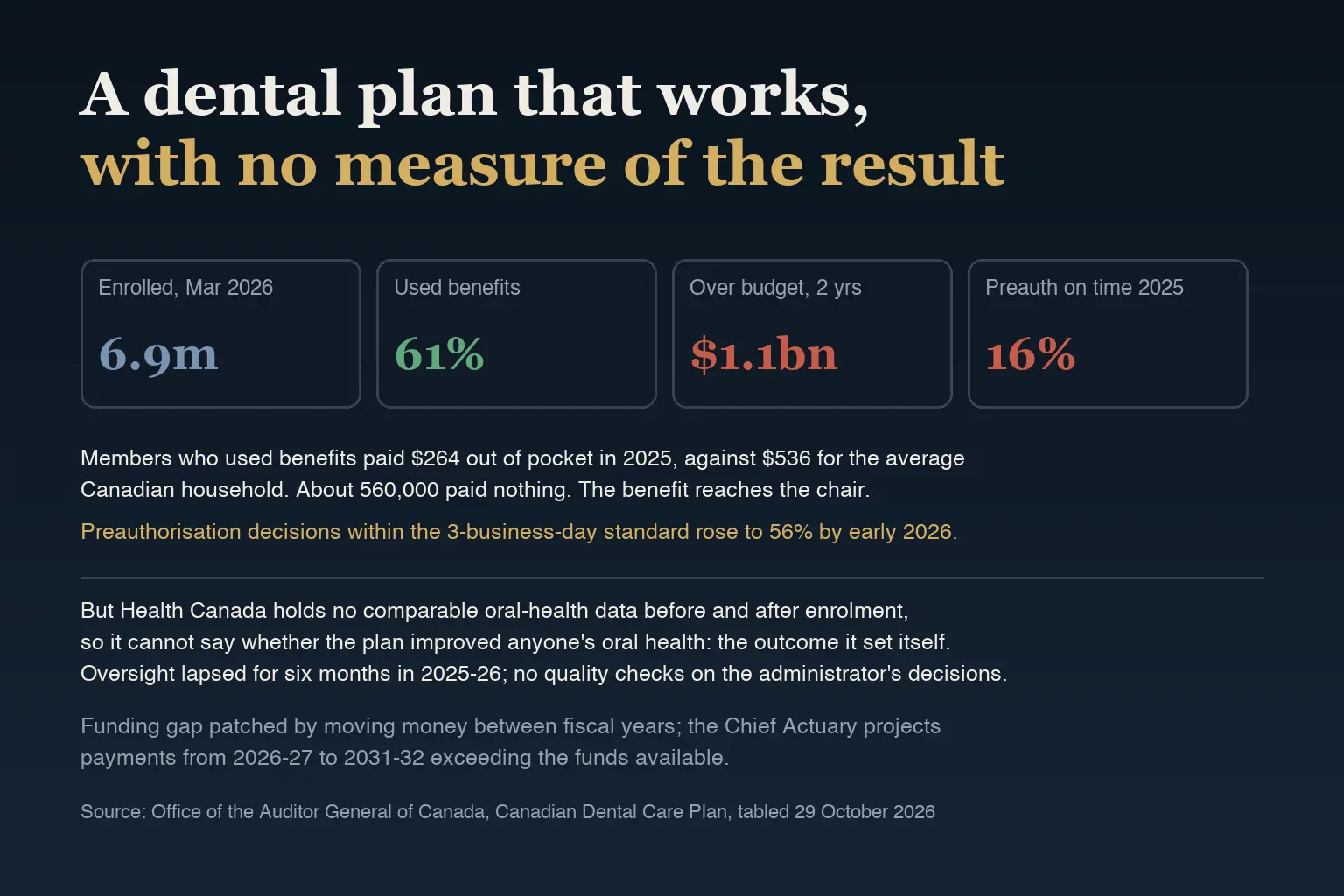
- The Auditor General of Canada's report, tabled on 29 October 2026, concludes that Health Canada made dental care more affordable for plan members: about 6.9 million were enrolled by March 2026 and roughly 61 per cent had used their benefits.
- In the plan's first two years, payments for dental benefits exceeded Health Canada's budget commitment by about $1.1 billion in total. The department covered the gap by moving funding between fiscal years, and the Office of the Chief Actuary forecasts that payments from 2026–27 to 2031–32 will exceed the funding available.
- Health Canada had no comparable information on members' oral health before and after joining, so it cannot determine whether the plan improved oral health over time — the ultimate outcome it set for itself.
- Its oversight was not continuous: for six months of 2025–26 it did not check whether claims and preauthorisation decisions were made accurately and according to its rules.
The receipts are good. The outcome is missing.
Start with what the audit credits. Roughly 6.9 million members by March 2026, about 61 per cent using benefits, more than 27,000 participating oral health providers, and about 97 per cent of claims needing no preauthorisation. The money is reaching chairs and drills.
The price to patients is the strongest number in the report. Members who used benefits spent an average of $264 out of pocket in 2025, against $536 for Canadian households in the most recent comparable Statistics Canada data. About 560,000 members paid nothing at all. For the lowest income band, the average out-of-pocket cost was $226 against $1,109 of reimbursement; for the top band it flipped to $502 against $215. The design does what it says on the form.
Then the audit asks the question the department cannot answer. Health Canada had no comparable information on members' oral health before and after joining. Exhibit 9 of the report lists "oral health of plan members is improved" as the ultimate outcome. The programme measures applications, enrolment, usage and provider participation — the immediate and intermediate steps — and stops one step short of the result it promised.
$1.1 billion over, patched year to year
Budget 2023 committed $13.0 billion over five years from 2023–24, then $4.4 billion a year. In the first two years of the programme, benefit payments exceeded that budget commitment by about $1.1 billion in total. Health Canada managed the overrun by moving funding between fiscal years.
Moving money between years is not a funding strategy; it is a payment method. The Office of the Chief Actuary's forecasts show payments from 2026–27 to 2031–32 expected to exceed the funding currently available, and the report says plainly that year-to-year transfers have covered current expenses but are only a temporary solution. The choice facing the government is therefore not whether to revisit the dental budget, but when — with a spread of numbers the public can already see.
An overrun in a popular programme is politically awkward rather than mysteriously large: demand for subsidised dental care at $90,000 income thresholds was always going to surprise the forecast. The interesting governance failure is that the forecast error was not converted into a correction. It was converted into an annual act of accounting.
Six months without checking the administrator
Health Canada contracts a private partner, Sun Life, to assess, process and pay claims, enrol members and providers, and run the technology. The department is supposed to check that the administrator's decisions follow its rules. For six months in 2025–26 it did not, which the report says reduced its assurance that members received the coverage they were entitled to.
The preauthorisation service standard shows what happens when nobody watches. In 2025, only 16 per cent of preauthorisation decisions were communicated within the three-business-day standard. By early 2026 that had reached 56 per cent — better, still not good. Some denials arrived without a clear explanation. For a patient waiting on a root canal, a missing explanation is the difference between a decision and a wall.
The recommendation is unglamorous and correct: sustained, regular quality assurance on whether Sun Life's assessment of claims and preauthorisations complies with instructions. A contract without a testing regime is a promise with a payment attached.
Who is not enrolled is the next audit
Utilisation varies enormously between provinces: 65 per cent in Ontario, 63 per cent in British Columbia, 60 per cent in Quebec, but 25 per cent in the Northwest Territories and 9 per cent in Nunavut, where 198 people are enrolled. The plan is not yet open to children in provincial and territorial care through the enrolment process, and after a broad launch campaign Health Canada did not run tailored outreach to populations with lower enrolment or use.
A programme that measures its national total and not its gaps can look healthy for years. The report names the gap and recommends assessing low-enrolment and low-utilisation populations so barriers can be removed, including for children in care. That is the difference between a benefit that exists and a benefit that reaches the people it was built for.
What changes the judgement
Two things would turn this audit into a management story rather than a caution: a published baseline of members' oral health with a follow-up measure at a stated interval, and an actuarily costed, multi-year funding line instead of annual transfers. Either one alone is not enough. Without the first, the programme cannot prove success; without the second, it will keep discovering that success costs more than the envelope.
The dental plan is, by the auditor's own account, a programme that works for the people who use it. That is rare enough to be worth saying plainly, and the reason the missing evidence matters: a programme this useful deserves a record that can survive a change of government, a tight budget and a hostile question.
Sources
Member Briefing
Read the full trend briefing
Members read the full briefing with the source notes behind every finding.
Strategic Circle
A daily briefing in your language, built from changes we have verified.
Join for USD 20/monthCancel anytime.
Members also get the full research library, a daily briefing on the networks they follow and the private forum.