Summary
- The Auditor General of Canada's report, tabled on 29 October 2026, concludes that National Defence did not manage its ammunition to meet regular-use and strategic stockpile needs, and that its assessment of what the strategic stockpile requires was not based on comprehensive analysis.
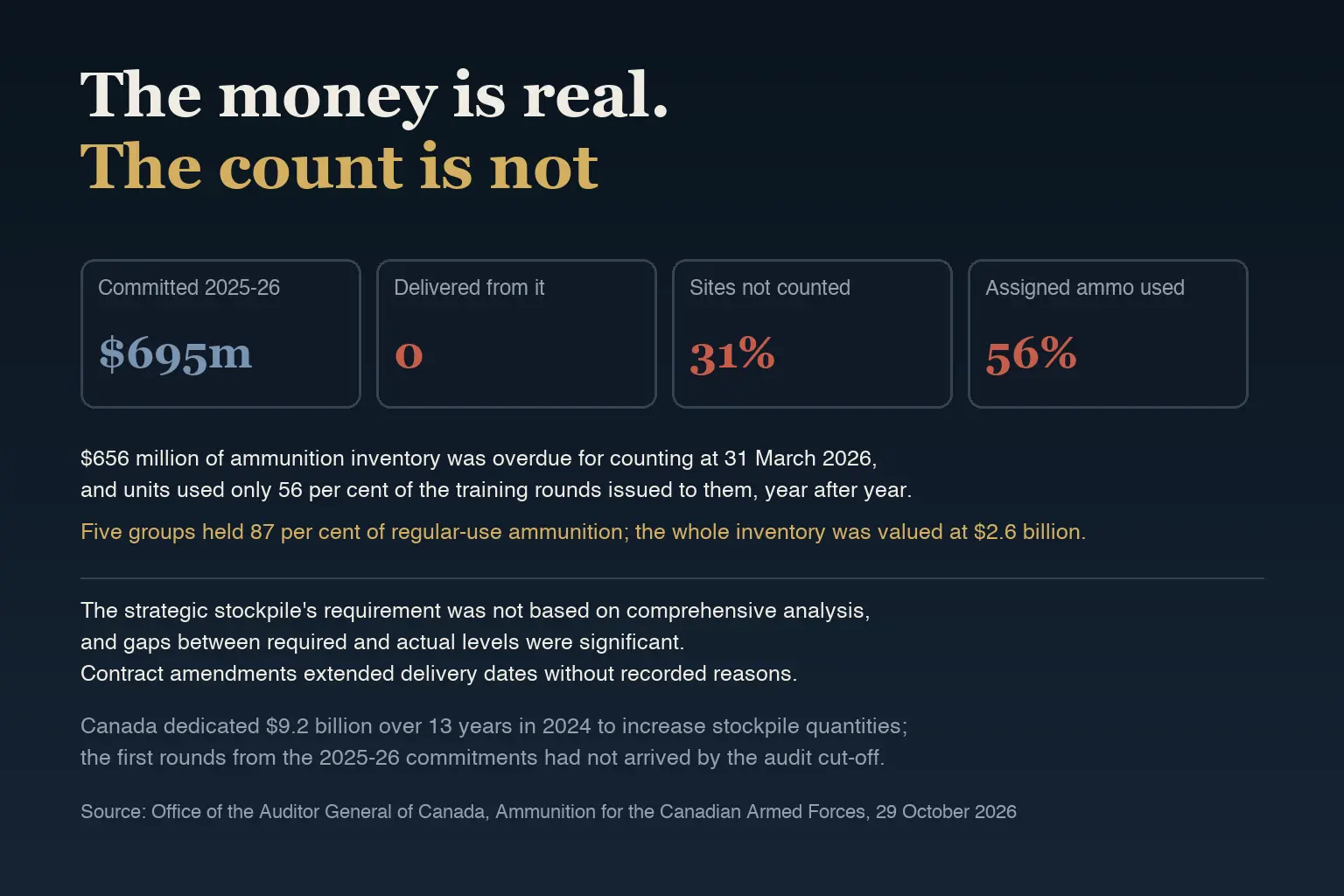
- In 2024 the government dedicated $9.2 billion over 13 years to increase strategic stockpile quantities. National Defence committed $695 million of that in 2025–26, but ammunition from those commitments had not been received as at 31 March 2026.
- As at 31 March 2026, 31 per cent of locations holding ammunition inventory had not completed their required annual count, representing $656 million of inventory overdue for counting.
- Averaged over three fiscal years, the armed forces groups used only 56 per cent of the regular-use ammunition assigned to them, and National Defence did not assess why rounds went unused or what that meant for readiness.
The money arrived. The ammunition did not.
Canada's ammunition inventory was worth $2.5 billion in March 2025 and $2.6 billion in March 2026, with large-calibre ammunition at 28 per cent of the value, guided munitions and bombs at 26 per cent, medium-calibre rounds at 16 per cent, small arms at 12 per cent and the rest split between pyrotechnics, smoke and miscellaneous stock.
Then the government did the thing governments do when a war makes a category urgent: it announced money. Nine point two billion dollars over thirteen years, dedicated to increasing the quantity of ammunition in the strategic stockpile. In 2025–26, National Defence committed $695 million of it. By 31 March 2026, no ammunition from those commitments had been received for the strategic stockpile.
One year is not thirteen, and procurement takes time. The audit's complaint is not that a delivery slipped a quarter; it is that the department has no system that turns a commitment into an arrival it can forecast, and that the gap between required and actual stockpile levels was significant enough to be a readiness fact rather than a bookkeeping inconvenience.
A third of the warehouses did not count
Inventories are only as good as the count. As at 31 March 2026, 31 per cent of the locations where National Defence holds ammunition had not completed their required annual count — $656 million of ammunition overdue for counting.
That number is the quiet centre of the report. Ammunition is a stock you must be able to count in the sense a shopkeeper counts tins: type, quantity, condition, location, shelf life. The department runs two information systems for this, and the auditor's recommendation is pointed — fix the data quality, including performing annual counts, before consolidating the two systems. Merging two unreliable ledgers produces one unreliable ledger, faster.
The count matters for readiness first and money second. A commander who cannot say how many rounds of a given calibre are held, and where, cannot plan training or deployment. The department's inventory valuation is not a substitute, because value tells you what was bought, not what can be fired.
Nobody asked why a hundred rounds in ten went unfired
Averaged over three fiscal years, the armed forces groups used 56 per cent of the regular-use ammunition assigned to them. The Canadian Army used roughly 70 per cent; the Navy 40 per cent in two years and 55 in the third; the Air Force 60, 60 and 70; Special Operations 50, 40 and 60; Joint Operations 65, 50 and 30.
Five groups held about 87 per cent of all regular-use ammunition — the Army 57 per cent, Special Operations 13, Joint Operations 8, Navy 6, Air Force 3. When nearly half of the assigned stock of a training category goes unused year after year, one of two things is true: the allocation formula is wrong, or the training is not happening as planned. The audit records that National Defence did not assess why ammunition went unused, so it could not say which.
This is a governance failure with a cost curve. Over-allocating ammunition that then sits is not free: it occupies storage, expires, and hides the shortage in the categories that matter. Under-training is not free either. The audit does not price it; it only notes that the department never asked the question that would.
The stockpile analysis is a guess with a letterhead
For the strategic stockpile — the rounds reserved for combat operations — the assessment of types and quantities was not based on comprehensive analyses showing that all operational requirements had been considered. Significant gaps existed between required and actual levels.
A strategic stockpile requirement is a judgement about future wars: who, where, how long, with which allies. Reasonable people can differ. What is not reasonable is having no documented method for reaching the judgement, because then every gap is deniable and every top-up is unfalsifiable. The recommendation follows: a formal, regular, documented process for determining and updating the types and quantities the stockpile needs.
Contracting has its own weaknesses. Public Services and Procurement Canada supported the department when asked, but contract management did not track or document the reasons for frequent amendments, which constrained restocking. Under the Munitions Supply Program, non-competitive contracts go to Canadian suppliers for domestic production; the Foreign Military Sales route buys from the United States; other purchases are competitive. The audit recommends tracking supplier performance, including how often and why delivery dates are extended.
What changes the judgement
Three things, in order. A published count: annual inventory counting completed at every location, with the count results public, because a number nobody audits is a number nobody trusts. A documented requirement: the analysis behind the strategic stockpile's types and quantities, reviewable each year. And a delivery curve: for each $9.2 billion tranche, committed, ordered, received, with dates — so a promise announced in 2024 can be compared with racks in 2026.
The money for ammunition is now real, which makes the missing count more expensive than it used to be. A country that cannot say how much it has, cannot say why it fired less than half of what it issued, and has not received the first rounds of its own replenishment has a readiness problem that no further announcement fixes.
Sources
Member Briefing
Read the full trend briefing
Members read the full briefing with the source notes behind every finding.
Strategic Circle
A daily briefing in your language, built from changes we have verified.
Join for USD 20/monthCancel anytime.
Members also get the full research library, a daily briefing on the networks they follow and the private forum.