Summary
- BPSec COSE revision 18 adds a section on OCSP in delay-tolerant networks: prompt revocation of a long-lived certificate needs an online path from the verifier to the responder.
- The issuing CA decides whether to place an OCSP URI in the certificate. Each verifier decides whether to check it, and may condition that decision on whether the responder is expected to be reachable.
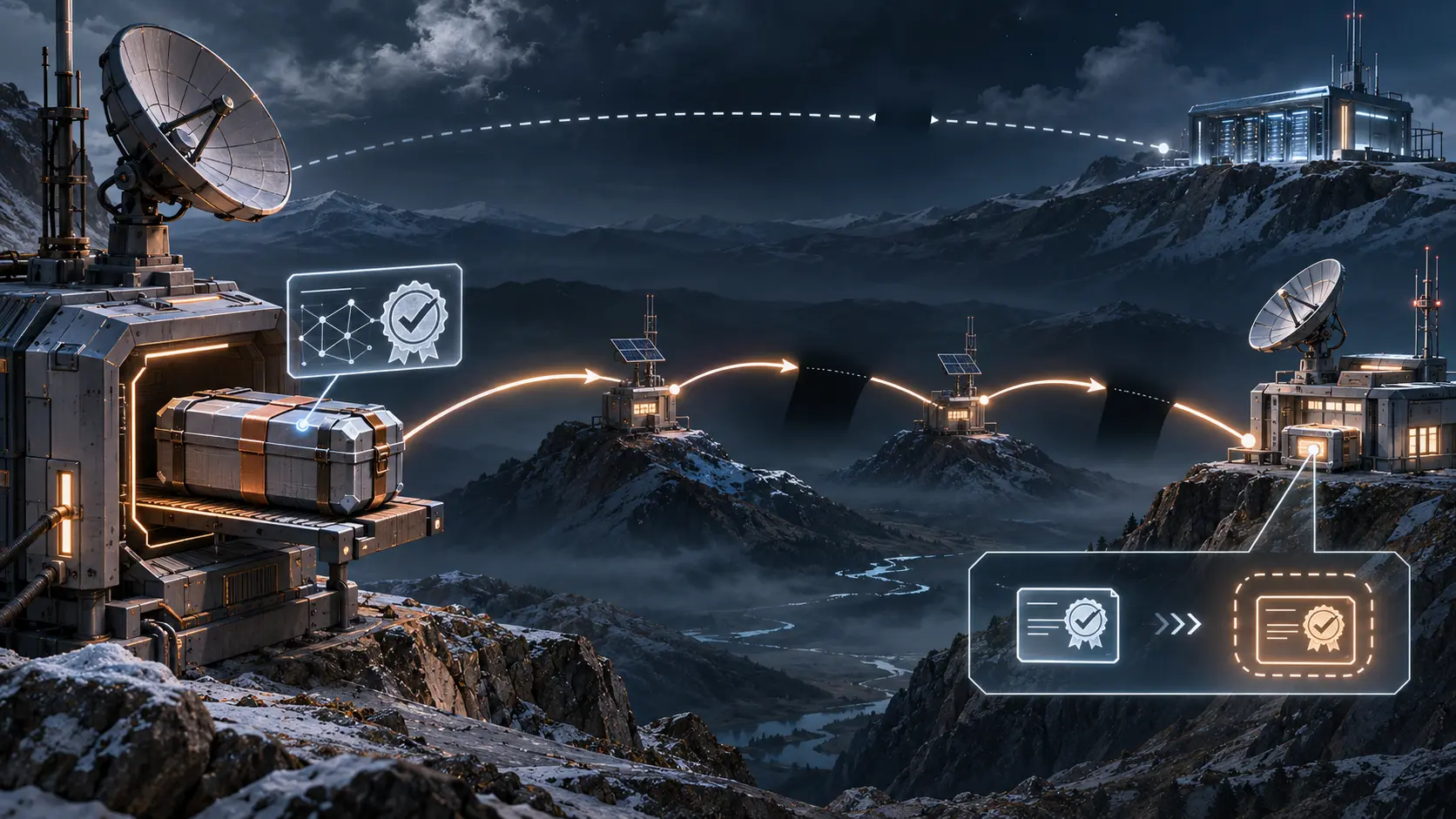
The bundle has done its job. It waited through a broken link and reached another node. Its COSE result carries a certificate that can be checked against a trusted CA. Now the receiver wants to know whether that credential has been revoked. The new 2 November section makes the missing connection explicit: OCSP is an online status question, even when the signed message traveled through a network built to tolerate long silence. The August revision 17 did not contain this operational section. The IETF tracker still lists the text as a Standards Track draft under IESG evaluation.
The draft assigns two decisions to different people. The CA can put a responder URI in the certificate. The receiving node's policy can require an OCSP check, require it only for reachable URIs, or leave it off. Section 2.6.2 recommends checking when internet connectivity exists. An advertised URI is therefore a location, not proof that a remote verifier has a working route to it. The draft suggests geographic load balancing or anycast for long-delay IP enclaves; these are placement options, not observations of a deployment.
There is a second clock. For the certificate Validity interval, section 2.6.1.2 tells the verifier to use the bundle’s Creation Time rather than wall-clock arrival time. That historical test does not produce a current revocation answer. The same security result can have a certificate valid when the bundle was made and still face an OCSP policy decision when it is finally accepted.
The proposed alternative is a chain of short-term, automatically renewed certificates under RFC 8739, with RFC 9891 NODE-ID validation online at the issuing CA and possibly a CA placed closer to its nodes. A compromised credential can stop receiving renewals; an already issued certificate still runs to its expiry. The operator trades live responder access at each verifier for more frequent issuance and a bounded residual lifetime. The official record names no deployment with paired reachability and acceptance logs; such a trace would show how either policy behaves during a real contact gap.
Member Briefing
Deeper Profile Context
Sign in with the right membership level to unlock the full briefing and source notes.
Only for Strategic Circle
Strategic Circle
Open to all readers. Unlock profile briefings after joining and signing in.
Join Strategic CircleOnly for Leadership Alliance
Leadership Alliance
For qualified IP-asset owners and management; sign in to unlock alliance briefings.
Join Leadership Alliance