
Summary
- Booking.com B.V. is the exact current directory company object and the sponsoring organisation recorded by IANA for both
.bookingand.hotels.[1][2][3] - The two delegations expose DNS, DNSSEC, RDAP, registration-data and continuity control surfaces, but public records and bounded observations do not reveal private architecture or establish longitudinal reliability.
- ICANN agreements, escrow, reporting, controlled zone access and emergency-operation mechanisms define continuing responsibilities rather than proving that an outage occurred, a service objective was achieved or a customer obtained a production result.[6][7][8][9][13][14][16][17]
- Supervision, integration, maintenance and exception handling remain recurring costs across authority, keys, delegation, registration data, suppliers, recovery and evidence quality.
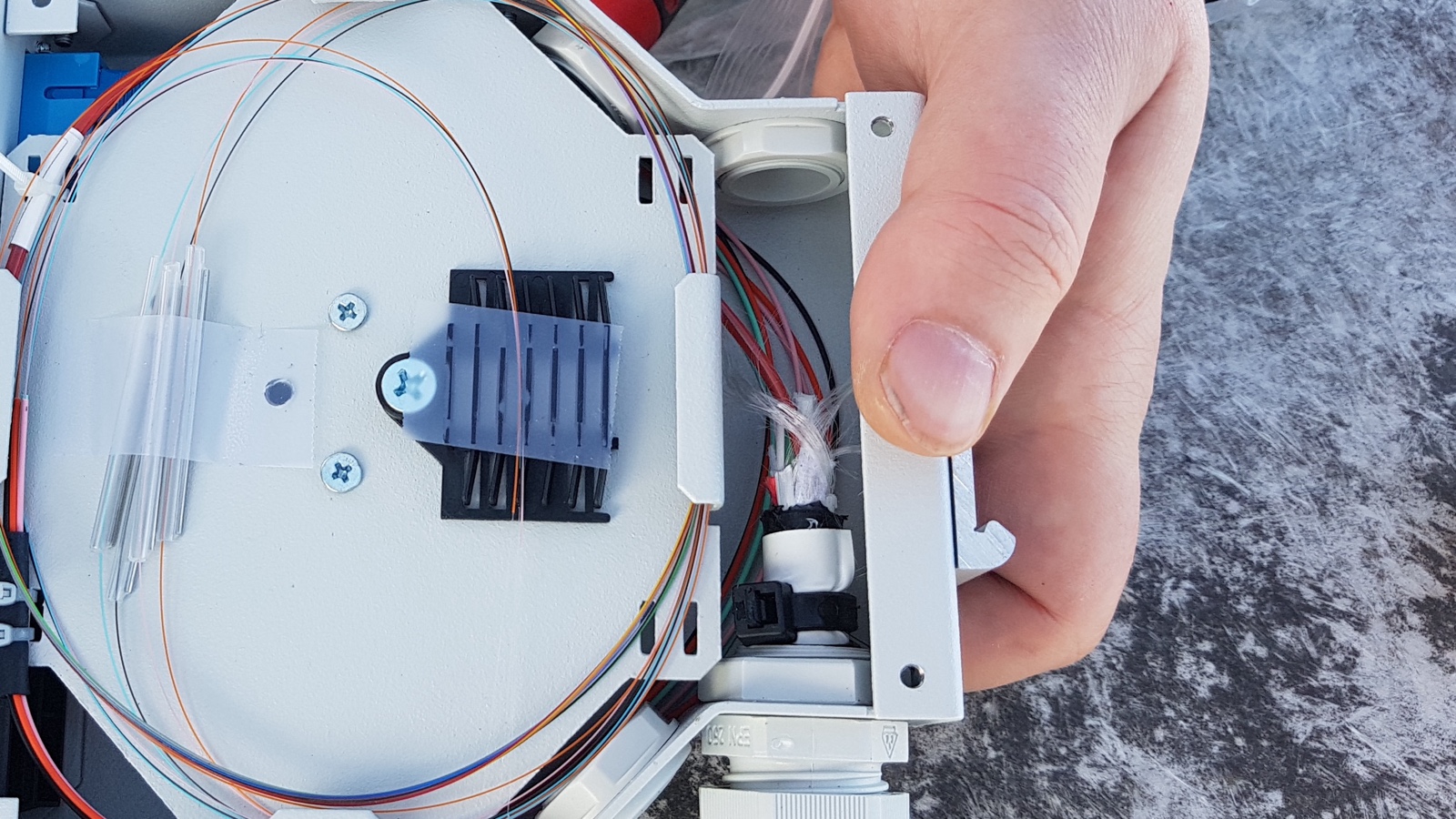
Image note: The accompanying Creative Commons photograph shows an open fiber-optic splice box during an installation in Austria. It provides infrastructure context only. It does not depict Booking.com B.V., either delegated TLD, a company facility, a registry backend, a customer deployment, private topology, an incident, measured reliability or a production outcome.
Booking.com B.V. has a public Internet-infrastructure role that is narrower than its familiar commercial identity but technically significant in its own right. The current BTW directory contains the company as an existing entity, while current IANA records name Booking.com B.V. as the sponsoring organisation for two generic top-level domains: .booking and .hotels.[1][2][3] ICANN's registry-agreement records also identify the company as the operator associated with both strings.[6][7] These records establish a company-to-namespace relationship that can be examined through delegation data, DNS, DNSSEC, registration-data services, contracts, and continuity arrangements.
The relationship does not make Booking.com B.V. the owner of the DNS root, an Internet regulator, or a sovereign authority over the words "booking" or "hotels." It places the company in a recorded operator role within a larger system. IANA maintains root-zone delegation records. ICANN administers the relevant registry agreements. Technical service providers, registrars, resolvers, network operators, certificate authorities, and application owners perform other functions. The public material shows selected roles and running interfaces, not the whole private architecture.
Two delegated TLDs also create a control problem that is easy to understate. The labels are short, but each represents a long-lived namespace with separate authority records, registration-data endpoints, agreement history, change controls, security metadata, reporting duties, and recovery dependencies. Similarity of purpose does not collapse those records into one object. A change that is correct for .booking can still be absent, delayed, or incorrectly applied for .hotels. A monitoring rule that recognizes one RDAP base URL can still miss the other. A contact update, key change, provider transition, or emergency procedure can diverge across the two.
The public evidence supports an assessment of declared capability and observable control surfaces. It does not support a benchmark of uptime, latency, resilience, security effectiveness, registration volume, customer satisfaction, or commercial success. One successful response is not a reliability history. A registry agreement is not proof that every operational obligation was met at every moment. The scale or reputation of Booking.com's travel marketplace is not evidence that either TLD is heavily used or technically superior. Customer production outcomes remain a separate evidence layer.
The useful research question is therefore operational: what does Booking.com B.V. have to keep accurate and recoverable across these two recorded namespaces, and what costs arise from supervising that work? Four cost classes recur throughout the analysis:
- Supervision cost: deciding who may change delegation, security, registration-data, supplier, and recovery controls, then reviewing evidence that approved changes reached the intended public state.
- Integration cost: connecting registry records, DNS, DNSSEC, RDAP, access systems, reporting, monitoring, and incident workflows without collapsing distinct identifiers or responsibilities.
- Maintenance cost: keeping contacts, credentials, keys, contracts, tests, escrow arrangements, runbooks, and supplier relationships current over the lifetime of two namespaces.
- Exception-handling cost: diagnosing mismatches, partial failures, stale records, failed validation, transport fallbacks, rate limits, disputed authority, and transitions when ordinary success indicators are insufficient.
The accompanying photograph shows an open fiber-optic splice box during an installation in Austria. It is generic infrastructure context. It does not show Booking.com B.V., either TLD, a company facility, a registry system, or any measured operational result.
The exact entity and the recorded responsibility boundary
Entity precision is the first control. The object examined here is Booking.com B.V., not a similarly named affiliate, a hotel, a registrar encountered in an unrelated record, or a technical supplier. The current directory page provides the local company-object anchor.[1] IANA's pages for .booking and .hotels independently identify Booking.com B.V. as the sponsoring organisation.[2][3] ICANN's agreement indexes identify the same company name for the corresponding registry relationships.[6][7] Those independent records support the entity binding without requiring an inference from brand recognition.
The two delegations have distinct timelines. IANA's .booking page records a registration date in July 2016 and links a delegation report concerning Booking.com B.V.[2] The .hotels page records a registration date in September 2016 and links a delegation report dated in April 2017.[3] The delegation reports describe eligibility and technical-conformance checks as completed before the requested root-zone responsibility was accepted.[4][5] That history is evidence of an authorization and conformance process at the time. It is not a continuing service-level measurement.
The underlying registry agreements predate the final delegation records. The public .booking agreement is dated July 2015, while the .hotels agreement is dated April 2016.[8][9] Both instruments define obligations associated with operating a gTLD, including data escrow, reporting, interoperability, continuity, and transition. The details matter because a root-zone record alone does not describe every duty of an operator. Conversely, an agreement alone does not demonstrate that a public interface is currently answering. Recorded authority and running services are complementary forms of evidence.
This division follows a practical principle: a registry is a ledger and recordkeeping function inside a technical and contractual hierarchy, not a sovereign. The root-zone record tells resolvers where authority begins. Registration-data services expose selected records and roles. Agreements define responsibilities and remedies. None of these layers grants unlimited power over users, language, or the wider Internet. Treating the operator as sovereign would obscure the actual controls and make accountability less precise.
The same precision is needed when technical contacts or backend indicators appear. A public nameserver name, an RDAP entity, an IP address, or a service hostname can show that another organisation or platform participates in a particular function. It does not automatically transfer the registry agreement, make the supplier the legal operator, or prove that Booking.com B.V. designed the supplier's architecture. The accountable company and the executing provider can be different actors. A responsible review records both without merging them.
That distinction also limits what can be said about Booking.com's broader business. The two TLD strings align semantically with travel and accommodation, but the public registry evidence does not quantify how they are used. It does not disclose how many names are registered, whether the namespaces are primarily defensive, how traffic is routed, which products depend on them, or whether they contribute measurable revenue. The registry role can be technically real even when these business questions remain unanswered.
The operator boundary should therefore be expressed as a set of responsibilities rather than a claim of total implementation ownership. Booking.com B.V. is the recorded company associated with the registry agreements and delegations. It must ensure that delegated authority, registration-data discovery, contractual reporting, continuity arrangements, and authorized changes remain governable. It may rely on suppliers for implementation. Public evidence does not show the complete allocation of those tasks, so supplier-specific architecture and performance claims would be speculation.
Running DNS, DNSSEC, WHOIS, and RDAP control surfaces
The DNS is the most visible running layer. IANA publishes delegation information for each TLD, including authoritative nameserver data and registration-service discovery.[2][3] A delegated TLD must remain reachable through the chain from the root to authoritative service. That chain is not one server or one database. It includes root-zone records, nameserver names, address reachability, authoritative responses, caching behavior, transport, and the operational processes used to change each component.
The current records expose multiple authoritative nameservers for both namespaces. Multiple listed servers are a capability signal: the delegation is not represented by a single nameserver entry. They are not, by themselves, proof of independent failure domains, geographic diversity, capacity, or sustained availability. Several names can depend on shared networks or control systems. Only architecture evidence and repeated observations could establish the degree of independence. The public record justifies saying that multiple authority endpoints are recorded.
DNSSEC adds another linked control surface. Public records and the observed nic.booking and nic.hotels RDAP objects indicate signed-delegation data.[11][12] DNSSEC resource records use defined formats, and DS records at a parent connect a child zone to the chain of trust.[21] Validators then apply protocol rules to determine whether answers are secure, insecure, or invalid.[22] This creates a security benefit and a maintenance obligation. A correct key or signature at one layer cannot compensate for inconsistent parent data, expired signatures, an incorrect rollover sequence, or a resolver's inability to reach required records.
The distinction between capability and reliability is especially important here. A DS record shows that a signed delegation is configured. A successful lookup shows that a particular query path worked at a particular time. Neither proves that every resolver, network path, record type, or moment behaves correctly. Longitudinal evidence would require repeated checks, multiple vantage points, expected-answer definitions, and incident classification. The retained public sources do not provide that series, so this article does not assign an uptime or DNSSEC-success percentage.
Registration-data discovery forms a second public layer. IANA's RDAP bootstrap file maps DNS labels to authoritative service base URLs.[10] The RDAP bootstrap design exists so clients can discover the right service instead of guessing from a domain name.[20] For these TLDs, current public records point to separate .booking and .hotels RDAP bases. The retained responses for nic.booking and nic.hotels were valid RDAP domain objects when observed.[11][12] They included status, event, nameserver, entity, and secure-DNS structures. That is evidence of queryable interfaces, not a complete audit of every object or query type.
RDAP's query format and response model are defined separately. RFC 9082 describes query paths and search behavior, while RFC 9083 defines the JSON response structures and error handling.[18][19] This separation matters operationally. A service can be reachable yet return a malformed object, an unexpected status, a redirect that clients mishandle, or an error response that monitoring treats as success. A complete health check must consider transport, HTTP status, content type, schema, required fields, bootstrap consistency, and the semantics of the requested object.
Legacy WHOIS references can coexist with RDAP records. The IANA .hotels page lists a WHOIS server as well as an RDAP server.[3] This does not mean the two interfaces are interchangeable. They differ in discovery, data model, encoding, access behavior, and client expectations. During a long migration period, operators and consumers may need to monitor both, document which interface is authoritative for which purpose, and avoid treating formatting differences as evidence of a substantive record change.
DNS transport creates additional failure boundaries. Modern DNS clients cannot assume that all useful responses fit a small UDP exchange. RFC 7766 describes requirements for DNS over TCP and the importance of persistent connections and fallback behavior.[23] A nameserver that answers simple UDP queries can still expose problems when responses are truncated, when TCP is filtered, or when connection handling is overloaded. A narrow check of one record type can therefore miss a transport-specific degradation.
Precise terminology helps prevent attribution errors. DNS vocabulary distinguishes recursive resolvers, authoritative servers, zones, delegations, registries, and registrars.[24] Those roles can interact in one user-visible lookup, but they are not the same function. When an end user reports that a name "does not work," the cause might be a parent delegation, an authoritative response, a DNSSEC validation failure, a network path, a recursive cache, an application rule, or a certificate issue. The registry operator owns only part of that chain.
The running-code principle is useful precisely because it is bounded. Public records establish who is recorded and what should exist. Queries show what selected interfaces returned at a time. Neither form of evidence should erase the other. A contract with no observable service is insufficient. A service response with no accountable record is also insufficient. For .booking and .hotels, the defensible conclusion is that recorded delegations and queryable public surfaces exist, while sustained reliability and customer effects remain unproven.
Two namespaces, lifecycle integration, and change risk
Operating two related TLDs creates parallel lifecycle work. Each label has its own root-zone object, agreement history, registration-data discovery, nameserver representation, security metadata, contact set, reports, and potential transition path.[2][3][8][9] Some implementation components may be shared, but public evidence does not establish the topology. Governance must therefore preserve separate identifiers even when one team, supplier, or tool handles both.
The first integration challenge is configuration identity. A change request needs an explicit target. "Update the Booking domains" is too vague when there are two TLD objects, multiple nameservers, RDAP bases, contacts, and associated records. A controlled change should name the TLD, record type, old value, new value, authorizing party, execution party, verification method, and reversal condition. The same change can then be evaluated independently for .booking and .hotels.
The second challenge is dependency mapping. A delegated namespace can touch DNS hosting, registry databases, registration protocols, access systems, escrow, reporting, security keys, monitoring, network connectivity, and corporate authorization. A change in one component may alter another. Replacing a service endpoint may require bootstrap updates, client changes, certificate coverage, firewall rules, monitoring revisions, contact changes, and recovery documentation. The cost lies less in changing a string than in proving that all dependent records agree afterward.
The third challenge is time. DNS records are cached. Contracts and contacts have effective dates. RDAP objects carry event timestamps. Escrow deposits and reports follow schedules. Security signatures expire. Credentials and certificates rotate. A transition can produce a period in which old and new states coexist. Monitoring must distinguish expected propagation from a fault, but it must also set a deadline after which inconsistency becomes an exception. Otherwise, "propagation" can become an indefinite explanation for stale control data.
The fourth challenge is tool coverage. A dashboard designed for website availability may not parse DNSSEC validation, compare parent and child state, inspect RDAP schema, or detect bootstrap drift. A registry-oriented view needs tests for authority, data shape, security metadata, status codes, transport fallback, and role consistency. It also needs human-readable evidence for high-impact changes. A green indicator without the underlying expected state is weak assurance.
Two TLDs can make shared automation attractive, but shared automation introduces correlated risk. A template error, credential problem, provider outage, or incorrect policy could affect both namespaces. Separate workflows reduce correlation but increase maintenance and drift risk. The correct choice depends on architecture and recovery objectives that are not public here. The control requirement is to know which dependencies are shared, test them deliberately, and retain a path to isolate one namespace when necessary.
The fifth challenge is organizational continuity. A namespace can outlive the team that launched it. Staff change roles. Vendors are acquired. Contact details age. Business priorities shift. A TLD may remain delegated even when it receives little product attention. Long-lived controls need owners, review dates, replacement procedures, and records that a new team can understand. Reliance on institutional memory is a hidden operational debt.
The delegation reports provide a useful historical baseline. They record that eligibility and technical conformance were considered before delegation.[4][5] A mature lifecycle process should preserve the same discipline for later changes: verify authority, verify technical consistency, obtain confirmations, observe the resulting state, and retain evidence. Historical approval does not carry every future change automatically. Each material transition needs its own bounded proof.
The agreements make this a governance issue rather than optional website housekeeping. They describe data escrow, reporting, continuity, and transition duties for each TLD.[8][9] Even if a supplier executes day-to-day registry functions, Booking.com B.V. remains the recorded company associated with the agreements. Oversight therefore includes understanding supplier roles, reviewing exceptions, preserving access to necessary data and credentials, and ensuring that an organizational change does not leave public records without an accountable owner.
Supervision, integration, maintenance, and exception costs
Registry operation creates costs that are often invisible in a product feature list. The first is supervision. Someone must decide who may authorize delegation changes, DNSSEC changes, RDAP updates, provider transitions, access grants, and continuity actions. That decision cannot be delegated merely by sharing credentials. It requires a responsibility model that distinguishes legal authority, technical execution, evidence review, and incident escalation.
Supervision also includes supplier management. Public records do not show the complete backend allocation for these TLDs, so this article does not attribute architecture or service quality to any provider. In practice, however, a recorded operator using suppliers still needs current contracts, named contacts, escalation paths, evidence rights, exit provisions, and clarity about which party can make which change. The governance cost persists even when the technical work is outsourced.
Integration cost appears whenever two systems use different identifiers or models. DNS uses labels, zones, and record types. RDAP uses HTTP paths and structured JSON objects.[18][19] Bootstrap data maps labels to service bases.[10][20] Contract systems use agreement names and dates. Escrow and reporting systems have their own schedules and file expectations. Monitoring tools, ticketing systems, access controls, and legal records may each name the same namespace differently. A sound integration layer preserves canonical identifiers and records mappings rather than relying on human recognition.
Maintenance cost accumulates over time. Nameserver records, keys, contacts, certificates, credentials, endpoint software, monitoring logic, schemas, and dependencies need review. Protocol standards evolve. Security requirements change. Vendor interfaces change. Even a namespace with low visible activity can require sustained maintenance because the delegation remains globally visible and failures can have reputational or recovery consequences.
Data escrow illustrates the difference between storing data and preserving recovery capability. ICANN describes registry data escrow as a continuity mechanism, and the agreements include escrow requirements.[13][8][9] A deposit can exist yet be unusable because it is incomplete, stale, malformed, encrypted with unavailable keys, or incompatible with recovery tooling. Meaningful assurance requires deposit validation, custody clarity, restoration exercises, and documented handling of exceptions. The public sources show the mechanism, not the results of Booking.com B.V.'s private tests.
Emergency registry operation creates another readiness cost. ICANN's emergency back-end registry operator framework is intended to preserve critical registry functions under defined conditions.[14] The agreements contain transition provisions and reference data needed by an emergency operator.[8][9] This does not prove that emergency operation has ever been invoked for either TLD. It shows that continuity is designed as a system responsibility beyond ordinary provider uptime. Preparing to use that mechanism requires data, contacts, credentials, authority records, and tested communication paths.
RDAP operations add policy and abuse-handling costs. The gTLD RDAP operational profile describes expected service behavior and operational requirements.[15] A registry must supervise not only whether an endpoint answers, but also whether it returns appropriate data, handles errors, supports discovery, and remains consistent with policy. Rate controls, privacy handling, schema changes, and client compatibility can create exceptions that simple availability monitoring misses.
Zone-data access adds controlled-disclosure work. ICANN's Centralized Zone Data Service provides a structured route for requesting access to gTLD zone data.[16] The existence of a centralized process does not eliminate operator work. Requests, authorization, delivery, changes, and revocation still need accurate records and service integration. For two TLDs, mistakes can arise if approval for one zone is applied to another or if contact and access data drift.
Registry reporting is another recurring surface. ICANN publishes registry reports and related resources.[17] Reports can support oversight, but a report is useful only when definitions, periods, completeness, and exceptions are understood. Aggregate counts do not prove service reliability. A change in a metric may reflect policy, seasonality, portfolio decisions, data correction, or operational events. Review therefore requires context rather than automatic promotion of every number into a performance claim.
Exception handling is usually the most expensive class because it crosses teams. A DNSSEC mismatch may involve the registry service, root-zone process, key custody, monitoring, and application owners. An RDAP inconsistency may involve bootstrap data, endpoint deployment, data synchronization, schema validation, privacy rules, and client behavior. A disputed change may involve corporate authority and legal review. The technical repair can be quick while proving correctness and preventing recurrence takes much longer.
These cost categories should remain qualitative unless the company publishes verified figures. The retained record does not show Booking.com B.V.'s staffing, budgets, supplier fees, incident hours, or recovery costs for these TLDs. It supports the existence of work categories, not a financial estimate. A responsible assessment can ask how the work is owned and evidenced without inventing numbers.
Capability, operating reliability, and customer production results
Three evidence layers must remain separate.
Capability concerns what a system is designed, required, or visibly able to do. The current record supports several capability statements. Booking.com B.V. is named for two delegated TLDs.[2][3][6][7] Public delegation records exist. RDAP discovery data exists.[10] The retained nic.booking and nic.hotels responses were queryable and structurally recognizable as RDAP domain objects.[11][12] Registry agreements, escrow, reporting, zone access, and emergency-continuity mechanisms are documented.[8][9][13][14][16][17]
Operating reliability concerns whether those capabilities work consistently under ordinary load, change, partial failure, and recovery. The retained observations provide only a bounded snapshot. They do not establish availability over weeks or years, response-time distributions, DNSSEC-validation success across resolvers, recovery time, change-failure rate, or exception age. Contractual obligations and public service endpoints are relevant inputs, but neither substitutes for longitudinal measurements.
Customer production results concern whether registrants, users, partners, or dependent applications achieved specific outcomes. The retained sources do not provide verified customer case studies, incident reports, adoption data, or performance results tied to .booking or .hotels. They do not show that a hotel, travel partner, registrar, or end user gained a measurable benefit. They also do not document a customer production failure. The correct result classification is unproven, not positive or negative.
This separation prevents common analytical errors. A signed delegation is not proof of continuous validation. Multiple nameservers are not proof of independent resilience. A 200 response is not proof of complete data accuracy. An active agreement is not proof of perfect compliance. A continuity mechanism is not proof that recovery was tested successfully. A recognizable brand is not proof of namespace adoption.
It also improves operational decisions. Capability questions can often be answered through records and configuration. Reliability questions require repeated observation, controlled changes, and recovery exercises. Customer-result questions require data from actual users and dependencies. Mixing these methods produces false confidence. Keeping them separate makes evidence requests more specific.
A production-grade reliability assessment would request time-series DNS and RDAP checks from multiple networks, parent-child DNSSEC consistency, key-roll evidence, change histories, incident summaries, service reviews, escalation tests, escrow-validation records, and recovery exercises. It would define expected states for both TLDs and record exceptions. It would also map which evidence belongs to Booking.com B.V. and which belongs to suppliers.
A customer-outcome assessment would need a different record: documented use cases, dependency maps, registration or resolution patterns with appropriate context, partner feedback, verified incidents, and business outcomes linked causally to the namespaces. None of that should be inferred from the delegation itself. The public infrastructure role can be assessed responsibly without turning it into a marketing story.
Escrow, emergency transition, and operator continuity
Continuity is not merely high availability. It includes the ability to preserve critical functions when an ordinary operator or provider can no longer perform them. The registry agreements and ICANN resources describe data escrow and emergency-operation mechanisms because a TLD is a durable public dependency.[8][9][13][14] Names and registration data cannot be treated like a disposable website database.
Escrow provides a separate custody path for registry data. The design objective is not to duplicate every private system. It is to preserve the data needed for continuity under defined conditions. Effective escrow depends on completeness, timeliness, format, encryption, access authorization, and restore capability. A deposited file that cannot be validated or restored is weak continuity evidence. The public framework identifies the mechanism but does not expose private deposit quality for these TLDs.
Emergency back-end operation provides an interim path when critical registry functions cross defined thresholds.[14] It is a last-resort continuity layer, not a substitute for the operator's ordinary resilience. Invocation can involve legal authority, transfer of data, service activation, communications, and later transition. Preparation therefore requires more than a vendor phone number. It needs current contacts, verified authority, compatible data, documented dependencies, and decisions about what must continue first.
The agreements also address transition to a successor operator and the use of escrowed data.[8][9] That makes portability a governance requirement. Proprietary tools can still be used, but the accountable organisation needs to understand what data, credentials, formats, and rights would be required to move. A supplier relationship that works well in normal conditions may still create high exit cost if those assets are unclear.
Two TLDs complicate continuity because the preferred response may differ. One namespace could be affected while the other remains healthy. Both could share a failed dependency. A transition could cover one agreement but not the other. Recovery priorities could differ based on actual dependencies that are not public. The plan should therefore identify shared and separate components rather than assume an all-or-nothing portfolio.
Continuity evidence also ages. A successful restoration test from two years ago does not prove that current schemas, keys, contacts, or endpoints still work. Supplier and personnel changes can invalidate a previously sound procedure. Review intervals should be tied to change as well as time. Material changes to DNS, RDAP, escrow, access controls, provider allocation, or corporate authority should trigger targeted retesting.
The most useful continuity metric is not the existence of a document. It is whether the organisation can demonstrate a current, authorized path from recorded responsibility to restored critical service. That path should identify decision makers, data sources, credentials, dependencies, verification checks, communications, and exit criteria. It should also state what remains unknown. Public records cannot prove this private readiness, but they show why the question is necessary.
Failure modes that the public record makes testable
The evidence supports a concrete failure catalogue without claiming that any failure has occurred.
1. Entity and role collapse
Booking.com B.V., ICANN, IANA, a technical provider, a registrar, and an RDAP entity can be described as though they were one actor. That produces incorrect accountability. The control is a dated role map that binds each claim to a named record and keeps legal responsibility separate from technical execution.[2][3][6][7]
2. Cross-TLD configuration drift
A change is applied to .booking but not .hotels, or the two receive different values without an approved reason. The control is a paired expected-state record with explicit per-TLD verification. Shared tooling should not erase the two distinct namespace identifiers.
3. Parent-child DNSSEC inconsistency
A key or DS change leaves the parent and child views inconsistent, causing validating resolvers to reject answers. DNSSEC record formats and validation behavior are protocol-defined.[21][22] The control is staged rollover, independent validation, clear timing, and a reversal plan.
4. Bootstrap-to-service mismatch
The IANA RDAP bootstrap points clients to a service base that is stale, redirected unexpectedly, or inconsistent with the deployed endpoint.[10][20] The control is to compare bootstrap data, TLS service, HTTP behavior, and object responses after every relevant change.
5. Reachable but semantically invalid RDAP
An endpoint returns HTTP success while the body is malformed, missing expected fields, or inconsistent with the requested object. RFC 9082 and RFC 9083 separate query and response responsibilities.[18][19] The control is schema-aware and semantics-aware monitoring, not status-code monitoring alone.
6. DNS transport blind spot
Small UDP queries succeed while larger or truncated responses fail over TCP, or connection handling degrades under load.[23] The control is to test relevant record types and transport paths, including fallback behavior, from multiple networks.
7. Stale or unusable escrow
Deposits exist but are incomplete, invalid, inaccessible, or incompatible with restoration tooling. The escrow framework shows the intended continuity function.[13] The control is validation and restoration rehearsal with current data, keys, and ownership.
8. Emergency transition authority gap
A severe event occurs, but it is unclear who can authorize data release, service activation, or supplier coordination. The emergency operator framework and agreement transition clauses make this a foreseeable control issue.[14][8][9] The control is a current authority chain and tested contact path.
9. Contact and credential decay
Public contacts, escalation lists, certificates, or credentials remain unchanged after staff or supplier transitions. Ordinary service may continue until the first exception reveals the gap. The control is periodic review plus event-driven updates when people, providers, or corporate authority change.
10. Capability promoted into outcome
A delegation, agreement, signed response, or familiar brand is presented as proof of reliability or customer benefit. That is an evidence failure even if the underlying technical record is accurate. The control is to label capability, reliability, and customer results separately and require the appropriate evidence for each.
These modes show why exception handling deserves its own budget and ownership. Most are not solved by adding another dashboard. They require a combination of recorded authority, protocol knowledge, current data, supplier coordination, and a decision process that can act under uncertainty.
A decision framework for leadership and operators
Leadership should begin with five bounded questions.
First, what exactly is being governed? The answer should name .booking or .hotels, the relevant record or service, the entity with contractual responsibility, and the party executing the change. Vague portfolio language is not enough for high-impact controls.
Second, what is the approved state? For DNS this can include delegation, nameserver, address, DNSSEC, and transport expectations. For RDAP it can include bootstrap base URLs, TLS, HTTP status, media type, schema, object identity, and error behavior. For continuity it can include escrow recency, validation status, contacts, authority, and recovery dependencies.
Third, what evidence shows the running state matches the approved state? A screenshot or one successful query may be useful, but material changes need machine-readable comparisons, timestamps, independent checks, and explicit interpretation. Evidence should distinguish expected propagation from unresolved inconsistency.
Fourth, what happens when a dependency fails? The answer should cover partial failure as well as total outage. It should identify how operators separate parent delegation, authoritative service, DNSSEC, transport, RDAP, network, certificate, access, data, and corporate-authority problems before assigning responsibility.
Fifth, what remains reversible? Some changes are easier to undo than others. Removing a working endpoint, rotating a trust anchor, terminating a provider, releasing data, or allowing continuity arrangements to lapse can reduce recovery options. High-impact decisions should preserve a verified return path when technically and legally possible.
The resulting control model should have separate evidence for authority, execution, and verification. The person approving a change may rely on a provider to execute it, but an independent check should confirm the public result. Separation need not imply a large organization. It means that one action is not accepted as proof of itself.
Monitoring should use exception age and closure quality, not just event count. A transient discrepancy that is understood and resolved within an approved window differs from an unexplained mismatch that persists. Repeat failures matter more than raw alert volume. A closed ticket should state what changed, why it was safe, how the final state was verified, and whether other namespace records need the same correction.
Supplier oversight should focus on evidence rights and portability. The operator needs enough visibility to understand current state, review incidents, test continuity, and transition if necessary. This does not require public disclosure of private architecture. It requires the accountable company to avoid a situation where the only party able to prove or restore the service is the party that has failed.
Risk acceptance should be explicit and dated. A known monitoring gap, stale contact, untested restoration path, or shared dependency may be accepted temporarily, but the owner, rationale, expiry, and remediation condition should be recorded. Otherwise, temporary exceptions become permanent architecture by neglect.
For customer claims, leadership should apply a separate test. No statement about user benefit, adoption, reliability, or commercial value should be derived solely from delegation or contract records. Verified use cases and measurements are needed. This protects technical analysis from both marketing inflation and unsupported criticism.
What the evidence establishes, and what it leaves open
The public record establishes a real and specific control surface. Booking.com B.V. is the existing directory company object examined here.[1] IANA records it as the sponsoring organisation for .booking and .hotels.[2][3] Delegation reports document eligibility and technical-conformance steps.[4][5] ICANN records the registry relationships and publishes the two agreements.[6][7][8][9] RDAP bootstrap and observed RDAP objects expose current registration-data interfaces.[10][11][12] ICANN resources and the agreements describe escrow, emergency operation, controlled zone access, reporting, and transition mechanisms.[13][14][16][17]
Protocol standards explain important operational boundaries. RDAP queries, responses, errors, and discovery require more than endpoint reachability.[18][19][20] DNSSEC depends on correctly linked records and validation behavior.[21][22] DNS reliability includes transport behavior beyond a single UDP query.[23] Precise DNS terminology prevents role and fault attribution from collapsing into one vague "domain" problem.[24]
The public record does not establish private backend architecture, supplier allocation, staffing, budgets, monitoring coverage, incident history, restoration success, registration volume, namespace adoption, marketplace integration, or customer production outcomes. It does not prove continuous uptime or perfect compliance. It does not show that .booking and .hotels use independent systems, nor that they share one system. It does not justify a positive or negative benchmark.
The strongest conclusion is therefore disciplined rather than promotional. Booking.com B.V.'s two TLDs are recorded network identities with delegated authority, registration-data surfaces, security metadata, contracts, and continuity obligations. The operator's practical challenge is to keep those records unique, accurate, secure, transferable, and operational across time. Running services matter, but a bounded response must not be mistaken for a reliability history. Contracts matter, but recorded duties must not be mistaken for operating proof.
This is the reality layer of the company role. The two strings are small objects in the root zone, yet they connect legal authority, protocol behavior, supplier oversight, data custody, and recovery. Their maintenance cost comes from preserving agreement across those layers and resolving exceptions before they become ambiguous failures. A responsible assessment begins with current records and running interfaces, names what remains unknown, and asks for the evidence needed to move from capability to reliability and from reliability to verified outcomes.
Sources
Member Briefing
Deeper Profile Context
Sign in with the right membership level to unlock the full briefing and source notes.
Only for Strategic Circle
Strategic Circle
Open to all readers. Unlock profile briefings after joining and signing in.
Join Strategic CircleOnly for Leadership Alliance
Leadership Alliance
For qualified IP-asset owners and management; sign in to unlock alliance briefings.
Join Leadership Alliance