
Institution Profiling / Internet infrastructure institution

AI demand squeezes consumer electronics

AI demand squeezes consumer electronics is tracked as a internet infrastructure institution within the internet infrastructure ecosystem.

AI demand squeezes consumer electronics

Evidence Pack

Source records grounding the claims in this article.

CategoryInstitution Type

AI demand squeezes consumer electronics is tracked as a internet infrastructure institution within the internet infrastructure ecosystem.

RegionAsia Pacific

AI demand squeezes consumer electronics has public-source relevance to network operations, governance, dependency mapping, or market structure.

Signal FocusInternet infrastructure institution

AI demand squeezes consumer electronics has public-source relevance to network operations, governance, dependency mapping, or market structure.

Content TypeProfile

AI demand squeezes consumer electronics is tracked as a internet infrastructure institution within the internet infrastructure ecosystem.

Primary DomainGovernance

Public-source signals support medium-impact monitoring for infrastructure visibility and dependency analysis.

TopicInternet infrastructure institution

AI demand squeezes consumer electronics is profiled by BTW Media because public-source evidence links it to internet infrastructure, governance, operational dependencies, or market visibility.

ImpactMedium

Public-source signals support medium-impact monitoring for infrastructure visibility and dependency analysis.

Confidence?Confidence Grade
0.90–1.00AHigh — direct sources
0.75–0.89A/BStrong
0.55–0.74B/CMedium
0.35–0.54C/DWeak–medium
0.10–0.34DWeak signal
0.00–0.09DInternal monitoring
C · 0.80

Mixed-source

AI demand squeezes consumer electronics is profiled by BTW Media because public-source evidence links it to internet infrastructure, governance, operational dependencies, or market visibility.

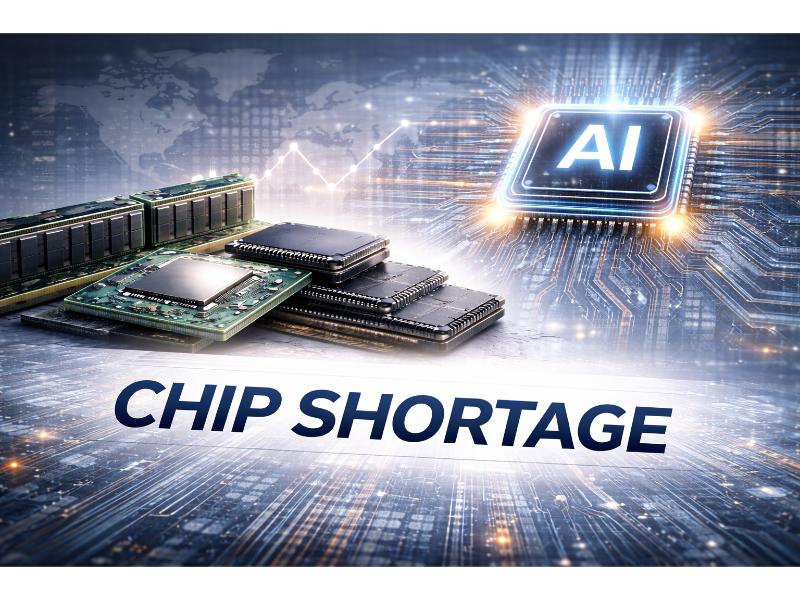
  • Surging AI‑related demand for memory, especially high‑bandwidth and flash storage, is depleting supplies of chips used in smartphones, PCs, and other consumer electronics.
  • Major chipmakers are prioritizing AI components and boosting long‑term investment, but supply constraints are expected to persist, reshaping industry cost structures.

What happened: memory and compute chips in short supply amid AI boom

The rapid expansion of artificial intelligence infrastructure and workloads has triggered a global shortage of memory chips and other compute‑related semiconductors, according to recent industry coverage. Originally highlighted in a Reuters report, companies building AI data centres and hyperscale computing platforms are now competing with traditional consumer‑electronics manufacturers—such as smartphone and PC makers—for limited supplies of DRAM, NAND flash, and high‑bandwidth memory.

Industry observers describe it as a structural supply shift: production capacity is increasingly allocated to the most profitable and cutting‑edge chips needed for AI workloads, leaving fewer wafers for conventional memory used in everyday electronics. For example, major memory makers such as Samsung, SK Hynix, and Micron have said they will continue prioritizing AI‑oriented memory production through 2026 and beyond, a move that is tightening supply for other segments and driving price increases.

As a result, companies across the tech ecosystem are feeling the squeeze. Apple has noted that rising memory costs are beginning to pinch profitability, while analysts forecast a potential decline in smartphone and PC sales as manufacturers pass on higher component costs.

Also Read: Intel results test turnaround amid AI demand

Also Read: Nvidia boss visits china amid regulatory headwinds and AI demand

Why it’s important

The current supply dynamics illustrate a deepening structural tension between burgeoning AI demand and traditional electronics markets. AI workloads—particularly those running in data centers and specialized accelerator hardware—consume far more memory and compute resources than conventional applications, leading to a reallocation of semiconductor capacity that benefits AI infrastructure but pressures other sectors.

These shifts have broader implications. Consumer devices, long a driver of mass technology adoption, may face slower innovation or higher prices if underlying components remain scarce or costly. Analysts note that the era when mass‑market electronics enjoyed abundant memory and compute could be giving way to a scenario where performance‑oriented AI systems take precedence, potentially elongating product cycles and dampening sales volumes in price‑sensitive segments.

At the same time, chipmakers are responding with significant capital expenditure increases and strategic support for AI‑relevant manufacturing, but these efforts are long‑term in nature. Supply constraints are expected to persist at least through 2026–2027, raising questions about how quickly the broader industry can adjust.

For technology markets, the memory and compute bottleneck suggests that the path to ubiquitous AI integration won’t be smooth or cost‑neutral, and that supply chain strategy and capacity planning will be as important as innovation itself.

Core Entity Brief

  • Entity: AI demand squeezes consumer electronics
  • Subject Type: Internet infrastructure institution
  • Region: Asia Pacific
  • Classification: Institution Type

Service Surface / Control Surface

  • Public records support monitoring of governance, service, and infrastructure control surfaces.

Governance and Policy Surface

  • Public-source signals support medium-impact monitoring for infrastructure visibility and dependency analysis.
  • Operational criticality: Medium
  • Time horizon: Quarter (30-120d)

Decision Trigger Matrix

  • Monitoring focuses on verified service continuity, governance changes, and relationship signals.
NowMedium priority

Current state favours active tracking due to infrastructure relevance.

QuarterMedium policy sensitivity

Public-source signals support medium-impact monitoring for infrastructure visibility and dependency analysis.

YearQuarter (30-120d) continuity dependency

Long-cycle infrastructure decisions likely to remain path-dependent.

Member Unlock

Restricted Profile Intelligence

Login is required to unlock full profile briefings and deep-dive sections.

Only for Strategy Circle

Strategic Circle Access

Open to all readers. Unlock profile briefings after joining and logging in.

Join Strategic Circle

Only for Leadership Alliance

Leadership Alliance Access

For owners and management of IP-holding companies. Login required to unlock.

Join Leadership Alliance
← BackAll Companies