Summary
- A remedial direction issued to Best Telecom Group Pty Ltd requires written quarterly reports on TIO complaints for two years from 1 July 2026, the first covering the quarter ending 30 September 2026 and due 30 November 2026; a quarter that produced no complaints still requires a written nil return.
- The regulator publishes the direction, the Federal Court ceiling of up to $10 million for a company, and a quarterly tally of its own completed assessments and investigations; across the eight ACMA pages read on 20 November 2026, none prints a return filed under the direction or any statement of whether one arrived.
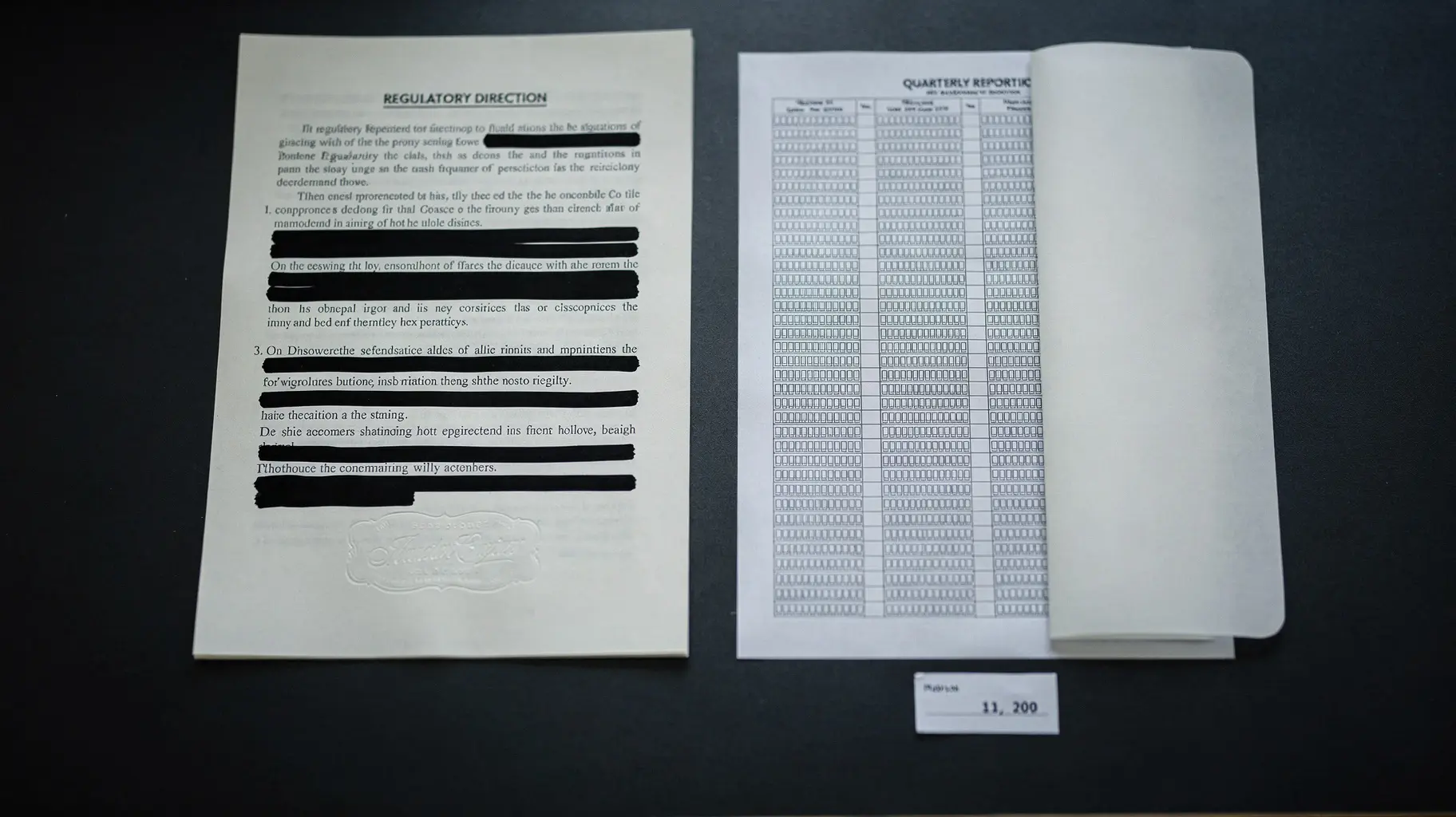
The obligation is one paragraph long. In a redacted remedial direction, the Australian Communications and Media Authority tells Best Telecom Group Pty Ltd that the report for the quarter ending on 30 September 2026 must be provided to the ACMA by 30 November 2026, and that the report for each following quarter must be provided within two weeks of the end of the quarter (remedial direction).
The next sentence shuts the obvious door. If no customer complaints were made to the TIO in a particular quarter, a nil return must be provided in writing to the ACMA (remedial direction). A silent quarter is not an empty quarter. It is a document, dated, signed and filed.
What put the direction in place is small enough to fit in a receipt. The TIO directed Best Telecom in February 2025 to reimburse a customer $1,103.38, being $1,088.38 in cancellation fees and $15.00 in overdraft fees; the company did not comply, and the TIO referred the decision to the regulator (ACMA announcement). A four-figure refund became a two-year reporting regime.
Now read the two clocks in that first paragraph side by side, because the direction prints them and does not reconcile them. The first return covers a quarter ending 30 September 2026 and is due 30 November 2026 — two months of runway. Every later return is due within two weeks of its quarter end.
Same instrument, same filer, same subject matter, and a first window four times the length of the rest. Whether that opening allowance is deliberate mercy or drafting convenience is not stated anywhere I read; it is simply there, and any compliance calendar built from it has to carry both intervals.
The price of missing them is printed in the announcement rather than the direction. If Best Telecom does not comply, the ACMA may pursue the matter in Federal Court with potential penalties of up to $10 million for companies, and up to $50,000 for each contravention by an individual (ACMA announcement). The direction adds a second, quieter consequence: contravening a subsection 102(2) direction is itself a contravention of the Telecommunications Act 1997 (remedial direction). The reporting duty is not decoration on the refund. It carries its own breach.
So how much of this can a stranger check? The register answers part of the question. ACMA's running list of telco outcomes records the Best Telecom matter as a remedial direction in February 2026, and lists ten such outcomes for the year (investigations register). It prints money too, in four separate proceedings that should never be added together: infringement notices of $138,600 to Amaysim Mobile in September 2026, $277,200 to Telstra Limited in September 2026, $59,400 to SpinTel in May 2026, and two notices totalling $376,200 to Lycamobile in February 2026, alongside formal warnings to Switch Mobile Networks/Ezee Mobile, Optus Mobile, Xenith IG Australia, Yomojo and Skymesh. Four parties, four files, four provisions. There is no year total, because there is no year total to have.
What the regulator does publish in quantity is its own activity. The April to June 2026 report prints 18 compliance assessments completed that quarter, 35 in the previous quarter and 122 for 2025-26 to date, with 3 investigations completed against 2 and 17 on the same three columns (April-June 2026 report). The January to March report records 17 compliance assessments opened after a sweep of 50 telco websites testing section 16 of the Standard (January-March 2026 report). These are counts of work done, and they are honest as far as they go. They are not a record of whether a direction was obeyed.
Here is the boundary, stated as narrowly as I can state it. Across the eight ACMA pages I read on 20 November 2026 — the direction, the Best Telecom announcement, the investigations register, the January-March and April-June 2026 quarterly reports, the Skymesh announcement, the Skymesh investigation report and the quarterly-report hub page (hub page) — no page publishes a Best Telecom quarterly return, any report filed under the direction, or any per-direction statement of whether a required report arrived. That is a finding about eight pages on one day. It is not a claim about what ACMA holds, and it is not an allegation about Best Telecom.
The habit is older than this file. Complaints record-keeping runs the same way. Under rules made by ACMA under section 529 of the Telecommunications Act 1997, a retail provider with more than 30,000 services in operation on the day before a record-keeping period must prepare a complaints report each quarter and give it to the regulator within 30 days of the quarter ending (Skymesh announcement).
And the counting inside that scheme is where readers most often slip. ACMA's Skymesh announcement says the investigation found the company failed its obligations on 20 occasions between July 2022 and October 2024. The investigation report underneath it does the arithmetic in public: ten occasions of failing to prepare a complaints report under subsection 11(1) and ten occasions of failing to give one to the ACMA under subsection 12(1), producing twenty occasions of contravention of section 530 and related provisions (investigation report). Twenty is not twenty missed reports. It is ten periods counted twice, because preparing a report and delivering it are separate duties with separate breach points. Any reader who carries away "twenty lost reports" has been given a number with the wrong unit attached, and the number is the one thing in the file that looks auditable.
Two dates in that same matter refuse to agree, and I am leaving them apart. The copy of the Skymesh formal warning that ACMA publishes carries a signature date of 15 January 2026. ACMA's own quarterly report says the warning was issued on 24 February 2026, which is also the date of the public announcement. Three dates, one event. The tidiest explanation is instrument date against publication date, but no document I read says so, and the honest reader-visible statement is the divergence itself.
What is new here needs saying plainly. This publication's earlier Australian regulator work reads the Office of the Australian Information Commissioner's Part IIIC notification-counting instrument and the Australian Prudential Regulation Authority's CPS 230 judgments on tolerance and materiality. Neither reads a telco consumer-protection remedy file, and neither turns on the difference between a return owed to a regulator and a record owed to a reader. A title search for the Australian Communications and Media Authority returned no article of this publication while the directory records two, so this is a provision-level reading of these instruments as far as the search reached. It is not first coverage of the regulator, and I am not claiming it.
The control worth asking for is boringly small, and the regulator already holds the material. A per-direction compliance line in ACMA's own quarterly report — received, not received, or nil — would let any outsider see whether each dated obligation in a two-year direction was met, without publishing a complainant's identity or a word of anyone's correspondence. The direction already forces every filer to write the answer down four times a year. The only thing missing is the column that would let the rest of us read it.
Member Briefing
Read the full trend briefing
Members read the full briefing with the source notes behind every finding.
Strategic Circle
A daily briefing in your language, built from changes we have verified.
Join for USD 20/monthCancel anytime.
Members also get the full research library, a daily briefing on the networks they follow and the private forum.