
Summary
- AccelerComm announced participation in an ESA-funded regenerative 5G satellite demonstrator on 14 September.
- The programme targets technology readiness level 5; it is not an announcement of an operational constellation or a mobile service.
The most consequential output of a satellite development contract may be a test result that stops a bad payload decision. That is a useful way to read AccelerComm's 14 September announcement. The physical-layer specialist will contribute to an ESA-funded effort to demonstrate a 5G base station intended for processing aboard satellites. The announcement discloses neither a contract value nor an order for a commercial constellation.
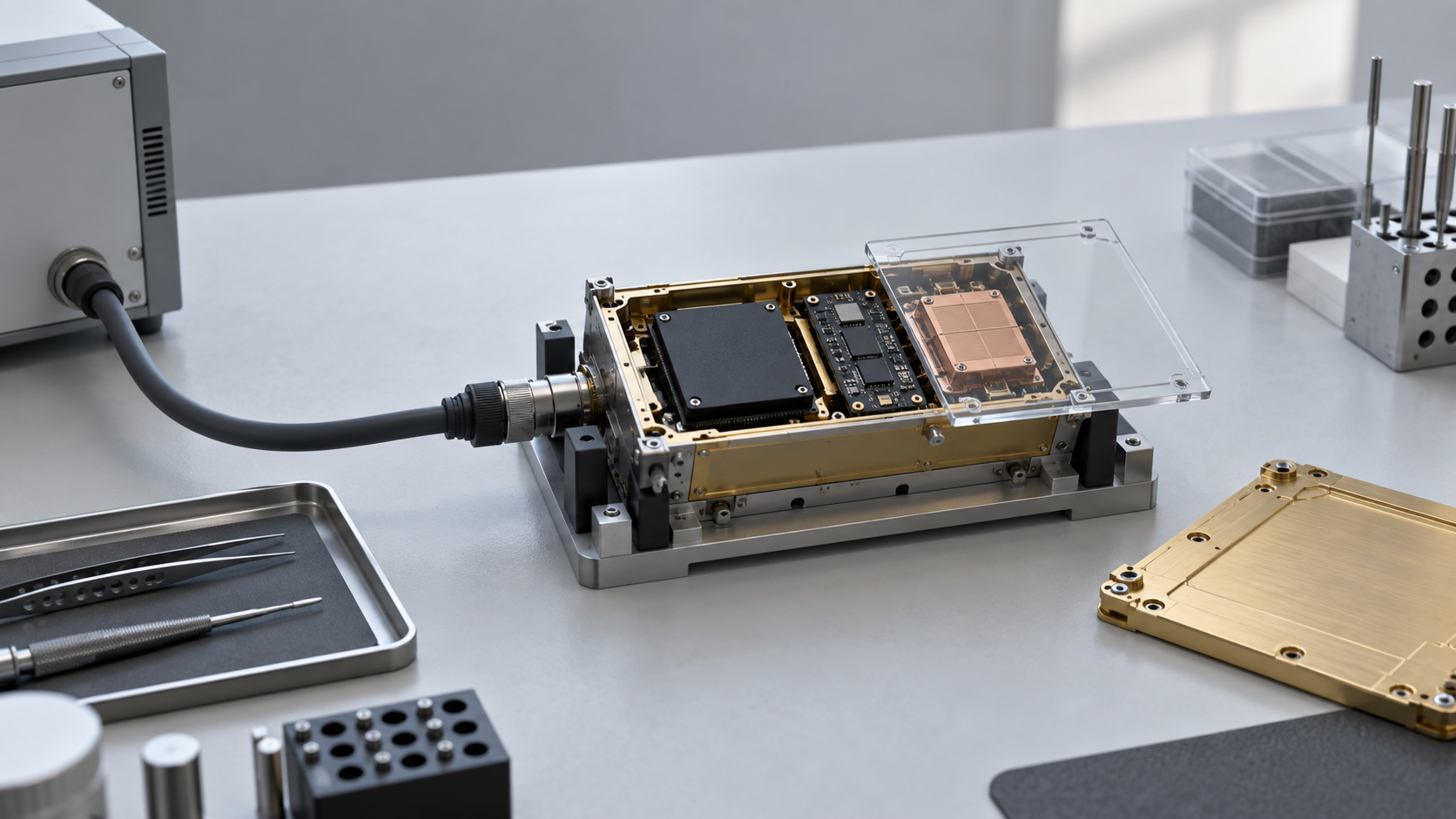
A regenerative architecture moves base-station processing into the spacecraft instead of using it merely to relay signals for ground processing. AccelerComm's architecture explanation identifies the resulting power, thermal, radiation and mass constraints. Moving the computation changes where engineering limits must be met; it does not establish that ground infrastructure becomes unnecessary.
What the money is intended to prove
ESA's D2SAT project record describes a real-time, scaled regenerative-processor demonstrator, with multiple beams and users under realistic, changing channel conditions. It lists an April 2026 start and a planned duration of 26 months. September's company announcement is therefore not the project's start date, and that timetable should not be recast as a service-launch commitment.
The team has a deliberate division of work. Antwerp Space leads and contributes payload design; AccelerComm supplies physical-layer processing; Lasting Software covers higher-layer implementations and emulation; Imec contributes resource allocation and beam management. The proposed architecture places physical-layer work on FPGA hardware and higher-layer processing on a general-purpose processor.
That allocation gives the demonstration its economic purpose. An efficient component is valuable, but the purchaser ultimately needs the combined system to remain useful when users, beams and channel conditions change. A result obtained from an isolated processing block does not settle how much power the integrated system needs or where a failure should be attributed.
Three different kinds of evidence
First comes the project target: TRL 5, not a claimed completed result. ESA's maturity framework distinguishes stages of technology development from the highest level, proven during a space flight mission. The D2SAT target is not evidence that this complete demonstrator has already flown.
Second comes the standards context. An approved 3GPP Release 19 change to TS 38.108 puts the network base-station function inside the satellite payload in its architecture diagrams. That supports the direction of the design. It is not a certificate for D2SAT, nor a substitute for testing the suppliers' implementations together.
Third comes the commercial decision after testing. ESA says the project's final stage will assess maturity and outline an industrialisation roadmap. That sequence matters: successful demonstration can improve the basis for a later production decision without being that decision itself.
For the market, public funding here purchases a chance to reduce shared integration uncertainty before more difficult-to-reverse payload commitments. Whether it does so depends on the evidence delivered, not on the label attached to the award.
Member Briefing
Deeper Profile Context
Sign in with the right membership level to unlock the full briefing and source notes.
Only for Strategic Circle
Strategic Circle
Open to all readers. Unlock profile briefings after joining and signing in.
Join Strategic CircleOnly for Leadership Alliance
Leadership Alliance
For qualified IP-asset owners and management; sign in to unlock alliance briefings.
Join Leadership Alliance