
Summary
- In 2002 Kyrgyzstan’s research and education network, KRENA, already had a reported 1.5 Mbps link and ten Bishkek institutions connected to the SILK regional network.
- Commercial ISP AKNET operated KRENA’s network on its behalf, a practical arrangement that also blurred the boundary between a research network and commercial competition.
- SILK’s east-to-west satellite transmitter channel lacked permission in the project’s early stages, so traffic went through an AKNET-operated satellite route via Moscow; by 2005 KRENA still had no communications channel to Osh.
- These are details from Peter T. Kirstein, a participant in the programme, not an independent regulatory record or measurement series. They show why link capacity alone cannot establish national reach.
In 2002, a 1.5 Mbps international link was already operating for Kyrgyzstan’s national research and education network. That figure sounds like the decisive milestone. It was not. Peter T. Kirstein’s account of the SILK-1 project describes ten Bishkek institutions attached to the regional network—more than in any other participating country at the time—but says the principal southern city, Osh, still lacked a communications channel in 2005. The number measured a link. It did not describe the geography it served. Kirstein, “Internet Provision for Universities in Central Asia”
The arrangement behind the connection was unusual. KRENA, the Kyrgyz national research and education network, did not operate its network alone: the commercial ISP AKNET ran it on KRENA’s behalf. Kirstein says this helped KRENA obtain a 1.5 Mbps link as early as 2002. The same arrangement made the institutional line harder to see.
The incumbent telecommunications provider, Kyrgyz Telecom, worried that KRENA might become commercial competition; Kirstein says the distinction between KRENA and AKNET was “somewhat opaque.” The retrospective does not include contract terms or a regulator’s decision, so it cannot establish who held formal authority or exactly how the concern was acted upon. It does show that operating capacity and institutional identity were entangled.
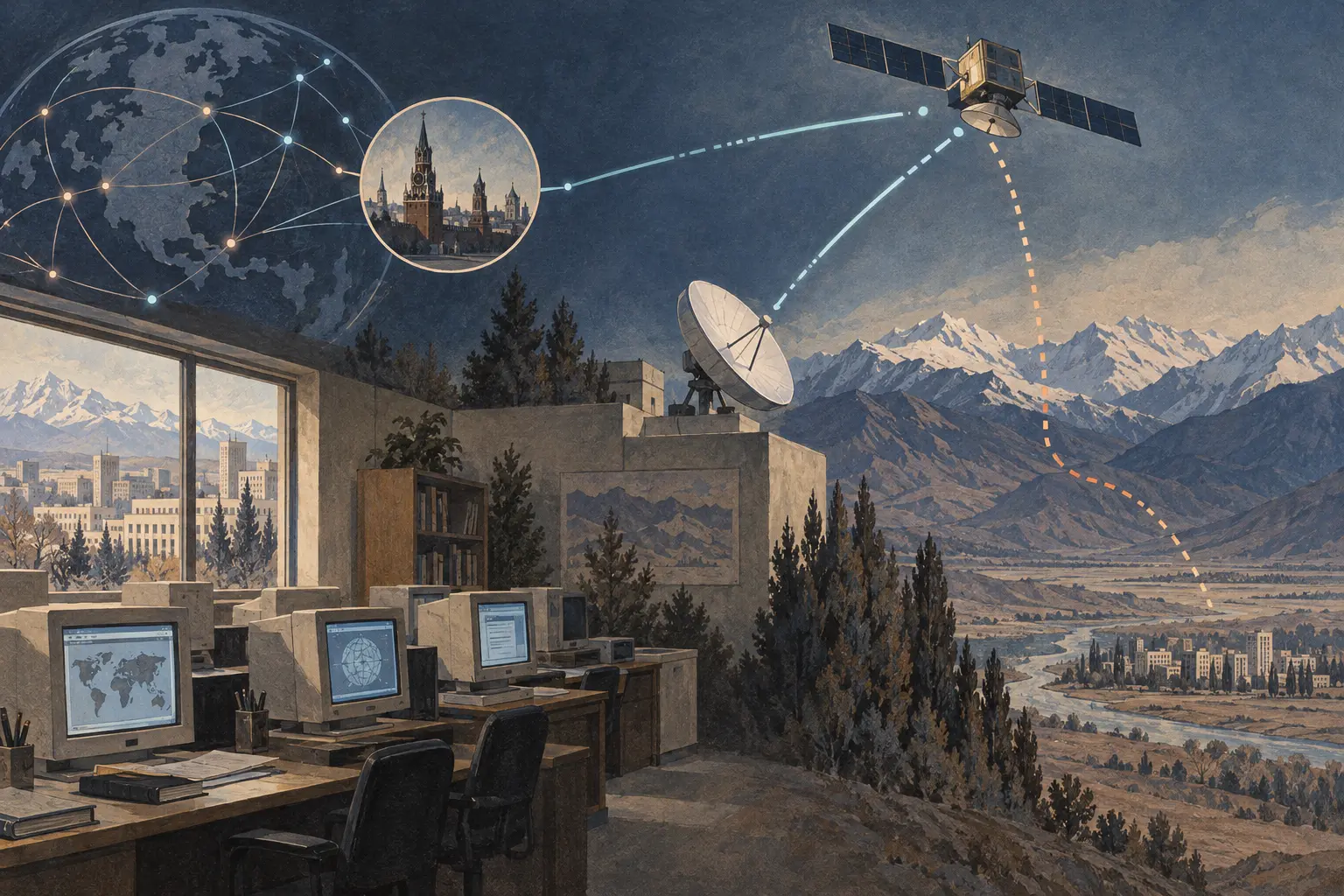
SILK-1 added a second boundary: permission to use a particular path. The regional project was designed to connect national research networks into Europe’s GEANT system. Its hub used satellite capacity. In the early phase, Kirstein reports, KRENA had no permission to use the east-to-west transmitter channel at its SILK node. Traffic therefore used a satellite channel via Moscow that AKNET operated. The workaround kept a connection moving, but it was not the same route or control arrangement that the project had intended. A regional network was present; access to its path depended on a permission the local participants did not yet have.
This is a narrower history than the story of a country “getting online.” SILK’s purpose was to provide international connectivity to existing NRENs, while local network development remained a separate task. Kirstein’s opening cautions that he writes from deep involvement in NATO’s programme and may have overlooked contributions from other sources. His account is valuable precisely when read within that limit: it records the project’s topology and the practical obstacles seen by one of its central participants, but it is not a complete national connectivity census.
By 2005, the gap between the capital and the south remained explicit in his account. KRENA had good service for Bishkek institutions, yet no communications channel to Osh. The text gives no route trace, traffic volume, service-level measurement or explanation of what individual users in Osh could reach through other providers. It therefore supports a claim about the research network’s geography, not a claim that Osh had no Internet access of any kind. That distinction matters: the absence of a KRENA channel is evidence about one network’s reach, not about every route available in the city.
Fibre later changed the constraint. Kirstein says KRENA was ready to move to international fibre once it became available and that fibre eased its regulatory problems. GÉANT’s archived overview describes CAREN as replacing the earlier mainly satellite SILK connectivity with a terrestrial fibre network; it lists KRENA-AKNET at 155 Mbps after CAREN went live in 2010. Robert Janz, in a later interview hosted by KRENA, also describes the regional migration from satellite to fibre. These later milestones show a changed transport system, but they do not retroactively prove what was permitted, connected or measured in every Kyrgyz city in 2005. GÉANT, Central Asia overview · Robert Janz interview
The record leaves an important asymmetry. A bandwidth figure is easy to repeat; the boundaries around it are harder to see. Who operated the network? Which transmission channel could it use? Which institutions and cities were actually connected? KRENA’s 2002–05 history answers those questions unevenly, but enough survives to resist the headline number. A 1.5 Mbps link could anchor a regional research connection in Bishkek and still leave the route to Osh unresolved. Capacity was one condition of access. Permission, operating responsibility and geographic extension were others.
Sources
Member Briefing
Deeper Profile Context
Sign in with the right membership level to unlock the full briefing and source notes.
Only for Strategic Circle
Strategic Circle
Open to all readers. Unlock profile briefings after joining and signing in.
Join Strategic CircleOnly for Leadership Alliance
Leadership Alliance
For qualified IP-asset owners and management; sign in to unlock alliance briefings.
Join Leadership Alliance