
The old Digi name has not disappeared; it has been absorbed
Reading DiGi Telecommunications Sdn. Bhd. as a still-independent Malaysian mobile operator would now misstate the object. The better reading is that the directory record captures a legacy operating company and network-resource layer inside the CelcomDigi group. The old DiGi name still appears in corporate structure, APNIC records, autonomous-system evidence and residual operational labels. The brand, investor narrative, main website, strategic control and market story now sit with CelcomDigi Berhad.
That distinction matters because the Celcom-Digi merger did more than change a name. It changed the resource allocation logic of the Malaysian mobile market. CelcomDigi now has scale, channel breadth, a larger customer base and a major synergy programme. At the same time, the Malaysian Communications and Multimedia Commission imposed spectrum-return remedies, MVNO wholesale conditions and a market structure in which Digital Nasional Berhad's wholesale 5G network constrains the freedom of even the largest operator. The central question is therefore not whether CelcomDigi is large. It is large. The question is how free that scale is.
The public corporate trail is clear. Digi.Com Berhad became CelcomDigi Berhad in 2023 after the Celcom-Digi combination. CelcomDigi's 2023 annual report lists Digi Telecommunications Sdn. Bhd. as a wholly owned subsidiary within the enlarged group. Current commercial identity is CelcomDigi, presented through celcomdigi.com, where the group describes itself as Malaysia's largest mobile network operator and markets mobile, broadband, enterprise and digital services. The old DiGi record is therefore not wrong. It is incomplete unless it is connected upward to CelcomDigi.
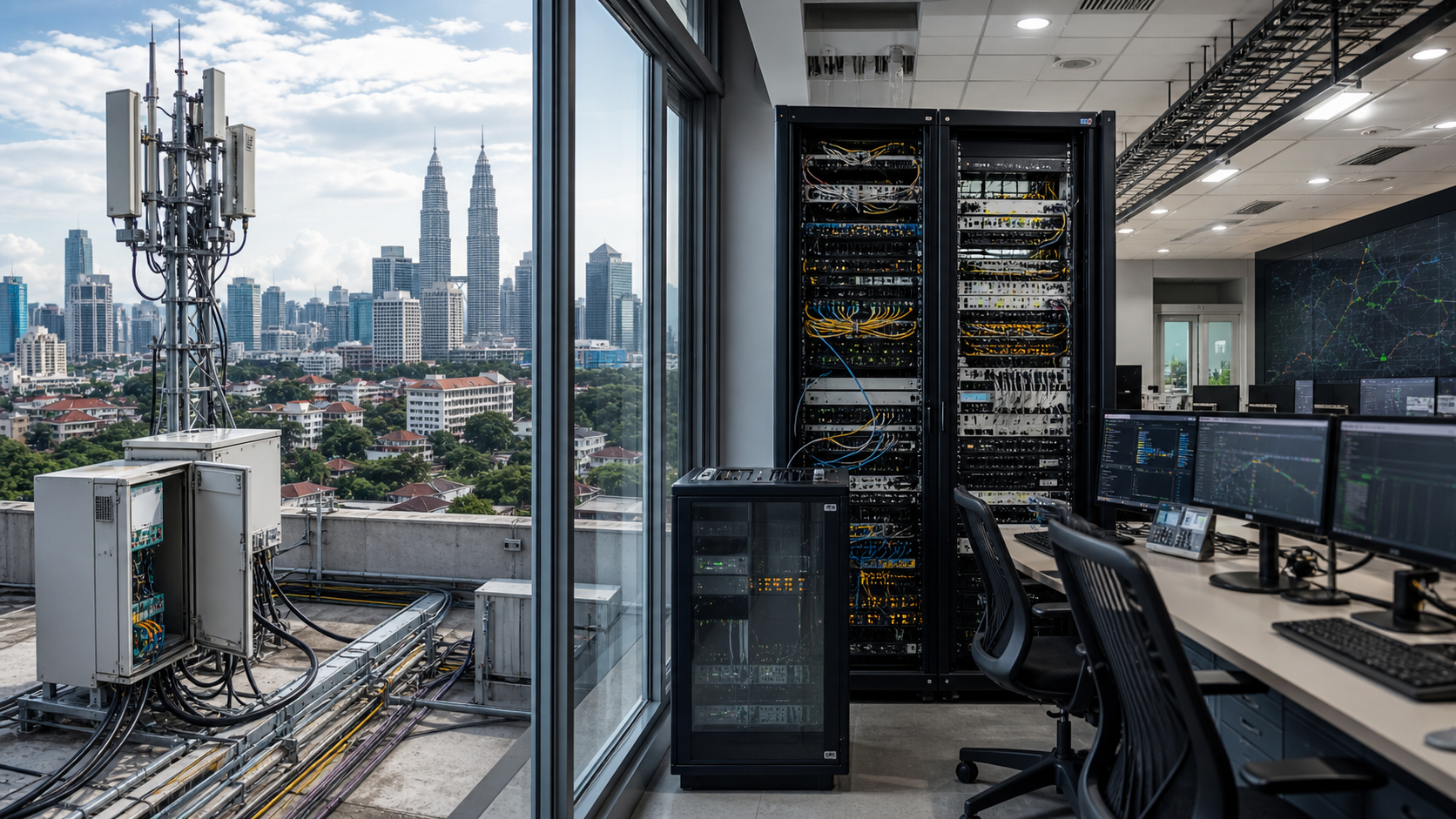
The network-resource trail makes the story more interesting. APNIC records continue to show AS10081 / DIGI-MY associated with DiGi Telecommunications Sdn. Bhd., while contact and abuse records point toward CelcomDigi Telecommunications Sdn. Bhd. PeeringDB records for AS4818 describe CelcomDigi and refer to the combined Celcom and Digi heritage. APNIC AS-SET material ties AS4818, AS10081 and AS10030 into the same larger routing context. This is the normal residue of a telecom merger: brands and investor pages move first; legal and registry surfaces move more slowly; network engineering moves with the greatest caution.
The merger created scale, then regulation took some of it back
The Celcom-Digi combination was the decisive event. Axiata, Telenor and Digi agreed the transaction in 2021, regulatory clearance arrived in 2022, and completion followed later that year. The resulting company combined Celcom's Axiata-backed network and customer base with Digi's Telenor-backed operations. Axiata and Telenor each retained roughly one-third ownership of the merged listed company, creating a joint-control context rather than a simple takeover by one side.
The merger gave CelcomDigi a larger customer base, broader distribution, stronger procurement leverage, more scope to rationalise duplicated assets and a clearer path to cost savings. CelcomDigi's own performance material reports large cumulative integration benefits: hundreds of millions of ringgit in profit-and-loss savings, material capex avoidance and a target for steady-state annual savings. The economic logic is classic telecom consolidation. Two radio networks, two retail systems, two support stacks and two investment plans are gradually compressed into one national operating machine.
But Malaysia did not allow this scale to arrive without conditions. The merger clearance required the combined operator to return 70 MHz of spectrum across the 1800 MHz, 2100 MHz and 2600 MHz bands, along with wholesale and MVNO protections. That remedy is the key to understanding CelcomDigi. Regulators accepted the industrial logic of the transaction, but they did not want the new operator to freeze too much scarce spectrum inside one group. Scale was permitted, yet bounded.
The spectrum story has therefore become dynamic rather than cumulative. CelcomDigi holds important low- and mid-band resources, including 900 MHz, 1800 MHz, 2100 MHz and 2600 MHz holdings referenced in market and company material. It later accepted new 1800 MHz and 2600 MHz assignments with upfront and annual payment obligations. But the history of spectrum return means every future renewal or reassignment has to be read through the regulator's market-structure lens. CelcomDigi is spectrum-rich compared with smaller challengers, but not unconstrained.
DNB changes the 5G economics
Malaysia's 5G model is the most important structural constraint. Digital Nasional Berhad was created to build a national wholesale 5G network and avoid duplicated rollout. DNB's model shifted early 5G economics away from each mobile operator building its own complete national 5G network and toward a wholesale access system. Only after national coverage reached policy thresholds would Malaysia move toward a dual-network model.
For CelcomDigi, this creates a paradox. As the largest mobile operator, it would normally want to use 5G network ownership to differentiate on speed, coverage, enterprise private networks and capital scale. Under the DNB framework, 5G begins as a wholesale input with long-term access obligations, service-level expectations and financial commitments. CelcomDigi can compete on retail packaging, device offers, customer service, indoor experience, 4G/5G handover, enterprise bundles and brand trust. It does not fully control the underlying national 5G asset in the way an unconstrained incumbent might.
This changes the profit mechanics. In a traditional self-build model, the cost pressure appears mainly as capex and depreciation. In the DNB model, 5G access charges become a visible operating burden. CelcomDigi's 2025 performance material points to 5G access charges, device subsidies, fibre expansion and network investment as offsets to earnings progress. That is the right economic frame: 5G monetisation must exceed the wholesale access and commercial acquisition costs attached to it.
The dual-network transition adds another complication. CelcomDigi publicly positioned itself as well suited to build Malaysia's second 5G network, citing national network experience and billions of ringgit already invested in modernisation. The government selected U Mobile instead. That outcome is strategically uncomfortable for CelcomDigi. It remains a dominant retail operator and DNB shareholder, but it did not receive the cleanest path to becoming the second-network builder. U Mobile, meanwhile, gained a policy-supported path to change its competitive ceiling.
The involvement of Huawei Malaysia and ZTE Malaysia in U Mobile's second-network plans adds another geopolitical and procurement layer. The issue is not simply equipment branding. It is whether a challenger can turn policy selection and vendor partnerships into enough network differentiation to weaken CelcomDigi's scale advantage in 5G.
The growth engine is ARPA, not just subscribers
CelcomDigi's customer base is large, but the economic story is increasingly about account value rather than raw SIM count. The company reported more than 20 million users and service revenue above RM10 billion in recent performance materials. The more important detail is mix. Postpaid, home fibre and enterprise services are doing more of the growth work, while prepaid remains more vulnerable to price competition and customer churn.
Postpaid matters because it creates a higher-value relationship. A customer on a postpaid plan can attach device financing, family lines, entertainment, roaming, home broadband, security services and enterprise benefits. CelcomDigi's use of ARPA language shows this shift. The company is trying to move from SIM-level revenue to account-level economics: more services per household, more services per business, and more reasons for a customer to stay.
Home and fibre are part of that strategy, but they remain smaller than mobile. CelcomDigi can use fixed wireless access, fibre resale or wholesale arrangements and bundled plans to deepen household value. The challenge is that Telekom Malaysia remains structurally powerful in fixed broadband and national backhaul. CelcomDigi can cross-sell home broadband to mobile customers, but it does not automatically become the national fixed-access incumbent.
Enterprise services offer a higher-upside version of the same move. CelcomDigi markets connectivity, business fibre, fixed wireless, 4G rapid mobility, API-as-a-Service, AI-related experiences, network APIs, digital financial security, smart-city and healthcare solutions. The commercial logic is to make connectivity part of a business process rather than a disposable data plan. Once connectivity is embedded into operations, the customer relationship becomes stickier and the provider can sell security, cloud, analytics and managed services around it.
The caveat is scale of contribution. The company can tell a credible technology-company story, but the financial base is still mobile. Enterprise and home broadband can improve growth and valuation language; they have not replaced mobile as the cash engine. The most realistic 12-36 month thesis is disciplined migration toward higher-value accounts, not a sudden reinvention as a software or cloud company.
Network records show the merger in motion
The strongest infrastructure evidence is not the marketing phrase "largest mobile network operator." It is the way the old Celcom and Digi networks still appear in public resource records while being pulled into a unified CelcomDigi frame. AS10081 / DIGI-MY remains associated with DiGi Telecommunications Sdn. Bhd. AS10030 / CELCOMNET-AP remains associated with the Celcom side of the heritage. AS4818 appears in CelcomDigi context and is linked to broader downstream and AS-SET structures.
This is how telecom integration usually looks. No serious operator tears up all autonomous-system numbers, prefixes, peering policies and operational contacts at once. It would create needless outage risk. Instead, the company keeps legacy resources stable while customer systems, brand, billing, core network and routing policy are gradually rationalised. The public registry trail therefore becomes a map of integration sequencing.
Company comments on network modernisation line up with this interpretation. CelcomDigi has described a national network modernisation programme, a large number of 5G-ready sites and broad 4G LTE/LTE-A coverage across populated areas. The claim is not simply that the company has coverage. It is that the combined operator is trying to turn two inherited networks into one lower-cost national platform.
For investors and infrastructure readers, the resource record matters because it prevents a false binary. DiGi has not disappeared in the network layer. Nor is Digi a separate public-facing company competing with CelcomDigi. It is part of an integration state where old resource identities coexist with a new group strategy.
Reliability, app friction and consumer noise
CelcomDigi's reliability story is mixed rather than broken. Public incidents include a 2023 fire-related disruption affecting customers in parts of Pahang and Terengganu, and a 2026 system-upgrade disruption that produced short mobile-data issues for some users. Those incidents sit in different categories. The first is physical infrastructure exposure. The second is closer to the IT and systems-integration risk that often follows large telecom mergers.
The digital-service noise is more persistent. App Store, Google Play and forum comments around the CelcomDigi app have complained about slow loading, hard-to-find customer support, confusing menus and frustration after migration from older Celcom Life and MyDigi experiences. These comments do not prove network weakness. They show customer friction at the point where CelcomDigi is trying to raise account value. A company that wants customers to buy more services through one app cannot treat app quality as cosmetic.
CelcomDigi's own customer-service and app investments confirm that management recognises the issue. The group has talked about AI, automation and multi-touchpoint support, while continuing to update the unified app. The commercial question is whether those upgrades reduce friction before competitors use customer-service dissatisfaction as a switching argument.
Fixed-broadband chatter creates another signal. Malaysian forum discussions sometimes frame CelcomDigi fibre as dependent on TM/Unifi-style access or wholesale layers, with concern that fault resolution may involve responsibility shifting between providers. The exact claim varies and is not a settled fact for every product. The more useful conclusion is that CelcomDigi still has to earn credibility in fixed access. It is trusted as a mobile operator; it is not automatically seen as the owner of the fixed underlay.
Competition is becoming asymmetrical
CelcomDigi's biggest advantage remains scale. Its user base is materially larger than Maxis and U Mobile, and it has broader post-merger reach than any single legacy operator. Scale gives it cash flow, retail visibility, network investment capacity and procurement leverage. It also gives regulators a reason to watch every move closely.
Maxis is the strongest premium-quality comparator. It has a smaller user base but a strong postpaid, home and enterprise profile. Maxis can pressure CelcomDigi in high-value customers, family bundles and service perception rather than pure scale. If CelcomDigi wants to lift ARPA, Maxis is the rival most likely to make that expensive.
U Mobile is the most disruptive policy variable. Its second 5G network mandate, speed and availability marketing, and vendor selections give it a new role. A price-aggressive challenger with a policy-backed infrastructure path is more dangerous than a price-aggressive challenger alone. CelcomDigi can still defend coverage and base scale, but U Mobile can attack the 5G experience narrative.
Telekom Malaysia competes through fixed broadband, national backhaul, enterprise connectivity and wholesale infrastructure. It is not simply another mobile competitor. It shapes the economics of convergence. CelcomDigi can sell home and enterprise bundles, but TM's fixed-line and backhaul position remains a structural advantage in many parts of the market.
MVNOs add pressure at the low end and complexity in the wholesale layer. Merger remedies required continued attention to MVNO wholesale arrangements. CelcomDigi also has equity exposure to parts of the MVNO ecosystem, including Tune Talk. That creates a market where wholesale, retail and investment interests can overlap. CelcomDigi may benefit from ecosystem breadth, but it also faces low-price erosion in segments where customers are highly price-sensitive.
Rumours, weak signals and ownership speculation
The market noise around CelcomDigi falls into three buckets. The first is ownership speculation. Telenor's long-term position in Asian telecom assets is often debated, and market commentary periodically asks whether holdings could be adjusted after integration milestones. There is no need to turn that into a sale claim. The useful point is that a dual Axiata-Telenor ownership structure will keep capital-allocation questions alive.
The second bucket is DNB economics. Reuters and investor commentary have pointed to Malaysia 5G-related accounting or cost effects for Telenor. That signal reinforces a broader concern: DNB exposure is not a simple operating detail. It can affect accounting, cash flow, shareholder perception and future network strategy.
The third bucket is customer friction after integration. App complaints, fibre-underlay rumours, support frustration and outage chatter all sit below the level of hard financial evidence. They are still worth watching because telecom churn often begins as service irritation before it shows in quarterly numbers.
Evidence ledger
CelcomDigi's corporate site at https://www.celcomdigi.com/ and company pages such as https://www.celcomdigi.com/about-us support the current commercial identity, brand and service perimeter.
CelcomDigi investor materials at https://www.celcomdigi.com/investor-relations support the financial, integration, synergy, ownership and performance context.
CelcomDigi business pages at https://www.celcomdigi.com/our-business support the enterprise and service-surface discussion.
Public BGP references such as https://bgp.he.net/AS4818 and APNIC-style records support the resource-layer analysis around CelcomDigi, AS4818, AS10081 / DIGI-MY and legacy Celcom/Digi integration.
MCMC merger clearance material, DNB reference access and government 5G policy material support the spectrum-remedy and wholesale-5G analysis.
Opensignal, Ookla and operator-announced network awards support the network-experience comparisons, with the usual limitation that benchmark methodology and timing affect results.
App-store reviews, Reddit/Lowyat discussions and customer complaints support the consumer-friction section as market noise and experience signals rather than audited market-share facts.
Watchpoints
Watch the economics of DNB access and the second 5G network. CelcomDigi's 5G margin will depend on wholesale costs, retail ARPA, U Mobile's build pace and future interconnection or roaming arrangements.
Watch spectrum renewal and reassignment, especially 2600 MHz and 1800 MHz timeframes. Spectrum policy can alter CelcomDigi's capacity advantage even if the company remains the largest operator.
Watch postpaid ARPA and convergence. The bull case strengthens if postpaid, home and enterprise growth offset prepaid erosion without excessive device subsidies.
Watch app, billing and customer-support quality. Customer friction is strategically important because CelcomDigi's account-value thesis depends on customers trusting a unified service layer.
Watch TM and U Mobile differently. TM constrains fixed and enterprise convergence; U Mobile pressures the future 5G narrative.
Watch any change in Axiata or Telenor's stance toward the holding. Ownership changes would not erase CelcomDigi's operating scale, but they could change capital allocation and strategic appetite.
CelcomDigi is therefore a constrained strong operator. The legacy DiGi record leads into a much larger merged platform with scale, coverage, cash flow and synergy potential. The constraint is that Malaysia's regulatory and 5G architecture prevents that scale from becoming unrestricted dominance. The company can still win, but it must win through integration discipline, ARPA expansion, customer experience and enterprise/fixed attach, not simply by being the biggest mobile network in the country.